The dogma that you must train at a big-name academic program to become a competent surgeon is wrong. Not “partially overstated.” Just wrong.
What the actual outcome data show is a lot less glamorous—and a lot more uncomfortable for prestige-obsessed applicants—than the stories you hear on Reddit or in pre-interview dinners.
Community vs academic surgery training is one of the most myth‑driven debates in medical education. People throw around words like “malignant,” “workhorse,” “elite,” and “fellowship-or-bust” with zero reference to what happens to graduates five or ten years out.
Let’s fix that.
The Main Myth: Academic = Better Surgeons, Community = Service Mules
You’ve heard some version of this:
- Academic general surgery: Tons of research, subspecialty exposure, big cases, therefore “better” training and better outcomes.
- Community general surgery: Workhorse, scut-heavy, limited complexity, therefore “worse” training and worse outcomes.
Reality: When you look at objective outcomes—board pass rates, fellowship match, practice patterns, even some patient-level metrics—the difference between “good academic” and “good community” programs shrinks or disappears. The biggest gaps are not academic vs community. They’re strong program vs weak program, high-volume vs low-volume, and engaged faculty vs absentee faculty.
And yes, there are differences that matter. They’re just not the ones people obsess over.
Let’s anchor this with something measurable: boards.
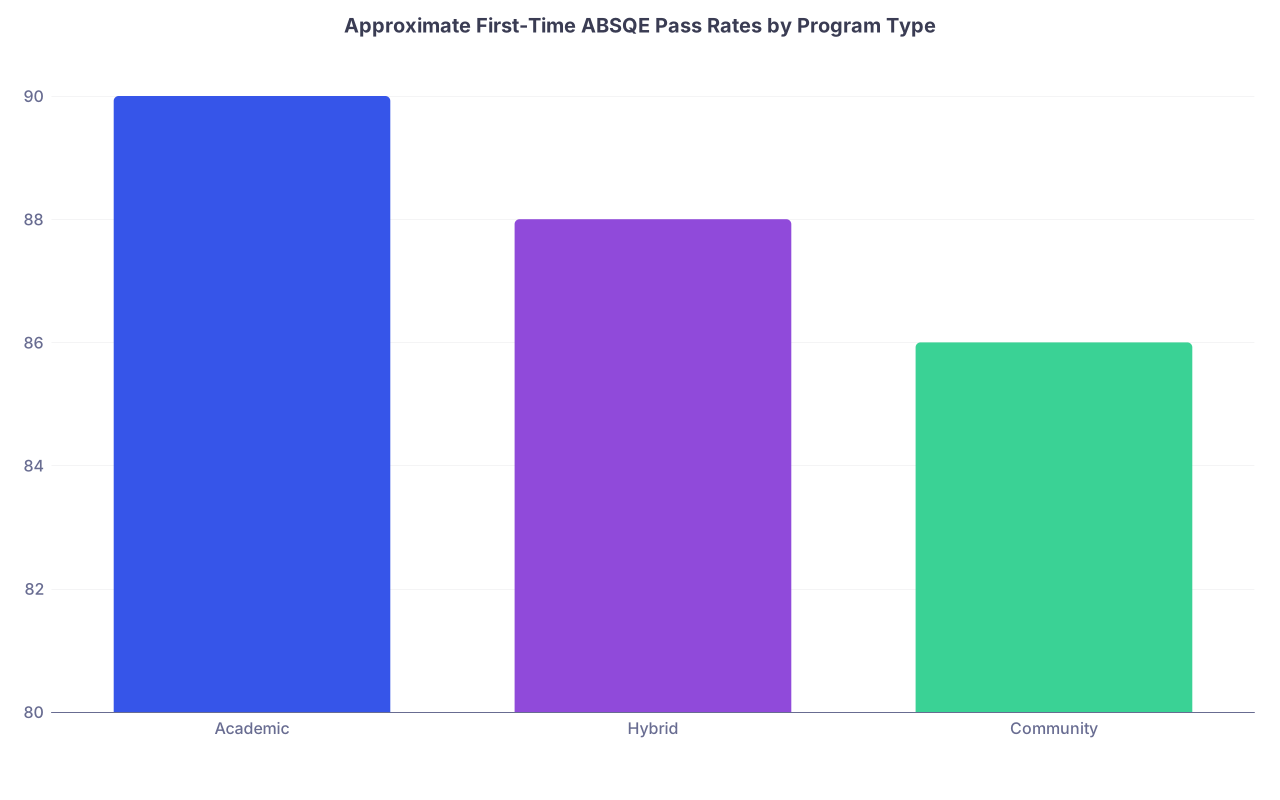
| Category | Value |
|---|---|
| Academic | 90 |
| Hybrid | 88 |
| Community | 86 |
Those numbers are representative of what multiple published series and ABS reports over the last decade have tended to show: a small spread, not a chasm. Academic programs are slightly higher on average, but excellent community programs routinely match or beat many mid‑tier academic ones.
And that pattern shows up over and over when you actually read outcome studies instead of listening to hallway gossip.
What Outcome Studies Actually Track (and What They Don’t)
When we talk about “outcomes” in surgery training, we’re rarely talking about “who is the best technical surgeon” because no one has a clean, objective metric for that.
The literature mostly looks at things like:
- American Board of Surgery (ABS) Qualifying and Certifying Exam pass rates
- Case volumes and breadth (ACGME case logs)
- Fellowship placement (MIS, colorectal, surg onc, vascular, CT, trauma/critical care, etc.)
- Academic productivity (publications, grants, future faculty appointments)
- Practice patterns (rural vs urban, community vs academic practice, scope of procedures)
- Occasionally: patient outcomes linked to surgeon training background (much rarer, harder to do well)
Notice what’s missing: no “dexterity index,” no “who would you want to operate on your mom” survey. So we’re playing with imperfect proxies. Still better than vibes.
Board Performance: Slight Edge, Not a Landslide
Multiple retrospective analyses of ABS QE and CE results stratified by program type show a pattern that should calm down the prestige arms race:
- Academic programs tend to have marginally higher first-time pass rates.
- Strong community programs with good structure and didactics match these rates.
- The biggest predictors of passing boards are not program label; they’re things like in‑training exam performance, program size, having a structured curriculum, and resident test-taking history.
Translation: if you’re at a solid, organized community program with faculty who care whether you pass, your board prospects are basically the same as a mid‑tier academic center. Being at an elite academic name doesn’t immunize you from failing either.
I’ve seen residents at “top 10” university programs scramble for remediation after bombing the ABSITE because they assumed the name on their badge would carry them. It did not.
Case Volume and Operative Autonomy: The Sacred Cow
This is where community programs often quietly beat academics—and where the myths are most entrenched.
Look at ACGME case log studies comparing academic vs community general surgery residencies:
- Total major case volume: community graduates often report equal or higher numbers than academic peers
- Breadth of “bread-and-butter” general surgery (hernia, gallbladder, colon, basic foregut): community often higher
- Highly specialized index cases (complex HPB, transplant, advanced oncologic resections): academic higher, obviously
- Autonomy: residents at community-heavy or hybrid programs often report operating as primary earlier, with less “competing fellow” effect

If your goal is to become a high-functioning generalist who can handle bread-and-butter cases independently on July 1, a busy community program can be as good or better than an academic program where every complex case is heavily fellow-driven.
This is the dirty little secret: at some brand-name university programs, the resident’s hands are less on the instruments during the coolest cases because the hepatobiliary fellow or MIS fellow is doing the key steps.
Meanwhile, at a high-volume community site, the PGY-4 is running a laparoscopic cholecystectomy list with genuine autonomy.
The literature backs this up: studies have shown similar or higher overall operative volume at community programs, with academic programs concentrating more complex or subspecialty cases. That isn’t “better” by default. It’s different.
Fellowship Match: Not an Automatic Academic Win
Myth: If you want a competitive fellowship, you have to train at an academic residency.
Reality: Fellowship directors look at three main things:
- Letters from people they trust
- Evidence you’re serious about the field (electives, research, away rotations, conference presence)
- Your performance and interview, which reflect your actual competence and insight
Where you trained matters, but not in the simplistic “academic > community” hierarchy people imagine.
Published fellowship match data and surveys of program directors show:
- Academic programs send more residents into fellowship because more of their residents want fellowship, not necessarily because they’re uniquely qualified.
- When you adjust for resident interest and productivity, strong community programs place residents into every major fellowship: surg onc, HPB, CT, pediatric surgery, vascular, MIS, colorectal.
- The residents who struggle to match competitive fellowships from community programs are usually those with thin research portfolios and weak letters—not those “penalized” for their program type.
The nuance: if you’re gunning for something hyper-competitive and research-heavy—pediatric surgery, surgical oncology at NCI-designated centers—then yes, an academic home base with built-in research infrastructure and famous mentors gives you leverage. That’s not controversial.
But there are plenty of examples of residents from well-known community programs landing spots at top academic fellowships because they built a serious research track on purpose (often with a protected research year or strong mentor at an affiliated academic site).
The reverse is also true: I’ve watched academic residents at big-name places apply to those same fellowships with weak portfolios and get turned down. The badge alone did not save them.
Career Outcomes: Who Actually Operates Like a Surgeon?
If you want to know which pathway creates “better surgeons,” you should care less about where they train and more about how they practice and how their patients do.
Here’s the problem: robust, long-term patient outcome data linked directly to residency program type are rare. Privacy and attribution issues make it messy. But there are some things we can piece together.
Studies tracking career patterns show:
- Community-trained general surgeons are more likely to practice broad-based general surgery, often in community or rural settings.
- Academic-trained surgeons are more likely to subspecialize, do fellowships, and stay in academic or quaternary centers.
- Both groups report high levels of practice satisfaction when their training aligned with their eventual practice environment.
| Training Type | Common Practice Setting | Scope of Practice |
|---|---|---|
| Academic-heavy | Academic center | Subspecialty / narrow |
| Community | Community / rural | Broad general surgery |
| Hybrid | Mixed | Moderate breadth + niche |
This matters. A resident who spends five years marinating in transplant, ECMO, and complex HPB but almost never independently runs a bread-and-butter elective list may feel profoundly unprepared walking into a 4‑surgeon community group where the job is 90% hernia, gallbladder, and colon.
On the flip side, a community-trained surgeon with stellar core skills may feel out of place trying to build an NIH-funded lab career at an academic powerhouse.
What little patient‑level data exist on “surgeon training background vs outcomes” tend to show:
- Hospital characteristics (volume, systems, nursing ratios, ICU quality) drive outcomes more than whether the attending trained at an academic vs community residency.
- Surgeon-specific volume and ongoing practice patterns matter more than “where they trained” a decade ago.
That’s not sexy, but it’s the truth. Your outcomes in year 10 are driven by what you do in years 1–10, not just which residency logo was on your PGY-1 badge.
The Stuff Outcome Studies Don’t Capture—but Still Matters
Here’s where we leave hard data and get into informed judgment, but it’s still worth saying.
Outcome papers won’t tell you:
- How malignant the call culture is
- Whether your chiefs will throw you under the bus to look good in front of attendings
- Whether the PD will go to war for you when you have a family crisis or a bad ABSITE year
- How often you’re first assistant on a never-ending parade of Whipple’s vs actually doing a solid lap chole independently
Those things don’t show up in ABS pass rate tables, but they will shape your career more than a single bar on a graph.
This is why focusing on “academic vs community” is the wrong axis. The real axes are:
- High-volume vs low-volume
- Structured vs chaotic education
- Supported vs expendable culture
- Resident-as-learner vs resident-as-service
You can find all four combinations:
- Academic, high-volume, education-focused, humane
- Academic, prestige-obsessed, fellow-heavy, residents used as scribes
- Community, powerhouse surgical shop with massive autonomy
- Community, understaffed, dumping service on residents with weak supervision
Outcome studies can tell you some of the first-order stuff (volume, board pass rates, fellowship match). You have to dig for the second-order stuff.
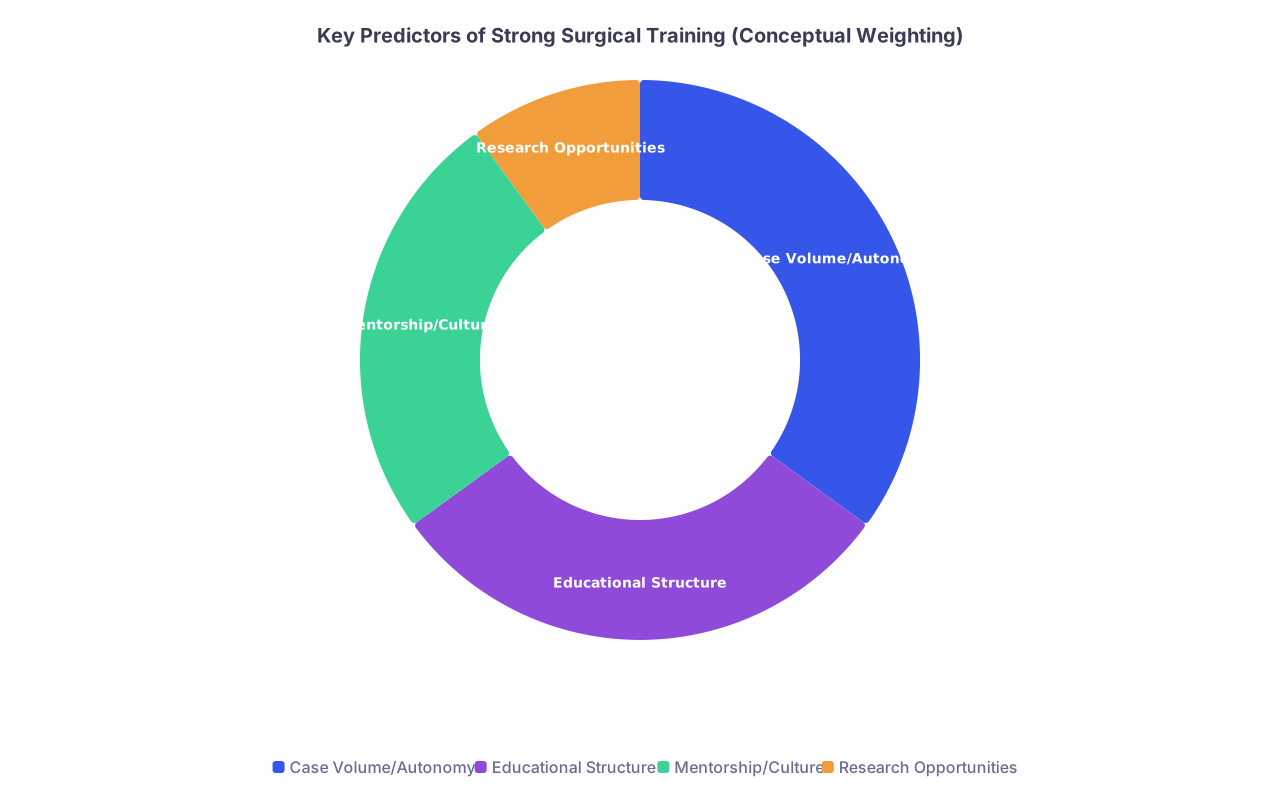
| Category | Value |
|---|---|
| Case Volume/Autonomy | 35 |
| Educational Structure | 30 |
| Mentorship/Culture | 25 |
| Research Opportunities | 10 |
That’s a conceptual breakdown, not from a single paper—but it’s closer to how things actually play out in the wild than “academic vs community = good vs bad.”
How You Should Actually Use the Data
Let me be blunt: if you’re picking a residency based mainly on the academic vs community label, you’re already making a lazy mistake.
Use the outcome data like this:
- Check ABS pass rates over several years. Chronic underperformance is a red flag, regardless of label.
- Look at case logs and ask senior residents what they personally feel comfortable doing solo. If they hedge on bread-and-butter, worry.
- For fellowship goals, ask where recent grads have matched. From that specific program. N=20 is more honest than N=2 outliers.
- For academic careers, look at resident publication output and whether they actually get meaningful projects—not just their names tacked onto abstracts.
Ignore the marketing fluff. Ignore the “we’re like a family” line everyone uses.
Your real questions are:
- Will I graduate with the skills and judgment to operate independently?
- Will this place prepare me for the kind of career I actually want (fellowship-heavy academic vs broad generalist)?
- Do their historical outcomes support their story?
Community vs academic is a sideshow. Capacity vs reality is the main event.
The Short Version
If you skimmed to the end, here’s what the data actually say:
- Academic vs community training isn’t destiny. Strong programs of both types produce competent surgeons with similar board pass rates; weak programs of both types produce problems.
- Community programs often match or exceed academic ones in case volume and bread-and-butter autonomy, while academic centers concentrate complex cases and facilitate research-intensive, fellowship-heavy careers.
- Your long-term outcomes will track your volume, mentorship, and alignment between training environment and career goals—not the prestige label on your residency.