
The usual advice of “just follow your passion” is useless when you genuinely love two surgical specialties. You need a strategy, not a vibe.
You are not choosing a favorite color. You are betting your 30s and most of your waking hours on a path that locks in your operative skillset, your lifestyle, and your earning ceiling. And the system is not kind to people who drift indecisively between two competitive surgical fields.
So you need a dual-plan strategy: a clear, step-by-step framework that lets you:
- Explore both specialties deeply.
- Build a primary target and a realistic backup.
- Stay rank-list-flexible without looking flaky to programs.
- Avoid burning bridges in either field.
Let me walk you through that system.
Step 1: Get Honest About the Stakes (Not the Vibes)
Before you even touch a rotation schedule, you need clarity about what is actually at risk.
Here is what you are up against if you are split between two surgical specialties (say Ortho vs Plastics, ENT vs Ophtho, Vascular vs CT, etc.):
- You cannot fully max out both. Time, letters, research, OR exposure – you will be forced to prioritize.
- Faculty have long memories. If you present as “sort of ortho, sort of plastics, maybe gen surg,” nobody fully claims you.
- Some pairings are compatible as Plan A / Plan B. Others are frankly terrible.
The mature move is not to pretend you can “keep all doors open.” You cannot. The mature move is:
- Choose a provisional primary specialty (Plan A).
- Choose a structurally realistic secondary specialty (Plan B).
- Design your MS3/MS4 or early residency around making Plan A very strong while keeping Plan B viable.
You can update the primary/secondary order as you gain data. But you must start with a working version.
Step 2: Map Your Two Specialties Like a Strategist
You are not just choosing what you “like.” You are choosing:
- Match difficulty
- Training length
- Lifestyle pattern
- Operative content
- Geographic flexibility
Build a quick comparison on paper. Not vibes. Actual structure.
| Factor | Specialty A (e.g., Ortho) | Specialty B (e.g., Plastics) |
|---|---|---|
| Competitiveness | High | Very High |
| Required Letters | 3 home Ortho | 2-3 Plastics |
| Research Expectations | Strongly preferred | Almost mandatory |
| Training Path | Categorical Ortho | Integrated or Gen Surg then Plastics |
| Lifestyle (Call) | Heavy trauma early | Variable, often heavy early |
You want to see in front of you:
- Which one is structurally harder to match.
- Which one has more “backdoor” routes (e.g., Gen Surg → Vascular; IM → Cards; Gen Surg → Plastics vs Integrated Plastics only).
- Which one aligns better with your academic record and Step scores.
Then force yourself to answer:
“If I had to make one of these my Plan A today, based purely on structure and my competitiveness, which would it be?”
Not forever. For the next 12–18 months.
That is your working Plan A.
Step 3: Choose a Rational Plan A / Plan B Pairing
Some specialty pairings actually work well in a dual-plan strategy. Others set you up to be mediocre in both.
Good pairings (structurally compatible):
- Integrated Plastics (Plan A) + General Surgery (Plan B)
- ENT (Plan A) + General Surgery (Plan B)
- Ortho (Plan A) + General Surgery (Plan B)
- CT (Plan A) + General Surgery (Plan B or route)
- Vascular (Plan A) + General Surgery (Plan B or route)
- Neurosurgery (Plan A) + General Surgery (Plan B)
Why these work:
- Overlap in letters (surgical faculty).
- Overlap in rotations (sub-I’s in gen surg often helpful).
- Reasonable narrative: “I am committed to surgery; these are the niches I am exploring.”
Risky or poor pairings:
- Integrated Plastics (Plan A) + Dermatology (Plan B).
- Ortho (Plan A) + Radiology (Plan B).
- Competitive surgical + non-surgical that has zero narrative link.
You can still do these, but you need a very tight story and you are diluting your signaling to both fields.
If your two loves are in a structurally poor pairing, your fix is blunt:
- Either reframe so both are under the “surgery umbrella” (e.g., Ortho vs Vascular – drop the third random thing), or
- Accept one as a true backup that you pivot to only if your early signals (scores, home letters, research, away feedback) are not competitive for your initial Plan A.
Step 4: Timeline Strategy – Year by Year
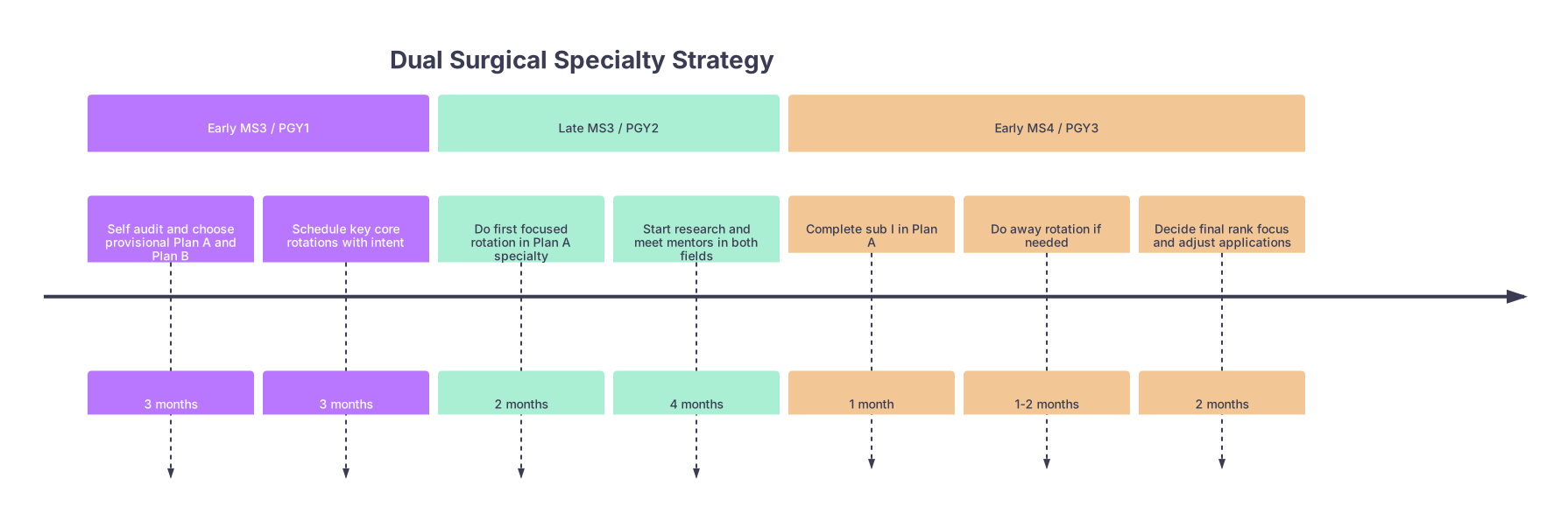
The core mistake I see: people wait until late MS4 (or PGY-2) to make the real decision. Too late. You need staged gates.
Here is a clean timeline.
| Period | Event |
|---|---|
| Early MS3 / PGY1 - Self audit and choose provisional Plan A and Plan B | 3 months |
| Early MS3 / PGY1 - Schedule key core rotations with intent | 3 months |
| Late MS3 / PGY2 - Do first focused rotation in Plan A specialty | 2 months |
| Late MS3 / PGY2 - Start research and meet mentors in both fields | 4 months |
| Early MS4 / PGY3 - Complete sub I in Plan A | 1 month |
| Early MS4 / PGY3 - Do away rotation if needed | 1-2 months |
| Early MS4 / PGY3 - Decide final rank focus and adjust applications | 2 months |
Early phase (MS3 or PGY-1): Data gathering with intent
Your priorities:
- Hit core rotations hard – aim for honors, strong evals.
- On each surgical service, do a 24–48 hour “this is my whole career” mental simulation.
- Start a simple decision log:
- What cases lit you up?
- What clinic days drained you?
- What did attendings actually do day to day?
Do one thing differently from most students: tell attendings you are deciding between two specific surgical fields, not “keeping an open mind.” That changes the quality of advice you get. Surgeons respect decisiveness, not vagueness.
Step 5: Structured Self-Audit – Who Actually Wins?
You cannot rely on feelings from one good week on a “sexy” service. Build a structured self-audit over 4–6 weeks.
Use three short lists for each specialty.
Cases that energized you most.
- For Ortho: open fractures, arthroplasty, sports, spine?
- For Plastics: microsurgery, recon after cancer, hand, cosmetic?
- For ENT: airway work, sinus, head and neck, otology?
Misery triggers.
- Long clinic days vs long in-house call nights.
- Trauma-heavy nights vs meticulous elective cases.
- Emergency page volume vs scheduled OR with few surprises.
Personality and culture fit.
- Did you like how residents talked to each other at 2 AM in the workroom?
- Did you respect how attendings handled complications?
- Did you see a version of your future self in the chiefs?
Then ask people who know you and the work:
- A chief in each field: “If I told you I am trying to choose between X and Y, based on what you have seen of me, what would you bet on?”
- A program director or clerkship director: “Where do you see me being strongest?”
Do not ignore the answer just because it conflicts with your fantasy. They are often right.
Step 6: Design Your Rotations for a Dual Plan (Without Looking Flaky)
You need to look fully committed to whichever service you are on. But behind the scenes, you are stacking the deck for both fields.
Practical rotation blueprint (MS4 example)
Let us say:
- Plan A: Integrated Plastics
- Plan B: General Surgery
Your schedule might look like:
- Sub-I 1: Plastic Surgery (home)
- Sub-I 2: General Surgery (home or affiliated)
- Away 1: Plastic Surgery at a realistic target program
- Remaining electives: 1–2 gen surg–adjacent (acute care, SICU), 1 free for revisiting whichever you are leaning toward or for rest if applying broadly.
Key rules:
- On each service, act as if that specialty is your destiny. No “I am also thinking about…” on rounds. It reads as hedging.
- Explicit dual-interest conversations should happen with a very small, trusted group:
- Your main mentor in each field.
- Maybe your dean’s advisor.
- Everyone else just needs to see you as laser-focused while you are with them.
Step 7: Letters of Recommendation – How to Split Without Signaling Chaos
Letters will either make this dual-plan look intentional or make you look confused.
The simple structure that works for most:
If both specialties are surgical and related (e.g., Ortho + Gen Surg):
- 2 letters from Plan A specialty attendings.
- 1–2 letters from strong general surgeons or other surgical attendings.
- Program-specific letter sets:
- For Ortho apps: use 2 Ortho + 1–2 general surgery / other surgical.
- For Gen Surg apps: use your best surgeons (ortho letters can sometimes count if writer is well known and letter clearly supports “this person will be an excellent surgeon”).
If specialties are structurally distant (e.g., Plastics + Derm):
- You probably need mostly field-specific letters and must choose one field as primary for ERAS.
- This pairing is weak; strongly reconsider if you are not a superstar applicant.
You will almost never send a letter where the attending says “they are deciding between X and Y.” That is deadly. The letter should sell you as a surgeon, full stop, and, if specialty-named, fully behind that field.
How to ask for letters when you are dual-plan:
- To Plastics mentor: “I am planning to apply primarily to Plastics with some General Surgery programs as a secondary plan. I would really value a strong letter specifically for Plastic Surgery programs. Would you feel comfortable writing that?”
- To Gen Surg mentor: “I am committed to a career in surgery and am applying to both Plastic Surgery and General Surgery programs. For the General Surgery programs, I was hoping you could comment on my strengths as a surgical trainee.”
You control what goes where through ERAS.
Step 8: Research and CV Positioning – Avoid the Split Identity Problem
I have watched students cripple themselves by doing one paper in five different fields instead of building a coherent body of work in one. Worse when you are already split between two specialties.
You want:
- A clear research center of gravity (ideally your Plan A field).
- A credible story that your skills and productivity will transfer to Plan B if needed.
Examples:
Plan A: Vascular; Plan B: Gen Surg
- Majority of research: vascular outcomes, endovascular vs open, limb salvage.
- Some: general surgery quality improvement, perioperative pathways.
Plan A: Ortho; Plan B: Gen Surg
- Majority: trauma, fracture fixation, ortho outcomes.
- Some: trauma systems, ED to OR flow, QI.
The key is that both fields can look at your CV and say: “This person is a serious surgeon-in-training; they are not random.”
If you are late and have scattered work already, your rescue move is to:
- Tie everything under one umbrella in your personal statement and experiences:
- “My interest has consistently centered on complex operative care, trauma care, and reconstruction, which I have explored through projects in X, Y, and Z.”
Step 9: Personal Statements and ERAS – Two Stories, One Core Identity
You will almost certainly write two versions of your personal statement:
- Plan A statement – laser-focused on that specialty.
- Plan B statement – still specialty-specific, but anchored in your broader identity as a surgeon.
The core identity should be the same:
- Serious, technically oriented, team-focused, resilient, interested in X type of pathology or Y patient population.
The specialty “wrapper” differs:
- For Plastics: heavy on reconstruction, form and function, multidisciplinary tumor boards, microsurgery.
- For Gen Surg: broader oncologic care, acute care surgery, surgical ICU, leading big teams.
Do not mention that you are applying to two specialties in either statement. Programs do not need to know your entire internal decision tree.
Step 10: Interview Season – What You Say and What You Do Not
This is where people expose themselves.
Rule 1: At any given program, you are committed to that specialty. Full stop.
Not because you are lying. Because by the time you are interviewing, you should have done the work to say this with integrity: “If I match here in this field, I will be happy and fully committed.”
You do not:
- Tell a Gen Surg PD, “I am also really into Plastics and applied there too.”
- Tell an Ortho PD, “I am torn between Ortho and ENT.”
You do:
- Answer questions about your interest in that specialty in detail:
- Specific cases you loved.
- Mentors who shaped you.
- Sub-I experiences that convinced you.
- Show that your CV and rotations support what you are saying.
Behind the scenes, you use the rank list to express your true hierarchy:
- Maybe all your Plastics interviews rank above all but one or two dream Gen Surg programs.
- Maybe you mix them based purely on where you would actually want to live and work.
Programs see only that you ranked them. They do not see you also ranked another field.
Step 11: If You Honestly Still Cannot Choose Near Rank Time
You might reach January and still feel pulled in two directions. Here is the protocol I give people who are stuck:
Write two 1-page documents:
- “10-year life if I match Specialty A.”
- “10-year life if I match Specialty B.” Include: daily schedule, clinic vs OR time, call burden, types of patients, approximate income, academic vs community, where you live.
Identify your non-negotiables:
- Geographic control?
- Income floor?
- Predictable schedule vs adrenaline-heavy?
- Long training vs shorter path?
Decide using regret minimization, not current excitement.
- Ask: “In 10 years, which missed path will hurt more?”
- If losing the reconstructive micro world will haunt you, that is one signal.
- If losing broad operative exposure and trauma will haunt you, that is another.
Make one uncomfortable move:
- Tell your mentors in both fields your leaning.
- Ask directly: “Given what you know of me and my application, do you think this is the right call?”
Then commit. Indecision is worse than a slightly imperfect choice between two good options.
Step 12: What If You “Choose Wrong”? The Reality of Later Transitions
You are not signing a blood oath. There are legitimate, if painful, pivot paths:
- Gen Surg → CT, Vascular, Surg Onc, Breast, MIS, Trauma/Critical Care, sometimes Plastics.
- Ortho → nonoperative sports, PM&R collaborations, pain.
- ENT/Plastics → Head & neck, facial plastics, recon focus.
Switching from one categorical residency into a completely different competitive field is rare but not impossible. I have seen:
- Gen Surg → Integrated Plastics (via reapplying, strong portfolio, brutal year).
- Gen Surg → ENT (early PGY switch, massive mentorship rescue).
You do not build your life assuming a unicorn transfer. But you should know the world does not end if your MS4 self guessed slightly “wrong” within surgery. Good surgeons find ways to carve out the work they love.
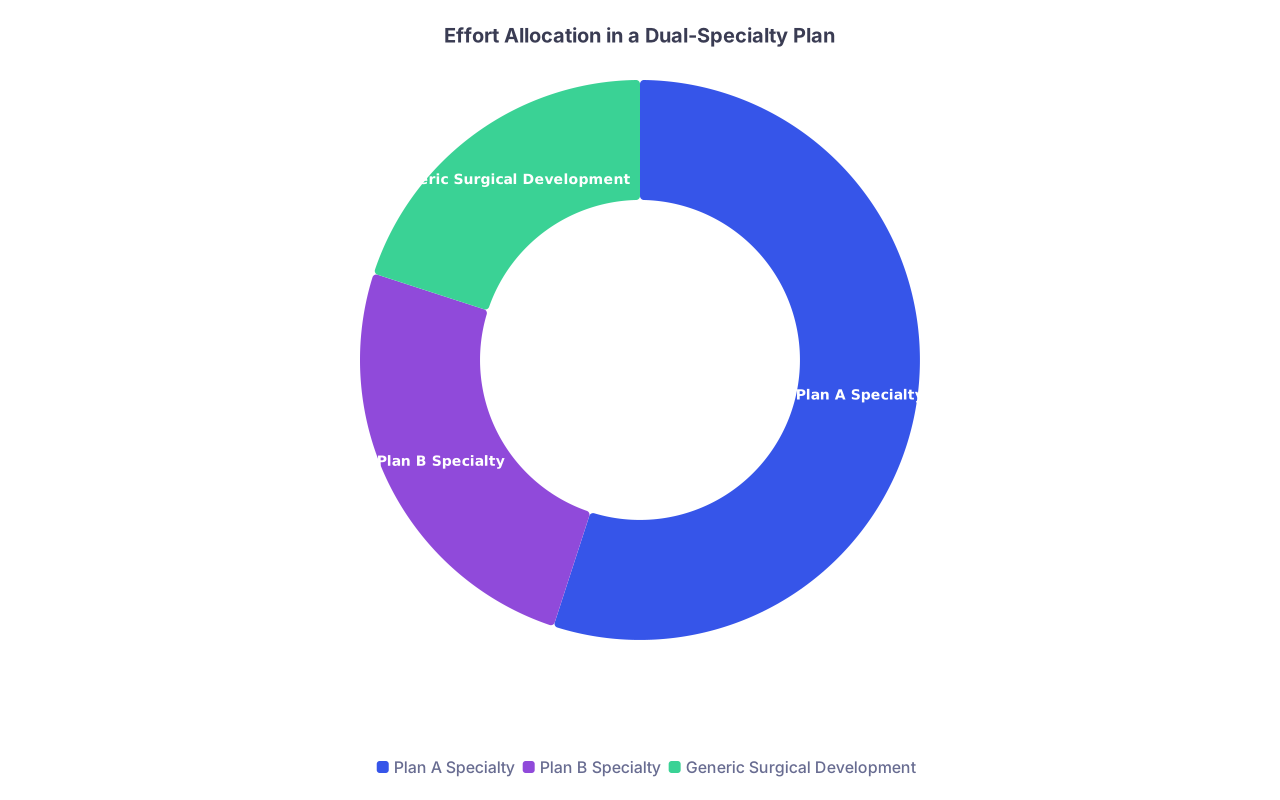
Visual: How Dual Planning Affects Your Application Energy
| Category | Value |
|---|---|
| Plan A Specialty | 55 |
| Plan B Specialty | 25 |
| Generic Surgical Development | 20 |
As a rule of thumb:
- ~50–60% of your focused energy goes to Plan A.
- ~20–30% preserves a real path for Plan B.
- The rest builds you as a solid surgeon no matter what: core skills, evaluations, Step/board performance, basic research habits.
If your split is closer to 40/40 with only 20 on generic surgical growth, you are at real risk of being weak in both.
Quick Dual-Plan Checklist
Use this as a gut-check. If you cannot answer “yes” to most of these, your dual-plan needs tightening.
- I can clearly name my Plan A and Plan B specialties.
- My Plan A and Plan B are structurally compatible or I have a strong reason for an odd pairing.
- I have at least one trusted mentor in each field who understands my dual-plan.
- My rotation schedule gives each specialty at least one strong sub-I or rotation.
- My letters can be assembled into a convincing specialty-specific set for each field.
- My research and CV tilt toward one field but still look coherent for the other.
- I have two versions of my personal statement ready, both honest and specific.
- On any given interview day, I can convincingly present as “all in” for that specialty.
- I know what I will do if I match my Plan B. I will not treat it as a consolation prize.
If you cannot check these off, fix the gaps now. Waiting until ERAS opens or, worse, until interview offers (or lack thereof) come in is how you end up scrambling.
FAQs
1. Is it ever smart to apply to both specialties equally and just see where I match?
That is lazy strategy disguised as “keeping options open.” You can send equal numbers of applications, but in reality, you will always have:
- One field where your letters are stronger.
- One field where your research is deeper.
- One field where your story is cleaner.
If you truly like both equally, then the deciding factor should be where you are objectively more competitive. Lean your prep toward that field as Plan A, with the other as Plan B. “Equal” effort usually means “suboptimal for both.”
2. Should I tell programs I am applying to another surgical specialty as well?
Generally, no. Programs want to believe you see their field as your destination, not one of several experiments. The only exception is a very frank, high-trust conversation with a mentor or PD who already knows you well and is actively trying to help you place somewhere. For standard interviews, you present as committed to that specialty, then let your rank list express your true hierarchy later.
3. What if my home institution does not have one of my two specialties?
Then your strategy must shift earlier and be more deliberate:
- Use early MS3 (or PGY-1 if a prelim year) to crush core rotations and build generic surgical credibility.
- Cold-email and network for away rotations in the missing specialty as early as permitted.
- Start remote research collaborations with that specialty at other institutions (retrospective chart reviews, database projects) to show real interest.
- Accept that the specialty without a home program will likely be disadvantaged and may need to be your Plan A only if you are a very strong applicant. If not, you may need to flip: make the home specialty Plan A and the away-only specialty Plan B or a future fellowship target.
Key takeaways:
- Loving two surgical specialties is not the problem. Lacking a structured dual-plan is.
- You must pick a provisional Plan A and Plan B, then build rotations, letters, research, and personal statements around that hierarchy.
- On every single service, you act “all in” for that field, then let your rank list, not your interviews, carry your internal indecision.