
Clinical volunteering matters before you transfer for one simple reason: it proves you didn't just wake up last week and decide healthcare sounded impressive. It shows patient-facing service, sustained commitment, and real exposure to how care actually works. Not the fantasy version. The waiting, the teamwork, the awkward moments, the human moments. That's what gives you substance for essays and interviews.
Educational note: this article is for educational planning only. It is not legal, financial, tax, employment, compliance, or institutional policy advice. Clinical volunteering is usually unpaid, but programs may still involve stipend policies, reimbursement questions, waivers, background-check forms, confidentiality agreements, scheduling rules, or other compensation-related or employment-adjacent paperwork. If a hospital, clinic, hospice, or volunteer program asks you to sign documents or raises questions about pay, reimbursement, legal obligations, taxes, privacy, or compliance, review the materials carefully and consult the program and other qualified professionals.
Your timeline depends on your transfer date.
- If you're 12 months out: you have time to apply broadly, finish slow onboarding, and build depth.
- If you're 6 months out: stop chasing perfect. You need a quick-start role, a realistic schedule, and consistency.
- If you're 3 months out: the job is documenting what you have, staying active, and turning experience into a clear story.
Here's the core strategy I recommend every time: pick one or two clinical settings, start early, and go deep. Random one-day events don't build a profile. They build clutter.
Transfer applicants need to think differently from first-time freshmen. Your runway is shorter. Your semesters are already moving. You usually don't have the luxury of "I'll explore for a year and then get serious." Every month should do a job. Research. Apply. Start. Stabilize. Reflect. Document. Use.
That's how you build clinical volunteering before transfer without wasting time.
This article is for educational purposes only. It is not financial advice, not legal advice, and not tax advice. Figures vary by individual circumstances, consult a qualified professional before acting.
Start Here: Build Your Clinical Volunteering Timeline Before You Transfer
Think backward from your transfer deadline. Always backward. I've seen students do the opposite, get excited, sign up for three things, miss onboarding emails, then realize none of it started in time to matter. Bad plan.
At this point you should create a very basic timeline with three anchors:
- Your transfer application deadline
- Your target date to begin volunteering
- Your latest acceptable onboarding start date
Then decide what kind of role actually fits your life. If you're balancing classes, commuting, and work, don't apply to a site demanding two full weekdays every week. That's not ambition. That's fantasy scheduling.
Good pre-transfer clinical volunteering roles often include:
- Hospital volunteer programs
- Outpatient clinic front-desk support with patient interaction
- Hospice volunteering
- Rehab center support roles
- Community health outreach tied to patient care settings
Your goal isn't to collect badges. Your goal is to become a reliable presence in a real care environment. At this point you should be asking: Where can I show up every week and still earn strong grades? That question matters more than prestige.
12 to 9 Months Before Transfer: Choose the Right Clinical Setting and Apply Early
At this point you should be researching local options aggressively. Not casually. Pull up hospital websites, call volunteer offices, check community clinics, and ask around at your current campus pre-health office if you have one.
Your shortlist should be based on four things:
- Access: Can you get there reliably?
- Time commitment: Weekly hours, minimum months required
- Onboarding length: Background checks, vaccines, orientation, training
- Exposure: Real patient interaction or meaningful clinical environment
A glamorous-sounding role that takes four months to onboard is useless if your application clock is already ticking.
Here's the pattern I've seen over and over:
- Student finds a hospital role in September
- Doesn't apply until November
- Learns orientation is in January
- Starts in February
- Then wonders why they only have 12 hours by application season
That's why early action wins.
Use a simple spreadsheet or notes app and track:
- Site name
- Contact person
- Application submitted date
- Follow-up date
- Requirements
- Orientation date
- Expected start date
Nothing fancy. Just organized.
Also, follow up. Politely. Consistently. Volunteer offices are often understaffed, and applications do get buried. If you don't hear back after a reasonable time, send the email.
9 to 6 Months Before Transfer: Secure a Consistent Schedule and Show Up Weekly
At this point you should be actively volunteering in one main role. Even if it's only 2 to 4 hours per week, that's enough, if you actually do it every week.
Consistency beats intensity. Every time.
Admissions readers can spot the difference between:
- a student who steadily volunteered every Thursday afternoon for six months, and
- a student who panic-loaded 25 hours across two weekends
One looks committed. The other looks cornered.
What should you do during this phase?
- Learn the workflow fast
- Arrive early
- Dress appropriately
- Know your boundaries
- Be useful without trying to play clinician
That last point matters. A lot. Don't overstep. If your role is escorting patients, stocking rooms, delivering comfort items, helping at reception, or guiding visitors, do that role well. Healthcare teams remember the volunteer who is dependable, calm, and respectful. They do not love the volunteer trying to cosplay as a medical student.
Start documenting what you observe after each shift:
- How staff communicate with anxious patients
- How nurses, physicians, techs, and front-desk staff coordinate
- What frustrates patients
- What moments feel meaningful to you
That reflection becomes gold later. Specific details make your application believable.

6 to 3 Months Before Transfer: Deepen Your Experience and Build a Narrative
At this point you should stay in the same role long enough to become familiar, trusted, and useful. This is where your experience starts turning from "I volunteered" into "I understand this environment."
You don't need dramatic stories. You need honest ones.
Maybe you notice how often patients are confused by wayfinding. Maybe you learn that the unit clerk keeps everything moving. Maybe you realize the most skilled staff aren't always the loudest people in the room. That's real learning.
If appropriate, ask whether you can take on slightly more responsibility:
- Restocking supplies
- Escorting more independently
- Helping with patient flow
- Supporting non-clinical administrative tasks
- Assisting families with directions and logistics
Don't ask for extra tasks in week one. Earn that ask.
At this point you should also start building your transfer narrative. Write down answers to these questions:
- Why does clinical service matter to me?
- What have I learned about healthcare teams?
- What kind of patient needs have stood out?
- How has this experience sharpened my academic goals?
If you still don't have enough clinical access, this is the point to add a second relevant role quickly, maybe hospice, clinic intake support, or a community health program. But keep it controlled. Overloading your schedule and tanking your GPA is a terrible trade.
3 Months to Transfer: Document Hours, Reflect on Impact, and Prepare Application Materials
At this point you should shift into record-keeping mode. Not glamorous, but absolutely necessary.
Verify:
- Total hours
- Exact start date
- Typical weekly schedule
- Supervisor name and title
- Contact email and phone
- Any forms required by transfer schools
Do this now, not the night before submission when your supervisor is on vacation and you're digging through old emails.
I strongly recommend keeping a running document with:
- Responsibilities
- Memorable patient-facing moments
- What challenged you
- What surprised you
- How the work changed your understanding of healthcare
A short reflection after each shift is enough. Three to five sentences. That's it. But those sentences prevent generic essay nonsense later. "I enjoy helping people" tells me nothing. "I watched a volunteer coordinator calm a frustrated family by slowing down, listening first, and giving clear directions" tells me you were actually paying attention.
At this point you should also connect volunteering to larger themes in your application:
- Service
- Maturity
- Reliability
- Teamwork
- Communication
- Comfort in clinical environments
And let's be blunt: if volunteering starts hurting your grades, fix your schedule immediately. Transfer admissions will not forgive a sliding academic record because you got too excited about extracurriculars. Strong service plus weak academics is not a winning package.
Final 4 Weeks Before Transfer: Tighten the Story, Keep Showing Up, and Avoid Last-Minute Gaps
At this point you should keep volunteering. Don't stop just because your application is almost done. Continued involvement shows this wasn't a temporary stunt.
Do one full accuracy check across all materials:
- Dates match
- Hours match
- Role title is correct
- Supervisor information is correct
- Descriptions are clear and honest
Then tighten your talking points. You should be able to explain, in plain language:
- What your role was
- What you actually did each shift
- What you learned about patients and care teams
- Why the experience mattered
- How it influenced your path toward healthcare
If your hours are still limited, don't do something dumb and cram a brand-new volunteer role into the final weeks just to look busier. That usually reads exactly how it is: rushed and shallow. Quality and continuity are stronger.
After You Transfer: Keep the Momentum and Turn Volunteering Into Long-Term Service
Once you transfer, the timeline doesn't end. It resets.
At this point you should look for continuity near your new school within your first month on campus. The easiest move is often to build on what you already know. If you volunteered in a hospital before transfer, apply to a hospital or clinic near your new campus. Prior experience makes you more credible and often more confident during onboarding.
Then, once you're academically settled, use that base to grow:
- Move into a more responsible volunteer role
- Join a specialized service program
- Add community health outreach
- Ask pre-health advising offices for local clinical leads
Keep a simple service log going forward:
- Dates
- Hours
- Responsibilities
- Reflections
- Supervisor contacts
That log will help with everything later, medical school applications, scholarships, committee letters, advising meetings. More importantly, it helps you build a coherent story instead of a pile of disconnected memories.
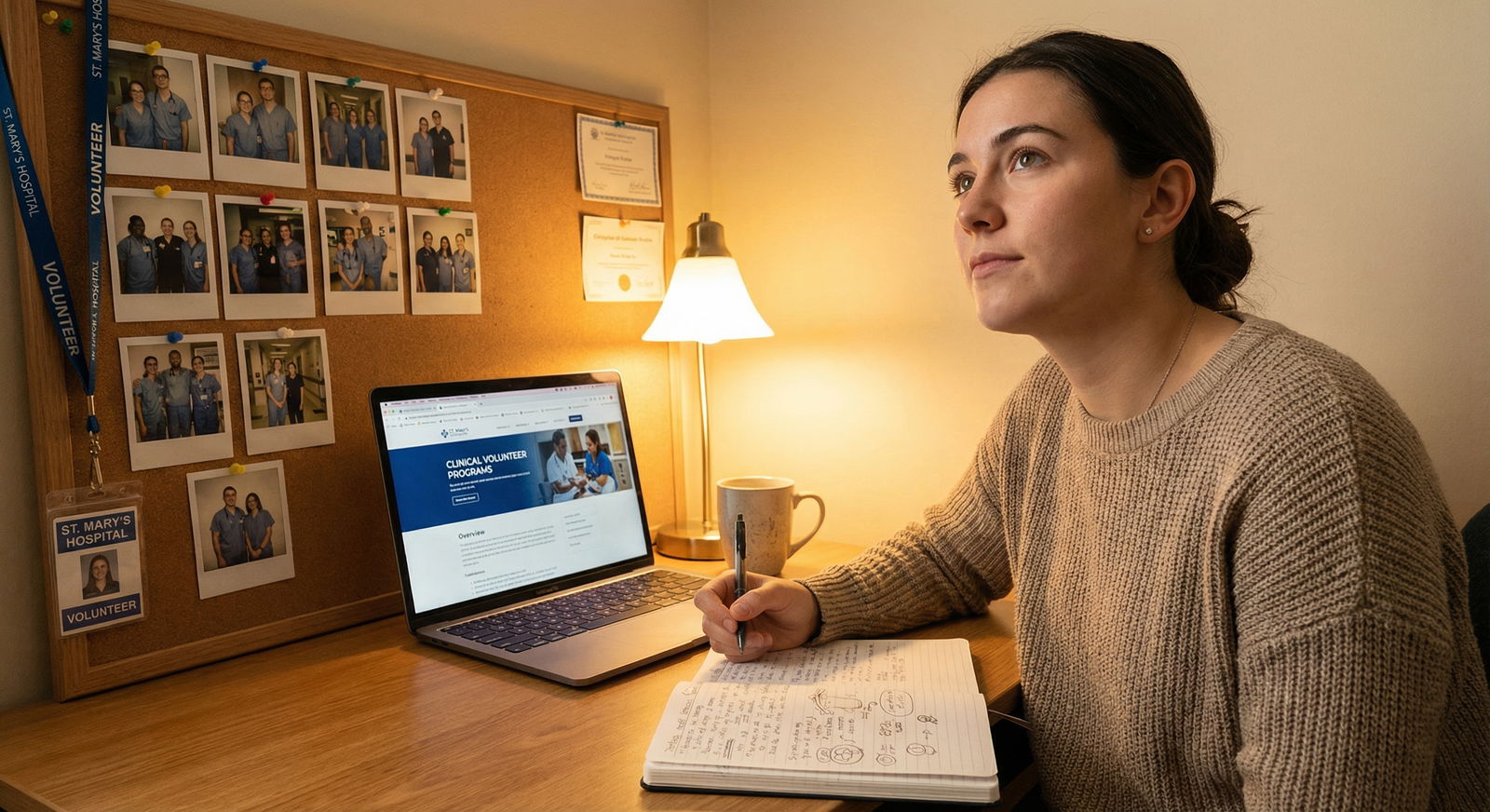
Here's the move I want you to make now:
- Pick one clinical site today
- Submit one application this week
- Schedule your first shift before the month ends
That's the timeline. Start early. Go deep. Track everything. And keep showing up. That's how transfer applicants build clinical volunteering that actually means something.