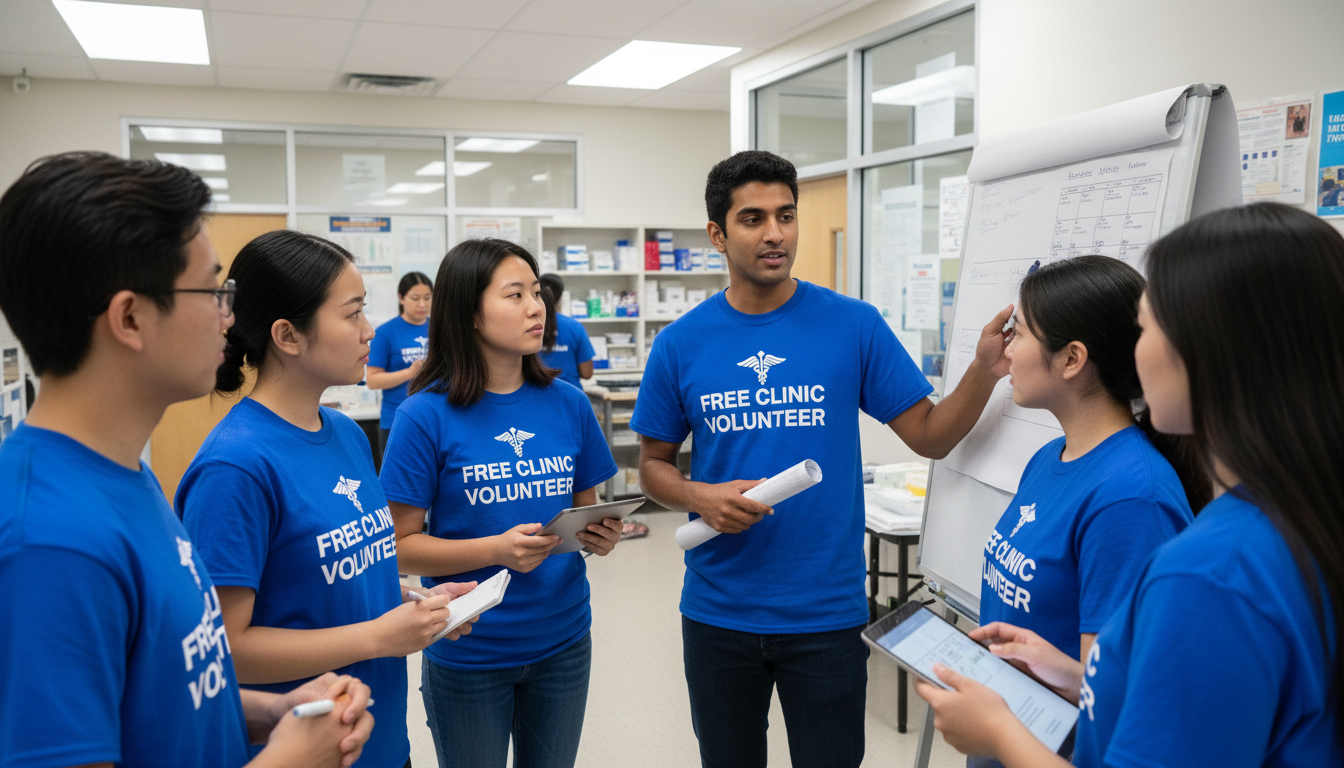
It is your first evening at the student-run free clinic. You are wearing a generic volunteer badge, shadowing another student as they wipe down rooms and restock supplies. You are mostly quiet, unsure when to step in and when to step back. The clinic director just introduced you to a fourth-year medical student who “runs the whole Tuesday night session,” and you find yourself thinking: how do you get from here to there?
This guide walks you through that path in time order: what to do in your first month, your first year, and how to position yourself to move from basic volunteer to trusted clinic leader.
Phase 0: Before You Start – 1–2 Months Out
At this point you should be:
- Identifying clinics and roles
- Clarifying your target timeline
- Laying groundwork so you do not waste your first semester
4–8 weeks before your first clinic shift
Map your local options
- Search:
- Student-run free clinics at your college or nearby medical schools
- Community health centers that accept student volunteers
- Mobile clinics and health fairs with regular schedules
- Make a simple comparison table:
- Time commitment (weekly vs monthly)
- Patient population (uninsured adults, homeless, refugees, pediatrics)
- Leadership structure (formal positions vs informal “lead” roles)
- Search:
Align with your academic timeline
- If you are premed:
- First or second year: focus on basic volunteering and skill-building
- Third year: transition to higher responsibility; consider leadership roles that will mature before you apply
- If you are early in medical school:
- M1: consistent volunteering and reliability
- Late M1 to M2: move into coordinator / shift leader roles
- M3+: higher-level clinic director or quality improvement roles, if your schedule permits
- If you are premed:
Reach out deliberately
- Email clinic coordinators with:
- A concise introduction (year in school, interest in underserved care)
- Your realistic availability for 6–12 months
- A line that signals long-term interest:
“I am looking for a place where I can grow from basic volunteer responsibilities into more involved roles over time.”
- Ask:
- “What does the progression from new volunteer to leadership look like in this clinic?”
- “What is the minimum time commitment expected for leadership positions?”
- Email clinic coordinators with:
At this point, you want clarity: is leadership even possible here within your timeframe? If the answer is no, broaden your search.
Phase 1: Months 0–3 – The Foundation as a Basic Volunteer
You are now on the schedule. You have a recurring shift. Your badge likely says “Volunteer” and nothing more.
At this point you should be:
- Learning the flow of the clinic
- Proving you can be counted on
- Building a reputation for reliability
Weeks 1–4: The acclimation period
Master the basics of showing up
- Arrive 10–15 minutes early every shift. Consistently.
- Introduce yourself to:
- The shift leader
- The attending physician if available
- The senior student volunteers
- Ask one concrete question each shift:
- “What is one thing brand-new volunteers often forget to do?”
- “Is there anything you wish you had known during your first month here?”
Learn the physical and digital layout
- Within your first 2–3 shifts you should know:
- Where supplies are stored (gloves, BP cuffs, alcohol pads, forms)
- How rooms are turned over
- How charts are started and where documentation happens (paper charts vs EMR)
- Make a simple personal map or note file after each shift:
- “Intake forms on shelf above printer”
- “Interpreter phone numbers on laminated sheet next to phone in Room 3”
- Within your first 2–3 shifts you should know:
Observe leadership in action
- Watch what shift leaders actually do:
- How they assign volunteers to rooms
- How they track patient flow
- How they communicate with attendings and nurses
- Jot down 2–3 behaviors you see repeatedly:
- Example: “Leaders constantly check whiteboard; they always know who is in each room.”
- Watch what shift leaders actually do:
Weeks 5–12: Becoming indispensable at the basic level
By the end of 3 months, you want clinic staff to think of you as “one of the regulars.”
Own your assigned tasks
- Common basic roles:
- Room turnover and restocking
- Escorting patients from waiting area to exam rooms
- Basic vitals (once trained and signed off)
- Handling forms, scanning, or simple documentation tasks
- Your goal:
- Perform these tasks without being reminded
- Anticipate needs:
- Refill exam table paper before it runs out
- Notice when the waiting room is full and offer to help with intake
- Common basic roles:
Track your shifts and responsibilities
- Keep a simple log:
- Date, role, skills used (vitals, EMR notes, Spanish interpretation, etc.)
- A short reflection: “What went smoothly? Where did I need help?”
- This log later becomes:
- Evidence for leadership applications
- Detail for personal statements and interviews
- Keep a simple log:
Signal interest in growth (quietly, consistently)
- After 6–8 shifts, say to a shift leader:
- “I would like to become more involved as I get more experience. What skills should I focus on right now to prepare for that?”
- Do not ask for a leadership role yet. Ask for:
- More complex tasks (e.g., managing the whiteboard, helping coordinate room assignments)
- Shadowing a more senior volunteer in intake or discharge
- After 6–8 shifts, say to a shift leader:
By the end of Month 3, your target outcome: at least one leader knows your name and would describe you as “reliable and eager to learn.”

Phase 2: Months 4–9 – From Volunteer to Senior Volunteer
Now you understand the clinic basics. The next step is to expand your responsibility horizontally before moving vertically into formal leadership.
At this point you should be:
- Building specific clinical and operational skills
- Becoming the person new volunteers look to
- Positioning yourself for a formal title in the next recruitment cycle
Months 4–6: Skill expansion
Earn sign-off on concrete skills
- Examples (varies by clinic and your training level):
- Vitals: BP, pulse, respiratory rate, SpO₂, temperature
- Intake: chief complaint, basic history, medications list
- Basic counseling: smoking cessation handouts, follow-up instructions (with supervision)
- Ask for structured training:
- “I would like to be signed off on intake. Is there a checklist or training session I should complete?”
- Examples (varies by clinic and your training level):
Start informally mentoring new volunteers
- When a new volunteer arrives:
- Offer to show them where supplies are kept
- Walk them through room turnover or escorting patients
- Check in at mid-shift:
- “How is it going? Any questions no one has had time to answer yet?”
- This is your first taste of leadership: informal, unassigned, but visible.
- When a new volunteer arrives:
Take ownership of one piece of clinic flow
- Examples:
- Being the unofficial “room turnover lead” who ensures rooms are always ready
- Managing the waiting room flow under supervision (updating the whiteboard, communicating delays)
- Coordinating interpreter resources for non-English-speaking patients
- Tell the shift leader:
- “I can take primary responsibility for X tonight. I will check in with you if I run into questions.”
- Examples:
Months 7–9: Acting as a de facto junior leader
Now you are one of the more experienced volunteers. Others may ask you where things are, how the sign-in system works, what to do when they are unsure.
Run parts of the shift under supervision
- Ask your shift leader:
- “For the first hour tonight, could I try managing room assignments while you supervise?”
- “Could I coordinate the volunteers while you focus on provider communication?”
- Focus on:
- Clear, brief communication:
- “Alex, please prepare Room 2 for the next patient.”
- “Jordan, could you escort Mr. R back to Room 3 and get vitals?”
- Situational awareness:
- Who has been waiting longest
- Which provider is close to finishing
- Clear, brief communication:
- Ask your shift leader:
Participate in debriefs and improvement conversations
- At the end of the shift, ask:
- “What is one thing we could adjust next week to handle the rush between 6–7 pm?”
- If the clinic has a quality improvement or operations committee:
- Attend a meeting as an observer
- Listen for recurring pain points:
- No-shows
- Missing lab results
- Long check-in times
- At the end of the shift, ask:
Identify the leadership ladder
- Clarify:
- What formal roles exist? (e.g., Operations Coordinator, Volunteer Coordinator, Shift Leader, Clinic Director)
- When are they selected? (often annually or each semester)
- What prerequisites exist? (minimum number of shifts, training modules, letters from current leaders)
- Mark application deadlines 3–6 months in advance on your calendar.
- Clarify:
By the end of Month 9, you should be seen as the “go-to” volunteer at least one night per week and have a clear understanding of the application timeline for leadership roles.
Phase 3: Months 9–15 – Applying for and Transitioning Into Leadership
At this point you should be:
- Preparing a competitive leadership application
- Making your interest explicit
- Planning a smooth handover from current leaders
3–4 months before leadership applications open
Seek targeted feedback from current leaders
- Request a brief meeting (15–20 minutes) with:
- The shift leader you work with most often
- A current clinic director or operations chief
- Ask:
- “I am interested in applying for [Shift Leader / Volunteer Coordinator] when applications open. Where do you think I am strong, and what should I work on over the next few months to be ready?”
- Listen for:
- Specific behaviors they want to see (e.g., more assertive communication, faster decision-making)
- Gaps in your experience (e.g., not enough exposure to EMR, little experience with scheduling)
- Request a brief meeting (15–20 minutes) with:
Fill obvious gaps proactively
- If you lack experience in a key domain:
- Ask to shadow the person who currently does that work
- Example:
- “Could I sit with you while you handle the scheduling emails next week to understand the process?”
- Offer to help with one small project:
- Updating the orientation guide for new volunteers
- Collecting simple data on wait times for a month
- If you lack experience in a key domain:
Application month
Assemble a focused application
- Emphasize:
- Time on task: number of shifts, roles held, specific skills
- Concrete contributions:
- “Streamlined room turnover by creating a checklist that reduced average prep time by 2 minutes per patient.”
- “Trained 5 new volunteers on clinic flow during spring semester.”
- Make your trajectory clear:
- “Started as basic volunteer in [Month, Year]; progressed to senior volunteer role with responsibility for [specific function].”
- If references or endorsements are required:
- Ask people who have seen you on hectic nights, not just quiet ones.
- Emphasize:
Prepare for possible interviews
- Expect questions like:
- “Describe a time you noticed a problem in clinic flow and what you did about it.”
- “How would you handle a volunteer who is consistently late?”
- “What will you do if your academic workload increases unexpectedly?”
- Use time-structured answers:
- Context → Action → Outcome
- Emphasize how you prioritize patient safety and team functioning over your own convenience.
- Expect questions like:
First 2–3 months as a new leader
You are now officially a “Shift Leader,” “Operations Coordinator,” or similar. The first weeks are critical.
Shadow-then-lead transition
- First 1–2 shifts:
- Shadow the outgoing leader
- Take notes on:
- How they open and close clinic
- How they handle late providers or no-shows
- Their scripts for speaking with upset patients or overburdened volunteers
- Next 2–3 shifts:
- You lead, they shadow
- Ask for debriefs:
- “What would you have done differently when we were backed up at 7 pm?”
- First 1–2 shifts:
Develop your personal systems
- For shift leaders:
- A standard pre-shift checklist:
- Confirm provider list and arrival times
- Confirm volunteer roster and roles
- Check supply levels in key rooms
- A whiteboard or digital tracker template for patient flow
- A standard pre-shift checklist:
- For operations/volunteer coordinators:
- A calendar of:
- Recruitment periods
- Orientation sessions
- Feedback surveys or evaluations
- A calendar of:
- For shift leaders:
Communicate your leadership style
- At the start of a shift:
- “I am [Name], I will be the shift leader tonight. Please check in with me if you finish a task and need a new assignment. If something seems unsafe or confusing, stop and come find me immediately.”
- Set norms early:
- Where volunteers should stand when not assigned
- How to handle no-show patients
- When to update you about delays or problems
- At the start of a shift:

Phase 4: Months 15+ – Growing as a High-Impact Clinic Leader
Now you are comfortable in your leadership role. You no longer spend all your energy just keeping the clinic afloat.
At this point you should be:
- Strengthening clinic systems
- Developing future leaders
- Translating your experience into your future applications
Months 15–24: System-building and mentorship
Formalize what you have learned
- Update or create:
- Shift leader checklists
- Orientation guides for new volunteers
- A brief handbook for your position (logins, key contacts, recurring issues)
- Example improvements:
- Color-coded whiteboard system for patient acuity or language needs
- Standard script for closing the clinic with patients still in the waiting room
- Update or create:
Identify and mentor your successors
- Notice:
- Who always shows up early
- Who quietly fixes problems without fanfare
- Who other volunteers already turn to for help
- Pull them aside:
- “If you are interested in leadership, I think you would be a strong candidate. Over the next few months, I can show you more of what I do on shift.”
- Give them graduated responsibility:
- First half-hour of the shift operations
- Handling one complex situation with your backup
- Notice:
Lead or support small quality improvement projects
- Examples:
- Reducing average patient wait times by 15 minutes over a semester
- Increasing completion rates of preventive screenings (e.g., depression, HIV, vaccines)
- Implementing a simple system to track follow-up appointments
- Document:
- Baseline data
- Interventions you introduced
- Outcome changes
- These projects become strong discussion points for medical school or residency interviews.
- Examples:
Aligning the Timeline With Premed and Medical Training
If you are premed (4-year college example)
- Year 1, Fall–Spring (Months 0–9): Basic volunteer → senior volunteer
- Year 2 (Months 10–21): Senior volunteer → shift-level leader
- Year 3 (Months 22–33): Experienced leader → project/QI work, mentorship
- Year 4: Taper leadership as needed while applying, but maintain continuity if possible
If you are in medical school
- M1: Basic → senior volunteer. Be ready to apply for formal roles by late M1.
- M2: Shift leader / operations role. Lead projects and mentor early students.
- M3–M4: Maintain manageable involvement or transition to higher-level oversight roles, depending on your clerkship schedule and school structure.
Final Checkpoints: Are You Ready to Call Yourself a Clinic Leader?
By the time you introduce yourself as a clinic leader on applications or in interviews, you should be able to point to:
Time and continuity
- At least 1–2 years in the same clinic, with a clear progression across roles.
Responsibility and impact
- Specific decisions you made that affected patient flow, safety, or clinic operations.
- At least one concrete improvement or project you helped implement.
People development
- Examples of new volunteers you trained or mentored who then took on greater responsibility.
If you structure your involvement with this timeline in mind, you move from “person who shows up” to “person who keeps the clinic running” in a deliberate, predictable way. The core of the transition is not a title change. It is the gradual shift from focusing on your own tasks to owning the experience and safety of the entire clinic session.