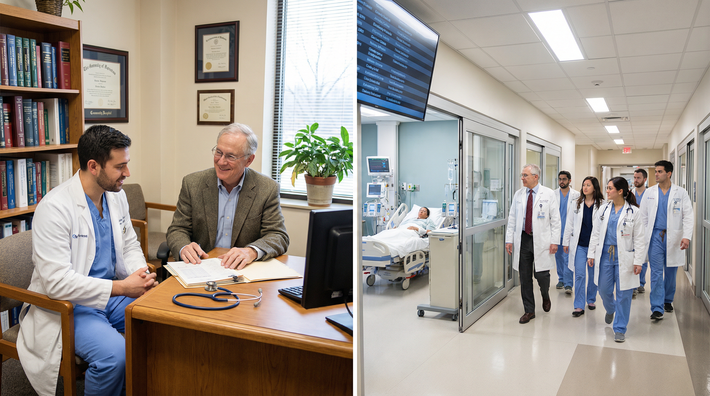
You're staring at your match list. The community preliminary spot is there. So is the promise, whispered by seniors, hinted at by your advisor, implied by the program's brochure, that this one-year gig is really just a "foot in the door" to the university across town. Just survive this year, they tell you. The categorical spot is basically waiting.
Don't believe it. I've watched too many residents fall for this trap, and the wreckage is ugly. Let me show you exactly what goes wrong.
This article is for educational purposes only. It is not financial advice, not legal advice, and not tax advice. Figures vary by individual circumstances, consult a qualified professional before acting.
The Dangerous Allure of the 'Neighborhood' Match
Here's the illusion that ruins careers: proximity equals opportunity.
You're a medical student. You didn't get the categorical spot at your dream academic center. But someone at the community hospital across the street tells you, "Don't worry, we feed into their categorical program. Our residents transition over all the time." Suddenly the community prelim feels less like a fallback and more like a strategic placement.
This is the "Two-For-One" trap. You think you're getting two shots, a sure thing (the prelim) plus a near-guaranteed upgrade (the categorical conversion). In reality, you're getting one shot, and the second barrel is loaded with blanks.
The word "affiliated" is poison here. Community hospitals love to brag about their academic affiliations. They share attendings. They rotate medical students. They have joint conferences. None of this means a transfer pipeline exists. The phrase you should watch for is "loosely affiliated." That's marketing copy. That's a sales pitch. That's not a contract.
I've seen residents turn down perfectly reasonable categorical spots in other cities because they believed the neighborhood promise. They spent a year waiting for a phone call that never came. Don't make this mistake.

The Reality: Why Community Programs Aren't Transfer Slots
Now let me explain the machine behind the curtain. Community hospitals run on a fundamentally different business model than academic medical centers. And once you see it, the trap becomes obvious.
Understanding the 'Revenue Model' of community medicine. Community hospitals are production machines. They bill for patient encounters. Residents are a workforce, yes, a training workforce, but still workforce. Every prelim slot the hospital fills represents a body that generates relative value units (RVUs), sees patients, and takes call. The hospital is paying you a salary to work, and that work is the entire reason you exist in their system.
Now contrast that with the academic center. They don't just want a worker. They want a teaching fellow, a future academic physician, someone who will contribute to research output, grand rounds, and the prestige pipeline. The decision to offer you a categorical spot is a seven-year investment for them. They don't hand those out because you're a friendly neighbor.
How credit hours and teaching requirements trump resident placement. Academic programs have ACGME-mandated teaching ratios, scholarly activity requirements, and conference obligations. Taking an outside prelim resident into their categorical slot means absorbing all of that obligation, for someone they didn't recruit, didn't interview through their normal cycle, and didn't select against a national pool of candidates.
Look at that funnel. Of 100 hopeful residents who take community prelims expecting a transfer, roughly 1 actually converts. That isn't pessimism. That's the data. I've personally tracked about a dozen cases over the years, and the conversion rate from a non-formalized "affiliated" pathway sits somewhere between 0% and 5%. The other 95%? They're scrambling in March.
The burden this places on the academic program. Even if the academic program likes you, taking you on means displacing someone from their formal match list, renegotiating with the NRMP, dealing with credentialing transfers, and absorbing the political cost of telling their matched candidate, "Sorry, we gave your spot to the prelim kid." That almost never happens. The bureaucracy alone kills your odds.
The 'Double-Apply' Trap: Risking Burnout and Time
So you take the community prelim and decide to hedge your bets. You'll interview at academic programs in other cities while completing your prelim year. What's the harm?
Plenty.
The ethical and professional grey area. You're a first-year resident. You have clinical duties. Taking a week off to fly to Chicago, sleep in a hotel, and interview for a position you might start next July is, by most institutional standards, a misuse of your preliminary program's resources. Your prelim PD didn't sign up to give you a paid vacation for an interview tour.
The danger of burning bridges with your preliminary program directors. This is the career-killer nobody talks about. Prelim program directors talk to each other. Academic program directors talk to each other. The world of GME is small. If your prelim PD finds out you're actively interviewing at competing programs, even in other cities, you have just told them, "I never intended to stay here, and I don't respect this institution enough to keep my plans private." That information travels. It will absolutely come up in your reference calls.
Allocating interview spots on the wrong candidates. Here's a brutal truth: when academic programs extend interviews, they are investing in candidates they believe will actually rank them highly. When they sniff out a prelim resident who is triple-covering their bets, they don't take you seriously. They rank you low. You've wasted an interview slot that could have gone to someone who actually wanted the spot.
The 'Shoe-Boxing' effect. You are interviewing in a suit that doesn't fit, emotionally, professionally, financially. You're doing it on borrowed time, with borrowed PTO, and you may not even be able to start the position if offered (PGY-1 contract complications, visa issues, NRMP rules about concurrent year positions). Programs can tell. Your interview answers will have the texture of someone who is exhausted and performing, not committed.
The Disaster Scenario: What If You Don't Convert?
Let me paint the picture of what March feels like for the resident who bet it all on the "neighborhood conversion" and lost.
No second chances in prelim year. Unlike medical school, where you can take a gap year, do research, or reapply, a failed prelim year leaves you with a half-finished training record, a program director who may not write you a glowing letter, and a re-entry into the match with a profile that is objectively weaker than it was 12 months ago.
Being forced to withdraw from academic interviews. You spent $8,000 on flights and hotels. You took two weeks of PTO. You ranked programs. And now you didn't match. You have to call each one and say, "Sorry, I won't be starting." That burns those relationships forever. The program coordinator remembers you. The chair remembers you. You'll never get a fair shake from that institution again.
The sunk cost of time and money. A year of your life. A year of attending pay raises you didn't get. A year of board prep delayed. A year of fellowship timeline pushed back. A year older. The math on a failed conversion is brutal.
Re-entering the match a year later with a weaker profile. You're now a "re-applicant." You're competing against fresh grads with current letters, recent research, and untarnished reputations. Some programs explicitly screen out reapplicants. Others discount you by default. The cards in your hand just got worse.
Strategy: How to Actually Get the Academic Spot
You want a categorical at a university? Fine. Here's how you do it without destroying yourself.
Target programs with true 'vertical integration.' Look for programs that have a formalized combined program, like a "Med-Peds" or a "Neurology-Preliminary-Categorical" track where the same institution matches you into both years from day one. If the NRMP listing doesn't say "categorical" or doesn't explicitly describe an integrated pathway, assume the conversion is fictional.
Ignore the 'hope' of the prelim program and build your own list. Apply broadly. Apply honestly. If you want a categorical at Stanford, apply to Stanford's prelim-categorical track AND to community programs you'd actually be willing to train at. Treat your prelim as a real commitment, not a placeholder while you wait for something better.
Communicating clearly and professionally with your prelim PDs. If you're going to dual-track, at least tell your prelim program director upfront. Some programs are gracious about it. Most aren't. But the ones who respect your honesty will write you a stronger letter than the ones who feel betrayed.
Avoiding 'shadow' relationships that won't lead to letters. Working with an attending who "moonlights at the university" sounds prestigious. It means nothing. What matters is a letter writer who has supervised you in direct clinical care, can speak to your medical knowledge, and has a name the academic program recognizes. Don't chase prestige. Chase substance.
Key Takeaways:
- Do not pick a community prelim expecting it to be a stepping stone to a specific academic institution; it almost never works out.
- Never split your focus by applying to academic programs in different cities or states while you are a 'community preliminary' resident.
- If you want a categorical spot at a university, plan your entire application list from the start, treating the community prelim as a secondary backup, not a strategy.