The biggest difference in autonomy between community and academic programs isn’t what most applicants think. It’s not “academic = no autonomy, community = total freedom.” That’s lazy thinking and it’ll get you misled fast.
Here’s the real story.
The core truth: autonomy is about supervision density, not labels
Autonomy in residency comes down to three things:
- How many residents vs attendings are around.
- How sick/complex the patients are.
- How risk‑tolerant the culture is.
Community vs academic is just the wrapper around those factors.
In general:
- Large academic centers = more layers (students, interns, juniors, seniors, fellows, attendings), more people watching, more protocols. Autonomy tends to be structured and delayed.
- Smaller community hospitals = fewer layers, fewer fellows, often fewer residents. Someone still has to do the work at 2 a.m. That “someone” is usually you. Autonomy tends to come earlier and more by necessity.
But that’s the pattern, not a universal rule. You can absolutely find:
- Academic programs with strong, real autonomy (especially senior-heavy services, night float, VA rotations).
- Community programs where attendings micromanage every order and note.
So don’t shop by label. Shop by how decisions actually get made on the floor.
How autonomy actually feels different day to day
Let’s get concrete. Imagine you’re a PGY-2 on medicine admitting chest pain.
Typical academic feel
You see the patient first, then:
- You present to a senior resident.
- The senior shapes the plan.
- Then you both present to the attending.
- Attending edits the plan.
- Sometimes a fellow (cards, heme-onc, ICU) has an opinion too.
You write orders… but a lot of the heavy decisions are pre-filtered by your senior or the fellow. You might not directly feel the pressure of: “Do I send this person home or admit them?” for a while, because there are buffers.
Autonomy does come, but it’s usually:
- During night float or cross-cover, when attendings are off-site and trust you to manage most stuff.
- In your PGY-3 year, when you’re the senior on a team and juniors run plans by you first.
- In specific rotations like the VA, county, or overflow services where attendings are more hands-off.
You’re still responsible. But there’s often someone else between you and the attending, especially in subspecialty-heavy programs.
Typical community feel
Same chest pain case at a community program:
- You see the patient.
- You call the attending with your assessment and plan.
- They may tweak a few things, but often they’ll say, “Okay, admit to tele, start heparin, you manage the rest and let me know if they worsen.”
There may be no fellow. No senior on top of you. Less hierarchy, more direct responsibility.
Common patterns I’ve seen at community sites:
- Interns cross-cover surgical floors alone with an attending at home. They call for real issues, but they aren’t hand-held for every Tylenol order.
- Senior residents run the ICU overnight with a phone call away intensivist.
- ED residents (EM or off-service) make real dispo decisions with attending sign-off, but not pre-filtered through three layers.
You get exposed earlier to the feeling of “I’m the doctor on-site right now.”
Where community programs usually give more autonomy
Here’s where community programs tend to win on autonomy, very consistently.
1. Night coverage and cross-cover
At many community programs:
- One resident covers multiple floors or services at night.
- There’s an attending available by phone (sometimes in-house, sometimes at home), but they expect you to try, decide, then call.
- You’re the one assessing: “Do I upgrade this patient? Does this need ICU? Is this real GI bleed or just bad labs?”
That’s scary early on. But it’s exactly what makes people feel ready as attendings.
At big academic centers, nights can be more supervised:
- In-house fellows and attendings in the ICU.
- Night float teams with multiple layers still.
- Strict protocols: “Call the fellow before you do X, Y, or Z.”
You still learn, but you may feel more like a cog than the primary decision-maker for a while.
2. Procedural independence
Community places often rely heavily on residents for procedures:
- Central lines, paracenteses, thoracenteses.
- Intubations in the ICU or ED.
- Chest tubes, emergent bedside procedures.
The attending might be scrubbed in the room, but they’ll often say, “You do it. I’m here if something goes wrong.”
In some academic programs, especially with lots of fellows:
- Fellows do many of the high-stakes procedures.
- Residents assist rather than lead.
- You might get fewer independent reps, especially if you’re not aggressive about asking.
Not universal, but a common complaint I hear from residents at very fellow-heavy academic centers.
3. Bread-and-butter decision-making
Community hospitals see a ton of:
- CHF, COPD, pneumonia, diabetes, basic GI bleed.
- Ortho fractures, straightforward surgical emergencies.
- Routine OB, uncomplicated deliveries.
You’re often the one deciding admit vs discharge, floor vs step-down, oral vs IV, etc. Without a fellow handing you a plan.
That type of autonomy is exactly what most general internists, hospitalists, EM docs, and general surgeons need day one as attendings.
Where academic programs may give better or more structured autonomy
This part people ignore because they’re stuck on the word “academic.”
1. Autonomy managing extreme complexity—with backup
Academic centers see the sickest 1–5% of everything:
- Transplant, LVAD, severe autoimmune diseases, rare cancers.
- ECMO, multi-organ failure, post-transplant complications.
You may not be the only brain in the room. But you are exposed to how high-level decisions are made:
- Debating what to do with refractory shock at 3 a.m. with a critical care fellow and attending.
- Managing a post-transplant patient circling the drain and deciding when to call surgery, when to go back to the OR.
That’s still autonomy—just in a different class of problems. You’re not deciding alone, but you’re learning to think at that level.
2. Graded autonomy and shielded failure
Good academic programs are deliberate about “graded responsibility”:
- Early: you focus on data gathering and basic plans.
- Middle: you run the team with attendings backing you.
- Late: as a senior, you effectively function like a junior attending supervising interns and students.
The advantage? You get to make mistakes in a safer sandbox. Faculty and fellows constantly adjust your decision-making before it reaches the patient.
In a small community program, you may not have as much buffer. That’s fine if you’re strong and self-directed. Risky if you need more scaffolding.
3. Autonomy in teaching and leadership
At big academic places, seniors often:
- Run teaching rounds.
- Lead morning report or case conferences.
- Decide how to structure the work for juniors and students.
That’s real autonomy too: leadership autonomy. Different from “you decide every Tylenol dose,” but crucial if you see yourself in academic or teaching roles long-term.
Key structural differences that drive autonomy
Let’s put some structure around this. These are the levers that actually change your autonomy experience.
| Factor | Academic-Heavy Tendency | Community-Heavy Tendency |
|---|---|---|
| Team structure | Multi-layer (MS3–fellow) | Flat (resident + attending) |
| Fellow presence | Many subspecialty fellows | Few or none |
| Night coverage | More in-house supervision | More resident-led, phone backup |
| Patient complexity | More rare/tertiary care cases | More bread-and-butter cases |
| Procedure allocation | Fellows often take key procedures | Residents do majority |
Now, two quick visuals to make this more obvious.
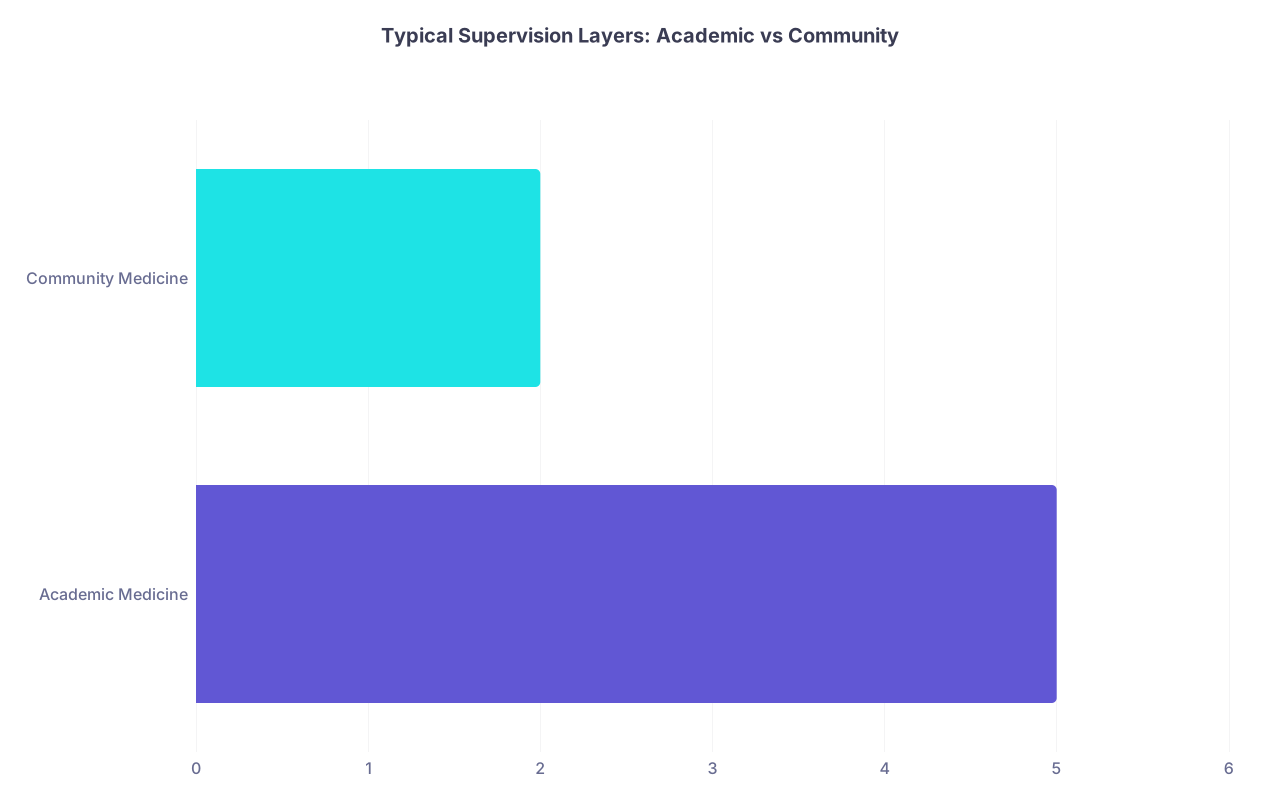
| Category | Value |
|---|---|
| Academic Medicine | 5 |
| Community Medicine | 2 |
(Think: student → intern → senior → fellow → attending vs resident → attending.)
And your actual independent decision volume over time:
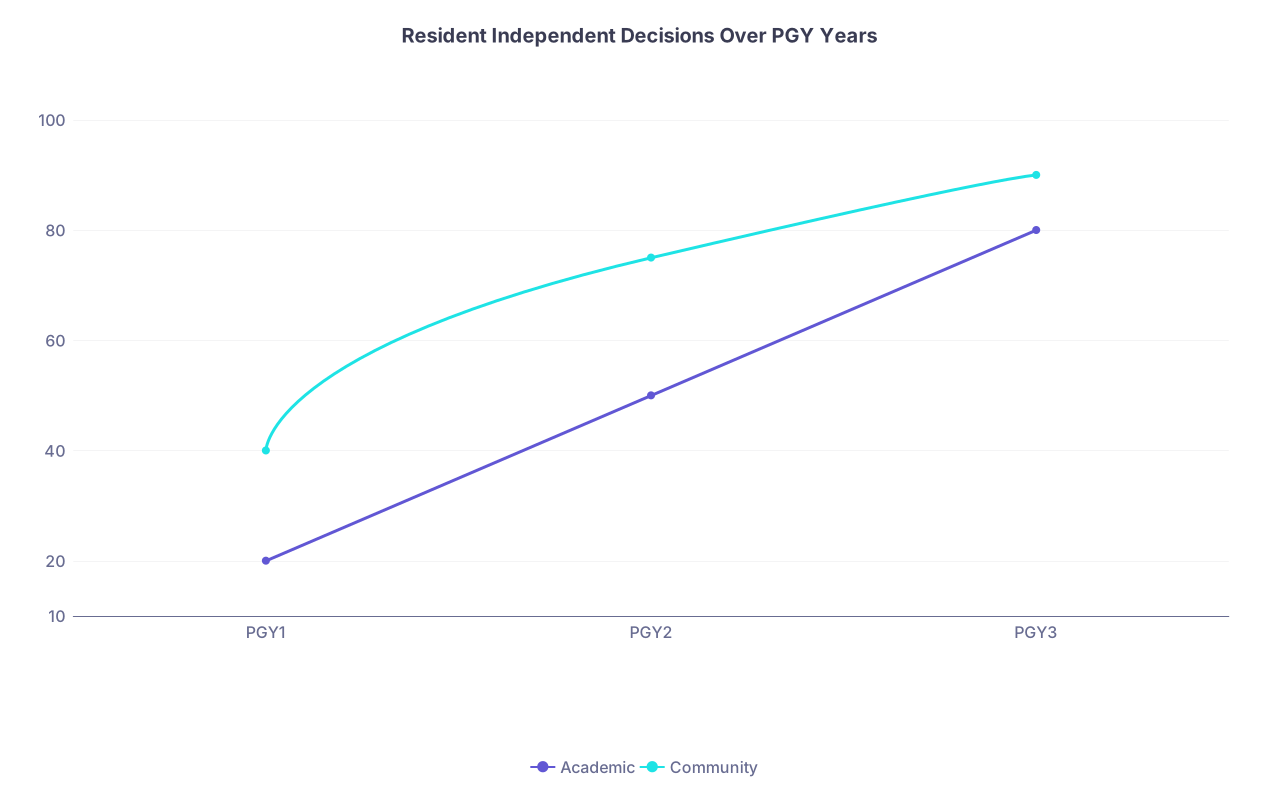
| Category | Academic | Community |
|---|---|---|
| PGY1 | 20 | 40 |
| PGY2 | 50 | 75 |
| PGY3 | 80 | 90 |
The shapes are similar. Community just tends to start higher and ramp sooner.
How to actually evaluate autonomy when you interview
Forget brochure buzzwords. Every program says “strong graduated autonomy.” Most are lying or at least stretching.
Here are the questions that cut through the fluff:
- “At 2 a.m., who is physically in-house on the ICU service? Who’s actually writing orders and running codes?”
- “Can you walk me through what a PGY-1 vs PGY-3 can do independently on nights?”
- “Who typically does central lines, intubations, and chest tubes? Residents vs fellows vs attendings?”
- “Tell me about a time a resident made a big call (transfer to ICU, take to OR, thrombolytics, etc.)—what did that process look like?”
- “Are there any services where residents feel over-supervised or under-supervised? Why?”
- “By the end of PGY-3, what do graduates feel absolutely comfortable managing alone on day one as attendings?”
Ask these separately to residents and attendings. Then compare answers. The gap tells you everything.
Red flags I’ve seen:
- Residents say, “We technically can do X, but fellows usually take over.”
- Or: “We’re on our own with no real backup. People are burned out and anxious.”
- Or attendings brag about “protected residents” to the point where you realize you won’t touch half the procedures you want.
You want a middle ground: supported but not shielded from reality.
So which gives “better” autonomy: community or academic?
Here’s my stance:
- If you want earlier, more frequent, bread-and-butter autonomy (and you’re comfortable being the person on the spot at 3 a.m.), community programs tend to deliver that better.
- If you want exposure to the sickest patients with structured backup and a bit more time before you’re truly on your own, strong academic programs can be fantastic.
- If your goal is hospitalist, general IM, EM, FM, general surgery in a typical U.S. setting, a solid community program can prepare you extremely well.
- If you’re aiming for highly competitive subspecialties or want a career in academics, you’ll often trade some early hands-on autonomy for research and complex-case exposure at academic centers.
The “right” answer depends on:
- How comfortable you are with uncertainty and being the only doc on-site.
- How much structure vs freedom you want early on.
- Your ultimate career goals (academic vs private, generalist vs subspecialist).
One thing I’ll say bluntly: plenty of residents from community programs feel more ready for independent practice than some from ultra-fellow-heavy academic giants. I’ve heard it straight from hiring groups.
Quick recap: what you should actually do with this
Don’t ask, “Community or academic for autonomy?” That’s too shallow.
Ask:
- Who really runs the service at night?
- Who owns the procedures?
- When do residents start making real decisions without someone pre-editing every thought?
- How safe do residents feel when they’re left alone? Overwhelmed or appropriately stretched?
Then pick the environment where you’ll grow the most without drowning.
FAQ (7 questions)
1. Do community programs always have more autonomy than academic programs?
No. Many do, but not always. Some community sites are heavily micromanaged, especially if the attendings are nervous about liability or not used to training residents. Some academic programs (especially at county or VA hospitals) give residents huge responsibility with attendings taking a step back.
2. Will I be less competitive for fellowship if I choose a community program for “better autonomy”?
You might be, depending on the fellowship and the specific program. Competitive subspecialties (GI, cards, heme-onc, dermatology, ortho subspecialties) care a lot about research, letters from known names, and complex case exposure. Pure community programs sometimes lag here. If fellowship is a high priority, look for hybrid or academic-affiliated community programs that still give you autonomy but have strong subspecialty exposure and research options.
3. Is more autonomy always better for my training?
No. Too much autonomy too early, with poor supervision, is dangerous—for patients and for you. The sweet spot is “supported autonomy”: you make real decisions, but there’s a safety net and feedback. If residents look chronically overwhelmed or burned out, that’s a warning sign the program leans too hard on resident independence without enough teaching.
4. How can I tell if fellows will limit my autonomy at an academic program?
Ask directly: “On your service, who usually does [central lines/intubations/specific procedures]? Fellows or residents?” And, “On call, do fellows take over or do they coach residents through decisions?” If residents say, “We rarely get to do X because the fellows need their numbers,” believe them. If they say fellows mainly teach and escalate only the hardest cases, that’s a better balance.
5. Does autonomy differ a lot between specialties or just by program type?
Both. Surgery, EM, and FM often give earlier procedural and decision-making autonomy across the board. Some internal medicine programs (especially at big-name academic centers) are more conservative. Within the same hospital, you can have a surgical program with huge autonomy and an IM program that’s tightly supervised. Always ask specialty-specific questions, not just generic ones.
6. Are VA and county hospitals more like community or academic for autonomy?
They’re hybrids. VA and county sites often align academically but function more like high-autonomy community settings: fewer fellows, high resident responsibility, attendings who are used to letting residents run the show. Many academic programs rely on their VA or county rotations to give residents their most independent experiences.
7. What’s the one question I should ask on interview day to gauge real autonomy?
Ask a senior resident: “Think about your last night on call where something serious happened—ICU transfer, unexpected crash, major decision. Walk me through exactly what you did, who you called, and who ultimately made the decision.” Their story will tell you more about real autonomy than any slide deck or mission statement.