You’re sitting in a community hospital workroom at 10:45 p.m., finishing notes on your fifth admission. Your co-intern just said, “Bro, I don’t think our PD cares about research. We’re a community program. It doesn’t matter here.”
An hour earlier, your medical school friend at a big-name academic center texted you a screenshot: “Mandatory scholarly product by PGY-3 or you don’t graduate.” Their program just sent out the annual “reminder” email about research expectations, complete with thinly veiled threats.
Same residency phase. Completely different world.
Everyone talks about “research opportunities” in community vs academic residencies. That’s the brochure language. What nobody tells you is how the politics of research actually drive promotions, fellowships, PD behavior, and how you’ll be labeled the second you walk in the door.
Let’s pull the curtain back.
The Unspoken Hierarchy: How PDs Really View Research
Here’s the part most applicants never hear: program directors do not all value research the same way—and they absolutely judge you based on how they value it, not how you do.
There’s a hidden three-tier system I’ve heard program directors use behind closed doors—community and academic both.
| PD Type | Core Priority | Typical Program Type |
|---|---|---|
| Grant Chaser | Publications, funding | Academic |
| Prestige Balancer | Mix of service/research | Hybrid/University |
| Workhorse Builder | Clinical productivity | Community |
Of course, real humans are more nuanced, but this is close enough to reality for you to make decisions.
The Academic “Grant Chaser”
These are the academic PDs who live and die by PubMed and grant cycles. They know their h-index. They know yours if you have one. They talk about “our research portfolio” like it’s their retirement plan.
What they’re actually judged on by their chair: publications, grant dollars, name recognition, fellowship match.
So when they read your ERAS:
- Your first-author paper in a mid-tier journal? They notice.
- Your “poster at local QI fair”? That’s background noise.
- Your lack of research? They’ll spin it in committee as: “Well, they might be fine for a clinical track, but probably not one of our research stars.”
They won’t say “no research = red flag” in public. In private, I’ve heard: “We’re not building a county program here. We need residents who will keep our output up.”
That’s the politics. Their job security is tied to your output.
The Hybrid “Prestige Balancer”
Think university-affiliated community hospitals or mid-tier academic centers. They’re trying to look academic enough to impress the dean and community-focused enough to fill service needs.
These PDs play both sides. I’ve heard lines like:
- “We don’t require research, but we strongly encourage scholarly activity.”
- Translation: “If you’re fellowship-bound, we expect something semi-real. If you’re career hospitalist, we won’t bother you as long as you work hard.”
In rank meetings, they’ll say, “This applicant has no research, but strong clinical evals and good Step scores. They’ll be a solid workhorse.” And that is not an insult in that room. That’s a role they need filled.
But if you show up saying “I want cardiology at a top-20,” their internal bar for you changes instantly. Now your lack of prior research isn’t “fine”—it’s “concerning.”
The Community “Workhorse Builder”
These are the true community programs. No med school attached. Minimal protected time. The chair’s priority is covering service lines and keeping length-of-stay down.
Official message: “Research is available for interested residents.”
Unofficial message in PD meetings: “We need people who won’t complain about call, won’t make noise about ACGME minutiae, and won’t disappear to ‘work on a paper’ when the ED is full.”
I’ve literally heard at a community program selection meeting:
- “This guy has 14 abstracts. Is he going to be happy here?”
- Followed by, “He’ll just be frustrated with our resources. I’d rather take the nurse who went to med school and will grind.”
If you’re research-heavy and applying to community programs, understand this: some PDs will quietly downrank you because they assume you’ll either leave, be miserable, or demand things they don’t have.
The Real Difference: Not Whether Research Exists, But Who Pays the Price
People think the difference between community vs academic is binary: research or no research. That’s wrong.
The real difference is who eats the cost of research.
In academic programs, the system is built so that:
- Faculty get promotion points for your project.
- Department gets prestige for publications.
- Residents get fellowships.
So the cost of your time is somewhat “shared.” There’s infrastructure: statisticians, IRB office, maybe a research coordinator, sometimes a dedicated “resident research day” where you get coverage.
Does it always work smoothly? Of course not. But the system at least pretends to support it.
In community programs, your time is the only real currency. There is no culture of blocked research months in many of these places. When you vanish to “work on a project,” someone else gets hit with an extra admission.
And everyone knows it.
I’ve seen this play out dozens of times: PGY-2 at a busy community IM program trying to do a retrospective chart review. No dedicated research month. Tries to do it nights and weekends. Gets crushed by 80-hour weeks.
Eventually, they stop. Or they cut corners. Or they burn out.
The PD shrugs and says, “See, this is why we don’t push research.” The faculty member says, “I don’t have time to babysit a resident through data cleaning. I have my own clinic.”
Nobody says this on interview day. But it’s how the politics shake out.
Interview Season: What You Say About Research Gets Weaponized
Let me walk you through the part you never hear: how your “I love research” answer plays when you walk out of the interview room.
At an academic program, if you say:
“I’m very interested in pursuing research in hem-onc and ideally a fellowship at a place like MD Anderson. I’ve done a couple of projects but want more mentorship and protected time.”
What the PD and interviewers hear: “Good. Ambitious. Fellowship-bound. Might help our match statistics and publishing.”
Then the question is: do they believe you’re capable? They’ll comb your application: number of pubs, seriousness of projects, any ongoing work. The politics is about potential output, not just interest.
At a true community program, if you say the same thing, I’ve watched the facial micro-reactions:
- Slight eyebrow raise.
- Quick glance at your CV.
- Subtle, “We do have some opportunities, but our focus is primarily strong clinical training.”
Then the discussion after you leave sounds like:
- “Are we just a backup for this applicant?”
- “Will they bad-mouth us if they don’t match hem-onc?”
- “We don’t have MD Anderson-level research. He’s going to be disappointed.”
If the program is already worried about resident morale, they’ll soft-block you. They don’t want the intern rallying others to complain that “we don’t do enough research.”
Flip side: if you go to an academic place and say, “Honestly I’m not that interested in research, I just want to be a solid clinician,” I’ve heard the post-interview comments:
- “Nice person, but might not elevate the academic profile.”
- “Fine for service, but not one of our top academic recruits.”
You’re slotted instantly.
That’s the hidden politics. Research interest is not neutral. It signals your likely role in the system, and they judge you accordingly.
How Research Really Affects Fellowship from Each Type of Program
Here’s the part applicants misjudge badly: the path to competitive fellowship from community vs academic—and how research interacts with it.
From Academic Programs
Fellowship PDs know academic programs. They know which programs have built-in research tracks, formal mentorship, and a culture of publishing.
When they see you from an academic program with weak or no research, they often think:
- “This resident had every resource and still has nothing to show.”
- “This may be a motivation or follow-through problem, not an access problem.”
Harsh? Yes. But I’ve sat in those rooms.
On the other hand, if you have solid research in your field (even if not groundbreaking), the academic name plus your output is a powerful combination. It ticks the mental box of “ready to be a fellow who can contribute to division output.”
From Community Programs
Fellowship PDs have a very different lens. Many of them actually like applicants from strong clinical community programs. But they immediately ask: “How did they get research done there?”
If they see:
- A couple of posters and maybe one publication, especially with community attendings,
- Plus strong letters saying you drove the project independently,
they respect that more than you think. The narrative becomes: “This person created opportunities in a resource-poor environment.”
But here’s the twist: if you apply from a community program with zero research and want something competitive (cards, GI, hem-onc), the assumption becomes:
- Either you didn’t care enough to find something.
- Or your PD/department truly has zero infrastructure, which raises another red flag: how much do they know about training you for that specialty at all?
For ultra-competitive fellowships (GI, cards, heme-onc, PCCM in hot markets), research from a community program doesn’t have to be fancy—but it has to exist.
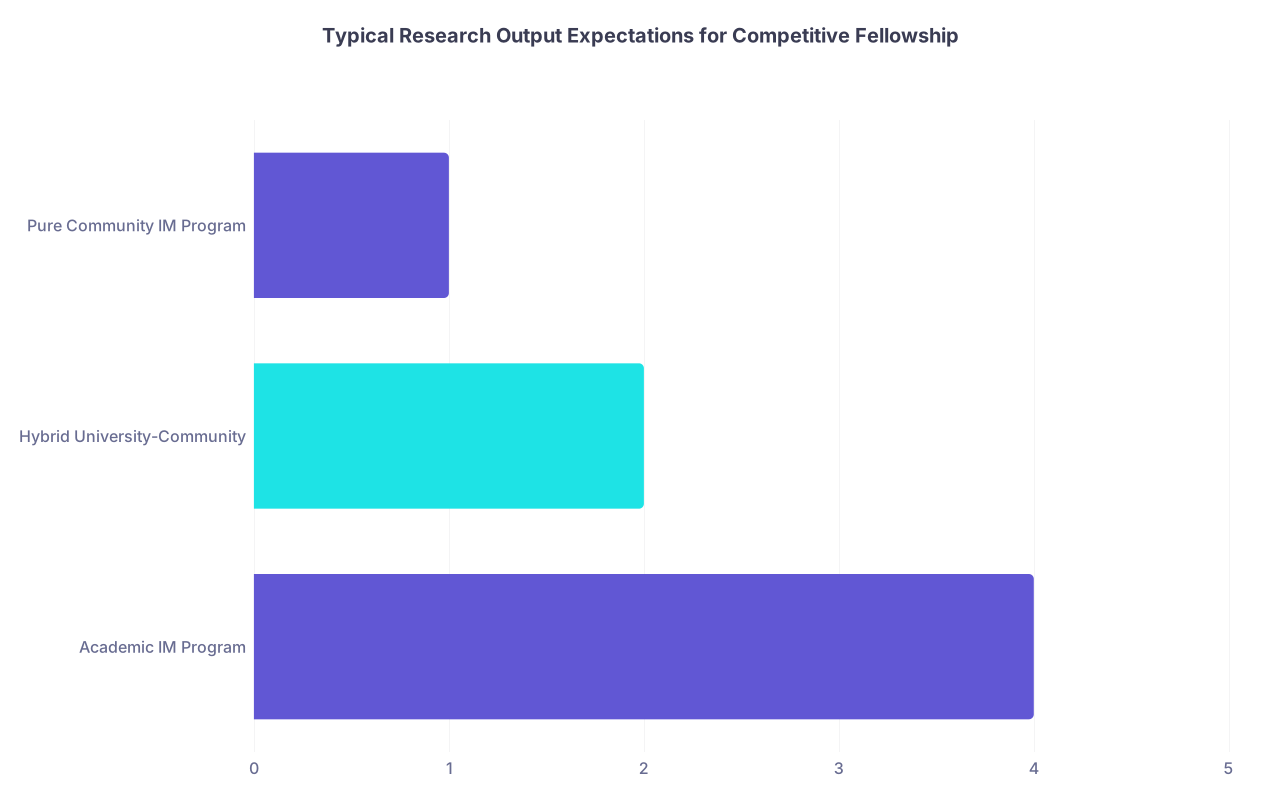
| Category | Value |
|---|---|
| Academic IM Program | 4 |
| Hybrid University-Community | 2 |
| Pure Community IM Program | 1 |
Those numbers aren’t published anywhere. But that’s the mental math I’ve heard in more than one fellowship selection meeting.
The Ugly Secret: Ghostwriting, Token Authorship, and “CV Padding”
Let me tell you what really happens inside some academic departments.
When promotion and funding are tied to “number of resident scholarly products,” people start playing games.
I’ve seen:
- Residents listed as middle authors on papers where their only contribution was “attended a couple of meetings” because the department needed to show “resident involvement.”
- Attendings recycle old datasets three, four, five times with different angles, just to churn out more abstracts.
- “Mandatory research rotation” that consists of residents copying data into a spreadsheet for a project they didn’t design and will never present.
On the resident side, I’ve heard the private comments over lunch:
- “Honestly, I just need my name on two papers so I can apply to GI, I don’t care what the project is.”
- “I wrote the abstract, the fellow wrote the paper, my name is on it. Good enough.”
This is the politics no program advertises: the system pushes quantity. You’re told to chase outputs. The line between genuine scholarship and CV padding gets blurry fast.
Community programs have their own version. A PD or APD feels pressure to show “scholarly activity” for accreditation. Suddenly every half-baked QI initiative becomes a “project,” every poster at a hospital fair morphs into “regional presentation.”
I’ve literally been asked, “Can we count this morbidity and mortality presentation as research for ACGME purposes?” with a straight face.
Understand what this means for you: not all “research experience” is equal. Fellowship PDs know which programs treat research seriously and which programs just do it to satisfy checkboxes.
They look at who you worked with, what you did, and where it ended up.
If all your “research” is poster abstracts at your own hospital QI day, and you’re applying to a top cards fellowship, that doesn’t carry the same weight as a small but real retrospective study that got into a modest peer-reviewed journal.
Even if both say “Research” on ERAS.
How to Read Between the Lines on Interview Day
You’re not powerless in this. The way programs talk about research on interview day tells you more than you think.
Pay attention to:
- Who brings up research first.
- How concrete they get.
- Whether anyone names actual residents and what they did.
If a program says, “We have lots of research opportunities,” but can’t name a single ongoing project or recent grad who matched a research-heavy fellowship, you already have your answer.
If an academic program boasts “80% of our residents present research,” ask:
- “Can you tell me about the projects of a couple of recent residents who went into my intended field?”
If the answer is vague fluff, you’re looking at a place that’s gaming the numbers.
At community programs, ask very specifically:
- “If I wanted to do a retrospective study in X and try to get it to publication, what practical supports are there—statistical help, IRB, protected time?”
If they say “Oh, we can figure something out,” that usually means “You’re on your own.”
Places that actually support research—from either side of the community/academic divide—will give you concrete examples.
The Politics of Saying “Research Isn’t My Priority”
There’s another side of this that people don’t talk about: what if you genuinely don’t care about research?
You want to be a community doc. Or a hospitalist. Or maybe do a less research-heavy fellowship like rheum at a regional place.
Here’s the truth:
At a true community program, saying, “I’m not very research-oriented; I care more about strong clinical training and maybe some QI,” is not a problem. In some rooms, it’s a relief. They see you as low drama and likely to stay in their ecosystem.
At a top academic program, that same line can quietly cap your ceiling. You might still match there if your scores and letters are strong, but don’t kid yourself: you’ll be slotted as a service workhorse unless you change your tune and show productivity.
Hybrid programs will judge you based on what niche they need filled. If they’re low on fellowship match stats that year, they’ll favor research-hungry applicants. If they’re drowning in service demands, they’ll favor the “solid clinician” line.
So what should you do?
Be honest with yourself first, not them.
If you want a research-driven career or a top-tier competitive fellowship, leaning into research during interview season at academic places makes sense. If you absolutely don’t, leaning into it just to impress them will backfire when they expect you to produce and you’re miserable.
The politics are simple: every program wants you to fit their unspoken needs. They just won’t tell you what those needs are explicitly.
Strategic Moves: Matching Your Research Story to the Right Program Type
Let’s put this together into actual strategy.
If you’re research-heavy and applying mostly academic:
- Do not pretend you “don’t care that much about research” to look “humble.” You’ll confuse them.
- Tie your past projects clearly to your future goals: “I did X, Y, Z in med school, and in residency I’d like to build on that by doing A and B with your hepatology group.”
- Show you understand the grind, not just the glory: “I’ve done the IRB slog and data cleaning; I know research isn’t glamorous, but it’s satisfying when it builds to something real.”
If you’re research-heavy but applying to some community programs (as realistic backups):
- Tone down the “I want to be a physician-scientist at a top-5 academic center” rhetoric at true community interview days. That screams flight risk.
- Instead: “I value research and may want to stay somewhat involved, especially with QI or retrospective work, but my primary priority is strong clinical training.”
- Reassure them you won’t be whining about lack of NIH cores. They do not want that energy.
If you’re light on research but aiming for competitive fellowships:
- From an academic program: aggressively use your residency to build real projects, not just “posters.” Attach yourself to attendings who publish, not just talk about publishing.
- From a community program: you need at least 1–2 legitimate, presentable things by PGY-2. That might mean hustling in your limited free time. Is it fair? No. But it’s reality.
If you truly don’t care about research and never will:
- You’ll probably be happier in a strong community or hybrid program that doesn’t pretend to be a mini-Harvard.
- But choose carefully: some “academic” places will work you to the bone on pure service while still expecting performative research. Worst of all worlds.
One Last Piece: The Quiet Label That Follows You
Inside departments there’s an unspoken labeling that happens early:
- “This one is research track.”
- “This one is a clinician-educator type.”
- “This one will be our future chief/hospitalist.”
- “This one will probably go home and do primary care.”
Those labels start your PGY-1 year. And your behavior around research—especially at academic programs—feeds into that pipeline.
You don’t have to accept the label they want to slap on you, but you do have to know it exists. Research is one of the strongest signals they use.
In community programs, those labels are more about work ethic, reliability, and whether you’re “fellowship material” or “stay in town material.” But research—even if minimal—often becomes the deciding factor when they argue your case to an outside fellowship.
I’ve watched a community PD tell a cards PD on the phone:
“Look, we’re not a research-heavy place, but she started and finished a decent retrospective project with one of our cardiologists. We published it in a smaller journal. That took real initiative here.”
That line carried more weight than you’d think. Because the politics cut both ways—fellowship PDs also know who’s fighting an uphill battle.

| Step | Description |
|---|---|
| Step 1 | MS4 Applicant |
| Step 2 | Research Expectations High |
| Step 3 | Mixed Priorities |
| Step 4 | Clinical Focus |
| Step 5 | Research Label |
| Step 6 | Clinician Label |
| Step 7 | Fellowship Advantage |
| Step 8 | Local Career Focus |
| Step 9 | Program Type |
| Step 10 | Resident Interest |
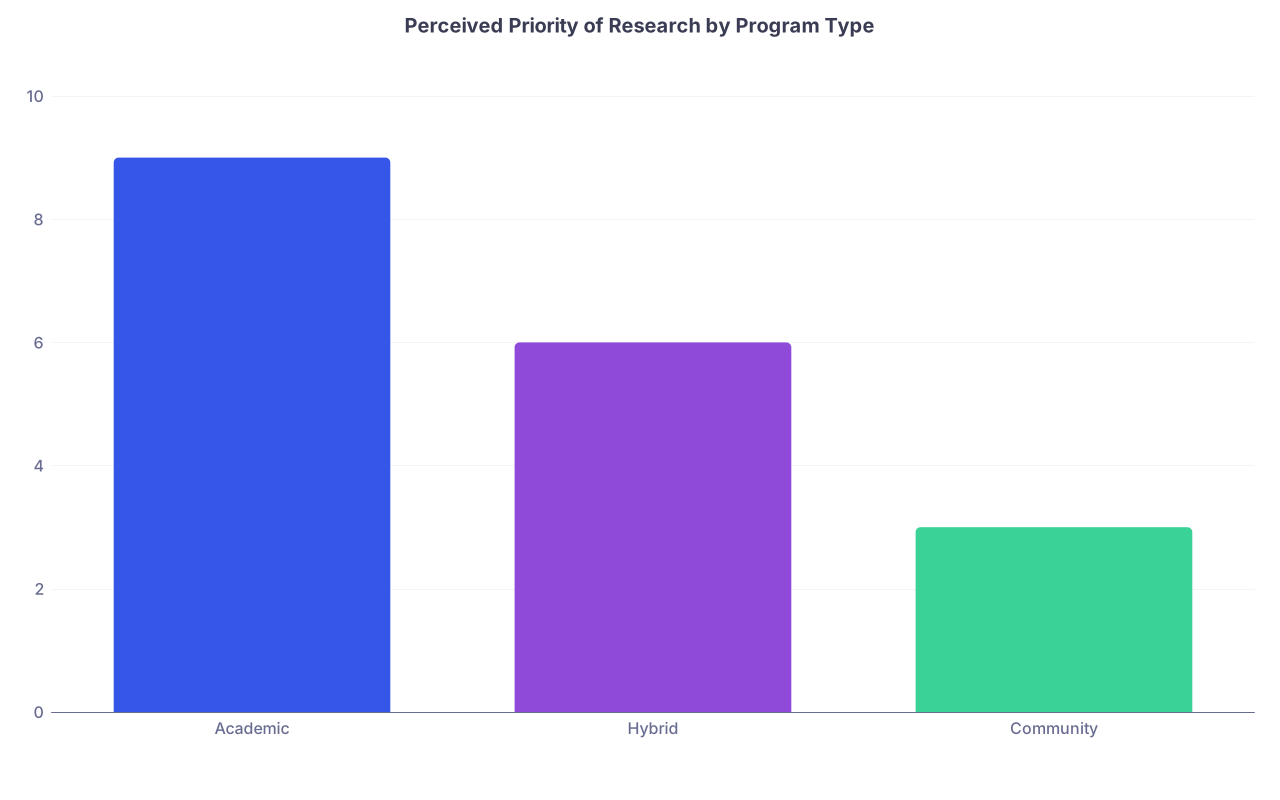
| Category | Value |
|---|---|
| Academic | 9 |
| Hybrid | 6 |
| Community | 3 |
With all that in mind, here’s where you are in your journey.
You’re about to hit submit on ERAS—or you’re about to start choosing which interview invites to accept. You’re staring at community vs academic, reading the same bland lines about “ample research opportunities” on every website, and trying to guess who’s lying.
Now you know what’s actually going on behind those phrases.
The next step is choosing programs that match who you are and who you realistically want to become. Then, once you’re in a residency, playing the research game—hardcore, minimal, or not at all—in a way that serves your goals instead of the institution’s metrics.
That’s the next chapter: how to use your first 6–12 months of residency to either build a real research track or get yourself off the hook without burning bridges. But that’s a story for another day.