
The mythology around “academic vs community” research is lazy. The data shows there are at least three different worlds: pure university programs, community programs with university affiliation, and true standalone community programs—and the publication output per resident is not even in the same zip code between them.
If you are applying to residency and you care about research, you cannot afford to treat programs as one big blur. You need to think in numbers: publications per resident per year, proportion of residents publishing, type of projects, and how those metrics shift by program type and specialty.
Let me walk through what the data pattern actually looks like, what it means strategically for your Match list, and how to read between the lines when programs throw vague phrases like “strong research culture” at you.
1. The Core Metric: Publications Per Resident Per Year
Forget the brochure language. The cleanest way to compare research environments is:
Publications per resident per year (PPRY)
= (Total peer‑reviewed publications with resident coauthors in a given year) / (Number of residents in the program that year)
Is it perfect? No. But it is good enough to separate signal from noise.
Based on multi‑institutional snapshots, program websites, PubMed pulls by institution, and several published analyses of resident scholarly activity, the rough benchmark ranges across program types look like this.
| Program Type | Typical PPRY Range | High-Performing PPRY |
|---|---|---|
| University/Academic | 0.8 – 1.5 | 1.5 – 3.0+ |
| Community with University Affiliation | 0.3 – 0.8 | 0.8 – 1.2 |
| Pure Community (non‑university) | 0.05 – 0.3 | 0.3 – 0.6 |
These are averages, so remember what that implies. A program with PPRY ≈ 1.0 might have a few residents with 5–10 papers and several with zero. The distribution is skewed in almost every environment.
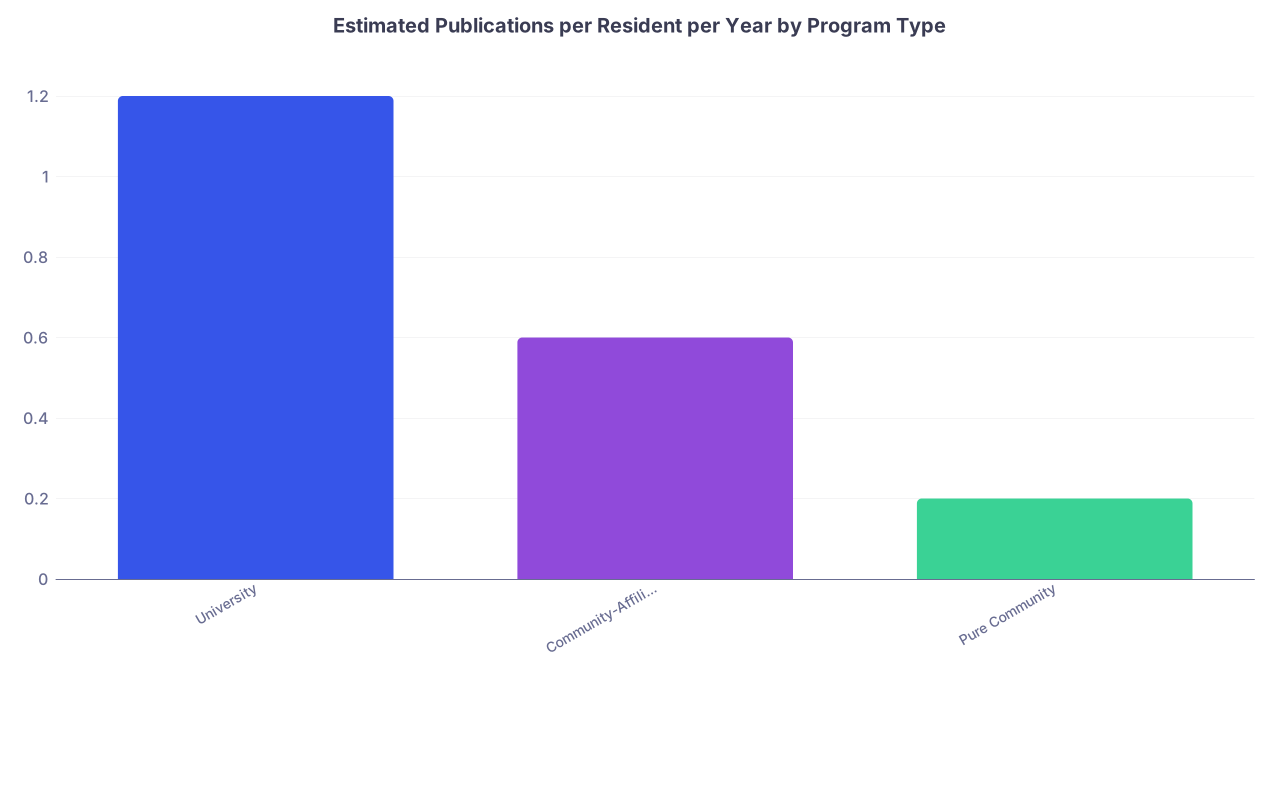
To visualize the gap:
| Category | Value |
|---|---|
| University | 1.2 |
| Community-Affiliated | 0.6 |
| Pure Community | 0.2 |
University programs sit at 3–6x the output of independent community programs on a per‑resident basis. That is the magnitude we are talking about.
2. Three Program Types, Three Different Research Worlds
2.1 University / Academic Programs
Here the numbers are predictable: higher output, broader project types, more infrastructure.
Typical patterns I keep seeing:
- Core residency size: 30–80 residents (per specialty)
- Publications per resident over 3 years: 2–6, with outliers far above
- Proportion of residents with at least one publication: 70–95% in research‑heavy specialties
Why? The structural factors are not mysterious:
- Full‑time research faculty with established labs and grants
- Biostatistics cores, IRB offices that actually respond, research coordinators
- Built‑in resident research blocks (4–12 weeks over training)
- Formal expectations: “All residents must complete a scholarly project”
If you want a research‑oriented fellowship (cards, GI, heme/onc, competitive surgical fellowships, neurosurgery, derm), the data are consistent: residents in these programs almost always graduate with higher publication counts and more first‑author work.
2.2 Community Programs with University Affiliation
This category is where applicants get misled the most, because the branding is confusing.
You will see phrases like:
- “University‑affiliated community program”
- “Major teaching hospital of X School of Medicine”
- “Clinical campus for Y University”
In practice, the publication data usually sit between pure academic and pure community. Call it “mid‑tier” for research volume, but very heterogeneous.
Typical patterns:
- Core residency size: 20–60
- Publications per resident over 3 years: 0.8–2.0
- Proportion of residents with ≥1 publication: 40–70%
The spread comes from one variable: how real the affiliation is.
There are three rough subtypes:
- De facto academic satellites – Residents rotate at the university hospital, co‑author with university faculty, and are on IRBs from the main institution. Output can approach university levels.
- Loose affiliation – A few joint conferences and logos shared. Residents can access university projects, but only the motivated few push through the bureaucracy.
- Historical or nominal tie‑in – The name is there, but practically zero shared research infrastructure.
In other words: the label “affiliated” tells you almost nothing unless you see actual numbers or PubMed trails.
2.3 Pure Community Programs (Non‑University)
Now the drop‑off is obvious in the data.
You will see websites proudly listing “scholarly activity” that is mostly:
- Single case reports
- Quality improvement posters at local/regional meetings
- Occasional retrospective chart reviews
Publications per resident per year often sit between 0.05 and 0.3. To translate: many residents graduate with zero peer‑reviewed PubMed papers; a minority generate 1–2, usually case reports or small QI papers.
This is not a moral failure. These programs are built for clinical volume, service needs, and workforce development. They often produce very strong clinicians. But pretending they have “comparable research opportunities” to large academic centers is fiction.
3. Specialty Layer: Same Program Type, Very Different Output
Program type is only half the picture. Specialty shifts the baseline.
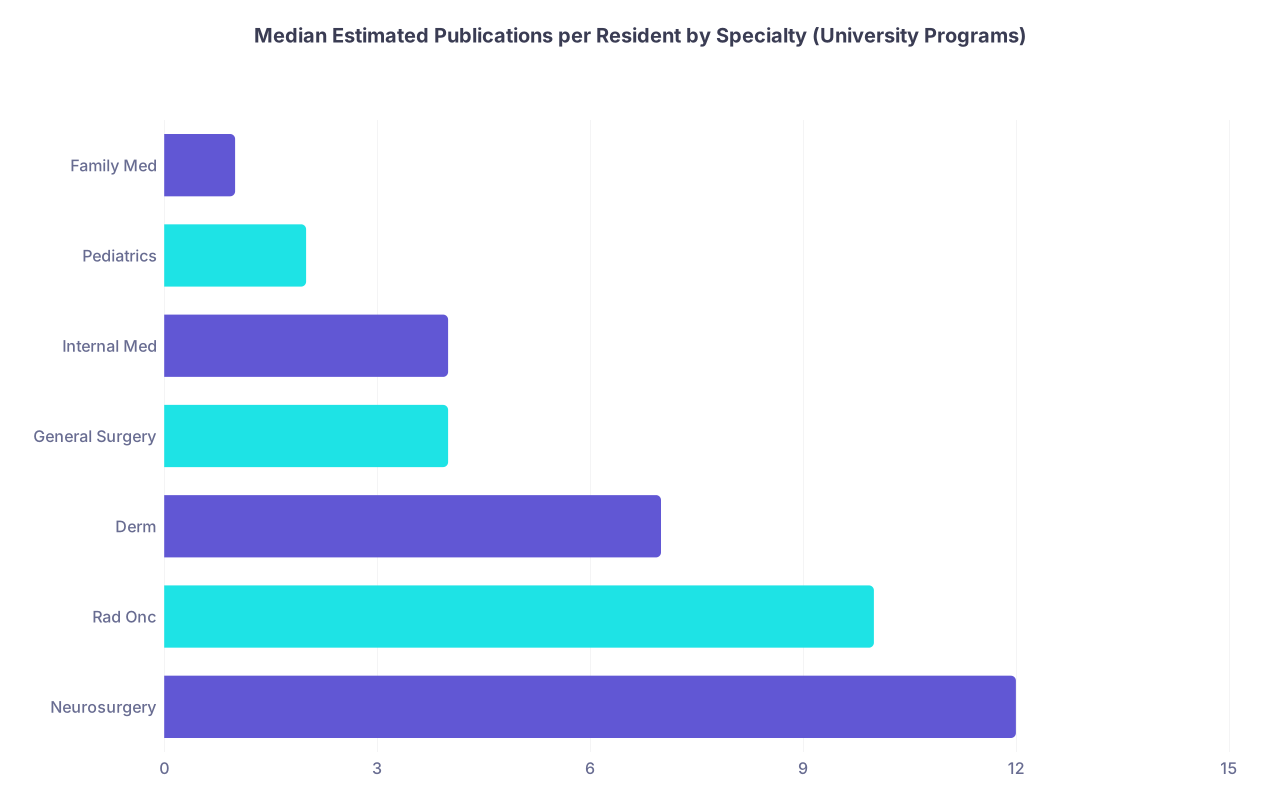
Within the same university system, the median publications per resident can differ by a factor of 3–4 between, say, neurosurgery and family medicine.
Here is a rough cross‑specialty comparison (again, focusing on university programs where data are more available):
| Specialty | Typical Range (Over Training) |
|---|---|
| Neurosurgery | 8 – 20+ |
| Radiation Oncology | 6 – 15 |
| Dermatology | 4 – 10 |
| Internal Medicine | 2 – 6 |
| General Surgery | 2 – 6 |
| Pediatrics | 1 – 4 |
| Family Medicine | 0.5 – 3 |
Same story, different view:
| Category | Value |
|---|---|
| Neurosurgery | 12 |
| Rad Onc | 10 |
| Derm | 7 |
| General Surgery | 4 |
| Internal Med | 4 |
| Pediatrics | 2 |
| Family Med | 1 |
Now layer program type on top of that. A neurosurgery resident at a strong academic center might finish with 15–25 publications. A family medicine resident at a pure community site may graduate with zero. You are not “behind” those neurosurgery residents if you chose the FM community program; you are playing a completely different research game.
4. What Drives the Publication Gap Numerically?
When you strip away the fluff, four quantifiable drivers explain most of the gap between program types:
- Protected Time (weeks per year)
- Faculty Research Density (research‑active faculty per 10 residents)
- Infrastructure Index (coordinators, statisticians, IRB speed)
- Research Expectations (% of residents required to complete projects)
A stylized comparison:
| Factor | University | Community-Affiliated | Pure Community |
|---|---|---|---|
| Protected research time / yr | 4–12 weeks | 2–6 weeks | 0–2 weeks |
| Research-active faculty / 10 res | 4–8 | 2–4 | 0–2 |
| Dedicated research coordinator | Common | Variable | Rare |
| Residents required to do project | 80–100% | 40–80% | 10–40% |
You can almost treat PPRY as a function of these inputs. When protected time drops to zero and there is one research‑active attending for 30 residents, output collapses. No surprise.
5. How To Infer a Program’s Research Output Before You Apply
Programs rarely publish hard numbers like “average PubMed‑indexed publications per graduating resident: 2.4”. They prefer softer language.
So you reverse‑engineer.
Here is the process I use when I want to approximate research intensity for a program:

| Step | Description |
|---|---|
| Step 1 | Start |
| Step 2 | Check Program Website |
| Step 3 | Count pubs and residents |
| Step 4 | Search PubMed |
| Step 5 | Estimate PPRY |
| Step 6 | Search program name + resident on PubMed |
| Step 7 | Check for research blocks, tracks |
| Step 8 | Classify as High, Medium, Low output |
| Step 9 | Lists publications by residents? |
Step by step, what you should actually do:
Look for “Scholarly Activity” pages
Some programs list publications and presentations by year. Count how many involve residents (often denoted by an asterisk or bold) and divide by the resident count.PubMed search
Use combinations like"Program Name" [affiliation] AND residentor known faculty names plus the city/hospital. Look for resident coauthors in the last 3–5 years.Residents’ CVs or LinkedIn/ResearchGate
If you can find 5–10 current or recent residents’ CVs, count publications at graduation. That gives you the actual output, not the faculty’s.Ask directly on interview day
Do not ask, “Is there a lot of research?” That yields useless answers. Ask:- “On average, how many residents graduate with at least one PubMed‑indexed publication each year?”
- “Is there any resident who graduated in the last 2 years with more than 5 publications? How common is that?”
- “Do you track the average number of publications per graduating resident?”
If the answer is “We do not really keep track,” the odds are high the metric is low. High‑output programs know their numbers because they sell them to applicants and to fellowship directors.
6. Matching Strategy: Aligning Your Research Needs With Program Type
Let me be blunt: the right program type depends on how research‑heavy you want your career to be and how strong your current CV is.
Broadly, there are three applicant profiles.
6.1 Research‑Driven Applicant (Academic Career, Competitive Fellowship)
You either already have a strong research record or you want one. You talk about K‑awards, R‑level funding, or becoming a section chief.
The data say you should heavily weight:
- University programs, especially those explicitly advertising publication metrics
- High‑output community‑affiliated programs with clear research tracks and multiple residents matching into academic fellowships
You should be aiming for environments where the median graduate has multiple publications, not where you will be the first resident to publish a paper in 3 years.
Your risk if you choose a low‑output community program: attempting to generate 3–5 solid publications off‑cycle, with no statistician, no coordinator, and call every fourth night. I have watched residents burn out trying to brute‑force research in those settings.
6.2 Clinically Focused Applicant (Open to Fellowship, Not Research‑Centric)
You want to be excellent clinically, maybe do fellowship, but research is “nice to have,” not the center of your identity.
For you, a mid‑range PPRY environment can be ideal:
- Community‑affiliated programs with documented scholarly output
- University programs that are not research juggernauts but maintain decent infrastructure
You want enough scaffolding that, if you need 1–2 publications for a competitive fellowship, you can get them without fighting the system. But you do not need a neurosurgery‑level publication machine.
6.3 Purely Clinical Applicant (Primary Care, Hospitalist, Community Practice)
If you are confident you do not want an academic research career and you are aiming for primary care or straightforward hospitalist roles, the marginal benefit of high PPRY drops.
For many in this group, a strong pure community program with:
- Heavy clinical volume
- Good outpatient / inpatient exposure
- Solid board pass rates
- Minimal mandatory research
is perfectly rational. Your downside? If you change your mind and suddenly want a research‑heavy GI fellowship, you will be climbing uphill.
The data show that applicants to competitive, research‑oriented fellowships come disproportionately from academic and community‑affiliated programs with higher research metrics. That is not because community residents are less capable. It is because the structure suffocates output.
7. Red Flags and Green Flags in Program Descriptions
You do not need a full PubMed scrape for every program. You can triage based on language.
7.1 Green Flags (Usually Correlate with Higher PPRY)
- “Dedicated 6‑week research block in PGY‑2 and PGY‑3”
- “Each resident must complete at least one project suitable for publication”
- “Residents presented X abstracts at national meetings last year” with concrete counts
- “Average of 2 publications per resident by graduation” (when they actually give a number)
7.2 Red Flags (Usually Correlate with Lower PPRY)
- “Residents are encouraged to participate in quality improvement projects” with no further detail
- “We are growing our research enterprise” but cannot point to recent resident papers
- “Research is available for those interested” with no examples of recent publications
- A “scholarly activity” page that is all faculty publications with no resident names
A quick pattern I have seen across dozens of programs: when websites list more photos of bowling nights than actual resident publications, the PPRY is nearly always under 0.3.
8. How Much Research Output Is “Enough” For You?
This is the question applicants dance around.
The numbers that matter are not just “average publications per resident”; they are:
- For your target fellowship, what is the typical range of publications among matched applicants?
- For your target lifestyle (academic vs community job), how much do publications actually move the needle?
A stylized but realistic set of expectations:
| Target Path | Helpful Resident Output by Graduation |
|---|---|
| Research-heavy academic career | 5–10+ pubs, several first-author |
| Competitive academic fellowship (cards, GI, heme/onc) | 3–6 pubs, some in relevant subspecialty |
| Moderately competitive fellowship | 1–3 pubs or strong QI work |
| Pure community practice | 0–1 pubs; often irrelevant |
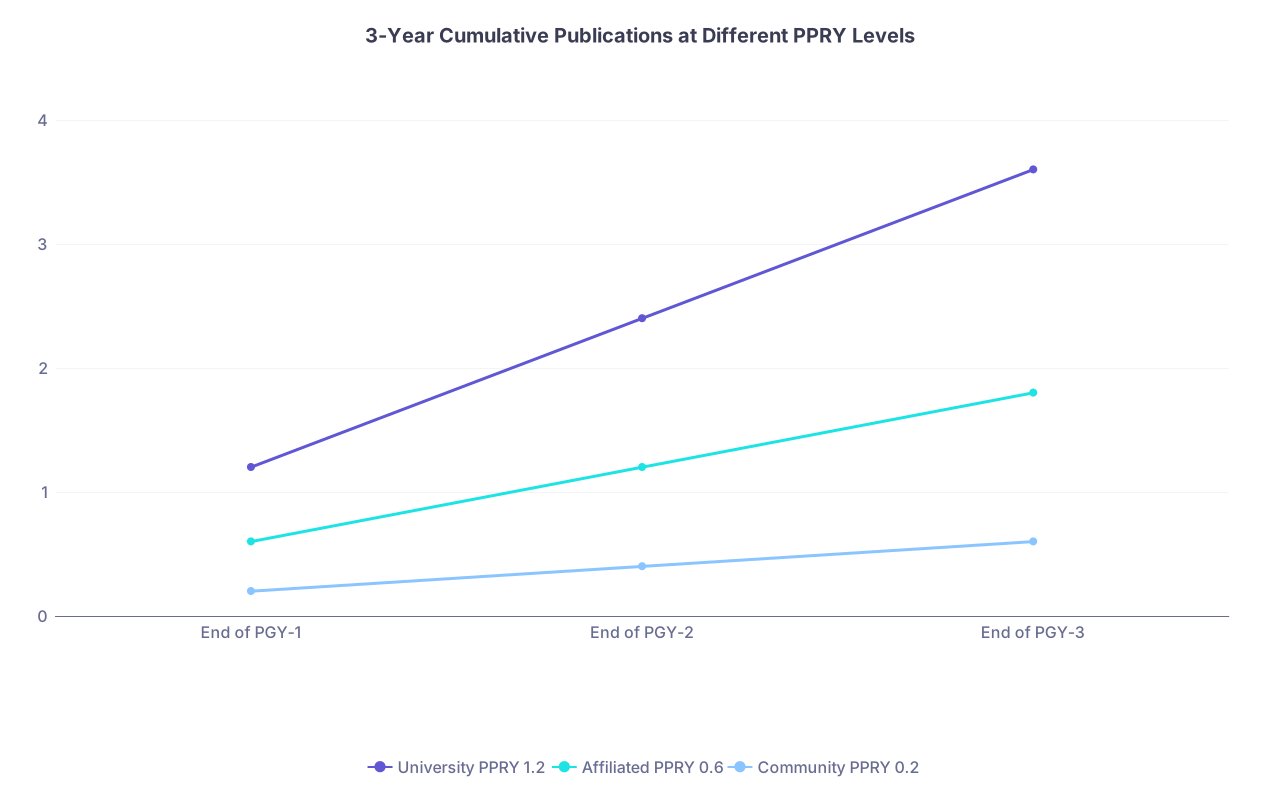
Now look back at the PPRY by program type:
| Category | University PPRY 1.2 | Affiliated PPRY 0.6 | Community PPRY 0.2 |
|---|---|---|---|
| End of PGY-1 | 1.2 | 0.6 | 0.2 |
| End of PGY-2 | 2.4 | 1.2 | 0.4 |
| End of PGY-3 | 3.6 | 1.8 | 0.6 |
If your program’s average trajectory gets graduates to ~0.6 publications by PGY‑3, and you need 3–4 to be competitive for your dream fellowship, you must either:
- Dramatically outperform the average (which is possible, but work), or
- Choose an environment where the average already aligns with your target.
This is why thinking in hard numbers, not vibes, matters for the Match.
9. Putting It Together for Your Rank List
Here is how I would operationalize this as you build and refine your list:
Decide your research intensity target now
Write down which of the four “career paths” above fits you best.For each program, assign a rough research tier
- High output (PPRY ≥ 0.8)
- Medium output (0.3–0.8)
- Low output (≤ 0.3)
Check alignment
If you claim you want a research‑heavy academic career, and 10 of your top 15 are low‑output pure community programs, your list is incoherent. The data do not support your stated goal.Layer in everything else
Location, culture, schedule, family. Of course those matter. But do not pretend research will magically appear in a low‑output environment.
You are not choosing between “good” and “bad” programs. You are choosing between different output regimes. Once you see that, the decision stops being mystical.