Most applicants comparing programs barely understand call structures—and it shows on interview day.
If you cannot clearly explain the difference between night float and 24‑hour call in a community vs academic setting, you are flying blind into residency. Call structure affects your sleep, your learning, your relationship, and whether you burn out in PGY‑2. This is not a side detail.
Let me break this down specifically.
1. The Two Big Call Archetypes: Night Float vs 24‑Hour Call
Call systems are just different ways of solving the same problem: someone has to cover nights and weekends while complying with ACGME duty hour rules and not destroying residents.
Night Float: Shift Work Disguised as “Call”
Night float = a dedicated block of nights, usually consecutive, with no daytime clinical work attached.
Common structure:
- 5–6 nights per week (often Sunday–Thursday)
- 10–14 nights in a row, sometimes 2–4 week blocks
- Start ~7 pm, end ~7 am (give or take an hour)
- Protected “post‑call” days because you are technically always “post‑call”
Core features:
- You only work at night during that rotation
- You often cover multiple teams’ cross‑cover plus new admissions
- Your circadian rhythm is wrecked for a short intense period, then you flip back
Why programs like it:
- Easy duty hour compliance
- Predictable coverage
- Day teams can focus on rounds and discharges, not getting crushed by late admits
Why residents are ambivalent:
- Night float blocks are brutal for sleep and life outside the hospital
- Educational exposure is narrower—lots of acute issues, less continuity and teaching rounds
- Some people love the autonomy and pace; others crash and burn
24‑Hour (or “Long”) Call: The Old Workhorse
Classic 24‑hour call = you work all day, stay overnight, and (if your program is sane) leave sometime the next morning.
Typical schedule:
- Day: normal work (rounds, discharges, admissions)
- Evening/Night: new admits + cross‑cover
- Next morning: sign out and leave (at 24–28 hours total, max)
Frequency:
- Q4 (every 4th night) historically; more often now Q5–Q7 in compliant programs
- Some places run “long call” that is 16–24 hours instead of a clean 24+
Core features:
- You see patients across the entire clock—morning to middle of the night
- You are wiped by the end, no matter how “resilient” you think you are
- More continuity: you admit at night and staff them the next day
Why programs like it:
- Fewer total bodies needed for coverage—one person can own a full 24‑hour period
- Old‑school attendings think it is where you “really learn medicine”
- Simpler scheduling structure for smaller hospitals
Why residents have strong feelings:
- You learn a lot, you suffer a lot
- Sleep debt accumulates
- “Post‑call days” are theoretically protected but often get eroded by sign‑out creep, discharge pressure, and “just one more thing”
2. How ACGME Duty Hours Actually Shape Call (Not Just On Paper)
Before we talk community vs academic, you need the duty hour constraints that live behind every schedule.
Key ACGME rules (for most specialties, especially IM/Gen Surg/OB):
- Max 80 hours/week averaged over 4 weeks
- Max 24 hours of continuous clinical work, plus up to 4 hours for transitions/education
- At least 8 hours off between shifts; 10+ “preferred”
- 1 day off in 7, averaged over 4 weeks
- No more q2 call, no “every other night” insanity
Programs “solve” this with different call models:
- Large academic centers: lots of residents → night float systems, multiple short calls, subspecialty night coverage
- Smaller community programs: fewer residents → more 24‑hour shifts, more cross‑coverage, more creative scheduling to hit 80‑hour average
There is no free lunch. If something looks cushy (no nights, rare weekends), there is almost always a hidden cost: heavy day census, massive clinic time, or aggressive “service vs education” trade‑offs.
3. Academic Programs: How Call Plays Out in Real Life
Academic = big university hospital, multiple fellowships, strong subspecialty presence, lots of learners (med students, NPs/PAs, other residencies).
Internal Medicine – Academic Model
Most mid‑to‑large academic IM programs now run some flavor of night float.
Typical pattern:
- Admit days: “short call” and “long call” day teams (but long call often just means later admitting, not 24 hours)
- Night float: 1–2 residents + interns covering several ward teams and sometimes step‑down
- ICU: separate night float or 24‑hour call in smaller academics
A common structure:
- Wards:
- Day teams: 6 days/week
- Night float: 2–4 week block, Sunday–Thursday nights, Friday/Saturday covered by night team or 24‑hr call
- ICU:
- Some academic programs still use 24‑hour call q4–q6 in MICU
- Others have switched to 12‑hour shifts (day/night), particularly in places with fellows and APPs
What this feels like as a resident:
- PGY‑1: You rotate through night float blocks—high call volume, more cross‑cover pages than admissions in some places. You learn to triage when 3 nurses are calling you at once.
- PGY‑2/3: You take more responsibility for admissions decisions, rapid responses, and supervising interns overnight.
Education vs service balance:
- Pro: Night float admits are staffed the next morning—daytime attending teaching can still be solid.
- Con: You rarely meet many of “your” patients during the day when you are on nights. You become good at acute stabilization, less good at continuity decision making.
General Surgery – Academic Model
General surgery is often where you still see real 24‑hour call, especially on trauma and ICU.
Common academic surgery structure:
- Wards/Consults:
- PGY‑1: Mostly day work + some night float or 24‑hour calls q4–q6
- PGY‑2/3: More ICU and trauma nights, often 24‑hour
- Trauma:
- Many Level I centers: 24‑hour in‑house trauma call (PGY‑2/3 with attending backup)
- Some larger centers: 12‑hour shifts; nights can still be crushing
- SICU:
- Mix of 24‑hour call q3–q4 vs 12‑hour shifts, depending on fellow and APP support
Why academic surg call can be painful:
- Higher acuity, more penetrating trauma, complex post‑op care
- You might be in the OR at 2 am, then in conference at 7 am
- Technically “post‑call” but you are still responsible for handoffs, notes, and sometimes cases that spill past the 24‑hour mark (yes, this still happens)
OB/GYN – Academic Model
OB/GYN programs are night heavy by nature—babies do not care about your circadian rhythm.
Common structure:
- L&D:
- 12‑hour day/night shifts or 24‑hour calls in many academic centers
- PGY‑1/2: lots of nights, frequent weekend coverage
- Gyn/Onc/REI:
- More daytime clinic/OR, fewer nights, but still q4–q7 calls
Because academics have more residents, call is “thinner” per resident across the year—but when you are on nights, the volume can be insane.
4. Community Programs: Where Coverage Pressure Really Shows
Community programs are not all the same. You have:
- Community-based academic (university-affiliated, some fellowships, robust teaching)
- Pure community (no fellows, limited subspecialty, smaller resident pool)
The main constraint: fewer residents, same 24/7 coverage requirements.
Internal Medicine – Community Programs
Pure community IM often still leans heavily on 24‑hour call, especially early in the program’s life cycle when there are only a few classes.
Common patterns:
- Wards:
- Q4–q6 24‑hour call for interns/PGY‑2s
- Night float may be only for a short stretch or limited to higher years
- Cross‑cover:
- One intern + one resident may cover almost the entire hospital’s IM patients at night
- You learn fast because you have no choice
The upside:
- Massive autonomy. You will be the person managing acute GI bleeds, DKA, new chest pain, all at 3 am.
- You get very efficient with cross‑cover and triage. There is no hiding.
The downside:
- Thin backup. Attendings may be at home and “available by phone” rather than in‑house.
- 24‑hour call plus large census = real risk of burnout if leadership is not protective.
Community-based academic IM (think “university affiliate at a large community hospital”) is usually a hybrid:
- Night float exists for wards
- ICU may still be 24‑hour or 12‑hour shifts
- Call is lighter than pure community, heavier than flagship university
Surgery & OB in Community Programs
Here is where things get stark.
General Surgery – pure community:
- More 24‑hour calls, fewer residents to spread them around
- PGY‑2/3 may be q3–q4 trauma/ICU call in some places
- APP support and hospitalist services may be weaker at night; you do more, sometimes too much
OB/GYN – pure community:
- L&D coverage is often 24‑hour in‑house call
- One resident running the floor with an in‑house or home-call attending
- Fewer backup residents; you own anything that walks through the door
If you are someone who wants high autonomy, early independence, and “sink or swim” experience, this can be phenomenal. If you need structure, layered supervision, and subspecialty teaching at 2 am, you will hate it.
5. Side‑by‑Side: Call Structures by Program Type
Let us put some of this in a structured comparison.
| Program Type | Nights Model | Common Pattern | Resident Experience |
|---|---|---|---|
| Large Academic IM | Night float | 2–4 week NF blocks | High volume, good backup |
| Community-based Academic IM | Hybrid | Some NF + 24-hr in ICU | Moderate volume, variable |
| Pure Community IM | 24-hr heavy | q4–q6 24-hr calls | High autonomy, high burden |
| Large Academic Surgery | 24-hr + shifts | 24-hr trauma/ICU | High acuity, many learners |
| Pure Community OB/GYN | 24-hr in-house | Solo L&D coverage q3–q6 | Intense, very hands-on |
And a visual sense of how often residents might be on nights in different models:
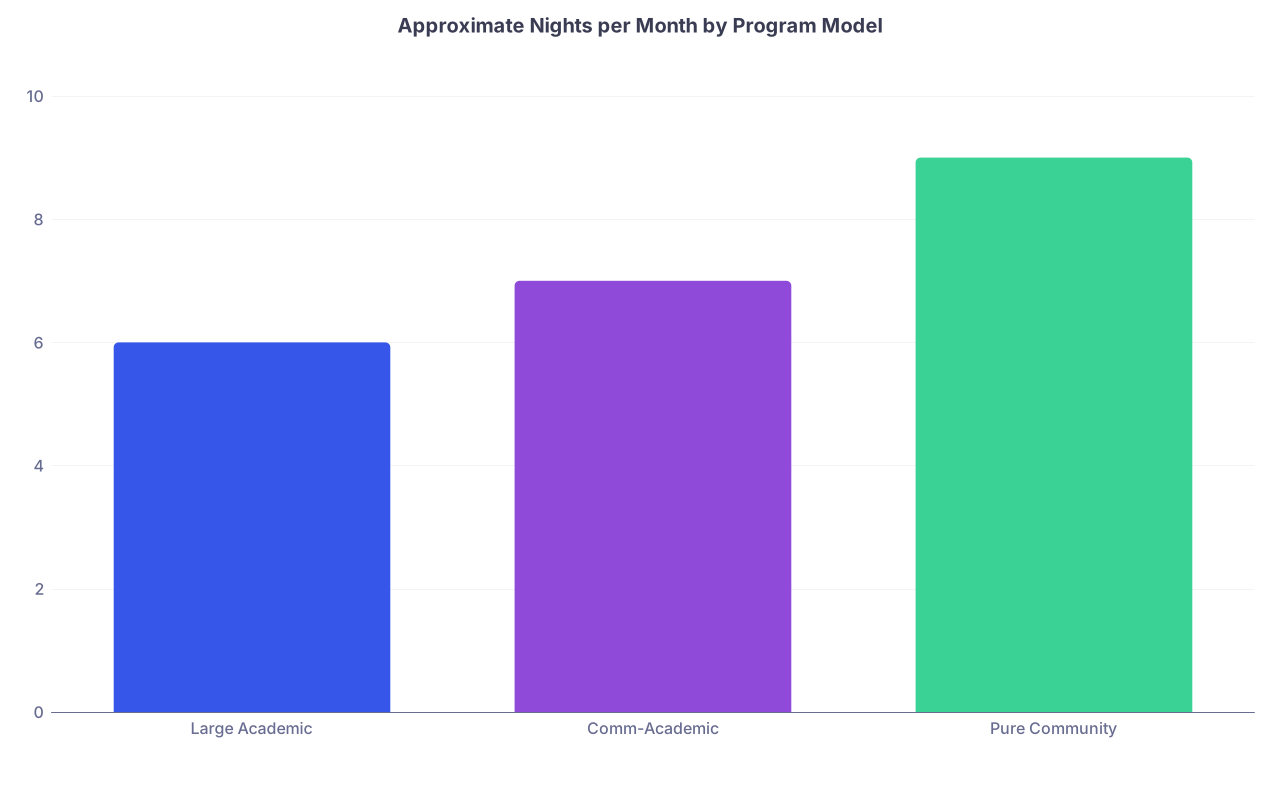
| Category | Value |
|---|---|
| Large Academic | 6 |
| Comm-Academic | 7 |
| Pure Community | 9 |
These are rough, but directionally correct for many programs.
6. What This Means for Your Life: Sleep, Learning, and Burnout
Let us be blunt. Call structure is not just about being “busy” vs “chill.” It shapes:
- How often you flip your sleep schedule
- How you experience fatigue (constant moderate vs periodic extreme)
- What kind of learning you get (acute management vs longitudinal care)
Night Float Lifestyle
Pros:
- Predictable: When you are on nights, you know you are on nights. No random “surprise” 24s.
- Day teams are protected, so your ward months might feel more manageable.
- You avoid the cognitive whiplash of doing rounds until 5 pm then turning into the night admitting machine until 7 am.
Cons:
- Circadian death. Two weeks of nights = 2+ weeks of feeling off, plus the flip back.
- Social isolation. Your “days off” are when everyone else is working.
- You might feel disconnected from “your” team; you become a floating admissions entity.
24‑Hour Call Lifestyle
Pros:
- Strong sense of ownership. You admit, you staff, you round on the same patients.
- Fewer full night disruptions across the month (q6 24‑hour call can feel better than 2 full weeks of night float for some people).
- More classical “see everything, do everything” training in some environments.
Cons:
- Acute exhaustion. By hour 22 your brain is not functioning at 100%.
- Vulnerable to abuse. I have seen “post‑call” residents still stuck doing discharges at 3 pm because “we’re short today.”
- If coverage is thin, those 24s can be genuinely unsafe for you and your patients.
Fatigue is not linear, and neither is learning.
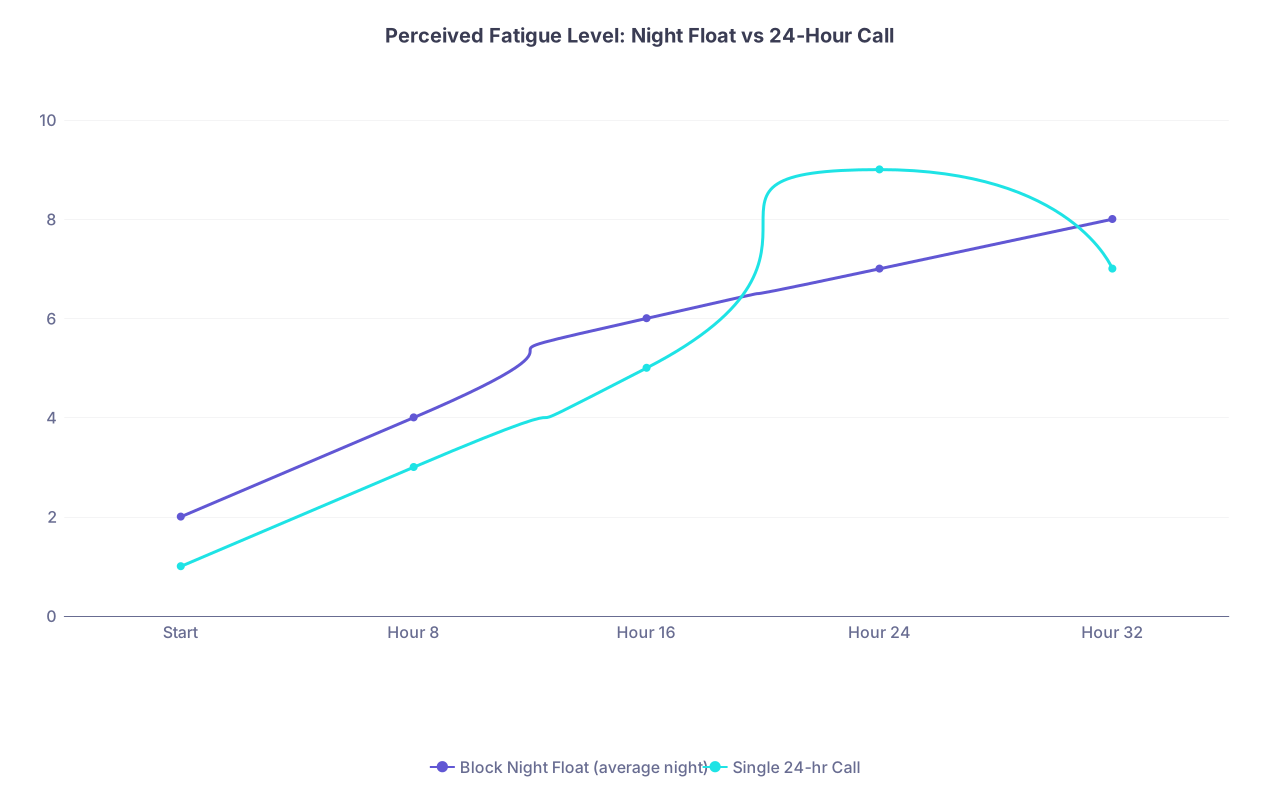
| Category | Block Night Float (average night) | Single 24-hr Call |
|---|---|---|
| Start | 2 | 1 |
| Hour 8 | 4 | 3 |
| Hour 16 | 6 | 5 |
| Hour 24 | 7 | 9 |
| Hour 32 | 8 | 7 |
Rough conceptual scale: 0–10 fatigue, not real data, but it matches what most residents will tell you. Night float hurts more on cumulative days 8–12. 24‑hour call hurts more acutely on hours 18–24.
7. Community vs Academic: How To Read Between the Lines on Interview Day
Most programs will not say, “Our call is terrible.” You have to decode it.
Here is the mental flowchart you should be running when they talk about call:

| Step | Description |
|---|---|
| Step 1 | Ask about night coverage |
| Step 2 | Ask length of NF blocks |
| Step 3 | Mostly 24 hr call |
| Step 4 | Heavy NF burden |
| Step 5 | Moderate NF burden |
| Step 6 | High burnout risk |
| Step 7 | Ask about backup and APPs |
| Step 8 | Night float present |
| Step 9 | NF more than 4 weeks PGY1? |
| Step 10 | q4 or tighter? |
Specific questions you should be asking (and listening to the tone of the answer):
- “How is night coverage structured for wards, ICU, and subspecialty services?”
- “How many weeks of night float does a typical resident do per year?”
- “For 24‑hour calls, what is the real time you usually get out post‑call?”
- “When you are on nights, what is your typical cap on new admissions and total census?”
- “Who else is in house overnight? Fellows? Attendings? APPs? Is there a second resident for backup?”
Academic red flags:
- Intern: “Our night float blocks are 4 weeks at a time, twice a year, plus some random nights on ICU.”
- Senior: “Post‑call we’re supposed to leave by 11, but realistically it’s later during winter or if the hospital is full.”
Community red flags:
- PD: “We do mostly 24‑hour calls. It is great experience.”
- Resident (later, quietly): “Yeah, they’re rough. You are cross‑covering almost the whole medicine service at night.”
You are listening less for exact numbers and more for:
- Whether residents look dead when talking about nights
- Whether faculty acknowledge the difficulty and describe real mitigation
- Whether there is a culture of “we protect post‑call days” or “we just push through”
8. Choosing Between Models: What Actually Matters For You
You will not find a program with zero nights, zero weekends, and strong training. If you do, they are lying.
So your job is trade‑off selection.
You might be better suited for:
Heavy night float (typical of larger academic centers) if:
- You like predictable blocks of suffering and then recovery.
- You value daytime teaching rounds and subspecialty exposure.
- You prefer more in‑house support at night (fellow, in‑house attendings).
Heavier 24‑hour call (more common in pure community) if:
- You want early autonomy and do not mind being “the” doctor overnight.
- You can tolerate acute exhaustion better than chronic circadian disruption.
- You are aiming for community practice and want realistic exposure to how those hospitals run.
One more uncomfortable truth: competitiveness of the program does not always correlate with humane call. Some ultra‑prestigious academic programs run their residents hard. Some less flashy community‑academic hybrids are quietly very livable with solid training.
So you need to explicitly factor:
- Nights per year
- Structure (night float vs 24‑hour vs 12‑hour shifts)
- Backup/coverage at night
- Post‑call culture
Into the same decision bucket as:
- Fellowship match lists
- Research
- Location
- Salary/benefits
Most applicants obsess over the last four and mumble through the first four. Do not be that person.
9. Concrete Application Season Strategy
You are applying now. What do you actually do with this?
Before interviews
For each program on your list, look for:- Duty hour/QI presentations on their website
- Photos of call rooms and workrooms
- Hints in resident testimonials: “we feel very supported on nights” vs “we learn so much independence on call”
During interviews
Ask a PGY‑2 or PGY‑3 (not just PGY‑1s) these direct questions:- “What was your hardest month PGY‑1? Why?”
- “How many consecutive nights have you worked?”
- “How many times a month are you still in the hospital after noon post‑call?”
On your rank list
If two programs are equal on training quality but one has:- 8–10 weeks of night float/year vs 4–6
- Regular q4 24‑hour calls vs q6 with real post‑call days You should strongly favor the saner call structure. Three years is a long time to be miserable at 3 am.
Reality check
No program is perfect. You are looking for:- Awareness of fatigue
- Transparency from residents
- Evidence that leadership has adjusted schedules over time in response to feedback
If you hear, “We changed our ICU calls from 24‑hour to 12‑hour shifts two years ago because residents were burning out,” that is a green flag. They are willing to change. You want that.

10. Key Takeaways
Let me strip it down.
- Night float vs 24‑hour call is not an abstract policy difference. It determines how you sleep, how you learn, and whether you hate PGY‑2.
- Academic programs tend to use more night float with more in‑house backup; community programs rely more on 24‑hour calls and give you earlier autonomy, sometimes at the cost of safety and sanity.
- On interview day, you must aggressively clarify:
- How many nights you work
- How they are structured
- How often “post‑call” actually means “you go home before noon” And then rank accordingly.

FAQ (Exactly 5 Questions)
1. Is night float always better than 24‑hour call?
No. Night float reduces single‑shift exhaustion but increases circadian disruption and can stack a lot of nights into one block. A well‑designed 24‑hour system with q6+ call and genuinely protected post‑call days can feel more sustainable than a poorly run night float system that piles on excessive admissions with minimal support.
2. Do community programs always have worse call than academic programs?
Not always, but they are more constrained. Pure community programs with small resident classes often require more 24‑hour coverage and broader cross‑cover. Some community‑academic hybrids have very reasonable schedules and strong backup. You have to evaluate each program individually instead of assuming “university good, community bad.”
3. How many weeks of night float per year is too much?
Once you are hitting 8+ weeks of night float per year, especially PGY‑1, you should scrutinize very carefully. Four to six weeks total is common and tolerable. Eight to twelve weeks starts to feel like a chronic night job with short breaks. If they also have additional 24‑hour calls on top, that is a clear red flag.
4. What is a realistic “good” post‑call policy?
A reasonable standard: leave by 10–11 am post‑call, no new admissions after a certain early‑morning cutoff, and a culture that respects that boundary. If residents routinely say, “We are still writing full progress notes and discharging at 3 pm post‑call,” then the policy exists only on paper.
5. Should I ever choose a program with heavier call if training seems stronger?
Yes, sometimes. If the program offers clearly superior clinical exposure, better fellowship outcomes in your target field, and residents who are tired but not broken, heavier call can be an acceptable trade‑off. But if two programs are comparable in training quality, and one clearly abuses call and post‑call time, you are making a mistake by choosing the more punishing schedule “for prestige.”