56% of internal medicine residents report they feel underprepared for independent ICU decision‑making by graduation. Most of them discovered the gap only after they started moonlighting or working as attendings.
You are trying to decide between a community and an academic residency, and everyone throws around vague lines like “you get more hands‑on ICU in community” and “academic ICU is more complex and evidence‑based.” Half‑true. Half marketing. Let me break down what actually changes for you, day to day, when you are in the unit at a community program versus an academic program.
We will stay anchored on what matters for the Match and for your career: autonomy, procedures, complexity, supervision, and how all of this shows up on your application and in your future job offers.
1. How ICU Time Is Structured: Rotations, Call, and Volume
ICU exposure is not just “we have an ICU.” It is: how often you rotate, what type of ICU, how many beds, and who really runs it.
1.1 ICU rotation blocks: how much time you actually get
Here is the pattern I see over and over when I review schedules or talk to chiefs.
| Program Type | ICU Months PGY1 | ICU Months PGY2 | ICU Months PGY3 | Total ICU Months |
|---|---|---|---|---|
| Community-heavy | 2–3 | 2–3 | 1–2 | 5–7 |
| Hybrid community–academic | 1–2 | 2–3 | 1–2 | 4–6 |
| University academic | 1–2 | 2 | 1–2 | 3–5 |
Community programs often load you up on ICU PGY1 and PGY2 because service needs drive the schedule. Fewer fellows. Fewer advanced practice providers. Residents are the workforce.
Academic programs, especially large university hospitals, usually cap ICU exposure a bit more and spread it out. You may get one big MICU block as an intern, one or two as senior, maybe a subspecialty unit (neuro, CTICU, transplant) if you are lucky or in a specific track.
The trap: programs will say “you will see tons of critical care” but then you find out:
- “ICU” includes a step‑down unit,
- or only the night float covers the sicker patients,
- or a heavy presence of fellows means your name is on the list, but your hands are not on the vent.
Ask very specific questions on interview day: “How many calendar months in an actual closed ICU will I do over three years, and what are the unit types?”
1.2 ICU bed size and case volume
Where the community vs academic distinction really hits you is size and throughput.
Typical pattern:
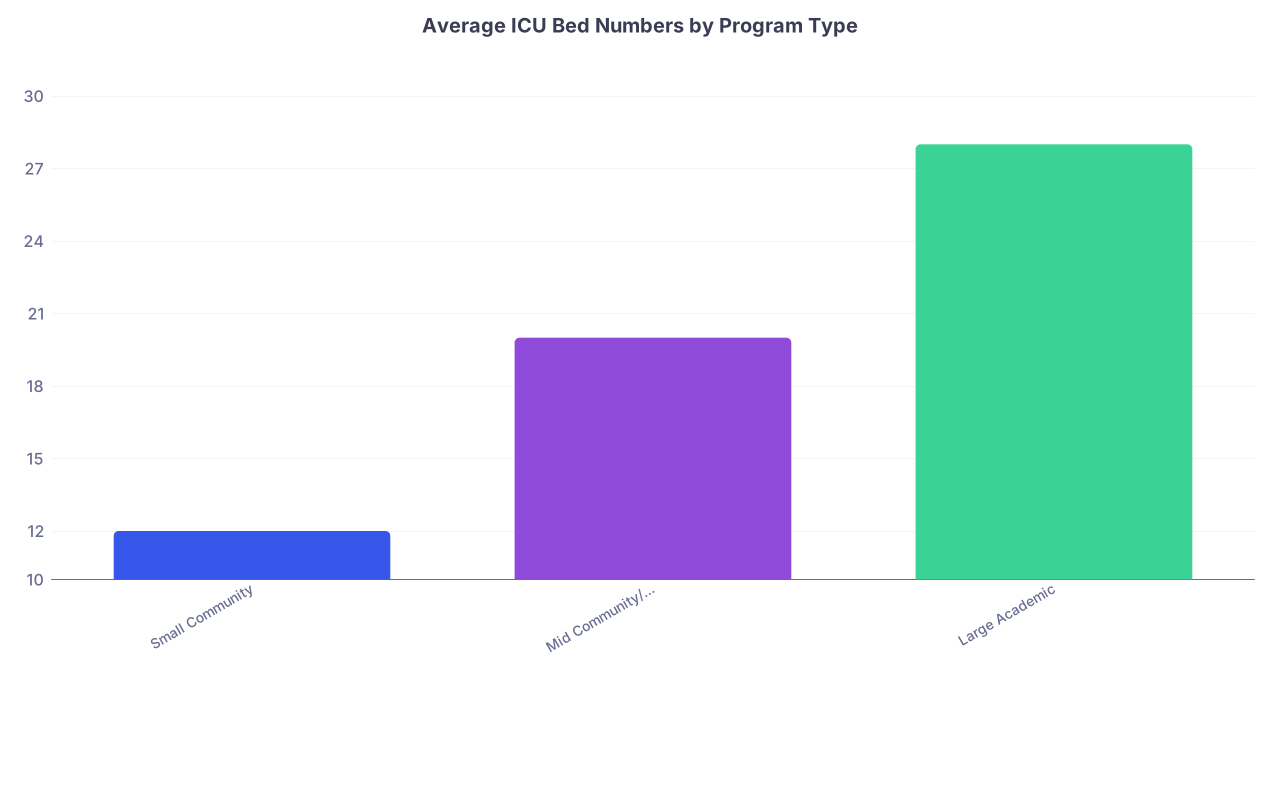
- Small community hospital: 8–16 bed combined medical–surgical ICU, maybe a separate step‑down.
- Mid‑size community / hybrid: 12–24 bed MICU, possibly a separate SICU run by surgery/anesthesia.
- Big academic center: 20–30 bed MICU, plus distinct units: CCU, neuro ICU, CTICU, transplant, burn, etc.
| Category | Value |
|---|---|
| Small Community | 12 |
| Mid Community/Hybrid | 20 |
| Large Academic | 28 |
Small community ICUs: you see bread‑and‑butter critical care in high concentration—sepsis, DKA, COPD exacerbations on BiPAP, GI bleeds, post‑op delirium, some cardiogenic shock on pressors if there is no standalone CCU. A lot of general internal medicine with ventilators attached.
Large academic MICUs: you may see a lower ratio of “generic” ICU and more weird, high‑acuity referrals—ARDS on ECMO, oncology patients with septic shock on three pressors, liver failure waiting for transplant. You do fewer admissions per night, but each admission consumes way more cognitive energy and multidisciplinary coordination.
1.3 Call structure and “who is actually in the unit at night”
This is the part that determines how fast you grow.
Common models in community programs:
- Traditional 24‑hour call in the ICU (intern + senior, attending from home or in‑house),
- Night float with one resident cross‑covering the entire ICU plus some floors,
- An in‑house intensivist at some places, but coverage intensity varies widely.
Academic centers:
- Almost always in‑house intensivist or fellow + attending,
- Night float system with an ICU‑dedicated team (not constantly running to the floor),
- Many units staffed by fellows (pulm/crit, anesthesia crit, surgery crit), you are never the only “doctor” in the building.
You want to ask: “At 2 a.m., when a patient decompensates, who is physically in the unit? What is the response pattern?” Community programs sometimes give you more raw responsibility and fear. Academic programs give you more structured support but sometimes slower autonomy.
2. Autonomy vs Oversight: Who Actually Runs the ICU Team?
People love to say, “You get more autonomy in community.” Sometimes true. Sometimes it just means “you are on your own because there is no one else.”
2.1 Team composition and your role
Let us walk through two real‑world setups I have seen.
Community IM program ICU team (12‑bed mixed unit):
- Day: 1 attending (pulm/crit, often splitting time between ICU and clinic), 1 senior resident, 1–2 interns, maybe 1 NP/PA.
- Night: 1 resident (sometimes PGY1 on nights with PGY2 backup), attending at home but available by phone, may come in for intubations and central lines.
How this feels: you run the show. You write the notes, place most orders, coordinate with consultants. You do not ask for permission to start norepinephrine in a crashing septic patient; you just do it and call the attending.
Academic university MICU (24–30 beds):
- Day: 1 attending, 1–2 critical care fellows, 1 senior resident, 2–3 interns, NP/PA(s), pharmacist, RTs heavily involved.
- Night: fellow in house, attending in house or immediately available, 1 senior + 1 intern.
How this feels: you are part of a machine. Morning rounds are long, highly detailed, protocol‑driven. You present, propose a plan, get grilled, adjust. You will still carry 6–10 patients, but your decisions are filtered through a fellow and attending.
Neither is inherently “better.” It depends what you want:
- If you want to feel comfortable independently managing pressors, sedation, ventilators early → community can force that growth.
- If you want to learn to think critically about borderline evidence, refine your approach with expert feedback, and see high‑level multidisciplinary decision‑making → academic is stronger.
2.2 Clinical decision‑making: orders vs plans
A key difference: who actually clicks the orders.
Community:
- You will frequently be the one starting vasopressors, pushing fluids, ordering imaging, adjusting ventilator settings with RT, often before running everything by the attending—especially nights.
- You will make more “first calls” on code status conversations, family updates, and transfer decisions.
Academic:
- Fellows often place most of the initial critical orders in unstable patients; residents follow the plan.
- You may manage the day‑to‑day adjustments (wean FiO2, diurese, titrate insulin, adjust sedation) but big decisions (proning, adding a second pressor, paralytics) often go through the fellow + attending.
I have seen residents from busy community ICUs comfortable running an entire step‑down / small ICU solo as new hospitalists. I have also seen academic residents with phenomenal theoretical knowledge freeze when no fellow is immediately behind them.
3. Procedures: Lines, Tubes, and What Actually Goes on Your CV
This is where applicants get misled constantly. “You will get tons of procedures here.” Ok. How many? Which ones? Logged where?
3.1 The usual procedural menu
For internal medicine‑based ICU exposure, think in categories:
- Airway: Intubations.
- Vascular access: Internal jugular / subclavian / femoral central lines, arterial lines, maybe dialysis catheters.
- Thoracic/abdominal: Thoracentesis, paracentesis, sometimes chest tube placements.
- Others: Lumbar punctures (often done elsewhere), bronchoscopy (usually fellow/attending dominated at academic centers), bedside ultrasound procedures.
Community trend:
- More lines and thoracenteses / paracenteses done by residents,
- Intubations: variable. If anesthesia “owns” the airway you will get fewer; if not, you may intubate a lot.
Academic trend:
- Procedures heavily skewed to fellows, especially airways and central lines in the sickest patients,
- Residents often get procedures in “low‑risk” cases or on step‑down, and many are ultrasound‑guided and protocolized.
Here is the reality of what I typically see in logs by end of PGY3:
| Procedure | Community-heavy (PGY3) | Large Academic (PGY3) |
|---|---|---|
| Central lines | 40–80 | 15–40 |
| Intubations | 20–60 (wide range) | 5–25 |
| Arterial lines | 20–50 | 10–30 |
| Thoracenteses | 20–40 | 10–30 |
| Paracenteses | 15–30 | 10–25 |
Some academic places break this pattern and are extremely procedurally heavy for residents, usually those without many fellows. But if a program has a pulmonary/critical care, anesthesia critical care, and surgical critical care fellowship all in one hospital, do not kid yourself—fellows will protect certain procedures.
3.2 How this affects your fellowship application
For critical care or pulm/crit fellowship:
- Coming from a community program with a strong procedural log can be a big plus. Program directors like seeing that you have actually done real airway and line work.
- But if your ICU is low complexity and you have never seen ECMO, CRRT, complex transplant patients, that will show in how you talk through cases.
For hospitalist roles with ICU work (open ICUs, rural settings):
- Community graduates with more direct ICU responsibility are often more “deployable” on day one.
- Academic graduates sometimes have more comfort with literature, protocols, and nuanced decision‑making but need a ramp‑up in hands‑on autonomy.
On your CV, numbers matter less than being able to tell a coherent story: “I was the primary proceduralist for central lines on my ICU rotation; we used ultrasound‑guided techniques, and I performed about 50 by PGY3, including emergent lines during codes.”
4. Patient Mix and Complexity: What You Actually See in the Bed
The ICU is not one thing. A 65‑year‑old septic patient in a community unit is not the same as an ARDS patient bridged to lung transplant on VV‑ECMO at a tertiary center.
4.1 Typical community ICU case mix
You see:
- Sepsis from pneumonia, UTI, cellulitis,
- COPD and asthma exacerbations, often on BiPAP rather than intubated if you catch them early,
- DKA/HHS, severe electrolyte abnormalities,
- GI bleeds, especially varices if there is local liver disease,
- Post‑operative patients from general surgery, ortho, sometimes vascular surgery,
- Stroke patients pre- or post‑thrombectomy in hospitals without neuro ICU.
The complexity is not trivial. You see real shock, real multi‑organ failure. What is different is:
- Fewer solid organ transplant patients,
- Fewer complex oncology/immunosuppressed patients referred out,
- Little to no ECMO, LVAD, advanced mechanical circulatory support.
4.2 Typical academic MICU / specialized ICU mix
Add to the list:
- Complex oncology / BMT patients with neutropenic septic shock,
- Solid organ transplant patients: liver, lung, kidney, heart,
- ECMO and ARDS with advanced ventilator modes,
- Innovative therapies in clinical trials,
- Advanced CRRT strategies, complex vasoplegia, multi‑pressors, and mechanical support.
| Category | Value |
|---|---|
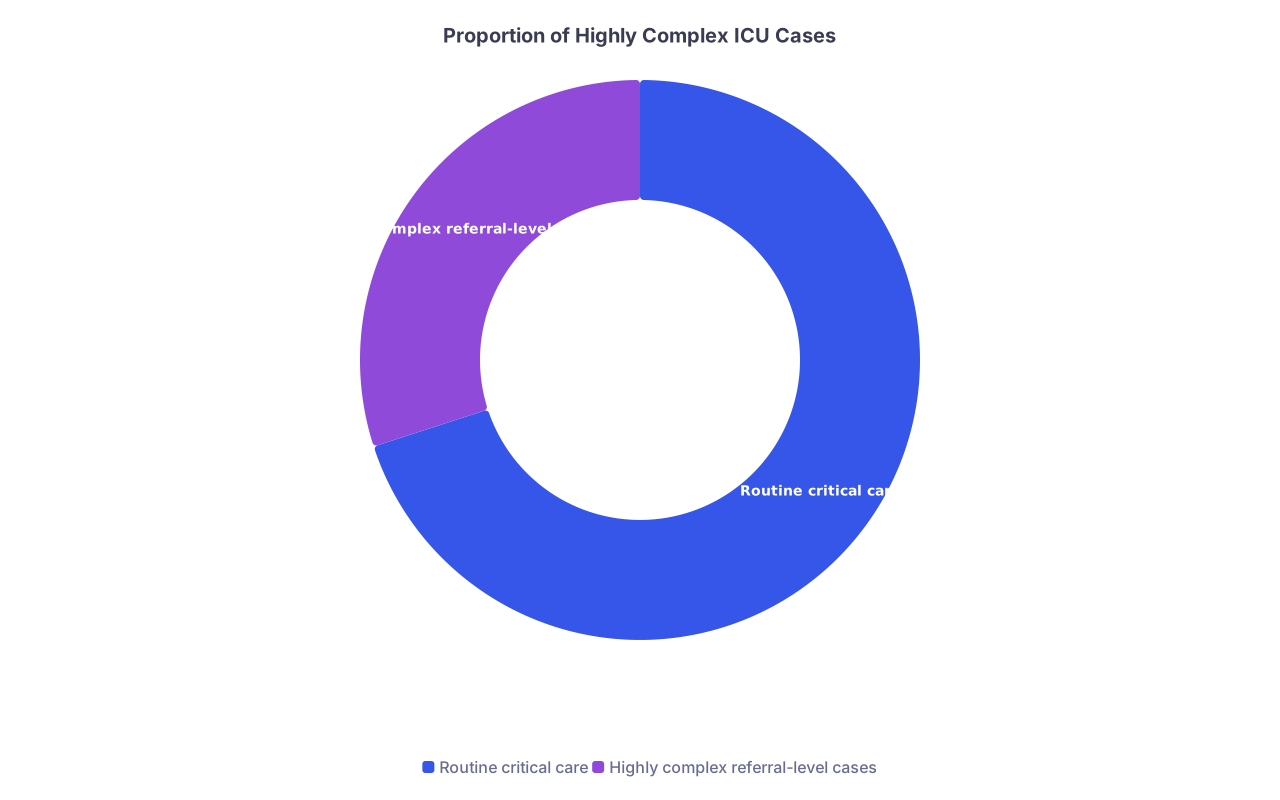
| Routine critical care | 70 |
| Highly complex referral-level cases | 30 |
In large academic centers, maybe 20–40% of your MICU census at any time falls into that “you will not see this in a smaller community hospital” bucket. You may see fewer overall patients per month but each patient requires deeper subspecialty knowledge.
4.3 The “sickest of the sick” illusion
One misconception: “Academic means everyone is sicker.” Not always. Quite a lot of beds in big centers are filled with moderate acuity patients waiting for step‑down or placement, just like anywhere else. The difference is the tail of the distribution—the extreme outliers are common enough that you learn to manage them.
In community, you may transfer these cases out. You get good at initial stabilization and triage, but you do not follow the full arc of complex ECMO cases or post‑transplant rejection.
If you are aiming for a career in tertiary critical care, you want to have experienced those extremes at least in some rotations. If you want to be a hospitalist doing occasional ICU “light” in a community setting, the bread‑and‑butter sepsis/resp failure focus of many community ICUs is actually more directly relevant.
5. Educational Culture: Conferences, Protocols, and How You Learn ICU Medicine
Residents often underrate this piece. The ICU you train in shapes how you think about sick patients for the rest of your career.
5.1 Teaching intensity and structure
Academic ICUs:
- Daily teaching rounds with fellows and attendings,
- Regular didactics: weekly ICU conferences, journal clubs, M&M with actual literature discussion,
- Protocol‑heavy environment: ARDSnet, sedation/analgesia bundles, delirium screening, early mobility, sepsis bundles baked into order sets.
Community ICUs:
- Big variation. Some have intensivists who are very academic-minded: daily chalk talks on ventilator modes, hemodynamics, ECMO theory.
- Others are more service‑oriented: shorter rounds, more focus on disposition and immediate management, less time for literature or pathophysiology discussions.
I have seen community ICUs where the attending runs a 20‑minute whiteboard session every morning on one topic—ARDS PEEP titration one day, vasopressor choice in septic vs cardiogenic shock another. I have also seen academic MICUs where residents are half‑asleep on hour 4 of rounds while the attending debates the third‑line therapy for a zebra diagnosis that nobody will remember.
You want to ask:
- “Are there dedicated ICU didactics?”
- “Who leads teaching—attendings, fellows, RT, pharmacist?”
- “Do you use standardized protocols for sepsis, ARDS, sedation?”
5.2 Exposure to evidence and research in critical care
If you care at all about critical care fellowship or an academic career, this matters.
Academic programs:
- Frequent journal clubs on landmark ICU trials (PROSEVA, EOLIA, VITAMINS, etc.),
- Exposure to ongoing clinical trials, research databases, and quality improvement projects,
- ICU attendings often have publications, are involved in national guidelines, or at least stay tightly current.
Community programs:
- Some have truly excellent, up‑to‑date intensivists who read like crazy and are deeply evidence‑driven.
- But fewer formal research opportunities. You do more QI or case reports than RCTs or registry analyses.
If your personal goal is a critical care fellowship at a big‑name center, academic ICU exposure plus some research or QI in the unit will help your application more than being the most autonomous person in a one‑attending community ICU with no scholarly activity.
6. How ICU Exposure Plays into the Match: What Programs Read Between the Lines
You are in the residency application phase. You are trying to choose where to apply and how to interpret program websites and interviews. ICU exposure is both a training and a marketing tool for these places. They will spin it. Your job is to decode it.
6.1 Reading between the brochure lines
A few common phrases and what they really tend to mean:
“High‑acuity community hospital with strong ICU exposure”
Usually: You will cover a busy mixed ICU with limited fellow presence. Excellent autonomy and procedures, variable complexity. Ask about transfer patterns.“Tertiary/quaternary academic referral center with multidisciplinary ICUs”
Usually: You will see very complex cases; many units have fellows. Resident procedural and decision autonomy depends on subspecialty and fellow culture.“Dedicated intensivist coverage 24/7”
Good for patient care, but can either support or limit your autonomy. Ask how often residents place lines/intubations vs attendings/fellows.“Residents gain extensive procedural experience”
Ask for hard numbers: “What are the median central lines and intubations logged by graduating residents?”

| Step | Description |
|---|---|
| Step 1 | Program ICU Overview |
| Step 2 | How many ICU months total? |
| Step 3 | What types of ICUs? |
| Step 4 | Who covers nights? |
| Step 5 | Resident autonomy |
| Step 6 | Case complexity |
| Step 7 | Procedural opportunities |
6.2 Aligning ICU profile with your career goals
If you are thinking:
Critical care / pulm‑crit fellowship:
You want at least some rotations in a high‑complexity, academic‑style ICU. You also want enough autonomy and procedures to not look helpless. A hybrid program that sends you to a university ICU for some months can be ideal.General hospitalist in community with open ICU responsibilities:
A community program with strong, hands‑on ICU rotations is often better training. You learn how to manage sepsis, DKA, respiratory failure with limited backup—exactly what many hospitalist jobs need.Cardiology, GI, heme‑onc, etc.:
You still need solid ICU exposure because your patients will crash. Academic programs often give you better exposure to the interplay between specialty services and the ICU (cardiogenic shock, variceal bleed in liver failure, neutropenic fever turning to shock).Outpatient‑heavy careers (primary care, outpatient subspecialty):
ICU exposure still matters for your board exam and ability to recognize instability. But you do not need to optimize around it. A reasonable mix in either setting is fine.
6.3 How to signal interest in ICU on the application
If you care about critical care, show it without sounding obsessed with procedures only.
You can:
- Mention meaningful ICU experiences in your personal statement: “Managing a 45‑year‑old with ARDS on high PEEP and paralytics taught me…”
- Highlight any ICU‑related QI or research on your CV,
- Ask thoughtful ICU‑oriented questions during interviews (about teaching, protocols, follow‑up of survivors, etc.).
Program directors can tell the difference between “I just want to intubate people” and “I understand critical care as a field of complex decision‑making and longitudinal impact.”
7. Practical Scenarios: How Your ICU Training Shows Up Later
To make this less abstract, let us walk through a few concrete scenarios from real graduates.
7.1 Community‑trained resident becoming a hospitalist in a small city
This person:
- Did 6–7 months of ICU in residency at a 250‑bed hospital,
- Ran many overnight codes, did dozens of central lines and intubations,
- Saw moderate complexity but transferred out ECMO, advanced liver failure, post‑transplant.
First job: hospitalist at a 200‑bed hospital with a 10‑bed open ICU, no in‑house intensivist at night.
Result: She was comfortable day one. Running codes, starting pressors, managing vents with RT, stabilizing and transferring the very complex. She occasionally called a tertiary center intensivist by phone for nuanced decisions, but her training matched her job almost one‑to‑one.
7.2 Academic‑trained resident going into pulm/crit fellowship
This person:
- Did 4–5 months of MICU at a university hospital, plus 1–2 months in subspecialty ICUs,
- Saw ECMO, transplant, CRRT routinely,
- Did fewer independent procedures, but understood advanced ventilator strategies, complex hemodynamics, and nuanced goals‑of‑care discussions.
In fellowship: He hit the ground running on pathophysiology, literature, and complex family meetings. He needed more early supervision on emergent intubations and procedures but caught up quickly. For an academic or high‑level ICU career, this trajectory made sense.
7.3 Community‑trained resident applying to academic critical care fellowship
This is where people worry.
If your ICU was:
- Procedurally strong,
- Autonomy heavy,
- But low on complex transplant/ECMO/oncology patients,
You can still match fine into good fellowships. The key is showing:
- You understand your environment’s limits (you know when you transferred),
- You can think critically about cases, not just “do things,”
- You have at least some scholarly or QI work that touches ICU topics.
A lot of academic ICU attendings actually respect residents who have clearly run real units and made hard decisions with limited support. But they will expect you to grow into the more advanced and academic aspects quickly.
Key Takeaways
Community ICUs usually give you more hands‑on autonomy and procedures; academic ICUs usually give you greater case complexity, structured teaching, and research exposure.
Neither setting is inherently superior. The right choice depends on your career direction: community hospitalist vs academic critical care vs subspecialty.
When evaluating programs, push past the marketing. Ask for specific ICU months, unit types, nighttime coverage, and real procedural numbers—because those details will define how competent you feel the first time you are the only doctor in a crashing patient’s room.