
The most dangerous rank list is the one that tries to be “neutral.”
You’re not neutral. You’re choosing between two very different futures: a community-heavy path and an academic-heavy path. You need two deliberate parallel rank lists, not one muddled compromise.
Here’s how to build them, step by step, on an actual timeline.
Big Picture: Your Two Parallel Futures
Before we get into the dates and steps, define the two tracks you’re building toward. If you’re fuzzy here, the rest falls apart.
| Factor | Community-Heavy Focus | Academic-Heavy Focus |
|---|---|---|
| Case Volume | High, bread-and-butter | Mix of routine and complex |
| Research | Optional / minimal | Expected / structured |
| Teaching Roles | Some, informal | Central, formal |
| Fellowship Focus | Less central | Often essential |
| Lifestyle | Often more predictable | Often more variable |
You are not committing today. You’re planning for both outcomes so you are not scrambling during rank week.
Think of it this way:
Rank List A = Community-Heavy Plan
“I’m okay (or happy) being mainly a clinician. Fellowship is optional. I want high volume, hands-on, less committee meetings.”Rank List B = Academic-Heavy Plan
“I want strong fellowship options, research mentorship, big-name letters, and maybe future faculty roles.”
You will build both plans in parallel, then decide which one you’ll actually certify in the NRMP system.
August–September (Pre-Interview Season): Set Up Your Framework
At this point you should not be thinking “I’ll decide after interviews.” That’s how you end up with a mess of emotional impressions and no structure.
Step 1: Define Your Non-Negotiables (Week 1)
Get out a doc or spreadsheet. Create three sections:
Dealbreakers (both tracks)
Examples:- No 24+ hour shifts after PGY-1
- Must be within X hours of partner/family
- Must sponsor visas (if applicable)
Community-Heavy Priorities
Examples:- Direct attending supervision early
- Strong autonomy in later years
- Procedural volume (e.g., for FM: OB, scopes; for IM: lines, codes)
Academic-Heavy Priorities
Examples:- Established fellowships in your target fields
- Protected research time (not fake “do it on your own time”)
- Publication track record of recent residents
These become your scoring criteria later.
Step 2: Build Your “Two Columns” Program List (Week 1–2)
List every program you’re considering and set up two parallel columns:
- Column A: Community Alignment Score (0–5)
- Column B: Academic Alignment Score (0–5)
At this stage it’s predictive, not precise. Gut-based is fine for now:
- Strong community program with minimal research? 4–5 in Community, 0–2 in Academic.
- Big-name university hospital with NIH funding and fellowships? 4–5 in Academic, 0–2 in Community.
- Hybrid county/university mix? Probably 3–4 in both.
You’ll update these scores after each interview.
October–November: Early Interviews, Data Collection Mode
At this point you should treat every interview day like a targeted scouting trip. You’re not just deciding “like vs don’t like.” You’re deciding “community list vs academic list vs neither.”
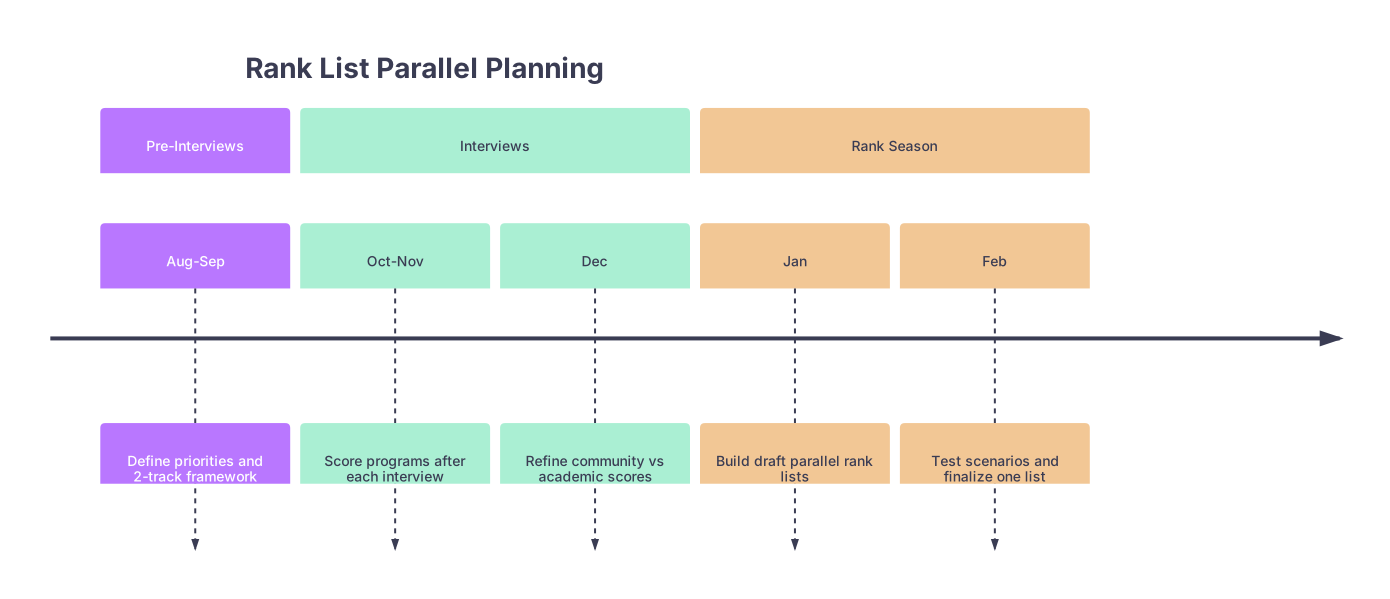
| Period | Event |
|---|---|
| Pre-Interviews - Aug-Sep | Define priorities and 2-track framework |
| Interviews - Oct-Nov | Score programs after each interview |
| Interviews - Dec | Refine community vs academic scores |
| Rank Season - Jan | Build draft parallel rank lists |
| Rank Season - Feb | Test scenarios and finalize one list |
After Each Interview (Same Day If Possible)
You’re tired. You still do this.
Create a quick template note for every program, with two lenses:
Community Lens Questions
- Did residents talk about autonomy?
- Did they describe themselves as “workhorses” vs “protected learners”?
- Is there a clear attending you call at 3am, or are you buried in hierarchy?
- What’s the community? Rural, suburban, safety-net? Fits your life?
Academic Lens Questions
- Is there real, functioning research infrastructure (coordinators, stats help, ongoing projects)?
- Do residents get first-author pubs, or just fellows and faculty?
- Are fellowship program directors present and engaged?
- Did anyone say “We don’t really have much research but you can find stuff if you look”? (Red flag for serious academic goals.)
Then immediately update:
- Community Score (0–5)
- Academic Score (0–5)
- Overall “How did this feel?” short note (1–2 sentences maximum)
Do not rely on memory in February. I’ve watched people swear a program was “amazing” but can’t remember one specific thing about it three months later.
December: Sort, Re-Score, and Identify Your “Core” Programs
By December, most interview invites are out. At this point you should move from chaos to structure.
Step 1: Clean the List (Early December)
Go through your full list:
- Remove clear “no” programs
- Flag any “only if desperate” programs
Be honest. If you told someone mid-interview “I’m only here because my advisor said to apply broadly,” that program is probably not top 10 material.
Step 2: Re-Score With More Information (Mid December)
Now that you’ve seen multiple programs, recalibrate your 0–5 scores. Early interviews often get over- or under-rated because you have no comparison.
For each program, answer:
- On a purely community-heavy future, where does this program land?
- On a purely academic-heavy future, where does this program land?
Update scores:
- Programs that shine clinically but have weak research? Push up the Community Score.
- Programs with structured scholarly time, big-name mentors, and track record of fellow success? Push up Academic Score.
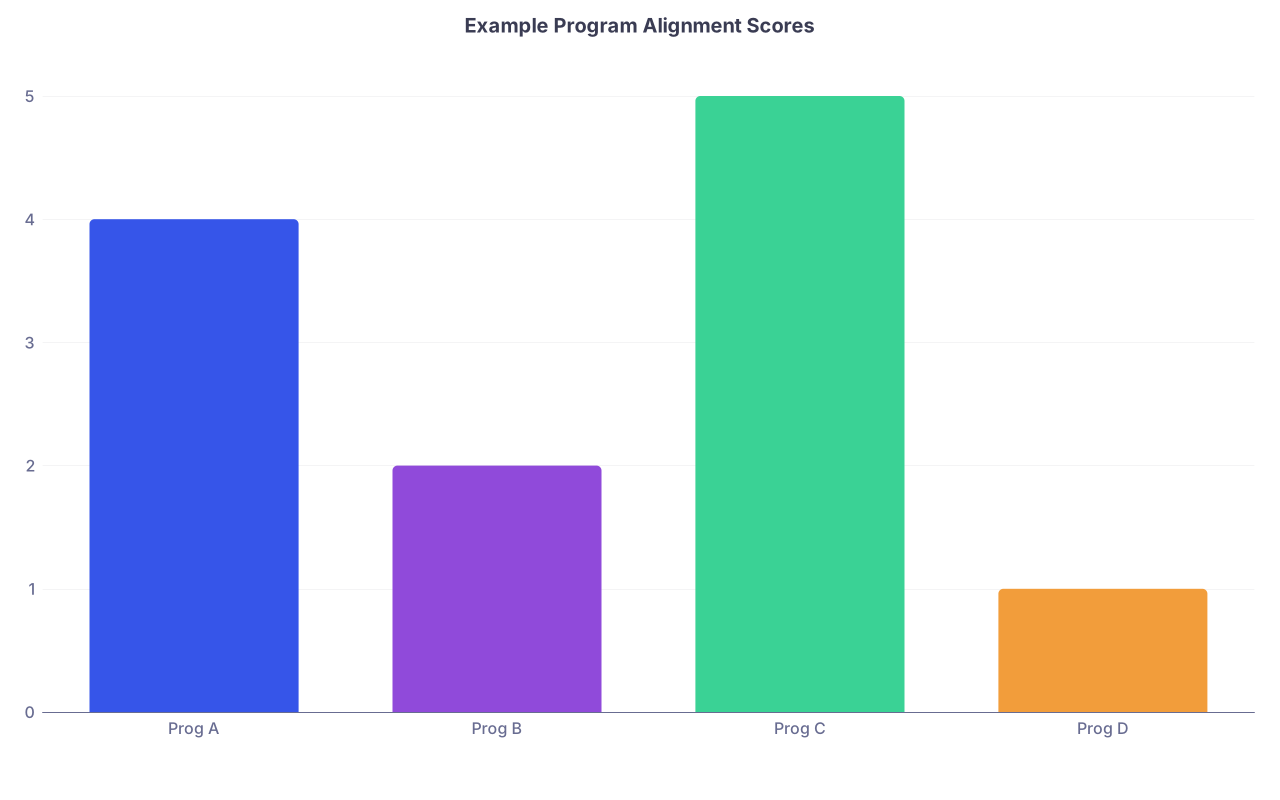
| Category | Value |
|---|---|
| Prog A | 4 |
| Prog B | 2 |
| Prog C | 5 |
| Prog D | 1 |
(Imagine this is just the community score; you’d have a similar chart for academic if you want.)
You don’t need this perfectly scientific. You just need consistent relative rankings.
Step 3: Identify Your “Anchor” Programs
You should now identify:
- 3–5 Core Community Programs: Excellent match if you choose a community-heavy path.
- 3–5 Core Academic Programs: Excellent match if you bet on an academic future.
These become the spine of your two parallel lists.
January: Build the Two Parallel Rank Lists
This is the key month. At this point you should stop hand-waving and actually construct two specific rank lists.
Step 1: Draft the Community-Heavy Rank List
Assume this future for a moment:
“I’m going to be primarily a clinician. I might do a fellowship, but it’s not the center of my identity. I want strong training, good attendings, and a life.”
Under that assumption, rank programs in the exact order you’d want to match if all you cared about was that community-centric future.
Rules here:
Anchor First
Start with your core community programs at the top, in your true preference order.Then Add Hybrids
Some academic centers actually function like big community hospitals. If they give strong patient volume, good autonomy, okay lifestyle, they may still fit this list well.Then Add “Would Still Be Fine” Programs
These are your safety nets. Not exciting, but acceptable.
Your final Community-Heavy list might look like:
- Mid-size suburban community program with strong procedural training
- County hospital with high volume, decent fellow exposure
- University-affiliated community hospital, mild research
- Large academic center that actually runs like a service-heavy community shop
- Smaller community site in your hometown
Step 2: Draft the Academic-Heavy Rank List
Now flip futures:
“I want strong fellowship options, academic mentors, multi-center trials, and I’m willing to sacrifice some lifestyle and volume balance to get that.”
Under that assumption, build a separate rank order:
- Big-name academic medical center with multiple fellowships
- University program with strong research in your interest area, high publication count
- County–university hybrid with good fellowships and protected research time
- “Academic-lite” program with one strong PI and strong connections
- Best of the community programs that still give you a realistic shot at your target fellowship
Your order between the same programs will often be very different across the two lists. That’s the point.
Late January: Scenario Testing and Sanity Checks
At this point you should have two fully built rank lists in your spreadsheet or notebook:
- Column L: Community-Heavy Rank 1–N
- Column R: Academic-Heavy Rank 1–N
Now comes the hard part: which life do you actually want to bias toward?
Step 1: Run Thought Experiments (1–2 Evenings)
Pick specific scenarios.
Example:
- Scenario A: You match at your #1 community program but turn down the chance to rank an academic giant first.
- Scenario B: You match at your #3 academic program and never develop much research output, but your name-brand institution still opens doors.
- Scenario C: You match at a mid-tier hybrid program that was #4 on both lists.
Ask yourself, honestly:
- Which scenario would you be happiest with three years from now, not just next July?
- Which scenario do you talk about with excitement, and which with “I guess that would be okay”?
If you feel relief imagining matching at a community-heavy program, listen to that. If you feel you’d be wasting your potential without a strong academic environment, that also matters.
Step 2: Check Against Real Fellowship Data (If Relevant)
If you care about fellowship, you don’t guess. You check.
Email or ask residents (not just the PD):
- Where did the last 5–10 graduates match for fellowship?
- From this program, what does it take to land GI/Cards/Onc/etc?
- Do community graduates from this program match at academic centers?

If a “community” program regularly sends people to solid university fellowships, its academic value goes up—especially on your academic-heavy list.
Early February: Converting Parallel Plans into One Certified Rank List
Here’s the punchline: NRMP only lets you submit one list. Your job is to decide how heavily you tilt it in each direction.
At this point you should:
Decide Your Primary Trajectory
- 60–70% sure you’re happier as a clinician first → lean Community-Heavy
- 60–70% sure you’re academic-leaning long-term → lean Academic-Heavy
You don’t need 100% certainty. Perfectionism here is just procrastination with better branding.
Blend the Two Lists Into One Final Rank Order
Practical way to do this:
Start with the top 3–5 spots:
Ask: “If I never did a fellowship, which of these would I still be happy at?” That eliminates unrealistic academic-only options if you’re not sure you’ll follow through.Then go down your lists side by side:
For each pair, ask:“If I matched at Academic Program X vs Community Program Y, which life’s ‘typical Tuesday’ do I actually prefer?”
Move the winner higher.
This often creates a hybrid final list like:
- Academic #1
- Community #1
- Academic #2
- Hybrid county/academic
- Community #2
- Academic #3
- Remaining acceptable programs
This is normal. You are not “purely” one path. You’re weighting.
Final Week Before Certification: Micro-Adjustments, Not Panic
By now you should be done with major overhauls. This last week is for tightening, not rebuilding.
Day-by-Day Guide (Last 7–10 Days)
Day 10–7 before deadline
- Re-read your post-interview notes for the top 10–15 programs.
- Correct any obvious emotional distortion (“I loved that city but actually hated their schedule”).
- Minor reshuffles only.
Day 6–4
- Reality check with someone who knows you well (mentor, trusted senior, partner):
- “Given what I’ve told you about wanting X vs Y, does this ordering make sense?”
They’ll often call out glaring contradictions. Listen.
- “Given what I’ve told you about wanting X vs Y, does this ordering make sense?”
Day 3–2
- Log into NRMP. Enter your current best version of the list.
- Confirm details: program codes, prelim vs categorical, etc. Admin errors are the dumbest way to sabotage yourself.
Day 1
- Do not restructure everything.
- Make at most 1–2 small swaps if you’ve been obsessing over the same question for days.
- Certify the list.

How To Tell If You Did This Right
Three quick tests:
The “Regret Test”
Imagine matching at your #1, #3, or #5. If all three feel like, “Yeah, that would actually be great for who I am,” you constructed the list well.The “Future Self” Test
Picture yourself PGY-3, looking back:- Would you laugh and say, “I clearly wanted academics; glad I owned it”?
- Or, “I clearly wanted community; glad I didn’t fake it for prestige”?
The “Parallel Universe” Test
If someone forced you to adopt the other parallel rank list you drafted, would it still be livable? If yes, you did solid groundwork. If no, you probably learned something important about your real priorities.
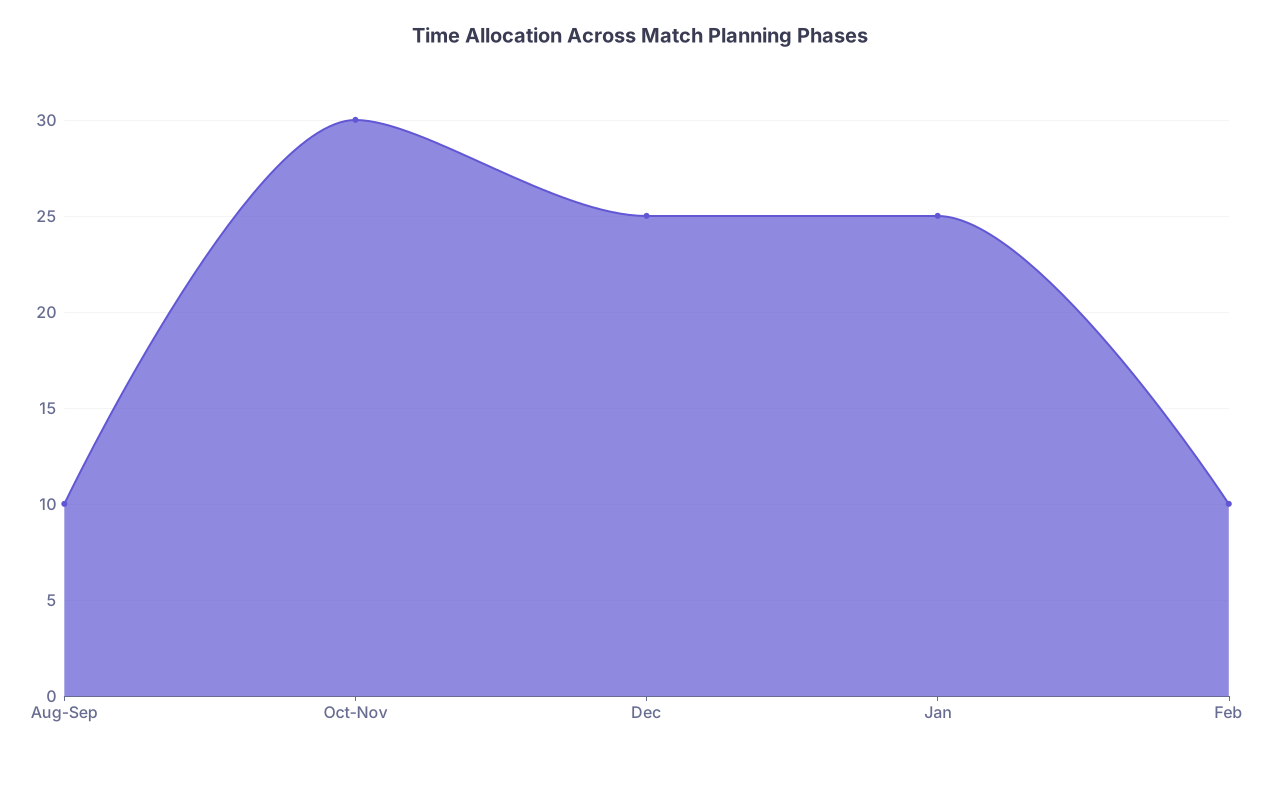
| Category | Value |
|---|---|
| Aug-Sep | 10 |
| Oct-Nov | 30 |
| Dec | 25 |
| Jan | 25 |
| Feb | 10 |
Key Takeaways
- Build two explicit parallel rank lists—community-heavy and academic-heavy—months before certification. Do not wing it in February.
- Use every interview to score programs separately on community and academic alignment, then refine those scores in December and January.
- In February, choose your primary trajectory, blend the two lists into one final rank list, and certify without last-minute chaos.