Last month I spoke with a PGY‑1 who looked wrecked. She’d ranked mostly community programs “for lifestyle,” matched happily, then accidentally fell in love with research on a QI project. Now she wants an academic career—and feels like she’s “already screwed” because she’s not at a big-name university program.
If that sounds uncomfortably close to your situation, you’re the target here. You matched into (or are applying mostly to) community programs and only after that did you realize: you actually care about research, teaching, fellowships, maybe becoming faculty. You’re late to the party—but not locked out.
Let me walk you through what to do, step by step, without sugar‑coating the hard parts.
1. First, be brutally clear about what “academic path” actually means
Too many residents chase “academics” as a vibe. White coats, conferences, maybe a name-brand hospital on the badge. That’s not a plan.
When you say you’ve “discovered research interests,” I want you to pin it down:
- Do you enjoy asking questions and digging into data?
- Do you see yourself writing papers, grants, or leading projects?
- Do you want a fellowship at a competitive academic center?
- Are you picturing a job with teaching + research + clinical, not just full-time clinic or hospitalist work?
Spell this out for yourself in one paragraph. Literally write:
“I want an academic career because I care about X (e.g., clinical research in sepsis, med ed research, health equity work), and I’m willing to trade some income and convenience for the chance to do Y (publish, teach, lead projects, work at a university).”
If what you really mean is “I want a slightly more interesting job and maybe to give a lecture once a year,” you can get that almost anywhere, including a strong community program. But if you mean papers, grants, national reputation—that’s a different level of commitment.
You’re not “late” until you know what you’re late for.
2. How much does it hurt that you’re at (or applying to) a community program?
Here’s the uncomfortable truth: program type does matter, but less than people think and not in the same way for everyone.
Let’s simplify.
| Factor | Community Program | Academic Program |
|---|---|---|
| Built-in research infrastructure | Usually limited | Robust (cores, statisticians, IRB support) |
| Faculty with research portfolios | Few, often 0–2 per department | Many, some with national reputation |
| Pressure to publish | Low, often optional | Moderate to high, sometimes expected |
| Ease of getting projects | You must hustle and build them | Often plug into existing projects |
| Fellowship pipeline | Variable, depends on relationships | Usually stronger, many grads to top fellowships |
If you:
- Want a super-competitive subspecialty (Derm, Ortho, Plastics, Rad Onc, some competitive IM subspecialties at top‑tier places)
- Have no research from med school
- And are at a small community program with zero academic ties
Then yes, you’re pushing uphill. Hard.
If you:
- Are in IM, Peds, EM, Psych, FM, etc.
- Have some research from med school or can build projects as a resident
- Or your “community” program is actually a hybrid (large teaching hospital with a university affiliation)
Then you are not dead in the water. But you will need to be deliberate and proactive.
3. If you haven’t matched yet: how to shift your rank list strategically
Let’s say you’re in the application cycle right now, and during interview season you discovered you love research. Different problem than the already‑matched PGY‑1, and you actually have more leverage than you think.
Here’s what you do right now:
Audit your list for true research environments.
Some “community” programs still have legit research going on—regional trials, active QI, population health. Others have nothing beyond chart audits.Look for:
- Residents with recent publications listed on the website
- Faculty bios mentioning grants, publications, or committee roles (AHA, ATS, ASCO, etc.)
- Clear mention of “protected research time” or “scholarly tracks”
Re-rank based on pathways, not branding.
A mid-tier university program with active research > “prestige” community program with nice call rooms but zero research support, if academics is your priority.Ask the right question in follow-up emails.
You email the PD (or APD) something like:“On interview day I realized I’m more interested than I expected in pursuing an academic path with research in [area]. If I matched at your program, what concrete avenues exist for residents to get involved in research and present/publish during training?”
You’re not asking “do you support research?” You’re asking “what specifically can I do and who helps me?”
Shift your rank list accordingly.
If you have:- A couple of academic programs where you had decent vibes
- A few community programs with real research pathways
- And some pure-service community programs with no academic output
Your order for an academic future should look more like:
- Academic programs
- Community-with-true-research programs
- Service-only community programs
Stop ranking “nice city” and “good schedule” over the actual career you want. They matter, but they’re not the main character anymore.
4. Already matched to a community program? Here’s your recovery plan.
You matched already. New research bug. Mild panic. Fine. Here’s the reality: you don’t get a do‑over on your residency location. You work from where you are.
Step 1: Map your current ecosystem in painful detail
Within the first 1–2 months of PGY‑1 (or now, if you’re already in training), you should know:
- Which attendings have any research experience (even old fellows who published once)
- Who at your hospital has MPH/PhD degrees, is involved with trials, or sits on clinical research committees
- Whether your hospital has:
- A research office
- IRB access
- A link to a nearby medical school or university
Find this out by:
- Asking senior residents: “Who here actually does research or publishes?”
- Reading faculty bios on the website
- Looking at recent resident posters/presentations (local or national)
You’re building a map. On that map, you’re looking for 2–3 potential mentors—not perfect ones, just “people who are doing something academic and aren’t jerks.”
Step 2: Start small, fast, and realistic
You don’t need a randomized trial. You need momentum and something on paper.
Low‑bar, high-yield project types in community settings:
- Chart review: Common diagnoses, readmissions, LOS, complication rates
- QI projects: Sepsis bundle compliance, code status documentation, discharge planning
- Case series / case reports for rare presentations or complications
Your pitch to a potential mentor can be simple:
“I’ve realized I’m interested in an academic path and want to build some research experience. I know we’re a busy clinical program, so I’m thinking something realistic like a [chart review / QI project] on [topic that fits their interest]. Would you be open to meeting once to brainstorm and see if this is feasible?”
You want a yes-able ask. Not “Adopt me as a mentee for five years.”
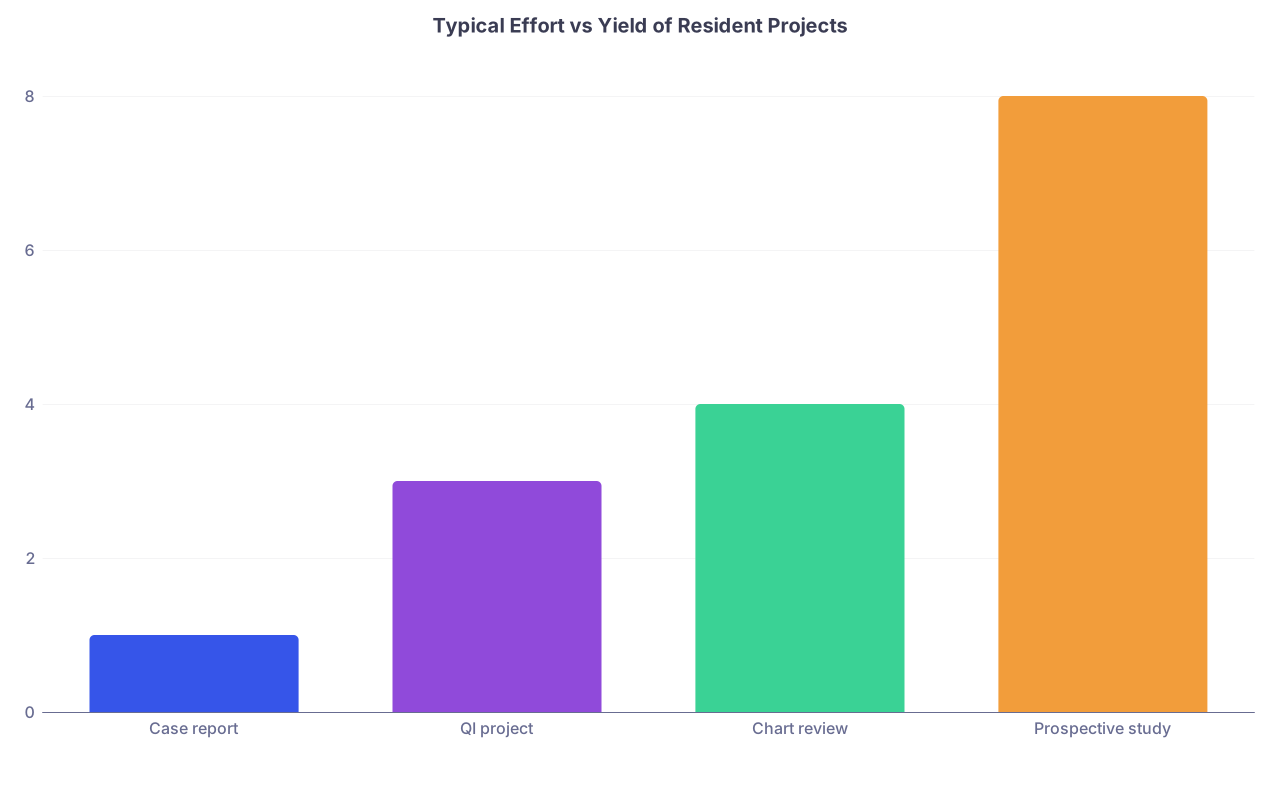
| Category | Value |
|---|---|
| Case report | 1 |
| QI project | 3 |
| Chart review | 4 |
| Prospective study | 8 |
(Think of that as effort level, not some fancy metric. Case report = light lift, prospective study = you’ll be done by retirement.)
Step 3: Carve out time without tanking your reputation
At a community program, residents live and die by clinical performance. If you look like you’re chasing CV lines while dropping balls on the floor, faculty will not support your “academic interests.”
So:
- First 3–4 months: be a rock‑solid intern. On time, notes done, patients know your name.
- Once you’ve proven you’re reliable, start blocking protected time in ways that are realistic:
- Use golden weekends occasionally for research blocks
- Do 30–60 min data pulls or analysis on lighter days
- Take a 1–2 week vacation block in PGY‑2 and convert part of it into research time (yes, this is not “vacation,” but if you want academics, this is the trade sometimes)
You don’t ask your PD for formal “research time” before you’ve shown you can handle normal resident life. That’s how you get labeled “not a team player” at a small program.
5. Linking from your community program to academic people and institutions
This is where people at community programs either win or disappear.
You need bridges—connections out of your hospital and into the academic world.
Bridge 1: Regional and national meetings
Your first goal: something you can submit as an abstract.
- A single‑center QI project
- A case series
- A chart review with a clean story
Target meetings that take posters generously:
- Specialty societies (ACP, ATS, AHA, ACG, APA, etc.)
- Regional chapters (e.g., ACP state meetings, regional EM/Peds meetings)
- National hospital medicine or QI conferences
Once accepted, this does three things:
- Gives you a line on your CV
- Gets you in physical rooms with academic people
- Lets you say in future applications: “Presented at [X] national meeting”
Bridge 2: Cold outreach to academic mentors
Yes, cold emails. People in academics are used to this. Most ignore; a few respond.
Your email template:
Subject: Resident at [Hospital Name] interested in [X] – possible collaboration?
Dear Dr [Name],
I’m a PGY‑[1/2/3] in [specialty] at [Hospital]. During residency I’ve become especially interested in [specific topic]. I recently completed/started a project on [1–2 line description].I came across your work on [specific paper/topic] and it closely aligns with where I’d like to grow. Given I’m at a community program with limited research infrastructure, I’m looking for mentorship and possibly opportunities to contribute remotely (data collection, literature reviews, etc.) to projects in this space.
Would you be open to a brief 15–20 minute call to see if there’s a way I could be useful to your work and learn in the process?
Best,
[Name, PGY‑X, contact info]
You’re not begging for a letter. You’re offering value (work) and being honest about your context.
Bridge 3: Local university affiliations
If your community hospital sends students from a med school or is part of a teaching network:
- Find out which university department claims your hospital
- Ask faculty: “Who at the university might be open to resident collaboration?”
- Show up to grand rounds, tumor boards, journal clubs whenever you can
The goal is to become “the resident from [X community site] who always shows up and is hungry.”
6. Positioning yourself for fellowship or an academic job coming from community
The endgame: you want to apply for fellowship or academic positions and not sound like you just woke up in PGY‑3 and panicked.
Here’s what you need on paper by the time you apply:
- At least 1–2 completed projects with:
- Abstract or poster at a regional/national meeting
- Ideally one publication (even a case report or short comm)
- Consistent involvement, not one‑off “I did a case report once”
- Strong letters that explicitly say:
- You sought out research in a resource‑limited environment
- You drove projects forward independently
- You’re serious about an academic trajectory
If you’re targeting top‑tier, hyper‑academic fellowships, you’d like:
- 2–4 total pubs/abstracts, with at least one original project
- Some link to a known academic mentor (co-author or letter-writer)
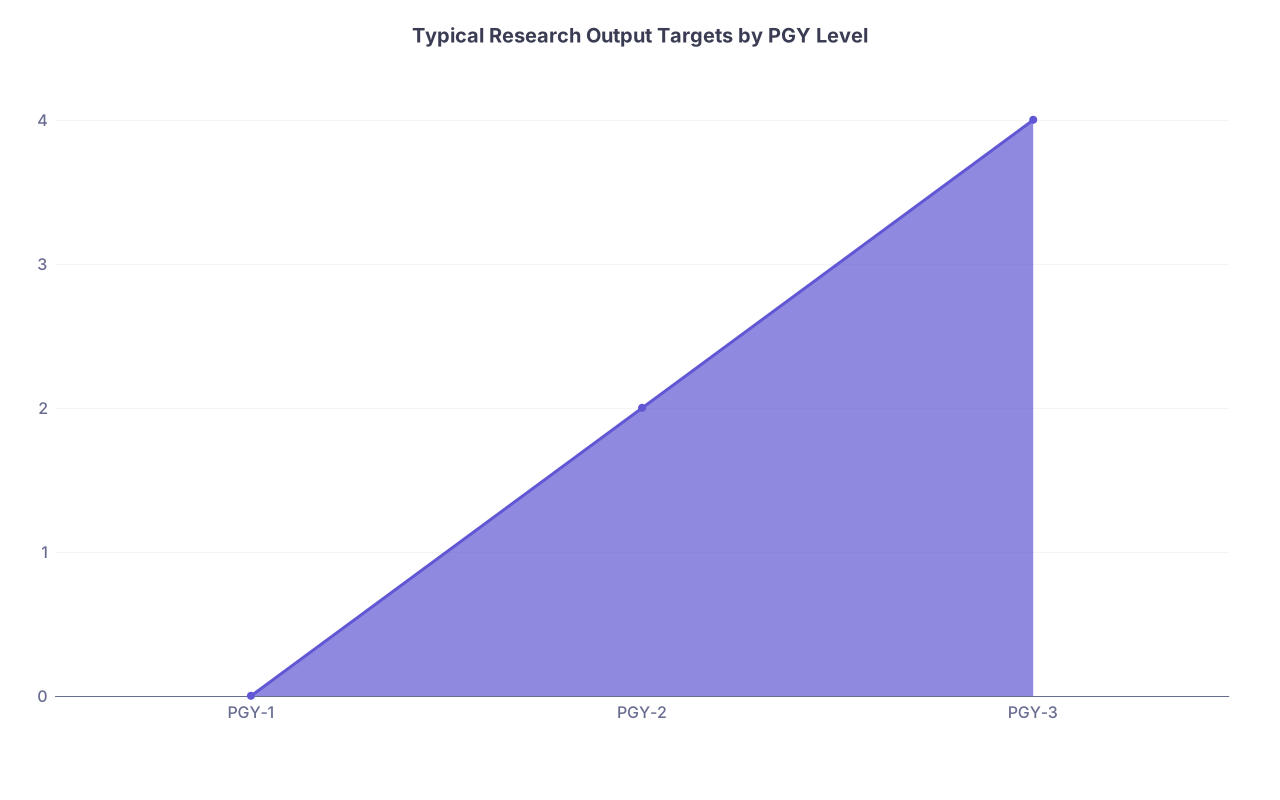
| Category | Value |
|---|---|
| PGY-1 | 0 |
| PGY-2 | 2 |
| PGY-3 | 4 |
Interpretation: in PGY‑1 you’re mostly starting; by PGY‑2 you should have 1–2 concrete things; by PGY‑3 you’re applying with something that looks like a pattern, not an accident.
7. How to talk about your “late discovery” without sounding flaky
You will be asked: “So why academics? Why research?” And they’ll see you trained at a community program.
Your story needs three beats:
Honest origin
“I didn’t start residency planning an academic career. I chose my program for its strong clinical training and supportive culture.”Concrete turning point
“During PGY‑1 I led a QI project on [X]. Getting into the data and seeing how small changes affected outcomes pulled me in. I realized I enjoyed the process of asking questions and systematically answering them.”Action, not just realization
“Since then I’ve [started/completed] [projects], presented at [meetings], and sought out mentorship from [name/affiliation]. Even without a large research infrastructure, I’ve been deliberate about building skills and contributions that I can bring to an academic environment.”
That’s a coherent narrative. No one expects you to be born wanting R01 grants.
8. When (and whether) to consider transferring programs
Everyone in your shoes eventually fantasizes about this: “Should I try to switch into an academic program?”
Here’s the blunt version.
A transfer might make sense if:
- You’re early (PGY‑1), truly miserable, and at a tiny place with almost zero academic opportunity
- You discover a strong reason (geographic/family + academic) to move
- You’re willing to accept uncertainty and maybe repeat a year
A transfer is not a smart plan if:
- Your only issue is “this place isn’t famous enough”
- You already have a few projects and possible fellowship routes where you are
- You’re in a specialty where your community program still places into solid fellowships (ask the PD for a list)
Most of the time, you’re better off maximizing your current context than detonating everything to chase an academic logo.
If you genuinely think a transfer is warranted:
- Talk privately with 1–2 trusted faculty first, not the whole program
- Be clear this is about career fit, not trashing your current place
- Understand there are very few open PGY‑2/3 spots and that you’re competing with people who often have much more obvious red flags or specific life reasons to relocate
9. Mental traps that will waste your time
I’ve watched residents in this exact situation lose a year to bad thinking. Avoid these:
“I’m behind, so I need a huge project”
No. You need finished projects. A modest QI project you complete and present beats an ambitious multicenter trial that dies in IRB purgatory.“My program doesn’t support research, so I can’t do it”
Some programs truly are black holes, but many are just passive. They won’t chase you with opportunities; you have to engineer them.“If I can’t get into a top‑5 fellowship, there’s no point”
This is insecurity talking. Plenty of excellent academic careers start at mid-tier places with solid mentorship and time.“Once I’m in fellowship, then I’ll start doing research”
Fellowship selection committees love patterns. If your pattern is “I say I like research but never had time,” you will not be their top choice.
10. What this actually looks like, month-by-month
Let me spell out a rough playbook if you’re an IM PGY‑1 at a community program who just discovered this interest. Adjust the specialty, the skeleton holds.
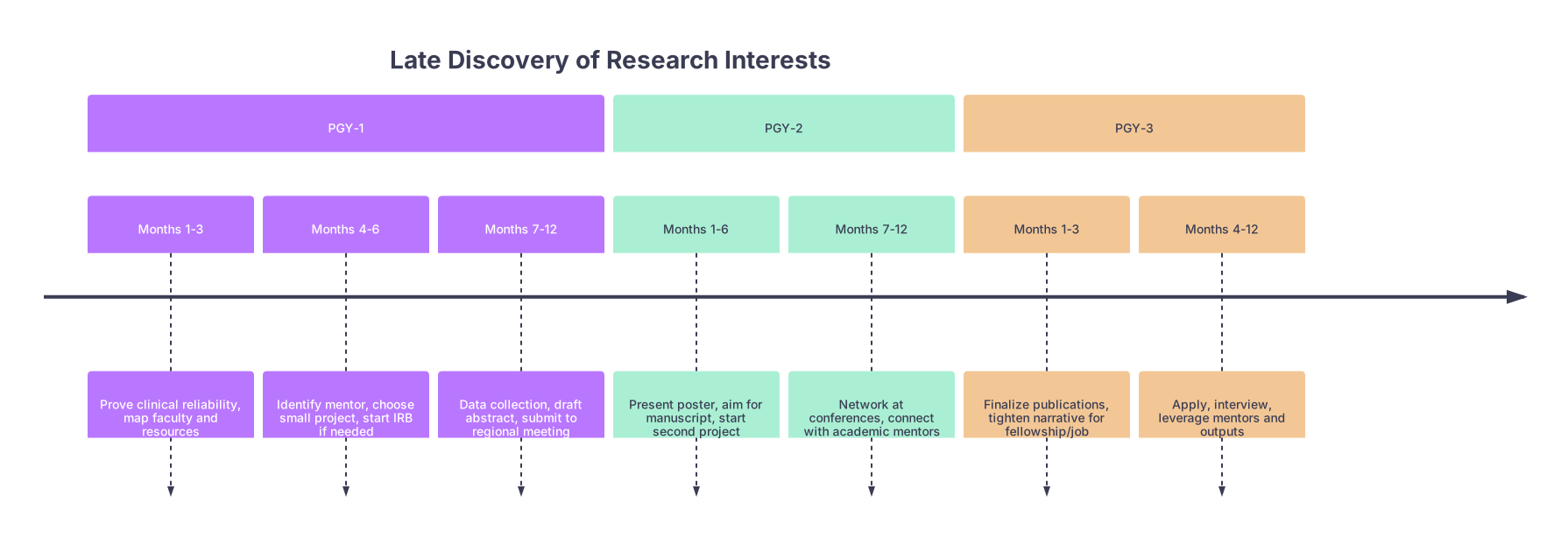
| Period | Event |
|---|---|
| PGY-1 - Months 1-3 | Prove clinical reliability, map faculty and resources |
| PGY-1 - Months 4-6 | Identify mentor, choose small project, start IRB if needed |
| PGY-1 - Months 7-12 | Data collection, draft abstract, submit to regional meeting |
| PGY-2 - Months 1-6 | Present poster, aim for manuscript, start second project |
| PGY-2 - Months 7-12 | Network at conferences, connect with academic mentors |
| PGY-3 - Months 1-3 | Finalize publications, tighten narrative for fellowship/job |
| PGY-3 - Months 4-12 | Apply, interview, leverage mentors and outputs |
Is this aggressive? Yes. Is it doable for a resident with normal work hours? Also yes—if you accept that some evenings and weekends become “research time.”
11. The quiet advantage you gain by starting late
One last thing: starting “late” has a hidden upside.
People who realize in PGY‑1 or PGY‑2 that they genuinely like research usually aren’t chasing prestige. They’ve seen actual patient care, they’ve been on nights, they know medicine is not Instagram. So when they say, “I want to study X because I keep seeing Y on the wards,” it comes from reality, not romance.
Academic leaders like that. Committees like that. Patients certainly benefit from that.
You’re not trying to cosplay as a PhD. You’re bringing the grind of a community residency and converting it into good questions and solid work. If you can frame it that way and do the actual labor, you will absolutely find a path into academics from a community starting point.
You’re not behind. You just started your second career—your academic one—a bit later than some. That’s fine. Now the question is whether you treat it like a real commitment or just another passing interest.
Get your first project scoped. Send the first email. Book the first 30‑minute work block. That’s how this starts.
The rest—fellowships, faculty jobs, grant ideas—will come. But that’s for another stage of your training.