
Last spring, a third-year med student sat in my office, ERAS spreadsheet open, eyes darting between two tabs. One was a big-name academic program with “prestige” written all over it. The other was a no-name community program with shockingly good case numbers. “I just want the best training,” he said. What he did not realize—and what nobody had ever explained to him—is that which hospital he chose was really a question about money. Who pays. For what. And why.
If you do not understand the funding streams behind a residency, you are flying blind. Because money quietly dictates your call schedule, your operative volume, how much clinic you get, how much research you’re expected to do, and even how program leadership treats you when budgets get tight. Residents like to talk about “fit” and “culture.” Program directors talk about “mission.” The C-suite talks about “alignment.” Underneath all of that is one blunt driver: revenue.
Let me walk you through what actually happens behind those closed-door meetings when they decide how to use you.
The Core Reality: You Are a Cost Center, a Revenue Engine, or Both
Here’s the first ugly truth faculty don’t spell out on interview day: administrators look at residents in one of two ways—either as an investment that may pay off indirectly, or as a semi-cheap labor force that supports revenue-generating services.
Academic hospitals lean heavily on the first narrative: residents as an educational and research investment funded by federal dollars and subsidies. Community hospitals, especially non-teaching ones that start new programs, often lean toward the second: residents as a workforce that allows them to expand service lines.
That difference is mostly about where the money comes from.
At a high level, residency funding streams usually involve some mix of:
- Federal GME dollars (Medicare)
- State/Medicaid educational support (varies a lot by state)
- Hospital operating revenue (clinical income)
- Faculty practice plans (billing from attendings and subspecialists)
- Grants, philanthropy, and research overhead (academic-heavy)
- Corporate/health system “strategic initiatives” money (expansion, new service lines, branding)
The ratio of those streams is not trivia. It’s the Rosetta stone for why your schedule looks the way it does and why your program director fights for some things and quietly folds on others.
How Academic Programs Are Funded: GME Dollars, Prestige, and Pressure
Let’s start with the “classic” model: big university-affiliated academic centers.
The GME cap nobody talks about on tour
Most academic residency positions are funded through Graduate Medical Education (GME) payments from Medicare. The government pays hospitals for “training” based on historical formulas that were essentially frozen in the late 1990s. That freeze—called the GME cap—means many big academic centers are already maxed out and cannot easily add more fully-funded residents.
So what happens?
They start playing shell games. They shift residents across affiliated sites to maximize reimbursement. They open “new” training tracks in community partners where additional funding might be available. They get creative with calling some positions “unfunded” or “partially funded” while covering gaps from hospital or departmental funds.
Programs rarely say this out loud, but it matters. If your slot is not fully GME-funded:
- Your position is less secure in a financial crisis.
- You may be pushed into more service-heavy rotations to “justify” your cost.
- Leadership may be under quiet pressure to show that “adding these residents increased throughput.”
And yes, when budgets get cut, unfunded or partially funded positions are the first under the microscope.
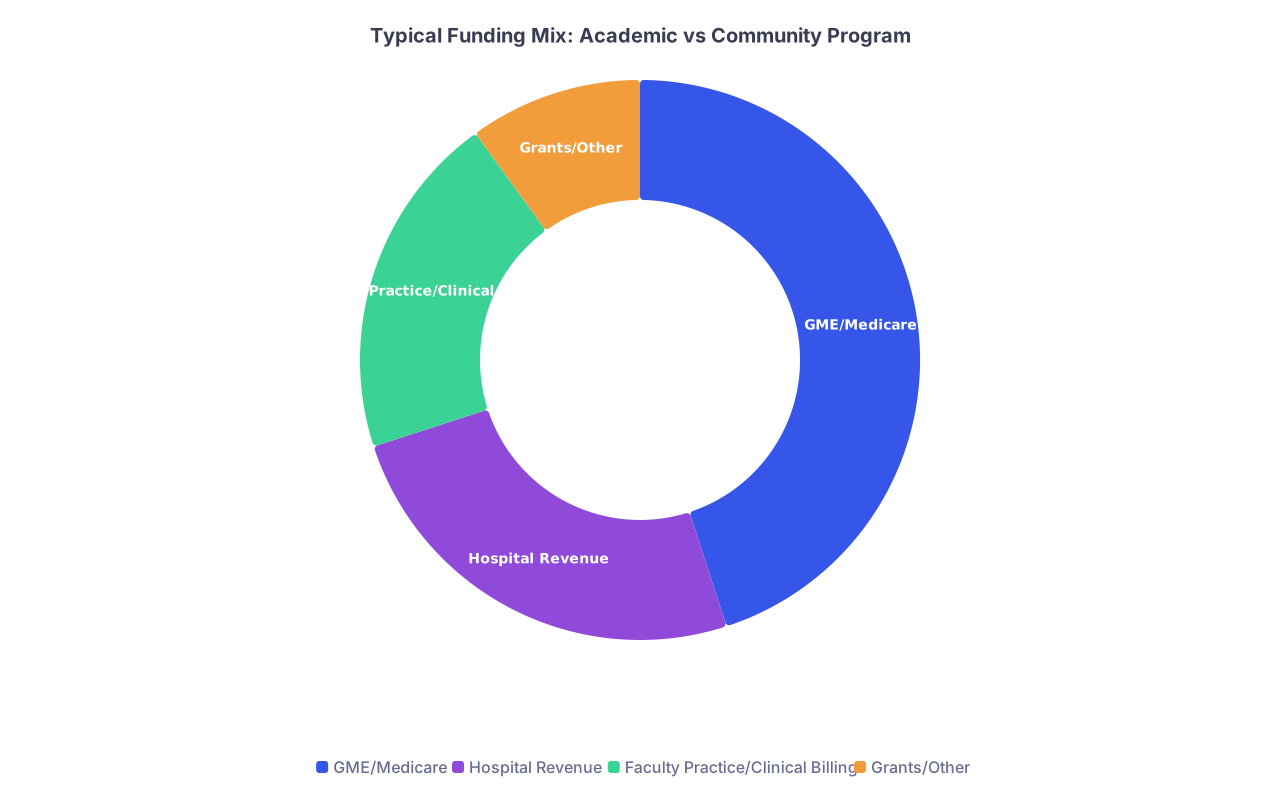
| Category | Value |
|---|---|
| GME/Medicare | 45 |
| Hospital Revenue | 25 |
| Faculty Practice/Clinical Billing | 20 |
| Grants/Other | 10 |
That chart is a rough silhouette of a traditional academic program: heavy GME support, decent chunk from hospital revenue, plus side streams from faculty billing and research.
Research prestige and the invisible subsidy
Academic centers that brag about NIH ranking or “top-20” status are playing a different game. Federal grants and research overhead don’t directly “pay” your salary, but they absolutely shape your life.
Here’s how the money loop works behind the scenes:
Faculty bring in grants → University takes a cut (overhead/indirects) → That money helps pay for infrastructure: labs, cores, admin, sometimes protected time → Protected time means attending availability on service shrinks → Residents absorb more scut and front-line work → Residents also become inexpensive research manpower.
So at a heavy research place, you may get:
- More pressure to publish, present, and “represent the program.”
- Blocks of “protected research time” that sound great but are often politically charged—who actually gets them, who doesn’t.
- Attendings who are half in, half out clinically because their real currency is grants, not your teaching.
Does that mean your education is worse? Not necessarily. But you aren’t the top priority line item. The money is.
How Community Programs Are Funded: Service Lines, Throughput, and “Value”
Now let me turn the lens to community programs, especially the newer ones.
When a community hospital decides to start a residency, it’s rarely out of pure altruism or a sudden passion for medical education. It’s strategy.
They want:
- More stable physician staffing in high-need areas (ED, hospitalist, primary care, certain surgical services).
- A pipeline of physicians who might stay in the network.
- A marketing win: “We’re a teaching hospital now.”
The funding mix looks very different.
| Aspect | Academic Program Focus | Community Program Focus |
|---|---|---|
| Primary Funding Source | GME + University/Hospital | GME + Hospital Operations |
| Top Admin Concern | Reputation, research, caps | Throughput, coverage, growth |
| Resident Role | Learner + junior workforce | Workforce + learner |
| Big Selling Point | Prestige, fellowships | Autonomy, case volume |
| Vulnerability | Grant cuts, GME caps | Census drops, service changes |
In many community settings, GME dollars are still there, but administrators watch one thing obsessively: does having residents help or hurt the bottom line?
I’ve sat in those meetings. Here’s the subtext:
- “Residents slowed down clinic today” = loss of revenue.
- “Residents staffed the night shift and allowed us to reduce locums” = cost savings.
- “Our surgical volume increased when we added residents to the service” = justification for more slots.
This is why so many community program websites pound the drum of “high autonomy” and “hands-on experience.” That’s not just educational philosophy. It’s financially convenient. If you, as a PGY-2, can cross-cover three floors of medicine patients with one attending on call from home, that’s a labor model.
Mixed Models: Community-Based, University-Affiliated Hybrids
Then there’s the messy middle: community hospitals affiliated with academic centers. A lot of internal medicine and FM programs live here, and this is where applicants get the most confused.
On paper, it sounds like the best of both worlds. In reality, it can be either the best or the worst, depending on one thing: who actually controls the money.
If the university holds the GME contracts and “leases” residents to the community sites, the academic center often calls the shots on curriculum and structure. Residents may rotate between a high-powered academic hub and a service-heavy community satellite.
If the community hospital is the primary sponsoring institution, with loose academic affiliation mostly for branding and occasional electives, the hospital C-suite has more leverage. Education competes directly with operational needs.
You’ll hear language like:
- “Aligning resident schedules with service needs”
- “Optimizing resident presence for patient flow”
- “Leveraging trainees to expand coverage”
All of those phrases are about money. I’ve heard them used explicitly when arguing to change call schedules, restructure clinic, or push residents into extra nights.
How Funding Streams Shape Your Daily Life
Let’s get concrete. Here’s how these different money sources show up in what you actually feel as a resident.
1. Operative and Procedural Volume
In a big academic surgical program, the hospital often has complex, high-acuity cases that draw in referrals. That’s great exposure—but also brings competing interests:
- Fellows may get first pick of complex cases because their future careers (and fellowship placement stats) matter to the department and its reputation.
- Attendings may want to “just get the case done” for efficiency and billing reasons, especially when ORs are slammed and turnover metrics are under scrutiny.
- Some high-revenue procedures get protected from trainee slowdown.
In community surgery programs without fellows, the dynamic flips:
- You’re often the only learner in the room. All the teaching goes to you.
- Attendings may be more procedure-hungry themselves, but they also know the marketing benefit of turning out competent, “hands-on” residents.
- Hospital admin likes that residents extend OR hours and support call coverage without having to pay as many midlevels or additional attendings.
So if your main priority is procedural competence and high-volume bread-and-butter surgery, a well-run community program can beat a brand-name academic one. Yes, even for competitive fellowships. I’ve seen fellowship directors quietly say, “The community grad knew how to run a room. The university grad needed more hand-holding.”
2. Clinic vs Inpatient Time
Funding decides where the hospital wants your body.
Academic departments often depend on faculty clinic revenue to stay afloat. Faculty see more patients → more billing → more departmental stability. But residents slow clinic down. So what do they do?
- They carve out “resident clinics” with lower productivity expectations.
- They limit your clinic days, or put you mostly in teaching clinics tied to specific grants, FQHCs, or state funding.
- They tacitly prioritize attendings’ high-revenue private clinics over resident continuity when conflicts arise.
In many community programs, especially primary care-heavy ones, residents are used to build out large continuity clinics:
- Residents become the core workforce of hospital-owned outpatient practices.
- Your panel size and clinic time increase as you progress in training.
- The hospital uses you to capture downstream revenue: tests, imaging, procedures, admissions.
On paper: more continuity and outpatient experience. In practice: sometimes you’re the cheapest primary care “provider” in the building, overseen by a single overbooked attending signing all of your notes.
3. Call Structure and Night Coverage
If you want to know how a hospital values residents, ask who covers nights and how much they rely on locums or moonlighters.
Where GME and education are the main drivers (classic academic center), you tend to see:
- More elaborate night float systems to avoid 24+ hour calls (sometimes driven by wellness and accreditation pressure).
- Dedicated “teaching nights” where attendings are in-house and not just on home call.
- Fellows doing more of the ugly cross-cover in some specialties.
Where hospital operations and cost-cutting dominate (many community/satellite sites), you’ll see:
- Residents as the primary night coverage for multiple services or even multiple physical sites.
- Attendings on home call covering large areas, with residents expected to “filter” and only wake them for critical issues.
- Pushback if you suggest adding another resident to nights—because that means losing daytime FTE somewhere else or funding an additional slot.
Here’s the non-romantic explanation: nights are expensive. If admin can replace three nocturnists with one nocturnist + two residents on night float, the spreadsheets look amazing. Whether that’s safe, sustainable, or educational? That’s secondary unless someone stands up and fights using ACGME language—and they will not always do that.
The “Unfunded” and “Over-the-Cap” Positions: Red Flags You Should Recognize
You’ll occasionally hear a program brag that it’s “growing” or “expanding.” More spots. More trainees. Sounds flattering. It is not always in your best interest.
Because of the GME cap I mentioned earlier, any position above that cap is often:
- Hospital-funded (from operating margins)
- Temporarily grant-funded
- Cross-subsidized from other services
When margins are good, everyone’s happy. When the system has a bad year, you suddenly hear phrases like “right-sizing the residency” or “redistributing educational resources.”
You don’t need to be a finance analyst to spot trouble. Just ask bluntly on interview day:
- “Are all of your positions fully GME-funded?”
- “Have you added any over-the-cap positions in the last 5 years?”
- “Has the program ever had to reduce positions or residents due to funding?”
If they get cagey, or nobody can give you a straight answer, that’s information. Because I’ve watched programs quietly drop a PGY class size, or not backfill a resident who left, because the CFO started asking questions.
State Money, Medicaid, and Safety-Net Hospitals
One more layer almost nobody explains to students: state and Medicaid-driven funding.
Safety-net and county hospitals often depend heavily on:
- Medicaid reimbursements
- State DSH (disproportionate share hospital) payments
- State-specific GME or workforce grants
These hospitals:
- See complex, underserved populations.
- Have insane clinical volume and pathology.
- Run tighter margins and are chronically under-resourced.
For you, that can mean phenomenal clinical training. You’ll see things most suburban programs only read about. But the financial stress leaks into your day:
- Old equipment, short-staffed units, chronically broken ancillary systems
- Pressure to move patients to keep beds open for high-need cases
- Less time and bandwidth for formal teaching; most of your learning is “on the fly”
Some of the best internists, surgeons, and EM docs I’ve seen trained at county programs that were constantly one budget cycle away from losing a service line. They came out tough, resourceful, and clinically sharp. But they paid for it in burnout and chaos.
What You Should Be Looking For (But No One Tells You To)
You’re not going to get a line-by-line GME budget on interview day. But you can absolutely read the signals if you know what to ask and what to watch.
Look for these patterns:
Who talks during your interview day?
If it’s mostly marketing folks and hospital executives, with very little time with residents unfiltered, that’s a red flag. Hospitals that see residency as a branding/operational tool tend to over-script the day.How do residents describe their role off-script?
Away from faculty, ask: “When the hospital is short-staffed, who feels it first?” If they say, “Us, always us,” you know where you stand on the priority ladder.What happens when census spikes?
“We cap at 16 patients” is meaningless if they also say, “We routinely break cap when ED is boarding.” Translation: service wins, education loses. That’s an admin culture and funding values problem.What’s the story of how the program started or expanded?
- “We’ve had residents for 40 years; the hospital has always been an academic center” → stable, education baked into DNA.
- “We started 5 years ago as part of a system expansion plan” → still proving to admin that residents are “worth it.”
Are there fellows? Where and why?
Heavy fellowship presence in an academic center usually means strong subspecialty depth but more competition for cases. In a community place, the sudden arrival of a new fellowship can be about capturing more complex cases (and revenue), not about building your learning experience.
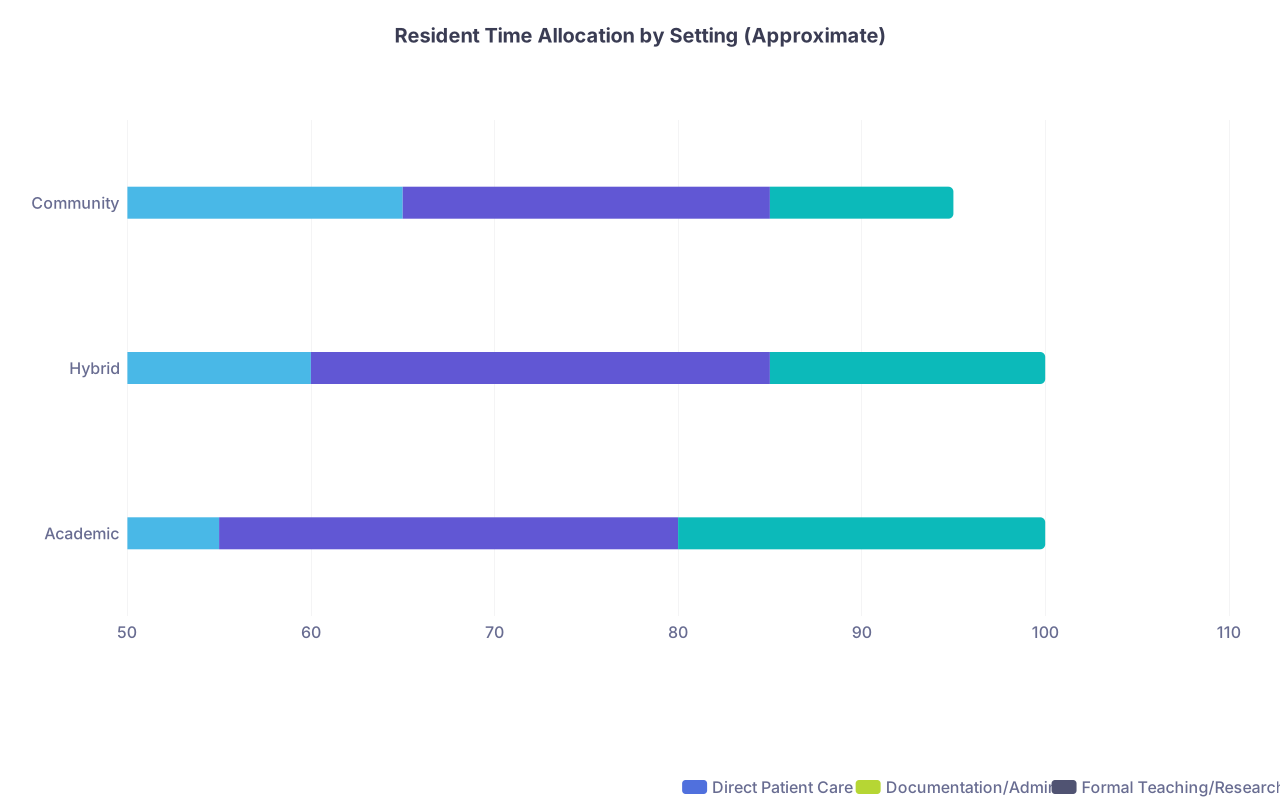
| Category | Direct Patient Care | Documentation/Admin | Formal Teaching/Research |
|---|---|---|---|
| Academic | 55 | 25 | 20 |
| Hybrid | 60 | 25 | 15 |
| Community | 65 | 20 | 10 |
Those numbers aren’t exact, but the tilt is real: the more community- and operations-driven the setting, the more of your time goes directly into throughput. That can be excellent or awful, depending on supervision and culture.
Two Composite Residents: Same Specialty, Different Money, Different Lives
Let me give you two very real composites from people I’ve worked with.
Resident A – Academic Powerhouse IM Program
- Large university hospital + VA + county site
- Strong NIH funding, multiple subspecialty fellowships
- Residents funded mostly by capped GME dollars with some hospital support
Her life:
- Inpatient months are intense but well-supervised; many fellows, a lot of complex patients.
- Outpatient continuity clinic only 1 half-day a week most of PGY-1, more later.
- Research is heavily pushed; she gets one full research elective per year, but she fights with co-residents for certain mentors.
- Night float is standard; there’s always an in-house nocturnist or fellow backing her up.
- She graduates with an impressive CV and a strong shot at competitive cards or GI fellowships, but she feels underexposed to bread-and-butter ambulatory medicine.
Resident B – Community-Based IM, University-Affiliated
- Sponsoring institution is a mid-sized community hospital
- Affiliation with a nearby med school for branding and a few electives
- Positions expanded quickly after launch; a few over-the-cap slots
His life:
- Heavy continuity clinic load, almost a full day weekly even as an intern.
- On nights, he often covers two floors of medicine with a hospitalist at home and a senior in-house.
- Teaching is variable. When census is high, morning report disappears and sign-out is in the hallway.
- He logs more procedures than his academic peers and feels very comfortable running codes and cross-covering sick patients.
- The program director frequently reminds residents to “show our value to leadership” during budget season.
Which one got “better” training? That is the wrong question. They each became excellent physicians—just shaped by different financial ecosystems.
How to Use This Knowledge When You Build Your Rank List
You cannot change how residency is funded. You can absolutely choose how much you let those hidden forces blindside you.
When you evaluate programs, stop asking only “community vs academic.” That’s lazy thinking. Ask:
- Who actually pays for these residents?
- What does the hospital gain by having residents here?
- When there’s tension between education and operations, who usually wins?
Then line that up with your goals.
If you want:
A research-heavy career, subspecialty fellowship at a top institution, and are ok being partly a cog in a big academic machine? A well-funded academic center where residents are secondary to grants and prestige might serve you well.
To be lethal on day one as an attending in community practice, comfortable running a service with minimal backup? A high-volume, service-heavy community or hybrid program, where your time equals throughput, might be ideal—if they also genuinely care about teaching.
A balanced life with strong education and reasonable expectations? You’re hunting for the rare culture where leadership is willing to say “no” to the C-suite when operations start to cannibalize teaching. That’s not about the label “academic” or “community.” It’s about who holds the line when money talks.

| Step | Description |
|---|---|
| Step 1 | Funding Source |
| Step 2 | Hospital Priorities |
| Step 3 | Staffing Models |
| Step 4 | Resident Schedule |
| Step 5 | Clinical Experience |
| Step 6 | Skills and Career Outcomes |
| Step 7 | University and Grants |
Once you see that chain, you can’t unsee it. And you shouldn’t.
Bottom Line
Three points to remember when you’re looking at “community vs academic”:
Labels are lazy; follow the money. GME caps, hospital margins, and research dollars decide how you’re used, not the marketing slide that says “academic” or “community.”
Your daily life is a direct reflection of who benefits financially from your presence—whether that’s more RVUs, cheaper night coverage, or better NIH rankings.
The smartest applicants don’t just ask, “Will I match here?” They ask, “Given how this place is funded, what kind of doctor will it turn me into?”