
Only about 55–60% of US MD seniors who match into internal medicine end up at university-based programs. The rest land in “less prestigious” community or hybrid programs that were supposedly impossible to match into… if you believed the hallway gossip.
The myth: academic = ultra‑competitive, community = safety net.
Reality: the line between “academic” and “community” competitiveness is a lot blurrier than most students want to admit. And in a few specialties, the stereotype flips completely on its head.
Let’s walk through what the match data actually shows, not what your stressed M3 classmate insisted during rounds.
The Basic Myth: Academic = Hard, Community = Easy
You’ve heard versions of this:
- “If your Step 2 is low, just rank community programs.”
- “University hospitals only take 250+ and AOA.”
- “Community is for people who couldn’t match academic.”
I see this mindset every cycle. Students building rank lists like there’s a single linear prestige ladder: big‑name university at the top, small community at the bottom, and “university‑affiliated community” tossed in if they run out of ideas.
Match data does not support that neat hierarchy.
First, the NRMP doesn’t label programs as “academic” or “community”. It classifies program types (university-based, community-based, community-based with university affiliation, military, etc.), and then you have to look at who actually matches where.
Here’s the punchline: when you look at where US MD seniors land, the differences in “competitiveness” between academic and community are much smaller than the mythology suggests, and they vary wildly by specialty.
What the Match Data Actually Shows
Let’s nail down the basic landscape first.
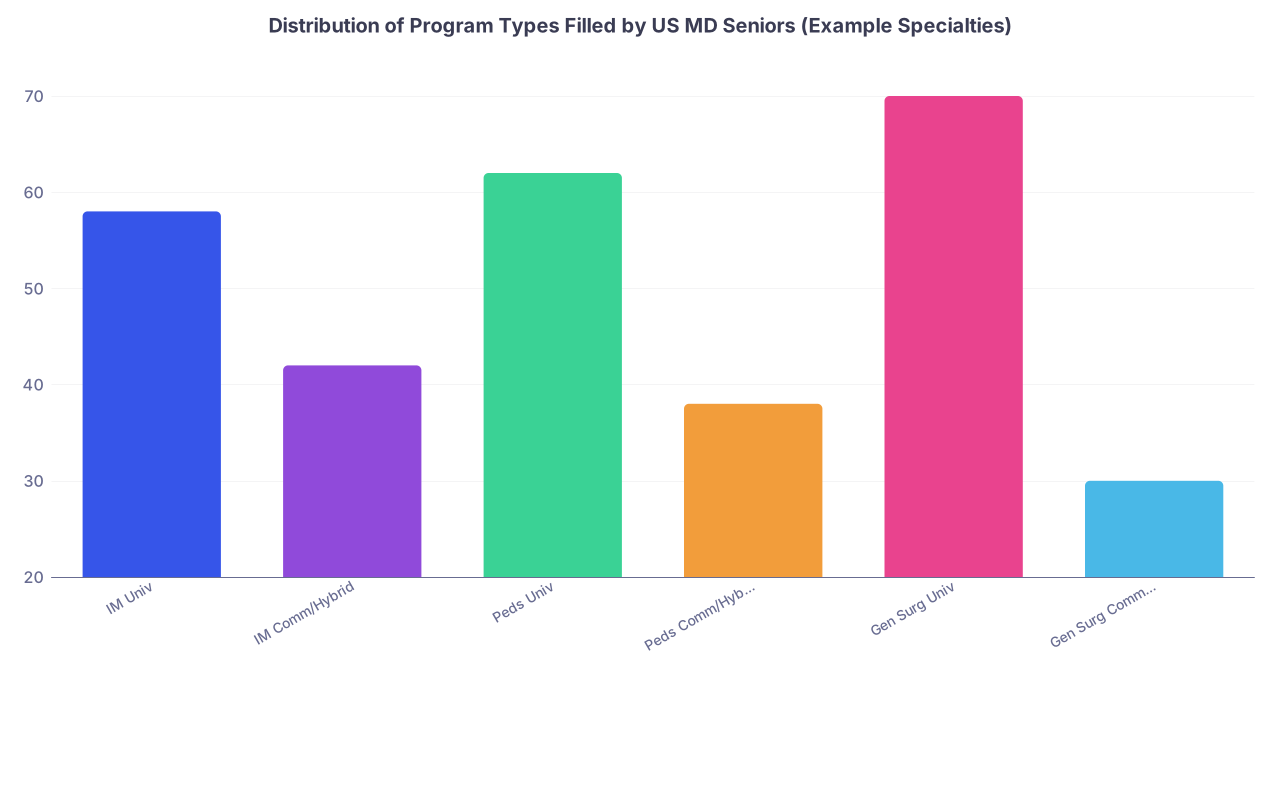
| Category | Value |
|---|---|
| IM Univ | 58 |
| IM Comm/Hybrid | 42 |
| Peds Univ | 62 |
| Peds Comm/Hybrid | 38 |
| Gen Surg Univ | 70 |
| Gen Surg Comm/Hybrid | 30 |
Those numbers are ballpark, pulled from trends in NRMP data over recent cycles for US MD seniors in internal medicine, pediatrics, and categorical general surgery. This is what they say:
- Most residents in these big core specialties are in university-based programs, but a huge chunk—30–45%—are in community or hybrid programs.
- Community ≠ backup bucket. It’s where a substantial fraction of first-choice ranks go.
And when you dig into USMLE scores and match outcomes, the pattern gets even more interesting.
Where Scores Really Matter (And Where They Don’t)
Let’s separate two different things people often conflate:
- Competitiveness to enter the specialty at all
- Competitiveness to land at a “top” program within that specialty
For very competitive specialties (derm, ortho, ENT, plastics, rad onc), you’ll see high USMLE cutoffs across both academic and community programs. Some tiny community programs in ortho or ENT run just as tight a screen as big-name academic centers.
The community vs academic split is much more obvious in the less competitive core fields—internal medicine, peds, family medicine, psych—where there’s real variation in program mission, resources, and applicant pools.
And that’s where the myth tends to be wrong in both directions:
- Some community programs are harder to get into than mid-tier academic ones.
- Some academic programs are far less selective than their logos suggest.
Specialty by Specialty: Where the Myth Breaks
Internal Medicine: The “Academic vs Community” Poster Child
People love to say: “If you’re gunning for cards/GI, you must do academic IM; community IM is backup only.”
What NRMP and fellowship match data actually show:
- University IM programs attract more applicants with higher average scores and more research. No surprise.
- But many large, well-regarded community hospitals (especially those with strong fellowship pipelines) quietly filter just as hard—particularly in saturated regions (NYC, Chicago, SoCal, Texas metros).
- Plenty of academic IM programs—often newer, smaller, or in less popular cities—have fill patterns and score ranges indistinguishable from solid community programs.
Here’s where students get burned: they assume “community = easier” and under-apply to them, while simultaneously overrating certain academic programs just based on name.
I’ve seen applicants with a 230‑ish Step 2, decent but not eye‑popping CV, get screened out of over-subscribed “mid-tier” academic IM programs but land interviews at highly selective community hospitals that value fit and interpersonal skills more than an extra 10 points on Step.
Surgery: Geographic Reality Check
General surgery is a good case study in how geography crushes the myth.
A well-known academic program in a midwestern city that isn’t on anyone’s “dream city” list may be statistically easier for a mid‑tier applicant than a community general surgery program in Southern California with a long track record and loyal local applicant pipeline.
Students cling to “but this is a university program, it must be harder” while residency coordinators in saturated urban community programs are throwing out triple‑digit applications per spot.
The NSQIP data and case logs also show that several high-volume community surgery programs offer busier operative experiences than some pedigreed academic ones where fellows dominate the OR. Residents know this. Word gets around. That drives demand—and competitiveness.
Pediatrics and Family Medicine: The Big Miss
In pediatrics and family medicine, the academic vs community competitiveness gap is often tiny.
The limiting factor isn’t “can I match somewhere?” It’s “can I match in the region and kind of program I want?”
You see this every cycle:
- Applicants underestimate how many people are trying to stay near a spouse or family.
- Community programs in desirable cities with good lifestyles get flooded with applications and can be pickier than they look on paper.
- Mid‑tier academic programs in less trendy regions sometimes struggle to fill early and become very accessible to solid applicants.
Calling academic “hard” and community “easy” in these specialties is just lazy thinking. It’s much more:
Desirable location + solid reputation + no malignant vibes = competitive, regardless of academic label.
Community Programs That Are More Competitive Than Academic Ones
Let’s talk about the programs that students mistake for “backups” and then can’t touch.
Classic example: well‑known community hospitals with:
- Strong fellowship placement (cards, GI, pulm/crit)
- Busy ICUs and procedural volume
- Tight-knit faculty who care about teaching
- Prime geography (major coastal cities, places with big immigrant communities, high case diversity)
These places don’t scream “prestige” on a PowerPoint slide. But among residents and fellows, their reputations are rock solid. Word of mouth does more for their competitiveness than any ranking.
| Program Type | City Attractiveness | Fellowship Pipeline | Relative Competitiveness* |
|---|---|---|---|
| Big-name academic IM | Medium | Strong | Very High |
| Older community IM with strong fellowships | High | Strong | High–Very High |
| New university-affiliated IM | High | Developing | Moderate |
| Small community IM, rural | Low | Limited | Low |
| Mid-tier academic peds, midwest | Low–Medium | Solid | Moderate |
*Relative competitiveness: compared with the median program in that specialty type.
Notice the second row. That’s the one people underestimate.
I’ve watched applicants with great stats aim only for top academic IM, get spooked late in the season, and then decide “I’ll just throw in a few community places in [very competitive metro area] as backups.”
They don’t understand they just entered a different, equally brutal pool—this one full of:
- Local rotators who impressed on audition
- Home medical students
- Residents from TY/prelim years trying to convert
- People with strong regional ties
On the flip side, some smaller academic programs in less-sought-after locations are begging for applicants with exactly that same profile.
Where Academic Programs Really Are Tougher
Let me be fair. The myth isn’t 100% wrong.
Top‑tier academic programs in hyper‑competitive specialties (derm, ortho, ENT, plastics, neurosurg) really do filter heavily by:
- Step 2 CK (since Step 1 went pass/fail)
- Research output (especially first‑author, specialty‑specific)
- Letters from recognized names
Big‑name university hospitals in IM, surgery, radiology, EM, anesthesia also see insane applicant volume. They can afford to be selective on:
- Scores
- AOA / Gold Humanism
- MD vs DO vs IMG status
- Red flags or non-traditional paths
In some very academic‑leaning fields (neurology, rheum, heme/onc fellowship pathways), strong research infrastructure and subspecialty exposure really are concentrated at universities. That attracts the more academically focused applicants, which raises the bar a bit on the front end.
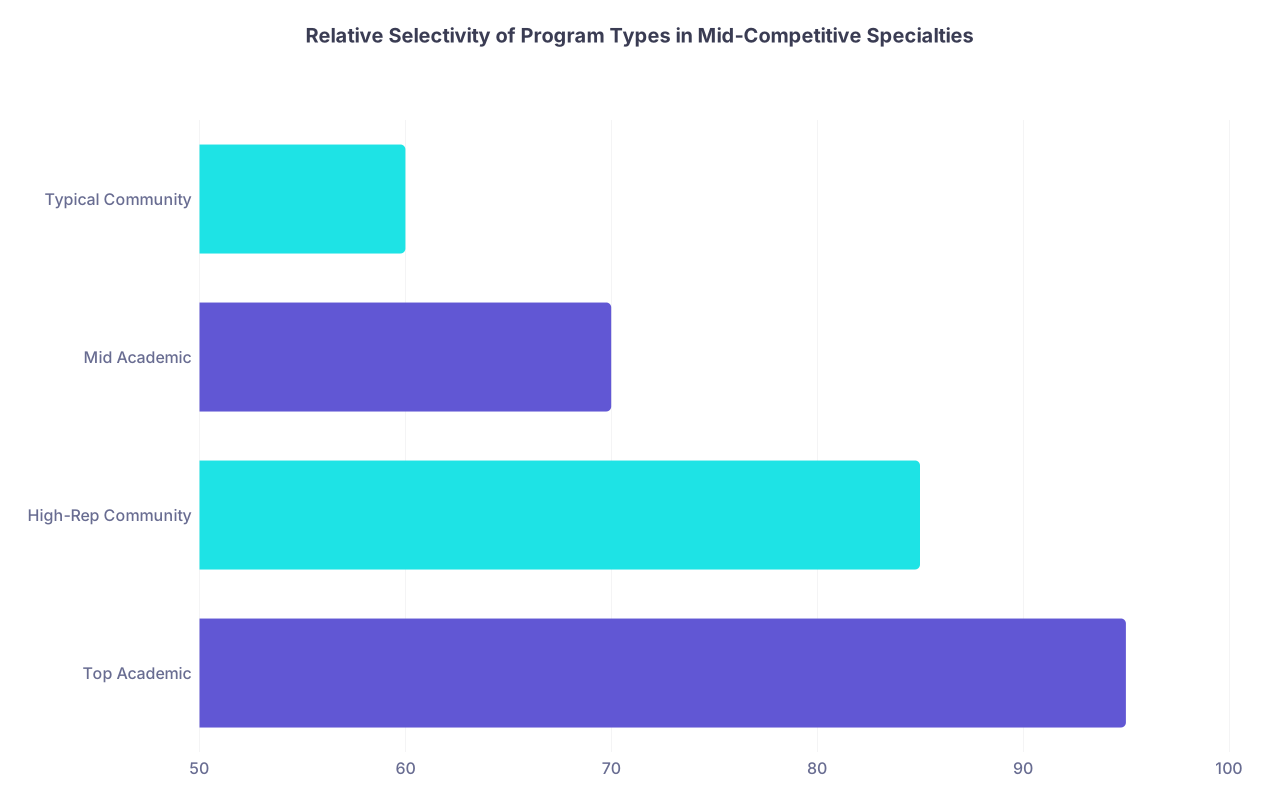
| Category | Value |
|---|---|
| Top Academic | 95 |
| High-Rep Community | 85 |
| Mid Academic | 70 |
| Typical Community | 60 |
Think of those percentages as “relative selectivity index” for a mid-competitive field like EM or anesthesia: not exact numbers, but a reasonable picture of the pattern. The top tier academic programs sit at the top, but notice how the high‑reputation community programs are not far behind—and sometimes harder to crack for outsiders because of regional preferences.
The Hidden Variable: Fit and Signaling
One reason the academic vs community “competitiveness” debate is so misguided is that it ignores how program directors actually choose residents.
Score cutoffs just get you in the door. After that, PDs care about:
- Will you do the work?
- Will you be miserable here?
- Will you fit with our residents?
- Do you actually want to be here versus using us as a backup?
Community programs, in particular, are hypersensitive to this. They’ve been burned enough by applicants treating them like second‑tier options that they can smell disinterest a mile away.
So the student with a 255 CK, three publications, and a faux‑enthusiastic boilerplate PS might absolutely lose a spot to someone with a 240 and a convincing story about why they want that specific city, those particular patient populations, and that hospital’s culture.
Academic programs do this too—but they have more bandwidth to launder it through formal metrics like research and letterhead. Community PDs often rely more heavily on interview impression, away rotation performance, and narrative signals.

| Step | Description |
|---|---|
| Step 1 | Applicant Pool |
| Step 2 | Heavier weight on research and pedigree |
| Step 3 | Score filter |
| Step 4 | Interview and fit |
| Step 5 | Geographic and personal ties |
| Step 6 | Academic Program |
| Step 7 | Community Program |
So, is the academic program “more competitive” if you have the stats but not the story? Depends who you are.
The Match Strategy Problem: Using the Wrong Mental Model
The real damage of the “academic = competitive, community = safety” myth is strategic.
I’ve watched students make the same mistakes over and over:
- Overloading their list with “mid-tier” academic programs in extremely popular cities and a tiny handful of distant community shots, then being shocked when interview season is thin.
- Ignoring well-established community or hybrid programs with great training because “I thought they were out of my league.”
- Applying to a bunch of academic programs they would never actually want to train at, while skipping nearby community ones that would be a far better fit and are just as competitive.
The right mental model is not a ladder. It’s more like a messy scatterplot of:
- Location desirability
- Program reputation (within the specialty, not on Google)
- Training resources (ICU, case mix, fellowship opportunities)
- Culture and workload
- Applicant pool dynamics (local schools, DO/IMG mix, historic loyalties)
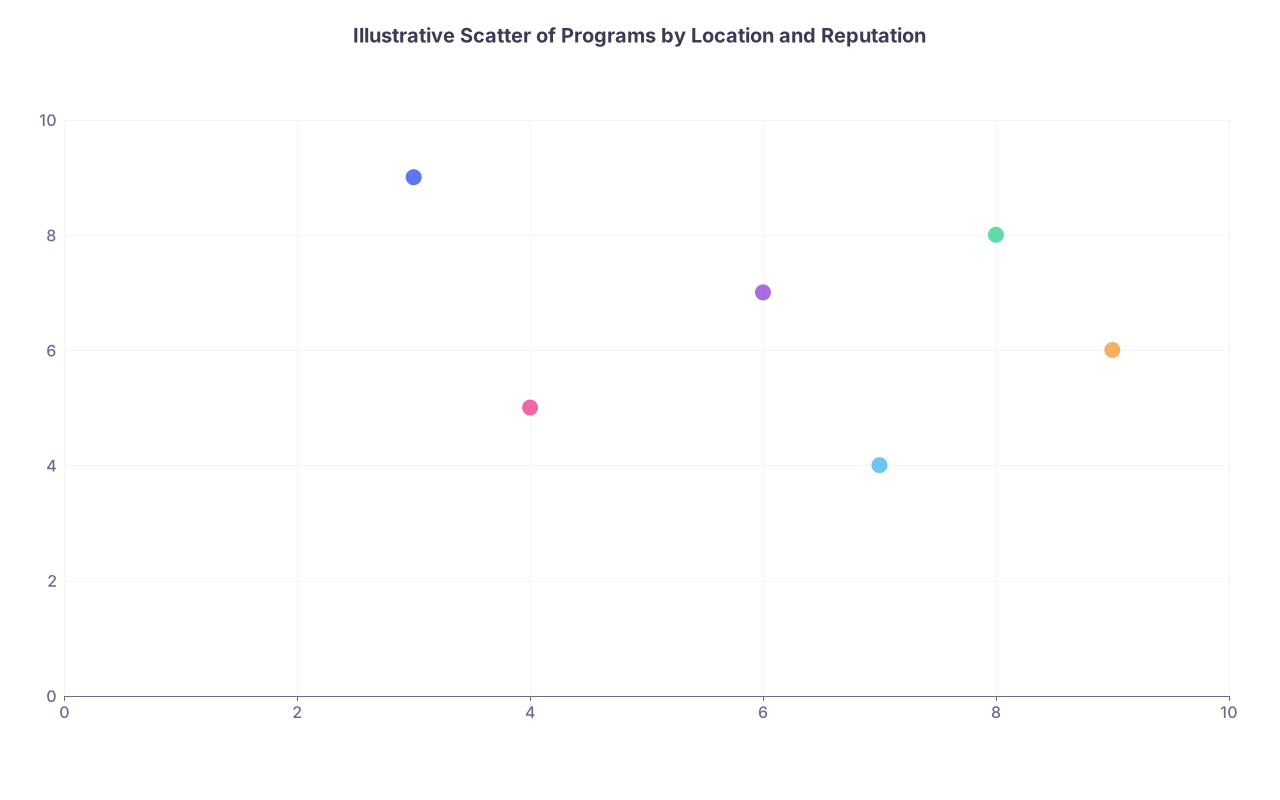
| Category | Value |
|---|---|
| Univ A | 3,9 |
| Univ B | 6,7 |
| Comm A | 8,8 |
| Comm B | 9,6 |
| Hybrid A | 4,5 |
| Hybrid B | 7,4 |
Imagine x‑axis = location desirability (1–10), y‑axis = specialty reputation (1–10). There’s no clean line where “academic” sits all the way on top and “community” huddles at the bottom. They intermingle.
Once you see that, the myth dies.
How You Should Actually Think About Academic vs Community
You should stop asking, “Are academic programs always more competitive?”
Ask instead:
- For my specialty, in my geographic targets, which specific programs attract the deepest pools of strong applicants?
- Where do my stats put me relative to those pools?
- What kind of training and career outcomes do I want: academic research, community practice, subspecialty fellowship, lifestyle, location?
- Which mix of academic, community, and hybrid programs actually match that?
Then build your application list accordingly, not by logo or lazy category.
And if you want a blunt rule of thumb: in most core specialties, strong community programs in attractive cities are at least as competitive as mid-tier academic programs in middling locations.
Ignore that, and your Match strategy leaks EV fast.
Key Takeaways
- Academic vs community is a terrible proxy for competitiveness; geography, reputation within the specialty, and applicant volume matter more.
- Many well-known community programs are just as selective—or more so—than mid-tier academic programs, especially in desirable cities.
- Build your application and rank lists by specific program characteristics and your own goals, not by the lazy “academic = hard, community = easy” myth.