The belief that “academic or bust” is the only smart residency strategy is dead wrong—and dangerously expensive.
You’re about to make one of the costliest, most avoidable mistakes in the Match: casually, almost automatically, writing off community programs in competitive fields.
The Hidden Disaster: Treating Community Programs as “Plan B”
Let me be blunt: ignoring community programs in specialties like dermatology, orthopedic surgery, radiology, anesthesia, EM, ophtho, ENT, urology, even competitive IM tracks—this is how otherwise strong applicants end up with a SOAP list, a scramble story, or a full-on reapply year they did not need.
The classic mindset that burns people:
- “I only want big-name academic centers.”
- “Community = weak training.”
- “If I can’t match academic, I’ll just do something else.”
- “Research is my thing, so I have to be academic.”
- “Community programs won’t help me match a competitive fellowship.”
I’ve watched this play out in real life:
- A 250+ Step 2, strong letters, no red flags. Applied derm only to powerhouse academics. 0 interviews. Later discovered several solid hybrid/community derm programs in their region that did take applicants with their profile—just not from their school because no one applied.
- An anesthesia applicant with mid-tier scores blacklisted every unbranded community program on their dean’s list. Overconfident in a handful of “reach” academic programs. Ended up SOAPing into a prelim year, then reapplying, now in a small community program anyway—two years delayed.
The mistake isn’t favoring academics. The mistake is treating community programs like they’re beneath you, instead of what many of them are: realistic, high-quality, career-shaping options that could save your Match.
Academic vs Community: Stop Believing the Lazy Myths
You’re not just comparing “good vs bad” here. You’re comparing different. If you don’t understand the differences, you will mis-rank, mis-apply, and misjudge.
| Factor | Academic Programs | Community Programs |
|---|---|---|
| Name recognition | Higher, national | Variable, often regional |
| Research intensity | High | Low to moderate |
| Service load | High subspecialty exposure | High generalist exposure |
| Autonomy | Often slower early | Often earlier, more hands-on |
| Fellowship pipeline | Strong in niche fields | Variable but improving |
The lazy myths I see applicants repeat every year:
“Community programs mean poor training.”
Wrong. Some of the best procedural volume, real-world autonomy, and bread-and-butter competence comes from community hospitals. I’ve seen community EM grads run circles around academically trained peers in actual shift work.“You can’t get a competitive fellowship from community.”
Also wrong. Harder in some fields? Yes. Impossible? No. I’ve seen:- Community IM → Cards, GI, Heme/Onc at big-name places
- Community anesthesia → Pain, ICU, regional at academics
- Community gen surg → Trauma/CC, MIS, vascular at strong centers
The consistent factor? The resident, not the zip code.
“Community programs are for weaker applicants.”
Outdated and arrogant. Some “community” or hybrid programs are insanely competitive now, especially in desirable cities or well-funded hospital systems.“Academic > community for every career plan.”
Completely false. If you want:- High-volume OR or procedure time
- Fast independence
- Private practice or community leadership
A busy community program can actually be the superior choice.
The real danger? You don’t bother to find out which programs are which. You just see “community hospital” and scroll past.
Where Ignoring Community Programs Actually Destroys You
Let’s get specific. Here’s where people get burned the hardest.
1. Underestimating Competitiveness and Over-shooting
You cannot afford magical thinking about your competitiveness.
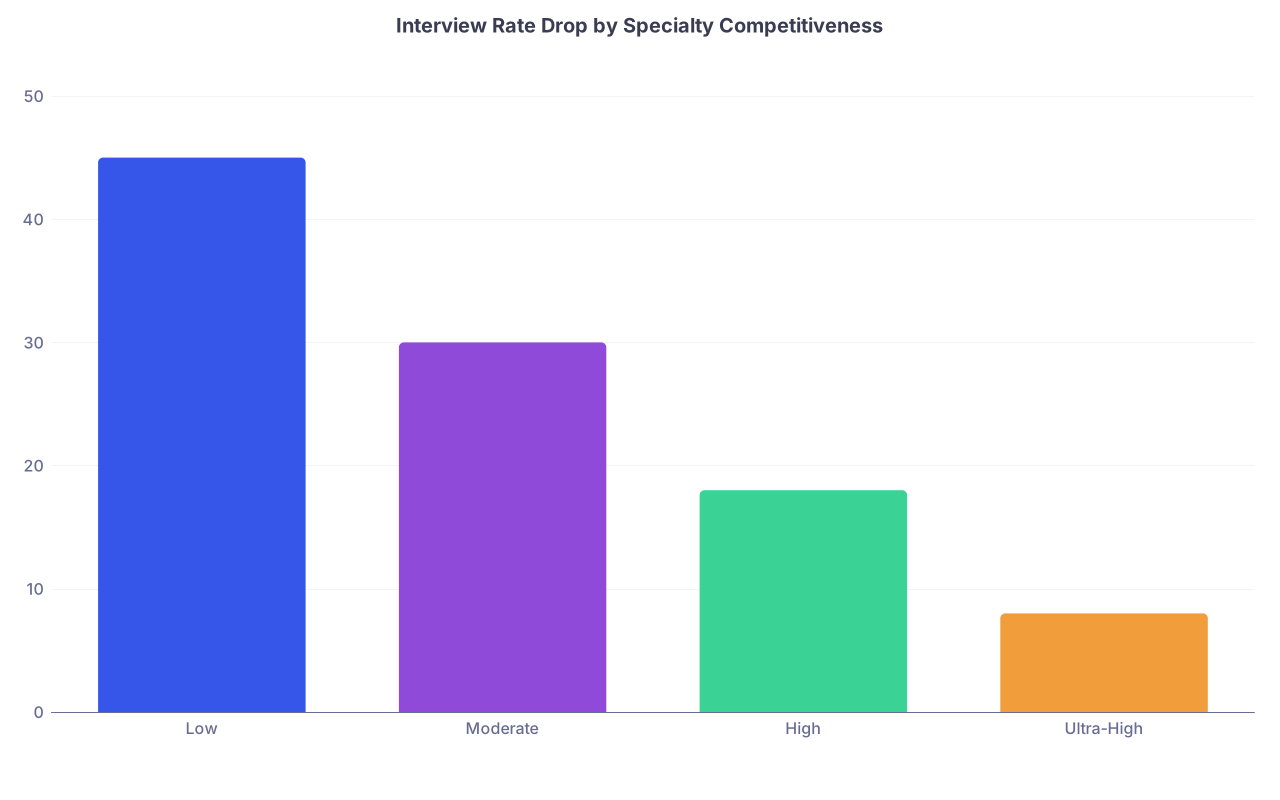
| Category | Value |
|---|---|
| Low | 45 |
| Moderate | 30 |
| High | 18 |
| Ultra-High | 8 |
Roughly how interview yield behaves across specialties:
- Low: FM, psych, peds – you can be choosy and still be safe.
- Moderate: IM, anesthesia, EM – you need a smart mix.
- High: radiology, gen surg, OB/GYN – ignoring community is risky.
- Ultra-high: derm, plastics, ortho, ENT, ophtho, urology – ignoring community is suicidal unless you’re truly top 5–10%.
The trap:
- You’re in a “high” or “ultra-high” competitive field.
- You apply mostly to name-brand academic centers.
- You have:
- Decent but not standout scores
- Some research but not first-author Cell papers
- Solid letters but no national-level sponsorship
You convince yourself your “fit” and personal statement will compensate.
They don’t.
You needed:
- 30–50+ total programs, with a big chunk being mid-tier or strong community.
- Instead, you applied to 15–20 “prestige only” places.
End result:
- Few or no interviews.
- Panic in October.
- Frantic emails.
- Then SOAP.
2. Not Using Community Programs as Safety Net and Opportunity
Here’s the part almost everyone misses: the “safety net” language makes people think community = backup. That’s lazy thinking.
The truth:
- Some community/hybrid programs:
- Have insane volume in joints, scopes, blocks, caths, scopes, lines—whatever your field does
- Produce confident day-one attendings
- Have PDs with serious connections
- Quietly send residents to strong fellowships every year
But because:
- They’re not attached to a famous med school
- They’re in a mid-sized city you’ve never romanticized
- They don’t have a glossy website
…you ignore them.
This is how applicants end up:
- Matching at a “name” academic spot where they barely touch a scope for 2 years.
- Watching community-trained colleagues comfortably handle cases they’ve only read about.
3. Misreading “Community” on the Label
Not all “community” is the same. And this is another major mistake: treating the label as the whole story.
There are at least four broad “types”:
True community, no residents elsewhere
- No med school affiliation
- Often heavy service, heavy autonomy
- Fellowships: variable; usually require personal hustle
Community with academic affiliation
- Affiliated with a university (e.g., “X University–Y Community Hospital”)
- May rotate at academic center
- Residents sometimes do research with university faculty
Hybrid / “academic feel” community
- Large health systems (Kaiser, HCA, Advocate, etc.)
- Teaching focus, lots of subspecialists on staff
- May have in-house fellowships
Former academic faculty now at community sites
- Prior big-name attendings who moved for lifestyle / leadership roles
- Quiet but powerful letter writers and connections
Treating all of those as the same thing is a lazy evaluation error that costs you options.

Concrete Ways Ignoring Community Programs Hurts Your Career
Let’s look at real downstream damage, not just “you might not match.”
1. You Lose Procedural Volume and Real-World Confidence
Common pattern:
- Big-name academic, tertiary-referral-center program
- Tons of zebras, rare disease, endless conferences
- But procedures are split among:
- Fellows
- Multiple residents per team
- Subspecialty services
Result:
- By graduation, you:
- Can recite guidelines from memory
- But feel shaky doing bread-and-butter cases alone
At many community programs:
- Fewer fellows elbowing you out of the OR, scope suite, or reading room
- You’re the one doing:
- Central lines
- Airway management
- Scope after scope
- Joint injections
- Bread-and-butter imaging reads
- You graduate actually ready for unsupervised practice
The mistake is assuming prestige > volume. Not always. Sometimes the “no-name” community hospital is the workhorse factory turning out confident, competent clinicians.
2. You Shrink Your Fellowship Options by Being Unmatchable, Not by Where You Train
Everyone obsesses over:
“Will X fellowship look down on a community residency?”
They don’t think about the more pressing question:
“Will I even be in this specialty if I don’t match?”
I’ve watched applicants:
- Avoid community programs in competitive fields.
- Fail to match.
- End up:
- Switching specialties
- Doing research years
- Or worse, never getting back in
Meanwhile, their classmates:
- Matched into community programs.
- Worked hard.
- Got solid letters and case logs.
- Landed fellowships that the unmatched applicant will now never even be eligible to apply for.
In many cases, the bigger limiting factor is not the community pedigree; it’s not being in the field at all.
3. You Mis-rank and End Up in a “Name” You Hate
Another subtle but costly mistake: ranking an academic badge above your actual daily life.
Example I’ve seen:
- Applicant ranks a big university gen surg program #1:
- Because it’s “Top 20” on some list
- Never really liked the residents’ vibe
- Sensed malignant culture but ignored it for the name
- Ranks a community-affiliated hybrid program #5:
- Residents seemed happy
- Strong operative volume
- PD was engaged and supportive
- Matches the academic name.
- Spends 5 years miserable, undercut, anxious, and constantly doubting themselves.
They could’ve:
- Ranked the solid community/hybrid higher.
- Gotten more OR time, more support, less toxicity.
- Still matched a fellowship with a decent CV and strong letters.
Name prestige will not save you from burnout. It will not protect you from an unsupportive PD. It will not make you a good surgeon/radiologist/anesthesiologist by itself.
How to Evaluate Community Programs (Without Getting Burned)
You should absolutely be picky. You should not be blind.
Here’s how to approach community programs intelligently rather than dismissively.
1. Look at Outcomes, Not Logos
Ask these non-negotiable questions:
- Where have graduates gone in the last 3–5 years?
- Fellowship types and locations?
- Jobs—academic vs community vs private practice?
- Are they board-pass strong?
- Do they track case logs or procedural volume transparently?
- Are there any in-house fellowships? (Often a good sign of subspecialty depth.)
If a community program:
- Regularly places people into the fellowships you want
- Has graduates working in highly desirable practice settings
…it’s not a “backup.” It’s a viable first-choice option.
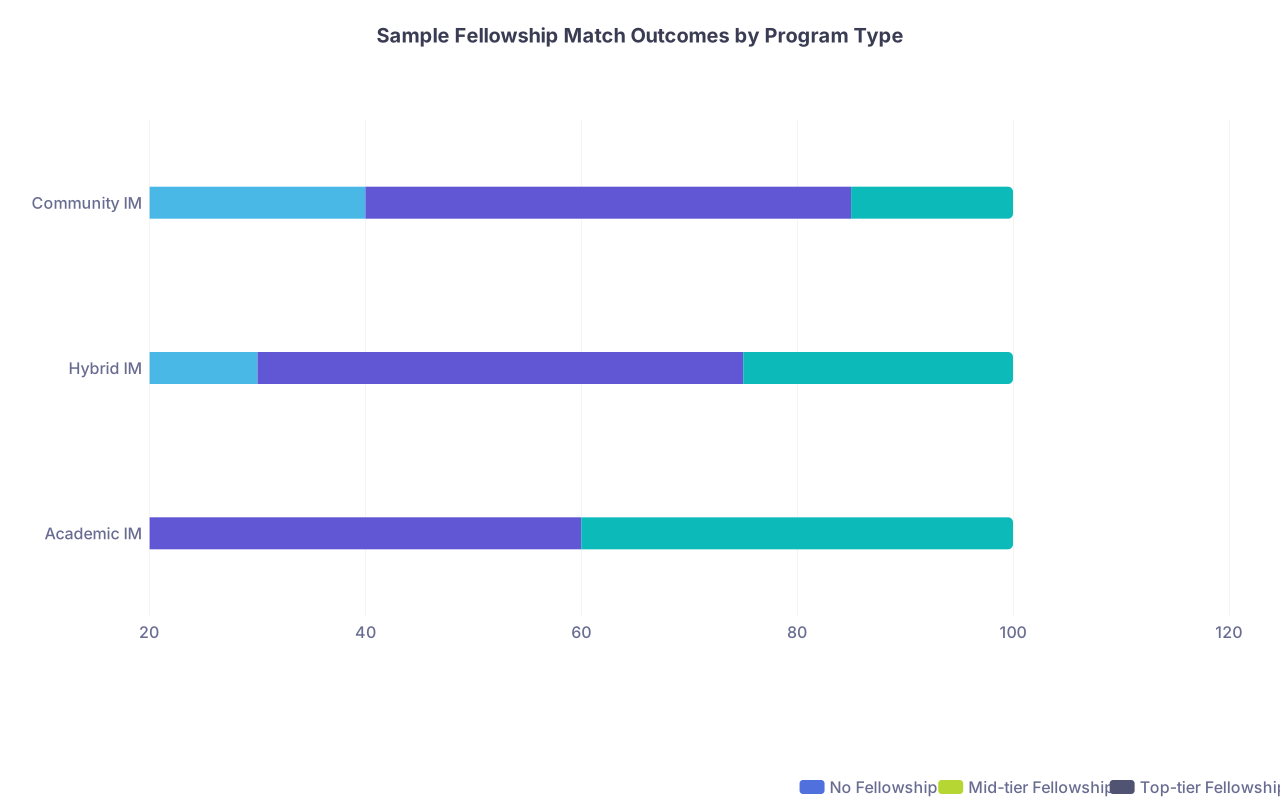
| Category | No Fellowship | Mid-tier Fellowship | Top-tier Fellowship |
|---|---|---|---|
| Academic IM | 20 | 40 | 40 |
| Hybrid IM | 30 | 45 | 25 |
| Community IM | 40 | 45 | 15 |
Notice: community IM still places plenty into mid-tier fellowships. For many people’s career goals, that’s more than enough.
2. Assess Faculty and Connections, Not Just Branding
Red flags to watch for:
- Faculty are mostly brand-new grads with no stable core.
- There’s obvious turnover or leadership churn.
- They can’t clearly articulate where grads have matched.
Green flags:
- PD and APDs with prior academic or leadership experience.
- Faculty with strong subspecialty training, even if now in community practice.
- Clear mentorship for research, QI, or fellowship planning if you want those.
Ask on interview day:
- “Can you tell me about recent graduates who went into [your interest]?”
- “Who here would mentor a resident interested in [X fellowship or pathway]?”
If they waffle or give you generic answers, that’s data.
3. Culture and Support: This Matters More in Community Settings
Community programs often run lean. That can be great for autonomy or terrible if no one has your back.
When you talk to residents, listen for:
- “Our PD really goes to bat for us” vs “Administration doesn’t listen.”
- “We get protected time” vs “We’re constantly pulled to cover.”
- “Fellows are supportive” vs “We fight for procedures.”
You do not want:
- A small community program with:
- Poor staffing
- No ancillary support
- Toxic leadership
That’s the nightmare combination. But those issues are not unique to community sites; they exist across the board. Ignoring all community programs because some are bad is lazy thinking.
A Smarter Application Strategy: Mix, Don’t Blindly Filter
The safest, sanest approach in competitive fields is not “academic or community.” It’s balanced portfolio.
1. Build Tiers of Programs—Not Just a Rank List of Logos
Organize your list by fit and realism, not ego:
Tier 1 – Reach academic
- Big-name, super competitive
- You want them, but they’re not likely
Tier 2 – Solid academic / hybrid
- Reasonable shot given your numbers and experiences
- Good training, some name recognition
Tier 3 – Strong community / hybrid
- High procedural volume
- Good fellowship or job placement
- Resident culture you actually like
Tier 4 – Safety community
- You’d still be willing to train there
- Maybe less ideal location, but not “never” territory
Your mistake if you’re like most:
- You overfill Tier 1.
- Underbuild Tier 2–3.
- Pretend Tier 4 doesn’t need to exist because “I’ll be fine.”
You might not be fine.
2. Be Honest About Your Profile Before You Cut Community Programs
Use a brutally honest checklist:
- Are your scores at or above the mean for your specialty?
- Do you have serious red flags? (remediations, leaves, failures)
- Any big-gap issues? (No home program, weak letters, low research in a research-heavy field)
- Are you from a lower-ranked med school without strong home advocacy?
If you:
- Aren’t near the top of your class
- Don’t have stellar scores and serious research
- Come from a school without a strong track record in your chosen specialty
…then a community-inclusive strategy isn’t optional. It’s protective.

| Step | Description |
|---|---|
| Step 1 | Choose Specialty |
| Step 2 | Apply broad mix |
| Step 3 | Academic heavy with some community |
| Step 4 | Balanced academic and community |
| Step 5 | Add safety community programs |
| Step 6 | Competitive field? |
| Step 7 | Top tier stats and research? |
3. Rank for Your Future Self, Not Your Current Ego
When you build your rank list:
- Don’t put a malignant-feeling academic program above a supportive community program just for prestige.
- Don’t drop community programs you liked “because they’re just community.”
Ask yourself:
- “If I woke up matched here, could I become the kind of clinician I want to be?”
- “Would I feel supported? Would I get enough volume? Will I be safe?”
If the answer is yes, it belongs on your list. If the answer is no, take it off—academic or community, doesn’t matter.
The Bottom Line: The Real “Costly Mistake”
The real mistake isn’t preferring academics. It’s:
- Ignoring community programs without actually evaluating them.
- Overestimating your competitiveness and underbuilding your safety net.
- Sacrificing your match chances on the altar of prestige.
- Forgetting that being in the specialty you love—at a solid, supportive program—is worth infinitely more than a brand name you never match into.
You’re not choosing between “real doctor” and “second-class doctor.” You’re choosing between multiple training environments with different strengths.
Do not let arrogance, ignorance, or lazy myths make that choice for you.
Do one concrete thing today:
Open your preliminary application list and mark every program you’ve dismissed solely because it says “community” or lacks a famous university name. For each one, spend 10 minutes:
- Look up their recent fellowship placements.
- Check resident bios and case volume.
- Ask a senior or advisor if anyone from your school has matched there.
If even one of those programs turns out stronger than you assumed, you just avoided the first step toward a very expensive mistake.