
You have a spreadsheet open with thirty-plus programs. You just highlighted half of the community programs in yellow with notes like “better lifestyle,” “less malignant,” “easier schedule.” You are telling yourself: “I will grind through intern year at a big academic place if I have to, but a community program will be more chill.”
This is where people get burned.
Not because community programs are bad. Many are excellent. Some are outstanding. The mistake is the lazy assumption that “community = better lifestyle” and “academic = rough lifestyle.” Those shortcuts are how you wake up PGY‑2 in a call room at 3 a.m. at “low-key community hospital” wondering why you have 20 cross-cover patients and no night float support.
Let’s go through the lifestyle assumptions about community programs that routinely backfire.
Mistake #1: Assuming Community Automatically Means Fewer Hours
The most common fantasy: “Academic programs are workhorses. Community programs are 8–5 with gentle call.”
No. Workload is about:
- Patient volume and acuity
- Staffing model
- Call structure
- How many services are covered by residents versus attendings/APPs
There are community hospitals where residents are the cheap labor equivalent of a large academic center—without the safety net of subspecialty teams. You may be doing the work of “medicine, cards, and step-down” all at once, with one single night resident on.
I have watched this play out repeatedly: students choose a community internal medicine program because “they said they cap at 10–12 per intern.” Then they arrive and discover:
- The “cap” is per service day, not total patient load
- No night float, just 28‑hour call every fourth night
- Weekends are “every other” but with post‑call still working until late afternoon
- Notes and discharges are entirely resident-driven—no scribes, few APPs
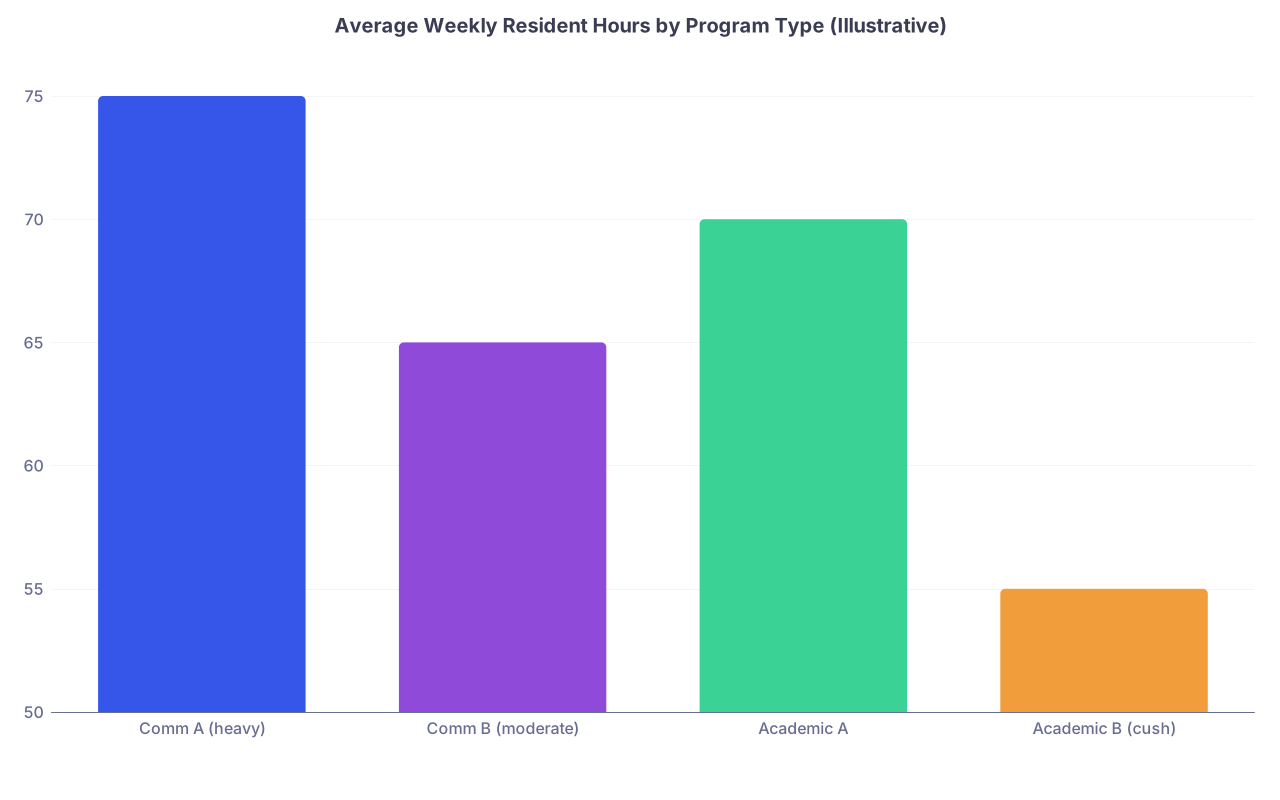
| Category | Value |
|---|---|
| Comm A (heavy) | 75 |
| Comm B (moderate) | 65 |
| Academic A | 70 |
| Academic B (cush) | 55 |
Notice the point: some community programs are heavier than solid academic ones.
Do not use “community vs academic” as a proxy for hours. You will pick wrong.
What to actually look at and ask:
- “What are your true average weekly hours on wards and ICU? Interns vs seniors?”
- “How often do residents violate duty hours, and for what reasons?”
- “Is there a night float system, or is it 24–28‑hour call?”
- “Who writes most of the notes and discharge summaries—residents or APPs/scribes?”
If you are not getting concrete ranges and specific descriptions from current residents, assume the lifestyle might not be as light as the brochure suggests.
Mistake #2: Confusing “Friendly” With “Protective”
Many community programs market a “family atmosphere.” You meet the PD, the coordinator remembers your name, attendings seem less intimidating than the ivory tower research giant across town. Students hear this warmth and mentally translate it to: they will protect my time and sanity.
Sometimes true. Sometimes absolutely not.
I have seen:
- Programs that feel very “family” but have zero pushback when hospital leadership piles more non-educational scut onto residents
- Chairs who are friendly at resident retreat but do not fight for caps, appropriate nursing support, or outpatient coverage
- A culture where saying “no” is socially difficult, so overwork continues because everyone wants to be a “team player”
That “nice” attending can still be the one who says, “We do not send people home early; we stay until the work is done,” on an 80‑hour week.
The more dangerous scenario: residents are overworked and under-empowered. At big academic centers, residents occasionally have house staff unions, GME oversight committees, and a tradition of pushing back. At smaller community sites, the residents are sometimes guests in a hospital that could, in theory, sustain itself with hospitalists and NPs. You have less leverage.
Red flags you are missing if you only listen for “we are like a family”:
- Residents cannot clearly describe mechanisms for raising concerns without fear
- Vague answers to, “What changed after the most recent ACGME site visit?”
- Nobody can recall the last time they successfully pushed back on an unsafe workload
- GME office is tiny and barely visible, or “mostly handles payroll and credentialing”
Ask directly:
- “Describe a time when residents complained about workload or safety. What changed?”
- “How does the program handle conflicts between service needs and educational needs?”
If the answers are soft stories about “we work it out” with no concrete examples of structural changes, do not assume “caring = protected lifestyle.”
Mistake #3: Overestimating Outpatient and Call Flexibility
Another common story: “I want a community program because I want a ‘normal’ clinic schedule and predictable call. Academic clinics are chaotic.”
Sometimes true. But many community programs exist to provide near-constant hospital coverage with fewer residents. That can warp your outpatient and lifestyle expectations.
Typical traps:
- You think clinic will be one fixed day per week; in reality, it is constantly bumped for staffing shortages on the wards
- You assume outpatient is relaxed; then you discover double-booked templates, minimal MA help, and you room your own patients
- You believe that “home call” means peace with occasional phone calls; it turns into constant pages plus coming in multiple times per night

| Step | Description |
|---|---|
| Step 1 | Community Program |
| Step 2 | High risk of heavy call |
| Step 3 | Assess APP and hospitalist coverage |
| Step 4 | Moderate burden |
| Step 5 | Residents primary night coverage |
| Step 6 | Protected caps? |
Academic programs often have:
- Night float systems integrated across services
- Fellows or in-house attendings who absorb consult load
- More house staff to share night and weekend responsibilities
Some community hospitals do not. You might be:
- The only in-house physician overnight for multiple floors
- Covering cross-cover plus admissions plus codes
- Responsible for triaging transfers without immediate subspecialty backup
Ask specifics, not labels:
- “On a typical call shift, how many admissions and cross-cover patients do you handle?”
- “How many in-house residents are there overnight? Which services?”
- “How many weekends per month are call weekends for interns and seniors?”
- “How often are clinic sessions protected from inpatient pull?”
If residents hedge or say, “It depends; it can get busy,” that usually means “some nights are brutal.” Do not assume community = gentler call.
Mistake #4: Assuming Less Research = More Free Time
You might think: “I do not care about research, so I want a community program that will not push it. Then I will have more time for myself.”
Dangerous simplification.
If the program does not have research pressure, that does not automatically convert into more personal time. Often it just means:
- Those hours are filled with more clinical service
- There is less elective time or fewer non-service rotations
- Administrative and documentation tasks fall to residents instead of fellows/research staff
In academic centers, research sometimes functions as the safety valve that creates lighter rotations: research months, QI electives, protected educational half-days.
In many community programs:
- “Elective” is still primarily clinical service for another department
- There is no true research month
- Quality improvement projects happen in your “free time” and are required for graduation anyway
| Program Type | Research Pressure | Protected Time for Projects | Typical Result for Lifestyle |
|---|---|---|---|
| Academic Heavy | High | Dedicated blocks | Busy but structured |
| Academic Moderate | Moderate | Half days / electives | Variable, can be balanced |
| Community Strong | Low–Moderate | Limited, ad hoc | More service, less cushion |
| Community Service | Low | None | Heavy service, little control |
If you truly do not want research, that is fine. But do not fantasize that the absence of research magically creates more time for hobbies. Look at the block schedule and ask:
- “How many true electives per year, and what can they be used for?”
- “Is there any rotation where clinical duties are genuinely lighter?”
- “What percentage of time is on core inpatient/ICU services vs electives/clinic?”
You are trying to find where the hours actually go, not what buzzwords appear on the website.
Mistake #5: Believing Community Means Less Administrative Nonsense
I have heard this one word for word: “Big academic centers drown you in committees and politics. A small community place is more straightforward and less bureaucratic, so day-to-day life is simpler.”
Wrong half the time.
Yes, academic centers have committees and governance structures. That bureaucracy, annoying as it is, sometimes protects residents:
- Formal duty hour monitoring
- Real GME oversight with reporting requirements
- Structured patient safety and incident response processes
Community hospitals often have:
- Fewer formal checks on resident workload or educational quality
- Administrators focused on revenue and throughput, with residents as inexpensive coverage
- “We will fix it” promises that go nowhere because there is no external pressure
Administrative pain in community programs shows up differently:
- You handle your own authorizations, referrals, social work tasks because support staff is thin
- You battle with IT or EMR limitations that academic centers have already invested to solve
- You spend longer on endless, nonstandard documentation because “this is how we have always done it”

Ask these unsexy but lifestyle-critical questions:
- “Do residents room their own clinic patients, or is there dedicated MA staff?”
- “Who handles prior authorizations and disability paperwork?”
- “How responsive is IT to EMR issues? Do residents have templates and dot phrases set up already?”
- “How are duty hours monitored and enforced?”
If everyone shrugs and says, “We just make it work,” that is code for: residents absorb the chaos.
Mistake #6: Assuming Lower Competitiveness = Easier Training
A lot of applicants quietly think: “Community programs are less competitive, so the training will be more manageable, and expectations lower. That will be easier on my lifestyle.”
This is a sharp way to get trapped.
Lower Step averages or looser selection criteria do not guarantee a gentler residency. Sometimes the opposite: these programs must prove they are not second-tier, so they lean on service, heavy clinical exposure, and high patient turnover to market “strong training.”
Picture this: A community surgery program that takes a wider academic range of residents. To attract applicants, they advertise:
- Huge operative volume
- Early autonomy
- “You will be more than prepared for independent practice”
Sounds great, until you realize you are:
- Operating constantly and pre-rounding on a massive list
- Doing your own floor work because no one else will
- Staying late every day to finish op notes and manage consults
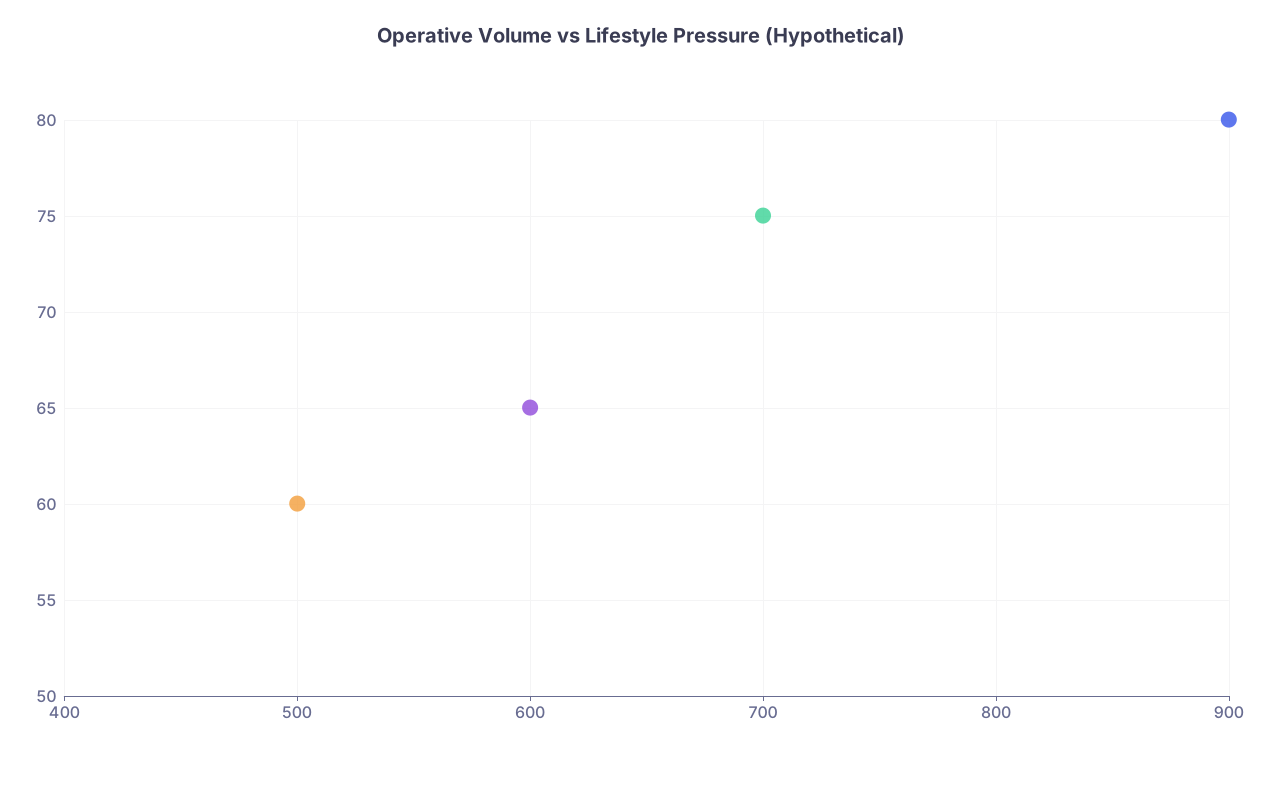
| Category | Value |
|---|---|
| Comm High Volume | 900,80 |
| Comm Moderate | 600,65 |
| Academic High Volume | 700,75 |
| Academic Balanced | 500,60 |
(Each point is [annual cases, average weekly hours]. More volume does not equal fewer hours.)
The real danger is misalignment of expectations:
- You wanted a more relaxed experience; they want to prove their graduates are tough and independent
- You think “less prestigious” means “less intense”; they think it means they must push you harder to succeed in the job market
Probe for this explicitly:
- “What is your philosophy on balancing service and education?”
- “How many graduates in the last 5 years have burned out, left the program, or switched specialties?”
- “What changes have you made in response to resident feedback about workload?”
If a program brags endlessly about volume and independence but cannot clearly talk about how they protect resident wellbeing, your lifestyle assumptions will not hold.
Mistake #7: Ignoring Commuting, Geography, and Support Systems
Lifestyle is not only about call schedules. It is about everything around work that either supports or drains you.
Community programs are often in:
- Suburbs far from major public transit
- Smaller cities with limited social outlets
- Areas where cost-of-living may be lower—or surprisingly high if there is no resident housing culture
I have seen residents:
- Drive 45 minutes each way because the “nice area” is far from the hospital
- Struggle with childcare because there is no hospital-affiliated daycare
- Feel isolated because they are the only single person in a very family-centered town

At a large academic center:
- Colleagues often live near each other
- There may be institutional support for housing, childcare, mental health
- You are more likely to find people your age, your interests, your background
At some community programs, you are on your own.
Ask yourself bluntly:
- “Where will I live, and how long is my real commute at rush hour?”
- “Who will I see outside of work?”
- “What do current residents with my life situation (partnered, single, with kids) actually do?”
And ask programs:
- “Do most residents live nearby or commute from other areas?”
- “Any hospital support for childcare or family needs?”
- “How do residents spend their rare free weekends? What is realistic here?”
You do not want to discover in January that your supposed “chill community program” comes with 10 extra hours of driving per week.
Mistake #8: Taking Resident Smiles at Face Value on Interview Day
Community programs often do a very good job of making interview day feel warm and personal. You talk to multiple residents; they seem genuinely happy. You leave thinking, “They look rested. They said people are ‘nice.’ It must be a good lifestyle.”
Here is the uncomfortable reality: residents rarely trash their own program in front of applicants. Small programs especially. Word travels fast.
Typical subtle ways people try to warn you without saying the forbidden words:
- They emphasize being “resilient” and “supportive of each other” more than describing actual schedule reforms
- They say, “You will be very prepared for independent practice,” and “We see everything,” but never talk about actual days off
- They use phrases like “we are busy, but it is good busy” and “we are like a family” without giving numerics
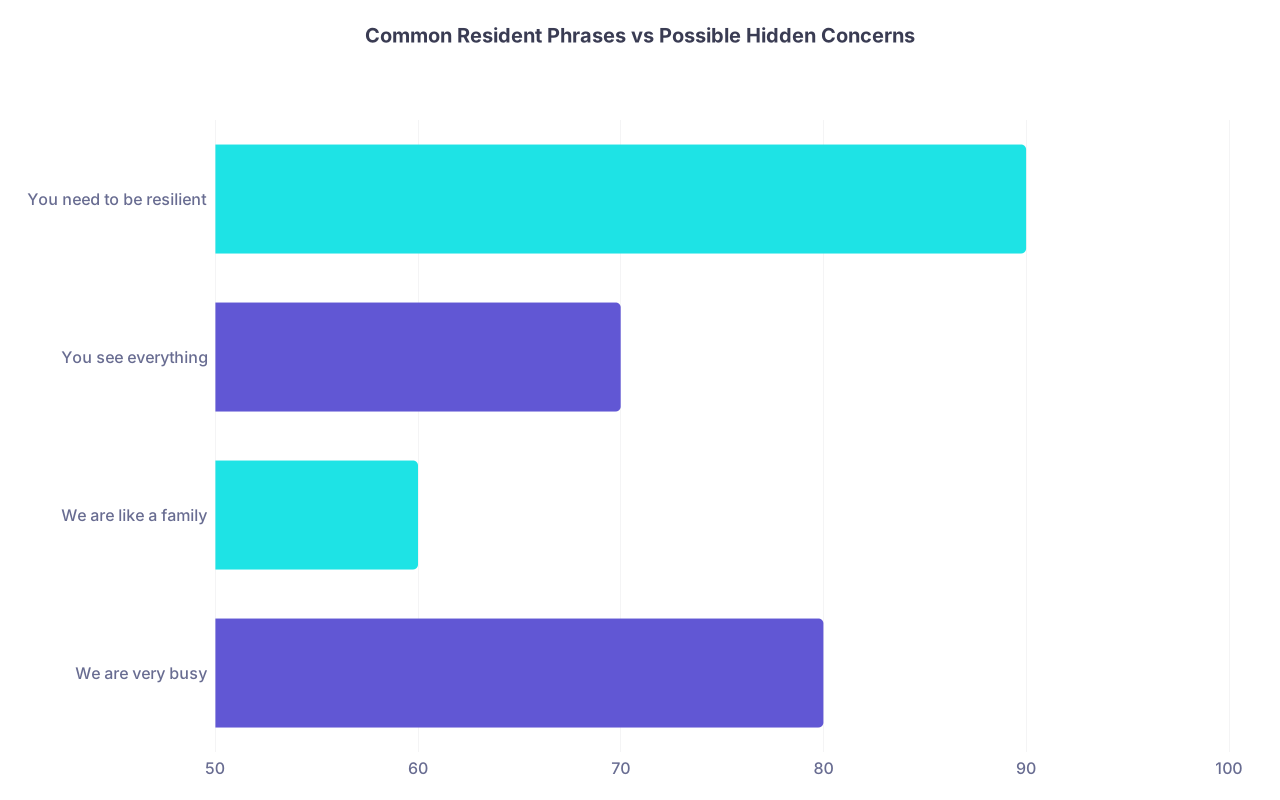
| Category | Value |
|---|---|
| We are very busy | 80 |
| We are like a family | 60 |
| You see everything | 70 |
| You need to be resilient | 90 |
(Values here represent relative likelihood that there is significant workload/stress under the surface.)
You need to ask questions that force concrete answers:
- “During your last inpatient block, how many golden weekends did you have?”
- “How many days off did you actually take last month?”
- “On your heaviest rotation, what is a typical day—start time, end time?”
- “Have you ever seriously considered leaving the program? Why did you stay?”
Then you pay more attention to the pauses and the facial expressions than the polished words.
Also: follow up after interview day. Ask for a phone call with a resident not on the recruiting committee. That is where the truth leaks out, if it is going to leak at all.
Mistake #9: Ignoring ACGME Citations and Structural Weaknesses
Community programs are more variable in structure. Some are extremely well-run. Some are held together with duct tape and goodwill.
If you assume “small = supportive, so things will get fixed if there are issues,” you risk walking into:
- Recent ACGME citations for duty hours, supervision, or curriculum
- New or rapidly expanding programs still figuring out scheduling and support
- Hospitals in financial strain leaning harder on residents for service
You need to treat the ACGME status as a lifestyle predictor. Programs under pressure may:
- Cut corners in ways that hit residents hardest
- Increase clinical load to satisfy hospital priorities
- Ignore educational changes because leadership is overwhelmed
Ask for transparency:
- “Have you had any recent ACGME citations or areas for improvement? What are they?”
- “Are there any major program changes planned in the next 1–2 years?”
- “How stable is the hospital financially? Any recent mergers or staffing cuts?”
If the PD dodges, minimizes, or gets vague, be careful. Silence about structural problems is a lifestyle risk.
How to Actually Evaluate Lifestyle at a Community Program
Stop using “community vs academic” as shorthand. That is lazy thinking and it backfires.
Instead, systematically check:
Schedule reality
- Concrete weekly hours on main rotations
- Call structure, nights, weekends, holidays
- True number of golden weekends
Support systems
- Night coverage: residents vs hospitalists vs APPs
- Ancillary staff: MAs, scribes, case managers, social work
- Protection of clinic and elective time
Resident leverage and culture
- Examples of resident feedback leading to real change
- Transparency around ACGME reviews and duty hours
- How comfortable residents seem being honest with you
Life outside the hospital
- Commute, cost of living, social support
- Fit with your stage of life, family, and priorities

If, after all of that, a community program still looks like a place where you can train hard and live a life that is sustainable for you, great. Rank it high. Community versus academic is not the issue. Alignment and transparency are.
The mistake is assuming lifestyle automatically tilts one way because of the label.
Key Takeaways
- “Community” does not equal “light lifestyle” any more than “academic” equals “brutal.” Hours, call, and culture are program-specific.
- Friendly vibe and “family atmosphere” do not guarantee protected time or reasonable workload. Demand concrete numbers and examples.
- Evaluate structure, support, and real schedules, not branding. The residents who are honest with you now are your best defense against lifestyle assumptions that will hurt later.