If Your Home Institution Only Has Community Programs: Maximizing Exposure
What do you do when you want strong academic letters and exposure, but your med school only has community residency programs and zero big-name university departments attached?
Let me be blunt: this is a real disadvantage for some specialties. Not fatal. But real. You have to work harder and be more intentional than the student who can just walk down a hallway at Mass General or UCSF and bump into five NIH-funded attendings.
Here is exactly how you handle it.
Step 1: Be Clear About What You’re Up Against
If your home institution is community-only, here’s what that usually means in practice:
- No home “university” IM, surgery, peds, etc. department with national name recognition
- Fewer or no subspecialty fellowships on site
- Less research infrastructure and fewer big grants
- Fewer faculty who are “names” on national committees or guideline panels
On ERAS, program directors see:
- Your med school (which might not be strongly associated with a major academic center)
- Your letters, often from community faculty they don’t know
- Your rotations, often all at community hospitals
If you’re aiming for:
- Highly academic IM, surgery, EM, peds, OB/Gyn, etc.
- Competitive fields (Derm, Ortho, ENT, Plastics, Urology, Radiation Oncology, Neurosurgery)
…this matters.
So your goal is simple, but not easy: manufacture academic exposure that’s not built into your home system.
You’re going to do this through three big levers:
- Away rotations
- Strategic research and networking
- Maximizing and “packaging” the strength of your community training
We’ll go one by one.
Step 2: Use Away Rotations Like Ammunition, Not Tourism
If you only have community programs at home, away rotations are not optional “fun trips.” They’re your primary academic exposure pipeline.
Pick aways with intent, not vibes
You don’t need ten away rotations. You need 2–3 that are well chosen.
Target:
- Strong academic programs in the specialty you want
- Places that actually take outside rotators (some don’t)
- At least one program in your geographic region of interest
Bad strategy:
“I’ll rotate at the coolest coastal city that looks fun.”
Good strategy:
“I’ll rotate at University X and Y, both mid- to high-tier academic, both with histories of taking students from less-known schools.”
| Rotation # | Type | Target Program Tier | Goal |
|---|---|---|---|
| 1 | Home community | Solid community | Strong clinical letter |
| 2 | Away academic | Mid-tier academic | Academic letter + compare level |
| 3 | Away academic | Higher-tier academic | Stretch option + visibility |
What you must accomplish on each away
You need at least one, ideally two, of the following out of aways:
A letter from an academic faculty member who:
- Has a recognizable institutional name
- Actually knows you well
- Writes detailed, specific letters
Someone willing to pick up a phone or send an email later on your behalf
Concrete talking points for interviews: complex cases, QI projects, teaching involvement, etc.
You are not on vacation. You are on a multi-week audition.
How to show you’re not “the small-school kid out of their depth”
You’re walking into an environment where, let’s be honest, some people assume:
- “Community-only background” = weaker clinical training
- “Unknown school” = weaker board scores or motivation
You counter that directly:
- Know the bread-and-butter cold. Be solid on common issues before you start (chest pain, sepsis, DKA, COPD exacerbation, appendicitis, etc.).
- Be early. Consistently. Not performatively one day.
- Ask for feedback in week 1–2:
“I really want to grow during this rotation. If there’s one thing I could do better clinically or on presentations, what would you say?”
And then actually improve it.
One attending commenting, “Came from a community-only background but performed at the top of our rotators” in your letter is gold.
Step 3: Build Academic Credibility Without a Built-In Engine
Your home program doesn’t have an NIH warehouse. Fine. You still need something on your CV that screams, “I can function in an academic environment.”
Find research in three layers
Layer 1: Inside your home institution (yes, even community sites)
- Every hospital has:
- QI projects
- M&M themes that need system changes
- Clinical questions that could be turned into case series or retrospective reviews
- Ask specific questions, not “Do you have research?”
Better: “I’m interested in a small QI or retrospective project on sepsis readmissions or ED bouncebacks—does anyone here do that sort of work?”
Layer 2: Your med school’s extended network
Some schools pair with a larger university or academic partner. Quietly, in the background. Ask your dean’s office or student affairs bluntly:
- “Which academic departments or universities do our students usually collaborate with for research?”
Then email those people directly with a short, sharp message: - Who you are
- Your interest area
- Your bandwidth (e.g., “I can put in 5–7 hours/week consistently for 4–6 months”)
- That you’re from a community-only clinical environment and want academic exposure
Layer 3: Remote / multi-institution projects
There are national student research groups, specialty societies, and multi-center studies that love free, motivated labor. They’re not going to fall into your lap. You’ll have to dig:
- Specialty society student/resident sections
- Slack or email lists for national interest groups
- Senior students from your school who matched academic programs—ask them who they worked with and how
What “enough” research looks like for most core specialties
You don’t need five first-author NEJM pieces. For IM, peds, EM, OB/Gyn, etc., a strong “community-only home, but I made it happen” profile might look like:
- 1–2 posters (regional or national)
- 1–2 local QI or case presentations
- Maybe 1 publication or submission, often as middle author
The key is the story:
“I didn’t have research dropped at my feet, so I built it.”
Step 4: Turn Community Exposure into a Feature, Not a Flaw
Programs know how sheltered some ivory-tower students can be. Your community background can be an asset if you don’t apologize for it.
You’re seeing real medicine. Use that.
Community settings tend to give you:
- Sicker patients with limited resources
- Less sub-specialty backup at 2 a.m.
- More hands-on procedural exposure in some fields
You frame it like this in your application and interviews:
“My training has been heavily community-based, which means I’ve had early, direct responsibility with patients who don’t always have easy follow-up or specialists on speed dial. I’ve had to think systematically about disposition and safety.”
“Working entirely in community hospitals has made me very comfortable managing bread-and-butter pathology, and I’m now looking to layer on more academic exposure and research at an academic residency.”
You are not “less than.” You are “different, and here’s what that gave me.”
Step 5: Letters of Recommendation When Home Faculty Aren’t Famous
This is a common fear: “My attendings are great but nobody knows who they are.”
Here’s the truth: a detailed, specific, enthusiastic letter from a “non-famous” community attending beats a lazy one-liner letter from a top-10 name.
But. You want at least one letter from a recognizable academic institution if possible.
Mix your letters strategically
For many core specialties, a solid mix looks like:
1–2 letters from your strongest home community rotations
- These show day-to-day work ethic, reliability, and clinical growth
1–2 letters from academic away rotations
- These show you can hang in a bigger pond and give you “brand-name” institutional backing
Make sure your letter writers:
- Have seen you do actual work, not just show up politely
- Know you purposefully came from a community background and are aiming for X type of residency
- Get a quick, focused “brag sheet” from you: bullet points of cases, projects, moments they saw you step up
What to directly ask for
Do not be vague. When you ask for a letter, try something like:
“I’m applying to academic internal medicine programs. My home clinical training is entirely community-based, so your perspective on how I performed in your academic environment would be really valuable. Would you feel comfortable writing a strong, supportive letter for me?”
If they hesitate or hedge, don’t use them. You cannot afford a lukewarm LOR when you’re already battling perception.
Step 6: Use Timing and Scheduling to Your Advantage
If you know from MS2 or early MS3 that your school is community-only and you want academic exposure, your calendar becomes a weapon.
Plan your key rotations: not random, not late
Target this pattern as much as your school allows:
Early core rotations (MS3):
Perform insanely well in your home community rotations. You need honors/HP and strong letters here. That’s your baseline.Mid MS3 – early MS4: Slot your most important away rotations in the late MS3/early MS4 window so letters are ready for ERAS.
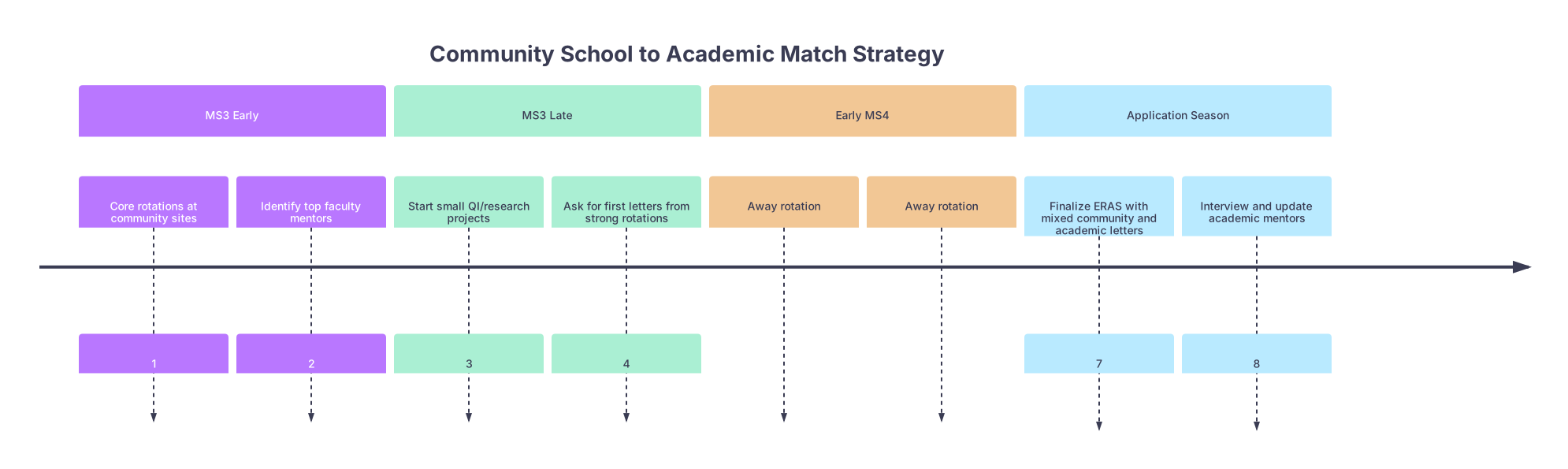
| Period | Event |
|---|---|
| MS3 Early - Core rotations at community sites | 1 |
| MS3 Early - Identify top faculty mentors | 2 |
| MS3 Late - Start small QI/research projects | 3 |
| MS3 Late - Ask for first letters from strong rotations | 4 |
| Early MS4 - Away rotation #1 academic site | 5 |
| Early MS4 - Away rotation #2 academic site | 6 |
| Application Season - Finalize ERAS with mixed community and academic letters | 7 |
| Application Season - Interview and update academic mentors | 8 |
What you’re avoiding is this scenario:
- You do all core rotations at home, delay aways, and by ERAS opening you only have community letters and no academic exposure at all.
Step 7: Target Programs That Actually Value Your Background
Not all academic programs are interested in a community-heavy applicant. Some are, some are not. Do not waste time trying to convince a place that only interviews T20 school + NIH CV robots.
Look at:
- Where recent grads from your school matched
- Which programs your advisors say actually read applications carefully instead of just screen by Step score + institution
- Mid-tier academic places that consistently mix community and academic training sites
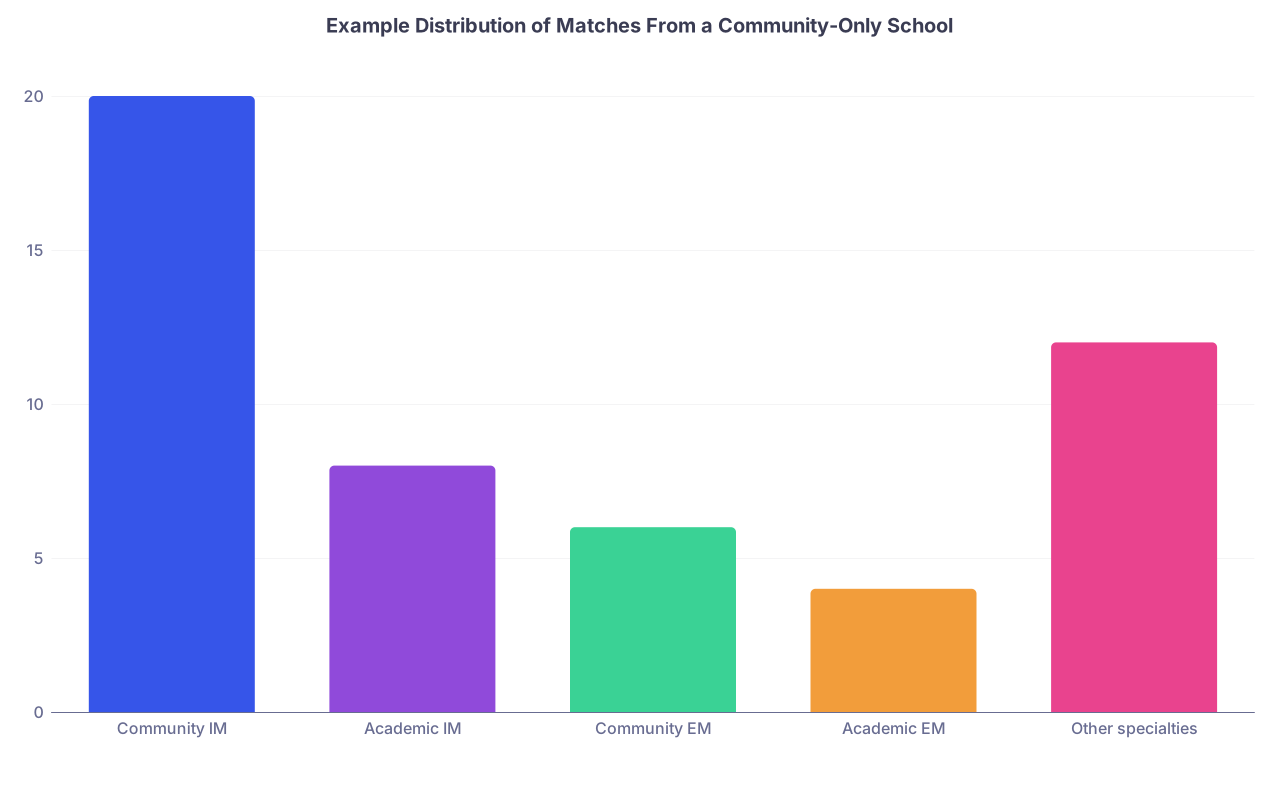
| Category | Value |
|---|---|
| Community IM | 20 |
| Academic IM | 8 |
| Community EM | 6 |
| Academic EM | 4 |
| Other specialties | 12 |
You are not trying to match “somewhere.” You’re trying to match where your story makes sense.
If you’ve done:
- Strong community rotations
- 1–2 meaningful research/QA efforts
- 2 academic away rotations
…then your application screams: “This person seeks out academic environments; they just weren’t handed them.”
Programs that like that type of hustle do exist.
Step 8: Address the “Community-Only” Issue Directly in Your Application
Do not pretend it doesn’t exist. Any good PD can see your rotation list and letters. They know.
Here’s how you bring it up without sounding defensive:
In your personal statement
One or two clean lines are enough. For example:
“My core clinical training has taken place entirely in community hospitals, where I have worked with diverse, often underserved patients and assumed early responsibility in their care. Because of that experience, I’m now seeking residency training in an academic program where I can combine this practical, frontline perspective with robust teaching and research.”
You’ve named the issue and turned it into intention.
In interviews
When someone asks, “Tell me about your clinical experiences” or “Why an academic program now?” you can say:
“I’ve seen the realities of patient care in resource-limited community settings—less specialty support, more social barriers, more need for creative planning. That’s been hugely valuable. Now I want to train in a program where I can add deeper subspecialty exposure, teaching, and scholarship so I can eventually bridge both worlds.”
You are not saying, “Please rescue me from my small hospital.” You’re saying, “I’ve done that world; I want to expand what I can do next.”
Step 9: Use Your Deans and Advisors Aggressively (Even If They’re Community-Based)
A lot of students underuse the people who sign their MSPE or know the program directors by first name.
Your student affairs office can:
- Tell you where past community-only grads have matched academically
- Make direct phone calls or send emails to program coordinators/PDs
- Help you time aways and letters
Ask them specifically:
- “Which academic programs have historically taken students like me from our community-only background?”
- “Who should I talk to if I’m trying to do an away at X program?”
- “Who’s the one faculty member here whose phone call actually gets answered by outside PDs?”
Then go talk to that person.
Step 10: If You’re Applying to Hyper-Competitive Specialties
Derm, Ortho, ENT, Urology, Plastics, Neurosurgery, etc. from a community-only home is not impossible, but it’s an uphill climb. You need to be realistic and over-prepare.
You’ll generally need:
- Strong board scores (or strong narrative if Step 1 is pass/fail but Step 2 high)
- Early and sustained research in that field
- Multiple away rotations in that specialty at real academic centers
- Dedicated mentorship from someone in that field, even if remote
And you need a Plan B that you’re not ashamed of.
If you’re MS2 or early MS3 and dead-set on a hyper-competitive field from a community-only background, you should:
- Start research yesterday
- Get plugged into that specialty’s national student/resident organizations
- Consider taking a research year if feasible and absolutely necessary
But do not stumble into that path late and hope your community-only CV can brute-force it. It usually cannot.
Sample “Story” You’re Building
By the time ERAS goes in, the ideal story for you looks roughly like this:
- “Student from a med school whose clinical training is entirely community-based.”
- “Consistently performed at the top of their group clinically—letters say specifics, not fluff.”
- “Recognized the limitation early, proactively sought 2–3 academic experiences and research.”
- “Came to our academic department as an away, clearly not intimidated, performed strongly.”
- “Understands both community and academic environments and has a believable reason for wanting academic training now.”
That’s coherent. That gets interviews.

Quick Reality Checks
Let me be straightforward about a few things:
- Yes, you are working uphill versus someone with a built-in academic department.
- No, that doesn’t mean you’re capped at “small community program forever.”
- You can absolutely match into academic programs if you manufacture the right evidence: aways, letters, research, and narrative.
- You do not have to apologize for your background. Own it, then show how you grew beyond it.
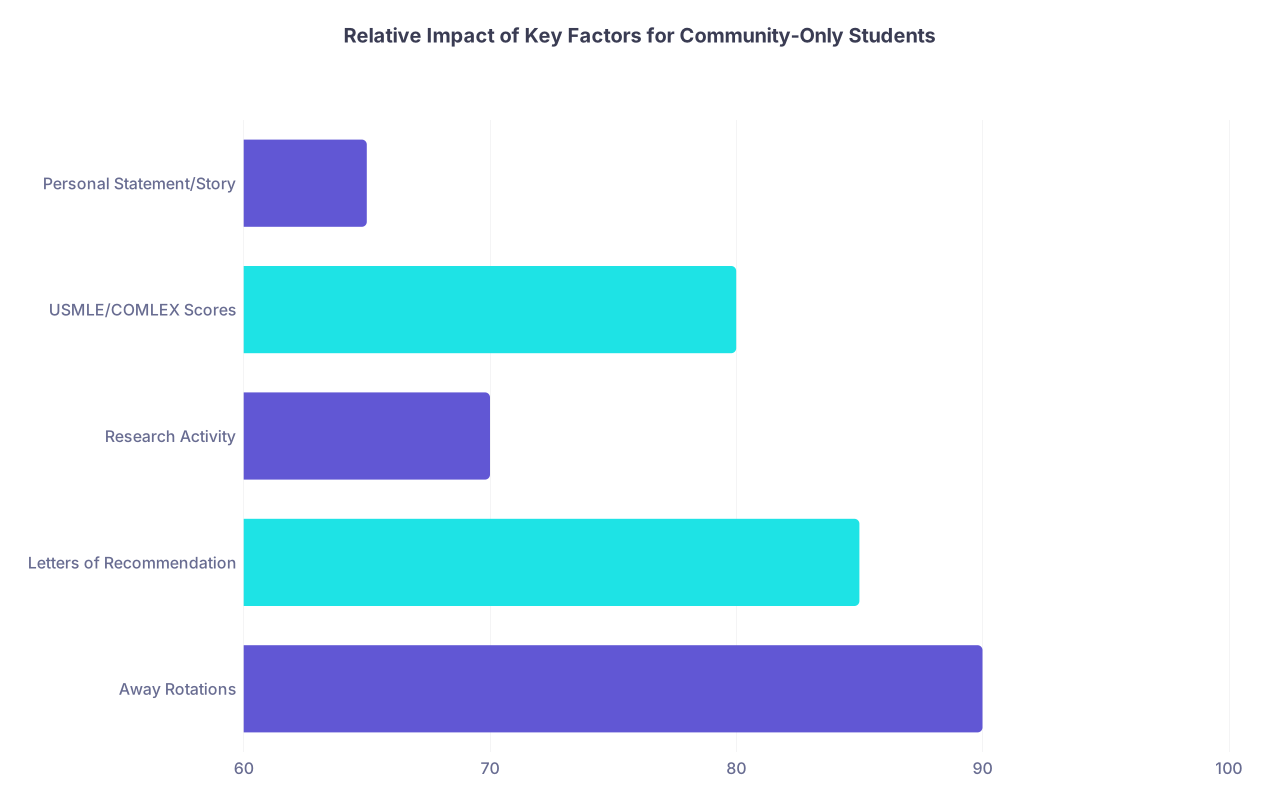
| Category | Value |
|---|---|
| Away Rotations | 90 |
| Letters of Recommendation | 85 |
| Research Activity | 70 |
| USMLE/COMLEX Scores | 80 |
| Personal Statement/Story | 65 |

FAQ (Exactly 4 Questions)
1. If my school only has community programs, do I have to do away rotations at academic centers?
If you want a realistic shot at academic residencies, yes. At least one, ideally two. Without aways, programs only see community letters and community exposure. That doesn’t kill your chances automatically, but it makes it much harder for PDs to benchmark you against students from academic-heavy environments. Aways are your best leverage point to get academic letters, show you can hang at that level, and build your story.
2. How much research do I actually need coming from a community-only background?
For core specialties (IM, EM, peds, OB/Gyn, FM, psych), you don’t need to be a research monster. A small but real portfolio—1–2 posters, a case report, QI project, maybe one publication—is enough to show that you can function in an academic mindset if given the chance. For competitive specialties, multiply that by 2–3 and consider a dedicated research year if you’re serious and late to the game.
3. Will programs hold it against me that my letters are from “unknown” community attendings?
Not if those letters are strong and specific, and especially not if you balance them with at least one academic letter from an away rotation. PDs care much more about what the letter says than whether your attending is Twitter-famous. That said, having a letter from a recognizable academic institution helps them feel more confident that you weren’t just the best of a very small, insular pool.
4. Should I explain my community-only background in my personal statement or avoid drawing attention to it?
You should acknowledge it briefly and frame it as a strength. One or two lines are enough: highlight the volume, responsibility, and real-world complexity you’ve seen, then pivot to why you now want academic training (teaching, research, subspecialty depth). Ignoring it looks naive. Over-explaining looks defensive. Name it, own it, and show how you’ve actively built academic exposure on top of it.
Key takeaways:
- You cannot change that your home institution is community-only, but you can aggressively add academic exposure through aways, targeted research, and strategic letters.
- Turn your community background into a selling point—frontline volume, responsibility, real-world constraints—then prove you can also thrive in academic settings.
- Be intentional early: plan your rotations, pick your aways wisely, and build a clear story that an academic PD can understand in 30 seconds.