
You did not “ruin your career” by matching into a community program. But if you want academic later and you handle the next 2–3 years passively, you probably will.
Let’s walk through what you can actually do from where you are now—not fantasy re-do-the-match advice, but concrete moves that change your trajectory.
I’m going to break this into two realities:
- What’s possible right now (before you start or early PGY-1)
- What’s possible later (PGY-2+ and beyond)
And we’ll be brutally honest about where the ceiling is.
Step 1: Get Very Specific About What You Mean by “Academic”
“Academic” is vague. That’s your first problem.
Do you mean:
- You want to be full-time faculty at a big-name university program?
- You want to do a competitive academic fellowship (GI, Cards, Heme/Onc, Ortho sports, etc.)?
- You want to do research, publish, maybe teach, and have some residents around?
- You just don’t want to feel like you’re in a tiny community hospital forever?
Because the path, and difficulty, depend heavily on which of these you really want.
Here’s the blunt version:
| Goal | Difficulty from Community Base |
|---|---|
| Any fellowship, any academic or community | Low–Moderate |
| Mid-tier academic fellowship | Moderate |
| Top-tier, research-heavy fellowship | High |
| Full-time university faculty at big-name place | High–Very High |
| Hybrid community–academic job (teaching + clinic) | Low–Moderate |
If your “academic dream” is:
- Attendings who teach
- Some med students/IM residents around
- A couple of publications
- Maybe a title like “Clinical Assistant Professor”
You can absolutely get there from a community residency with smart moves.
If your dream is:
- R01-level researcher
- Narrow subspecialty at a top-10 academic center
- K awards, lab, large trials
You’re starting from behind. It’s not impossible, but you cannot coast a single year.
So first: write down (literally, on your phone) what academic means to you:
- Title? (Assistant Professor, Program Director, Clinician Educator)
- Environment? (Big university, safety-net hospital with residents, VA with trainees)
- Activities? (Research, medical education, admin, QI, subspecialty procedures)
Once you name this clearly, then you can build backwards.
Step 2: Before PGY-1 Starts (or Very Early) – Fix What You Still Can
If you already matched community but haven’t started yet, you’re in the best possible version of this bad timing.
Here’s what you can realistically look at:
2.1. Consider a Deferral or Reapplication (Very Rare, Very Risky)
Let me be direct: most people should not do this. But I’d be lying if I said it never happens.
Situations where reapplying might be on the table:
- You matched a very, very weak or unaccredited community program that has obvious red flags (chronic probation, losing accreditation, notoriously poor fellowship placement, malignant culture).
- Your long-term target is extremely academic (physician-scientist track, super competitive specialty or fellowship) and you have major academic assets (PhD, 10+ pubs, strong mentors) but you tanked your Match strategy.
- You have a concrete, honest story and support from faculty to try again.
What reapplication would require:
- Being willing to sit out a year or two and accept the risk you do worse
- Letters from powerful academic people explicitly backing a re-try
- Zero illusions—programs hate perceived “flight risk” and non-commitment
If any part of you is thinking, “Maybe I’ll just rematch somewhere higher next year from a PGY-1 spot,” stop. That is not how this works 99% of the time, and trying often backfires badly. IMGs and DOs get burned here especially.
For almost everyone reading this, the play is:
You keep the community spot. Then you max out what you do with it.
Which takes us to the real plan.
Step 3: Understand Your Actual Levers Coming from a Community Program
You can’t magic your program into a university hospital. But you do have levers.
These are the four levers that matter for “academic” doors later:
- Research output
- Letters from known academic people
- Performance reputation (how you are talked about)
- Networking and visibility at academic centers
From a community residency, you’re at a structural disadvantage in #1, #2, and #4 unless you actively compensate.
If you do nothing, you probably:
- Get decent clinical training
- Have a couple of weak case reports
- Get letters from people no one outside your region knows
- Apply to fellowships/jobs and look “fine” but not particularly academic
That’s the default.
You are here because you don’t want the default.
Step 4: First Year: Build the Academic Engine Outside Your Program
Your PGY-1 year is not the year to announce how much you wish you were at a university hospital. It’s the year to:
- Prove you’re a top 5–10% resident clinically
- Quietly start building an external academic network
4.1. Dominate the Clinical Basics (You Need a Reputation Anchor)
Programs talk. Faculty talk. Applicants are not chosen on CV alone.
Your internal reputation needs to be: “He’s from a community program, but he’s really good. I’d trust her with anything. She’s functioning at a university level.”
How you get there:
- Know your patients cold on rounds (no guessing, no hand-wavy answers)
- Be the intern who reads about your cases that night (use Uptodate, guidelines, review articles)
- Hustle on cross-cover without being reckless (phone calls answered, notes done, follow-through)
- Show maturity: don’t complain about scut work out loud, especially early
Yes, this sounds basic. But if you don’t have this, none of the academic stuff matters. No one wants the “research star” resident who is clinically unsafe.
4.2. Identify Any Academic Adjacency in Your Program
Even small community programs often have:
- One or two faculty with university affiliations (voluntary faculty at a nearby medical school)
- A rotation at a tertiary or academic center
- A PD or APD who trained at a big place and still has weak ties
Your job:
- Map this in the first 3–4 months
- Ask seniors: “Who here still publishes or has academic connections?” You’ll get names.
- Read everyone’s faculty bios. If someone has a university faculty line or multiple publications, they’re your starting point.
Then you approach them like this (rough script):
“Dr. X, I’m really enjoying the clinical work here, and I know this is a community program, but I’m interested in keeping an academic door open for later, maybe for fellowship or a teaching position. I’d like to get involved in some research or academic projects. Is there anything you’re working on that I could help with, even small pieces?”
That’s it. No drama about “I wish I were at an academic program.” Just forward-motion energy.
Step 5: Create Research and Academic Output Even in a “Non-Research” Program
You’re not going to get handed a pre-built research machine. You’re going to build one out of scraps.
Here’s how.
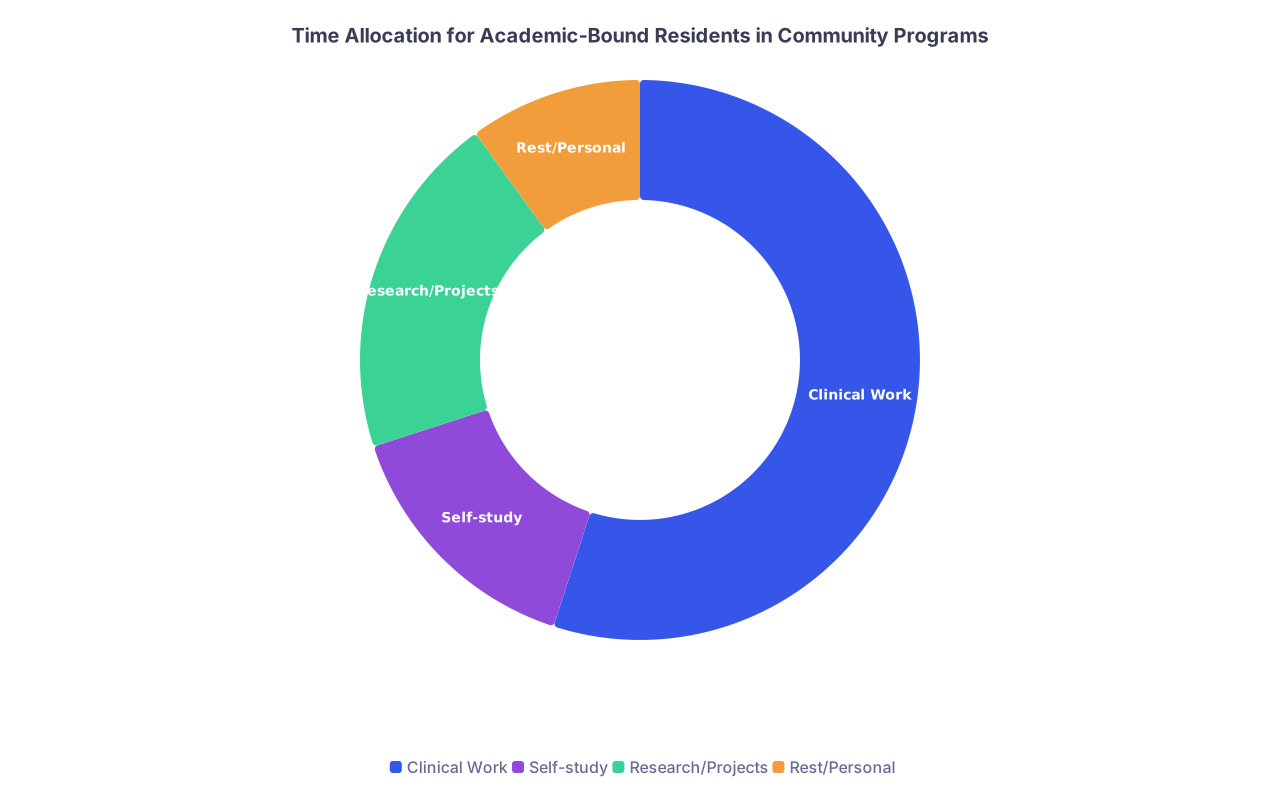
| Category | Value |
|---|---|
| Clinical Work | 55 |
| Self-study | 15 |
| Research/Projects | 20 |
| Rest/Personal | 10 |
5.1. Start with Low-Friction Wins
You don’t need an RCT. You need activity and trajectory.
Things that are actually doable in community programs:
- Case reports and case series (yes, they’re low-yield, but they start the list)
- Quality improvement projects (hand hygiene, sepsis bundles, readmission reduction)
- Retrospective chart reviews (if your program/hospital has basic IRB support)
- Educational projects (curriculum development, creating a teaching series)
The formula:
- 1–2 case reports PGY-1
- 1 real QI or retrospective project by late PGY-1/early PGY-2
- Abstracts/posters at state/regional/national meetings PGY-2
Don’t wait for someone to invent a project for you. Example moves:
- Ask: “Do we collect data on X? Could we look at outcomes?” (heart failure readmissions, ED boarding time, resident workflow, etc.)
- Volunteer to do the grunt work: data extraction, chart review, lit review, making the first draft of an abstract
Your line to faculty:
“I’m happy to do the heavy lifting on data and drafting. I know I’m junior so I’m not expecting first author on everything—I mainly want to contribute and learn.”
People will say yes to that.
5.2. Connect With External Mentors at Academic Centers
This is the pivot point for most community residents who end up academic: they attach themselves to a mentor at a nearby or aligned academic center.
How to do it:
Use any rotation you have at an academic hospital as a launchpad.
- Show up prepared.
- After a good interaction, say:
“I really appreciate your teaching this month. I’m at a community program but I’m trying to stay engaged academically. Would it be possible to help on any of your ongoing projects, even data collection or literature review?”
If you don’t have official academic rotations:
- Ask your PD/APDs if they can connect you informally with faculty at the affiliated med school or a prior training site.
- Use conference networking (present a poster, then go talk to people afterward, not awkwardly but purposefully).
Cold email (last resort, but it sometimes works):
- Short, respectful email
- 3 parts: who you are, what you’ve done, what you’re asking
Example:
Subject: Community resident interested in helping with [topic] projects
Dr. Y,
My name is [Name], PGY-1 in Internal Medicine at [Hospital]. I’m interested in a future in academic cardiology and have been trying to build research experience despite being at a community program.I’ve attached my CV—my prior work has been mostly case reports and small QI projects, but I’d like to assist with any ongoing projects in [broad area they publish in]. I’m happy to help with data abstraction, IRB paperwork, or literature review.
I understand your time is limited, but even brief guidance or the chance to contribute in a small way would be greatly appreciated.
Sincerely,
[Name, PGY-1, Program]
Send 5 of those. You may get one hit. That one hit can change your entire trajectory.
Step 6: If You Want Fellowship as Your Academic Door
For many of you, “academic” really means “get a strong fellowship then land at a teaching hospital.”
This is realistic.
You have three goals:
- Strong performance (evaluations, in-training exams, clinical reputation)
- Academic “story” (some research, posters, maybe a publication or two)
- At least 1–2 letters from known academic people
Here’s what changes year by year:

| Step | Description |
|---|---|
| Step 1 | PGY-1 Start |
| Step 2 | Clinical Excellence |
| Step 3 | Local Projects and Case Reports |
| Step 4 | Identify Academic Mentor |
| Step 5 | Research and Posters PGY-2 |
| Step 6 | Academic Rotations/Away Electives |
| Step 7 | Strong Letters of Recommendation |
| Step 8 | Fellowship Applications |
| Step 9 | Academic Fellowship Match |
PGY-1:
- Focus: Clinical, small research starts, finding mentors
- Optional: Present at local/state conferences
PGY-2:
- This is where you have to accelerate
- At least one project with an academic co-author (even if your home program is community)
- Aim for abstracts at national meetings (ACP, CHEST, ACG, AHA, etc. depending on specialty)
PGY-3 (for 3-year programs):
- Line up visiting or away electives at academic places where you may want to match
- Get face time: do a month there, work hard, ask smart questions, don’t be weirdly self-promotional
- Tell your mentor clearly: “My goal is academic [specialty/fellowship]. I’d appreciate an honest assessment of where I stand and what I need to strengthen before applications.”
If your stats are borderline (average ITE, modest research):
- Target mid-tier or clinically strong-but-not-hyper-researchy university programs
- Use your personal statement and interviews to lean into: “I’ve done a lot with limited resources at a community program, which shows I can self-start academically.”
Programs like to hear that. It’s a signal that you didn’t just float.
Step 7: If You’re Already Thinking About Switching Residencies
Different situation: you matched community in Internal Medicine but now want an academic IM program as a transfer. Or you matched FM but want categorical IM. Or you matched at a very small community place and already see massive structural issues.
Transfers are possible, but they’re messy.
Real constraints:
- There must be an open funded spot somewhere (this is the bottleneck)
- You need your current PD not to torpedo you
- You cannot look like a “runner” who will bail whenever unhappy
Your move:
Quietly start looking on:
- ACGME/AAMC open residency positions
- Specialty-specific forums/email lists
- Program websites that list “unexpected PGY-2 openings”
Talk to 1–2 trusted faculty and your PD once you have a real target, with this tone:
“I’m grateful for the training here and I’m committed to doing a good job while I’m here. Long term, I’m hoping to be in a setting with [more research/medical students/X]. If an academic PGY-2 spot opened that fits that, would you be open to supporting a transfer?”
Don’t threaten. Don’t bad-mouth your own program.
If your PD is openly hostile, transferring becomes much harder. Not impossible, but higher risk. Also, realize: a lateral transfer from weak community → slightly stronger academic-lite program is usually not worth burning bridges. You’re better off staying and leaning into the research + mentorship + fellowship path.
Step 8: Long Game – Academic Jobs After Residency or Fellowship
You may be thinking way down the line: “I want to be faculty.”
Here’s the play if you started community:
Route A: Community Residency → Academic Fellowship → Academic Job
This is the cleanest and most common.
Example:
- Community IM residency → university GI fellowship → academic GI job
- Community FM residency → academic Sports Medicine fellowship → assistant professor in a PM&R or FM sports division
The fellowship washes away a lot of your residency “branding” if:
- You perform well there
- You keep publishing/presenting
- You build local reputation as a teacher
Route B: Community Residency → Community Job → Then Academic
This is harder, but still doable, especially if:
- You practice near an academic center
- You keep a foot in the door (teaching students, residents, doing some QI, staying involved in societies)
Your way in:
- Volunteer as teaching faculty for a med school or residency (they always need community preceptors, clinic teachers, inpatient attendings)
- Show up, teach well, be reliable
- After a year or two, ask about formal faculty appointments (many med schools have clinical assistant professor titles for this exact role)
You might not be full “R01-funded professor,” but you’re in academic medicine. With trainees. With a faculty line. That counts.
Step 9: Mindset: Stop Wasting Energy on Regret
Let me say the quiet part out loud: you’re probably angry at yourself or the system right now.
You:
- Ranked too few academic programs
- Underestimated how much you cared about academics
- Overestimated how “academic” your community program was
- Listened to someone who said, “Any residency is fine, you can do academic later” without nuance
Fine. That happened.
Every hour you spend spiraling about “If I had just…” is an hour you’re not:
- Emailing a potential mentor
- Drafting a case report
- Reading for your patient admitted with something you don’t fully understand
- Improving your fellowship application odds
You’re allowed one night to rant to a friend or partner. Then you start acting like someone who plans to outperform her starting point.
Step 10: Putting It All Together – A Realistic 3-Year Plan
Here’s what an aggressive but realistic path looks like for a categorical 3-year resident who matched community but wants academic fellowship/job.
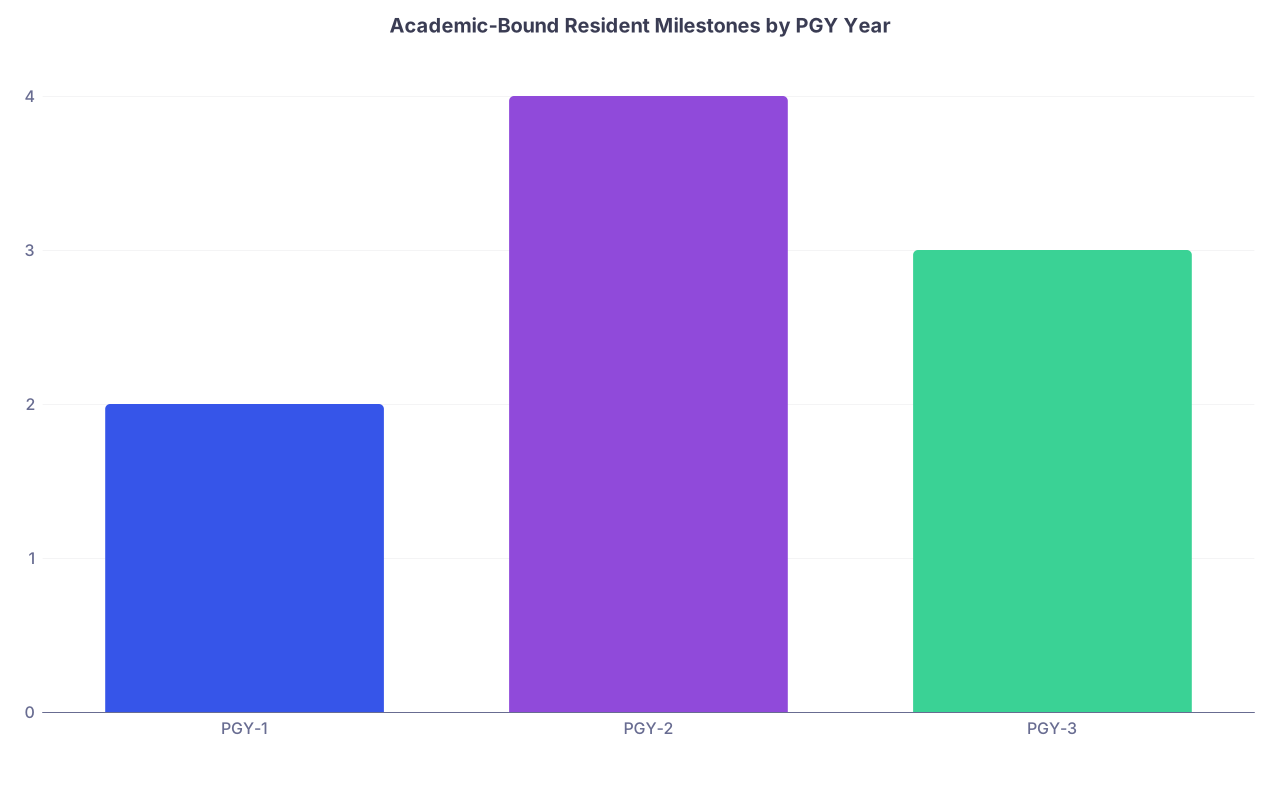
| Category | Value |
|---|---|
| PGY-1 | 2 |
| PGY-2 | 4 |
| PGY-3 | 3 |
Interpretation: “Number of concrete academic outputs/experiences per year” (case reports, posters, papers, away rotations, major presentations, etc.)
Year 1:
- Crush clinical work
- Identify at least one moderately academic faculty at your program
- Complete 1–2 case reports, maybe one small QI
- Present locally once (hospital QI day, state ACP, etc.)
- Start building a relationship with at least one external academic mentor
Year 2:
- Take on one “real” project with external academic collaborator (retrospective, QI, or education)
- Submit 1–2 abstracts to regional/national meetings
- Prepare for and do rotations at academic centers if possible
- Tell your PD clearly: “I’m aiming for academic [fellowship/job]. How can we position me well for that?”
Year 3:
- Finalize publications/abstracts before ERAS opens
- Stack your LORs with:
- 1–2 strong letters from your community program
- 1–2 letters from academic mentors/faculty at academic centers
- Apply broadly but strategically, with a personal statement emphasizing:
- That you’ve already behaved like an academic resident in a community setting
- That you want to bring that initiative into a richer environment
You do this, and “community vs academic” becomes less of a label and more of an origin story you use to your advantage.
Final Reality Check
You matched community. You want academic. That is not a dead end; it’s just a steeper hill.
The three things that matter most from here:
- Your program’s label is less important than your output and reputation. Become clinically excellent and produce academic work even if you have to build it yourself.
- You must borrow academic capital—mentors, letters, projects—from outside your community program. Rotations, conferences, cold emails, and QI projects are your tools.
- Stop replaying the Match in your head. Use that energy to build a 3-year plan and execute ruthlessly. Residents from small community programs end up in strong academic roles every year. The ones who make it didn’t wait for their program to turn academic—they acted like academic residents from day one.