What if the “high-volume” academic program you ranked #1 actually gives you less hands-on operative time than the “small” community program you dismissed on sight?
That specific mistake derails careers. I have watched it happen. Applicants confidently ranking programs based on lazy assumptions about case volume, then spending PGY‑2 trying to backpedal out of a bad training fit.
Let’s prevent you from being one of them.
The Core Myth: “Community = More Cases, Academic = Less Hands-On”
This is the lazy narrative:
- Community program → tons of bread‑and‑butter cases, you operate early and often
- Academic program → complex patients, but attendings and fellows “steal” all the cases
Sometimes that story is correct. Often it is completely wrong.
Here is where people go off the rails:
- They equate number of patients with number of usable cases
- They ignore who actually holds the scalpel or manages the case
- They do not consider competing learners (fellows, advanced practice providers, other services)
- They never check actual ACGME case logs or talk to upper levels about real numbers
So they match somewhere that “seemed busy” and discover they are mostly retracting or just writing notes.
You need to be skeptical of your own first impressions.
How Case Volume Is Actually Structured (Not How It’s Marketed)
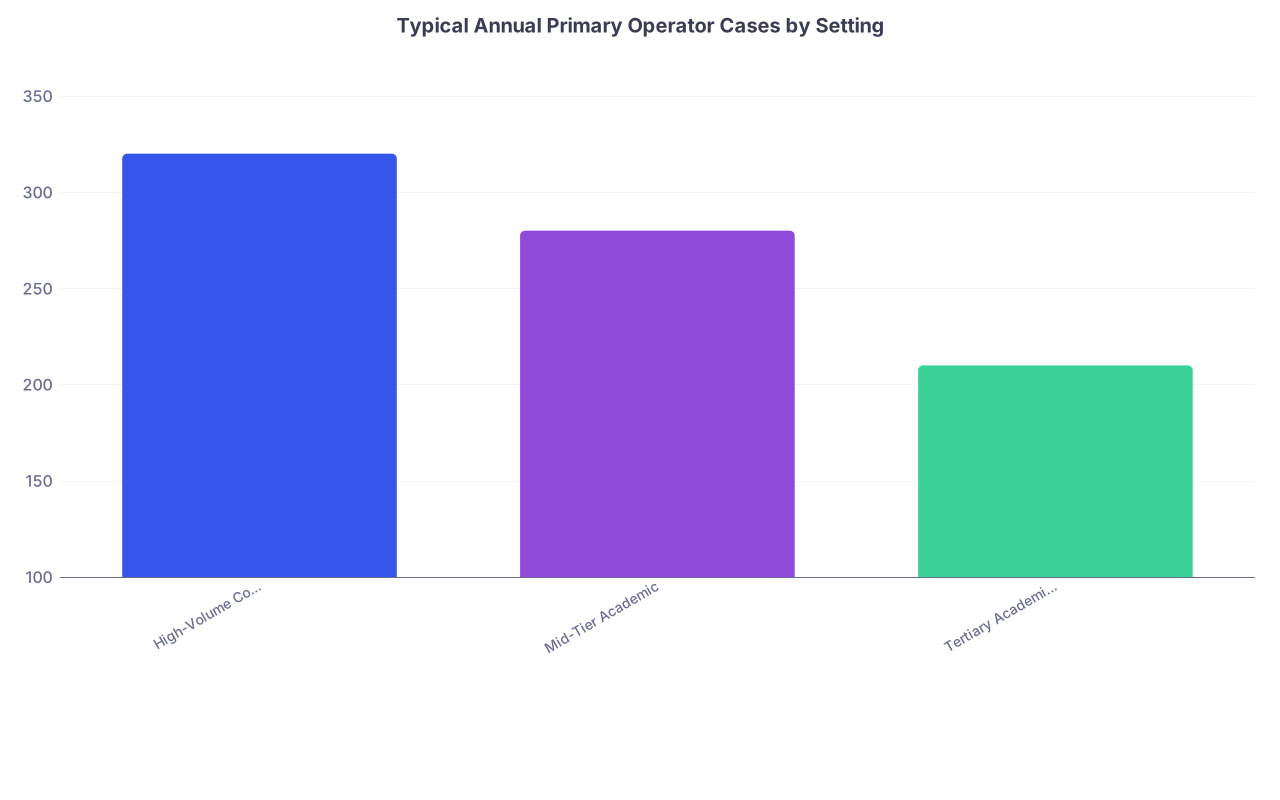
| Category | Value |
|---|---|
| High-Volume Community | 320 |
| Mid-Tier Academic | 280 |
| Tertiary Academic with Fellows | 210 |
Numbers above are ballpark, but I have seen distributions that look very similar when you pull aggregate logs from surgery or EM programs. Not the same for every specialty, but the pattern is recognizable.
1. “Busy Hospital” ≠ “High Resident Case Volume”
Common mistake: walking into a Level 1 trauma center, seeing every bed full, and assuming you will get massive volume.
Wrong metric.
Ask yourself:
- How many services are fighting over those patients?
- How many fellows do the big-volume attendings have?
- How many APPs (NPs/PAs) are doing first call, consults, and procedures?
Example I have seen in surgery:
- Big academic center advertises “over 1,000 trauma activations annually”
- Trauma team: fellows + APPs + residents from EM, surgery, ortho
- Result: PGY‑2s document, run the list, and hold retractors; fellows do the cool cases
- A small level 2 community center nearby, with no fellows, has PGY‑2s actually doing ex-laps and chest tubes
Same hospital census. Completely different resident experience.
2. Who Owns the Case? Follow the Incentives
Case volume is not just about raw numbers. It is about ownership:
- Does the service own consults and procedures, or are they pushed to another department?
- Are “simple” cases diverted to outpatient centers where residents are not involved?
- Do hospitalists or APPs swallow admissions that used to go to residents?
Community programs:
- Sometimes you get fantastic ownership: “You are the surgeon.” “You are the ICU team.”
- Sometimes the opposite: a hospitalist/APP army absorbs most bread-and-butter work and you see leftovers.
Academic programs:
- Often strong service ownership: neurology actually owns strokes, surgery owns all operative decision‑making.
- But fellow-heavy environments shift technical parts away from residents.
Do not guess. On interview day, ask specifically:
“Who typically performs X procedure at this institution—residents, fellows, or APPs?”
If they dodge, that is a red flag.
The Subtle Traps That Make Applicants Misjudge Volume
Most mistakes come from reading surface signals instead of underlying structure.
Trap 1: Believing Marketing Language
Programs know applicants are volume-obsessed, especially in procedural fields. So they say things like:
- “Exceptionally busy trauma center”
- “Tremendous operative exposure”
- “High-acuity patient population”
Those statements are close to meaningless without context. You need:
- Resident case log medians by PGY year
- Whose cases those actually are (primary surgeon vs assistant vs observer)
- The distribution of cases – are they all in the last 6 months of PGY‑5?
If a program cannot or will not tell you:
- Median number of [key procedure] by graduation
- Typical PGY level when residents start performing that independently
…assume the glossy brochure is doing a lot of heavy lifting.
Trap 2: Overvaluing “Cool Pathology” and Undervaluing Reps
Yes, quaternary academic centers see things nobody else does:
- Transplants
- Refractory autoimmune weirdness
- Rare tumors that show up in board questions
That is good for your brain. But you do not become technically competent on pathology alone.
You become competent on volume of repetitions in core skills:
- Intubations
- Central lines
- Laparoscopic cholecystectomies
- Vaginal deliveries
- Stroke codes
- Bread-and-butter ICU management
Where applicants screw up:
- They get dazzled by complex cases, but as interns and junior residents they are observers more than doers.
- Meanwhile, a lesser-known community program quietly graduates people with monster logs of core skills.
Board examiners, future employers, and your patients care more about whether you can safely manage common problems than whether you once saw a zebrafish syndrome during your PGY‑3.
Trap 3: Ignoring Time and Workflow
Another way applicants misjudge volume: they look at annual case numbers and forget about resident workflow constraints.
Ask:
- How many full clinic days per week are residents pulled from operative or procedural time?
- How many off-service months eat into your main specialty volume?
- How many hours do you lose to non-educational tasks because the hospital will not pay for scribes or adequate support staff?
An academic program with great support:
- Scribes or efficient EMR templates
- Strong ancillary staff
- Dedicated time for procedures
…can give you more meaningful volume in 55–60 hours per week than a chaotic community shop that works you 80 hours pushing stretchers and doing transport.
If most of your “busy” time is scut and not case participation, you are not training. You are cheap labor.
Community vs Academic: Real Differences That Matter for Volume
Let me cut through the noise and show you how I actually compare programs.
| Factor | Community Program | Academic Program |
|---|---|---|
| Fellows present | Rare / few | Common in many specialties |
| Resident procedural ownership | Often high, but variable | High in some services, low with fellows |
| Bread-and-butter exposure | Usually strong | Can be diluted by APPs / fellows |
| Rare/complex cases | Limited | High |
| Support staff / resources | Variable, often thinner | Usually stronger |
| Case log transparency | Often informal, depends on PD | Often tracked, but not always shared |
When Community Truly Wins on Volume
Community programs tend to deliver fantastic volume when:
- No or minimal fellows in your specialty
- Hospital depends heavily on residents for night coverage and procedures
- Minimal APP competition for bread-and-butter cases
- Strong relationship with community attendings who trust residents and are not terrified of efficiency loss
You will see it in:
- PGY‑2s confidently doing laparoscopic appendectomies, chest tubes, or deliveries as primary
- Seniors with case logs comfortably exceeding ACGME minimums without scrambling in the final year
The mistake is to assume all community programs fit this mold. Many do not.
When Academic Programs Quietly Outperform on Volume
Academic programs can absolutely crush community hospitals on volume if:
- They have high throughput and are regional referral hubs
- They aggressively protect resident procedures from being swallowed by APPs
- Fellows are either absent, minimal, or focused on different case types
You see this particularly in:
- EM programs at large trauma centers where residents run the resuscitations
- Surgical programs where fellows focus on transplant / complex oncology while residents own bread-and-butter general surgery
- IM or neuro programs with closed ICUs where residents manage vents, lines, and critical care daily
Again, you have to get beyond branding. Some “brand-name” places are terrible for hands-on volume. Some mid-tier academic programs with no fellows are gold mines.
Concrete Ways Applicants Mis-evaluate Volume on Interview Day

| Step | Description |
|---|---|
| Step 1 | Interview Day |
| Step 2 | Overestimate training |
| Step 3 | Clarify true exposure |
| Step 4 | Possible low resident hands on |
| Step 5 | Potential high resident volume |
| Step 6 | See Busy ED/OR |
| Step 7 | Fellows or APPs? |
Here is how I have watched people mess this up.
Mistake 1: Asking Vague Questions
Bad:
“How is the operative volume here?”
“Do you feel you get enough procedures?”
You will get rehearsed answers: “Yes, definitely” and “We meet ACGME requirements without a problem.”
They all say that.
Better questions:
- “How many laparoscopic cholecystectomies did you log as primary surgeon in PGY‑2?”
- “By the end of PGY‑3, about how many central lines had you personally placed?”
- “How often does a PGY‑1 in your program intubate on nights?”
- “Do seniors ever have to scramble at the end of residency to hit case minimums? In what areas?”
If they cannot give you ballpark numbers or dodge into generic talk, take that as data.
Mistake 2: Talking Only to Enthusiastic Juniors
Interns have no idea what their real volume will be. They are still learning the EMR and where the bathrooms are.
You want:
- PGY‑3+ residents who can say, “I logged 260 colonoscopies by the middle of this year.”
- Chiefs who are months from graduating and can tell you what they had to fight for and what came easily.
If the program keeps steering you toward interns and away from seniors, ask yourself why.
Mistake 3: Ignoring the Case Mix
High volume of garbage cases will not help you:
- 400 “assist” roles where you barely touch the scope
- Counting bedside “procedures” like foley placements as if that proves technical training
- Tons of chronic, low-acuity follow-ups with little teaching
You want to see:
- Sufficient core index cases for your specialty
- Real progression of responsibility from observer → assistant → primary
- Reasonable spread across settings (inpatient, ICU, clinic, OR, ED depending on field)
Ask explicitly:
- “What cases do residents still struggle to get enough of by graduation?”
- “Have any graduates needed extra fellowship or extra time just to feel comfortable with basic procedures?”
A Simple Framework to Sanity-Check Case Volume Claims
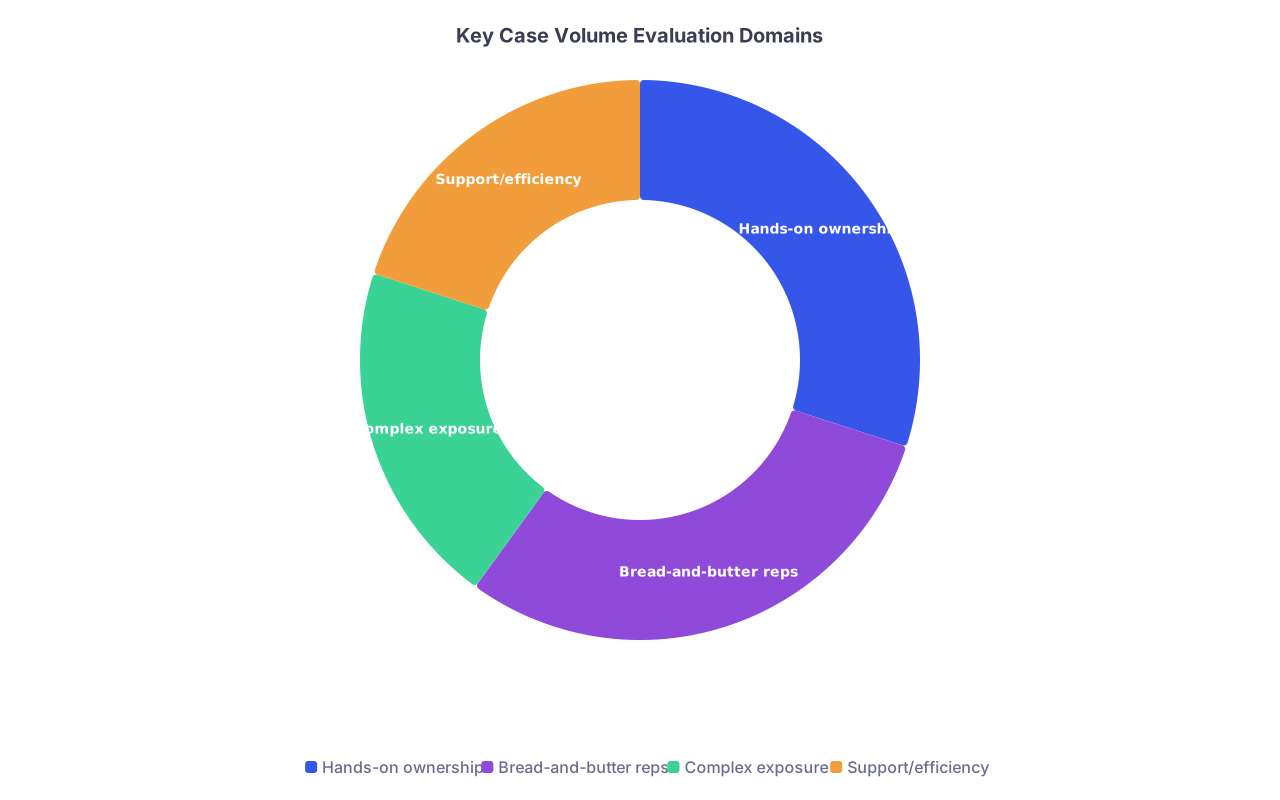
| Category | Value |
|---|---|
| Hands-on ownership | 30 |
| Bread-and-butter reps | 30 |
| Complex exposure | 20 |
| Support/efficiency | 20 |
When I advise applicants, I tell them to rate each program in four domains (1–5 scale):
Hands-on ownership
- Who actually does the procedure or runs the code?
- Are residents front and center or peripheral?
Bread-and-butter repetitions
- Are ACGME minimums exceeded by a wide margin for core cases?
- Or do they barely scrape by?
Complex exposure
- Do you see the edge cases needed for boards and referrals?
- This is nice, but not if it crowds out learning fundamentals.
Support and efficiency
- Are you spending time on actual patient care and procedures?
- Or are you drowning in clerical tasks that a half‑functional system could eliminate?
If a program scores strong on 1 and 2, and at least moderate on 3 and 4, I do not care whether it is “community” or “academic.” It is probably a good training environment.
If it is weak on hands-on ownership and bread-and-butter reps, fancy pathology and name brand will not save it.
Red Flags: When You Should Doubt the Case Volume Story

Pay attention to these signals; I have seen them predict disappointment with painful accuracy.
“Our graduates always meet ACGME minimums” is the only number you get
Translation: they are barely squeaking by and they know those metrics would scare you if shared.Seniors admit they had to “game” the schedule at the end
- Trading rotations
- Fighting for basic cases
- Being blocked by fellows for common procedures
APP-heavy services where residents do mostly documentation
If you hear, “Our NPs handle most of the procedures and routine cases so residents can focus on education,” run. That usually means you will be a consultant who writes notes while someone else gets the reps.Fellow-heavy departments in procedure-heavy specialties
Not all fellowships are a problem. But if you see:- Multiple fellowships competing for the same OR / procedural suite
- Fellows hanging around every bread-and-butter case
…you should be suspicious about how much will be left for you.
Residents cannot articulate when they “felt comfortable” with core skills
If a near-graduating EM resident cannot tell you roughly when they felt independent with airways, that is not reassuring.
How to Actually Avoid Misjudging Case Volume
You do not control everything. But you can stop making avoidable errors.
Look up or request case logs
- Ask programs for anonymized medians for key procedures.
- If they refuse, that alone is data.
Ask precise, uncomfortable questions on interview day
- “How many [X] did you personally log last year?”
- “Do any residents fail to meet case minimums without special efforts?”
Talk to recent graduates, not just current residents
Current residents might not see the big picture yet. Alumni working in real jobs know quickly whether their training was thin.Compare similar programs head-to-head
Do not compare a massive academic quaternary center to a tiny rural community program and act surprised by differences. Compare:- Community vs academic in the same city or region
- Programs with and without fellows in the same specialty
Be honest about your risk tolerance
- If you know you want a heavy procedural career, do not rank a program high where everyone admits they barely clear minimums “but the name is great.”
You have to live with the skill set you graduate with. Not your medical school advisor. Not the PD who sold you on “great exposure.”
FAQ (Exactly 5 Questions)
1. Is it always bad to train at a fellow-heavy academic program if I care about volume?
No, but you must verify that case allocation is structured intentionally. Some places clearly separate fellow vs resident cases: fellows do esoteric complex work, residents own bread‑and‑butter and emergencies. Others let fellows creep into everything. You need to see evidence—logs and resident testimony—not just promises.
2. How can I get case volume information if programs do not publish logs?
Ask chiefs and PGY‑3+ residents privately for their approximate numbers. Phrase it simply: “Roughly how many colonoscopies / intubations / C‑sections have you logged so far?” You do not need exact data; ballpark ranges will already separate strong from weak programs. Also, ask whether anyone in recent years had to extend training or do extra rotations for volume.
3. Are community programs always better for hands-on experience?
Absolutely not. Some are fantastic; some have APPs or community attendings who sideline residents. Others are just not busy enough. You evaluate them the same way: who owns procedures, what are the actual logs, and do seniors feel prepared for independent practice without remedial fellowship.
4. How much should case volume matter compared with research or prestige?
If your goal is to be a competent clinician or proceduralist, case volume should be near the top of your priorities—especially for surgery, EM, anesthesia, OB/GYN, and procedural subspecialties. Prestige and research help for academic careers, but they do not rescue weak technical training. Name recognition fades fast when you look incompetent in your first job.
5. What if I only realize after matching that my program’s volume is low?
You are not doomed, but you need to get aggressive early. Seek out elective rotations at higher-volume centers, negotiate for case-heavy electives, volunteer for extra call or procedure shifts when safe, and document every opportunity. In some situations, switching programs or pursuing a more intensive fellowship may be necessary. The key is not waiting until PGY‑5 to admit there is a problem.
Remember:
- Busy hospitals are not the same as high resident case volume. Always ask who actually does the work.
- ACGME minimums are a floor, not a goal. You want programs that exceed them comfortably, not barely.
- Community vs academic is the wrong question. The right question is: “Where will I get frequent, hands-on ownership of core cases with enough support to learn safely?”