The belief that you must train at an academic powerhouse to build a strong research CV is flat-out wrong.
You can absolutely build a serious, competitive research portfolio from a largely community residency. But it does not happen by accident, and it does not look the same as a fully academic path.
Let me walk you through what actually matters, what community programs can and cannot give you, and the concrete moves that turn a “non-academic” residency into a launchpad for a strong research CV.
The Real Question: What Counts as a “Strong” Research CV?
Before arguing about community vs academic, define the target.
A “strong” research CV for residency applications or early-career jobs usually means:
- Multiple peer‑reviewed publications (not just one case report)
- At least some original research or meaningful retrospective studies
- Evidence of consistency over time (not a one‑off burst)
- Increasing responsibility: from “data collector” to “first author / project lead”
- Outputs that fit your specialty:
- Cards: outcomes, imaging, quality improvement with meaningful endpoints
- EM: implementation science, operations, QI, education research
- Surgery: clinical outcomes, technique papers, prospective databases
- For academic jobs or fellowships at top programs:
- A handful of first‑author papers
- Clear niche (e.g., “sepsis outcomes,” “health disparities,” “global surgery,” “medical education”)
You do not need an R01-level portfolio during residency. You need proof you can generate scholarly work, work as part of a research team, and produce finished products.
That is all possible in a community environment—if you choose the right environment and act intentionally.
Community vs Academic Residencies: What Actually Changes?
Let’s strip the marketing and look at functional differences that matter for research.
| Factor | Strong Academic Program | Typical Community Program | Research-Friendly Community Program |
|---|---|---|---|
| Protected research time | Common in some tracks | Rare | Occasional / negotiable |
| On-site PhD / statisticians | Readily available | Usually absent | Sometimes via affiliated system |
| Built-in databases | Often robust | Limited | Growing in larger systems |
| Mentorship depth | Many active researchers | One or two at best | Small but motivated core |
| Culture of publishing | Normal / expected | Variable | Program-lead dependent |
What you lose in a non-academic residency
- Less automatic exposure to ongoing trials and major NIH-funded projects
- Fewer faculty who publish regularly and can pull you into projects
- Less structured research mentorship and fewer built-in pipelines
- Often no formal research curriculum or protected blocks
What you keep (or gain)
- Access to large patient volumes and “real world” data
- Tons of clinical questions, process problems, QI opportunities
- Usually more autonomy to design and lead your own projects
- Less competition from other residents for the few “good” projects
- Sometimes system-level data if your community hospital is part of a large network (HCA, Kaiser, big regional systems)
So the answer is not “yes or no.” It’s:
Yes, if you’re strategic about mentorship, project selection, and external collaborations.
Core Strategy: How to Build a Strong Research CV From a Community Base
Think of your research development as three pillars:
- Mentorship (local + external)
- Project pipeline (fast wins + long plays)
- Visibility (presenting and publishing beyond your hospital walls)
1. Get Serious About Mentorship – Beyond Your Own Hospital
Waiting for a perfect research mentor at a community program is a losing strategy. You cannot be passive here.
You should:
Identify anyone locally who publishes semi-regularly
- The one hospitalist who loves QI
- The cardiologist who’s on a multi-center registry
- The EM doc who does education research
Ask around explicitly: “Who here is most active in research or QI?”
Set up a targeted meeting
- Come with 2–3 loose ideas or a willingness to work on theirs
- Ask: “What’s stalled on your desk that a motivated resident could help finish?”
Build external mentorship
This is where community residents who win separate themselves:- Reach out to your med school contacts
- Email faculty at nearby academic centers in your specialty
- Join national research collaboratives or trainee networks
- Use conferences to meet people and say: “I’m at a community program, very motivated to do research. Do you work with external residents?”
You don’t need 10 mentors. You need 1–2 who are actually producing and willing to let you ride along.
2. Choose Projects That Fit Your Reality, Not Your Fantasy
Academic residents can sometimes survive five “interesting” but slow projects at once. You cannot.
From a community base, you should prioritize:
- Things with short feedback loops
- Projects you can push without daily in-person meetings
- Designs that don’t require complex infrastructure
Here’s the ladder I recommend:
Case reports and small series (months, not years)
- Pick them strategically: rare complication, unusual presentation, novel management
- The point is not prestige – it’s to prove you can finish something and learn submission mechanics
Retrospective chart reviews / database projects
- Feasible with EMR access and basic data pulls
- Partner with someone who has IRB experience
- Choose narrow questions with clear outcomes (“30-day readmission after X,” “door-to-antibiotic time before/after intervention”)
Quality improvement with publishable design
- Do not treat QI as throwaway fluff
- Use established models (PDSA, Lean, Six Sigma) and measure pre/post outcomes
- Target things your hospital already cares about: sepsis bundle compliance, CLABSI/CAUTI reduction, ED throughput, discharge documentation
Education research
- Simulation curricula, new teaching structures, flipped classroom sessions
- Use pre/post tests, objective outcomes (exam performance, milestone scores), simple stats
- Present at education conferences (APDIM, CORD, Council of Residency Directors, etc.)
You can absolutely get multiple first‑author publications out of steps 2–4 during a community residency if you’re ruthless about scope and follow-through.
3. Fill the Gaps With External Collaborations
Here’s the move that separates you from other community residents:
You deliberately plug into multi-center or externally led projects.
Where to find them:
- National trainee collaboratives (e.g., in surgery, EM, critical care, peds)
- Society-based registries (AHA, SCCM, ACS, etc.)
- Your old med school or nearby academic center – volunteer to be the “site PI” or data collector at your hospital
- Online research groups in your specialty (some are coordinated through Slack/Discord/listservs)
What you get out of these:
- Co-authorship on multi-center studies
- Experience with higher-level methodology
- Names on your CV that academic people recognize
- Stronger letters: “This resident at a community site still managed to be one of my most productive collaborators.”
This is how you turn a “small” hospital into one node of a larger research network.
Making It Work Under Community Workloads
Here’s the truth: community programs sometimes work you harder clinically, not easier.
So you need to plan like someone with very limited bandwidth.
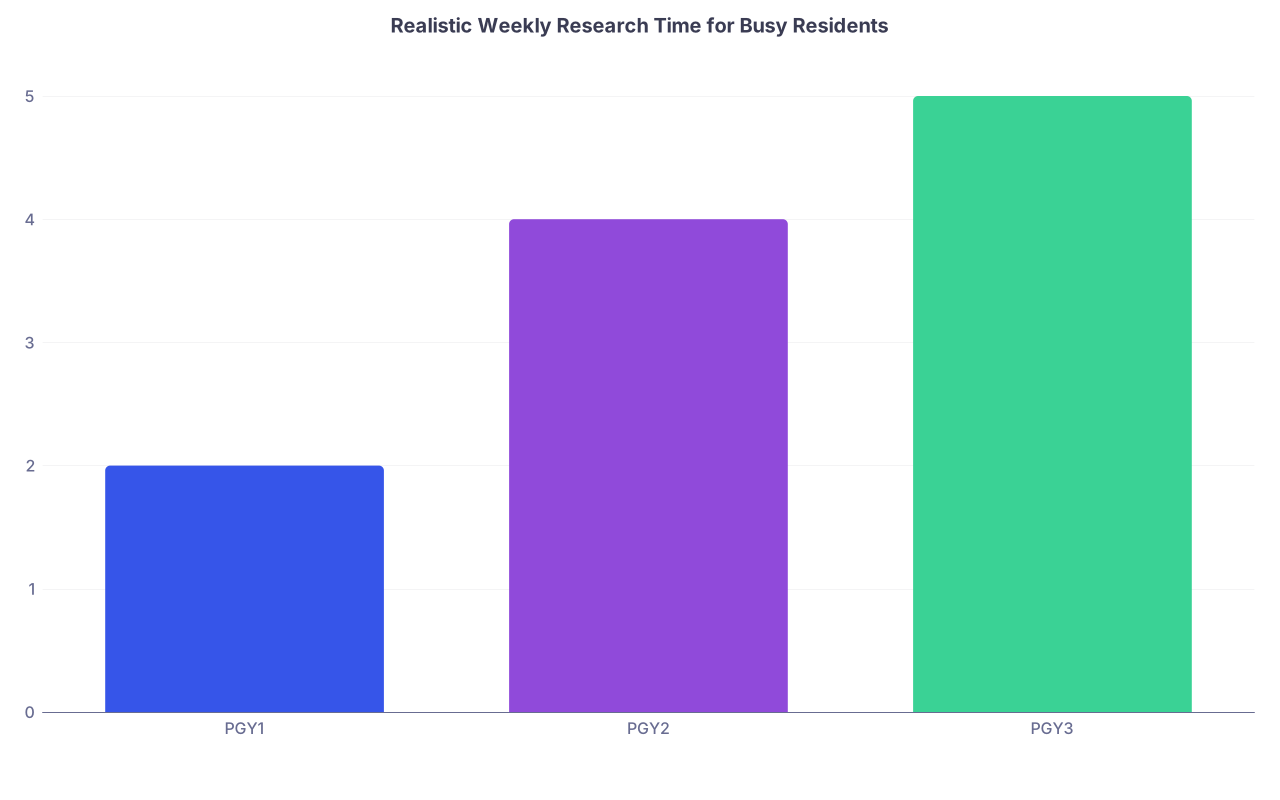
| Category | Value |
|---|---|
| PGY1 | 2 |
| PGY2 | 4 |
| PGY3 | 5 |
You are not doing 15 hours of research a week. Stop pretending.
What actually works:
- Protect 2–5 hours per week, religiously. Early morning or one afternoon on golden weekends.
- Batch your tasks: one session for data pulls, another for writing, another for figure generation.
- Treat email like a deliverable: if your mentor sends edits, turn them around within 48 hours. Fast responses keep you on people’s “reliable” list.
Timeline-wise, aim for:
- PGY1: Learn the system, finish 1–2 case reports / small QI projects, find mentors
- Early PGY2: Start 1–2 serious retrospective or QI projects, join one multi-center project
- Late PGY2–PGY3: Push projects to submission, present at national meetings, assume first-author roles
How Programs and Fellowships Actually Read a Community Research CV
Most selection committees don’t care if your residency was “community” or “academic” as an abstract label. They care about:
- Output: How many completed projects? What kinds of papers?
- Role: Are you first or second author anywhere, or always buried in the middle?
- Trajectory: Does your research activity increase over time?
- Fit: Does your work line up with the fellowship/specialty you’re aiming for?
- Story: Does your personal statement and letters explain how you made things happen despite structural limitations?
What impresses people from a community background:
- “Resident X had no formal research track, but still produced 4 publications, including 2 first-author QI/outcomes papers, and led an ED throughput project that changed local practice.”
- “They proactively worked with an academic mentor at our institution while on away electives; they are clearly self-driven.”
What raises red flags:
- Only one or two low-effort case reports across three years
- Lots of “submitted” and “in progress” with nothing actually published
- No clear theme; looks like you signed onto random projects without meaningful contribution
When a Community Program Really Does Limit You
I’m not going to sugarcoat this. There are community programs where serious research is almost impossible.
- No faculty publishing anything in the last 5–10 years
- Administration actively blocks data access or IRB support
- No relationship with any academic center or larger system
- Culture hostile to “resident research” (“We’re here to see patients, not write papers”)
If you’re applying and research matters to you, avoid those programs.
If you’re already in one of them, your play is almost entirely external:
- Projects based at an academic neighbor or your med school
- Multi-center collaborations where your location is just one data source
- Education or QI research that doesn’t require large dataset access
And yes, it’s harder. But still not impossible to build a meaningful CV if you start early and stay consistent.
Quick Decision Framework: Do You Need an Academic Residency?
Use this if you’re still choosing between community vs academic:

| Step | Description |
|---|---|
| Step 1 | Strong interest in future academic career |
| Step 2 | Prioritize academic programs |
| Step 3 | Choose research friendly community |
| Step 4 | Accept slower research growth or plan external collaborations |
| Step 5 | Willing to move or compromise on location |
| Step 6 | Community program with real research infrastructure available |
Rough guidance:
- If you want to be a physician‑scientist with heavy bench or grant-funded research → you should strongly prefer an academic residency.
- If you want to do clinical research, QI, education, and possibly academic hospitalist/fellowship work → a strong community or hybrid program is completely workable.
- If you care mainly about being a strong clinician but want a respectable CV → a research-friendly community program is often ideal.
Bottom Line
Yes, it’s absolutely possible to build a strong research CV without an academic residency.
But it will not happen by default, and it will not look like the path of your friends at big-name university hospitals.
From a community base, you win by:
- Aggressively finding and cultivating mentors (local and external)
- Choosing realistic, high-yield project types (retrospective, QI, education, multi-center)
- Being relentlessly consistent with small weekly time investments
- Using national networks and conferences to extend your reach beyond your hospital
Do this right, and your CV will read like someone who made things happen despite limited infrastructure—which is exactly the kind of person academic programs and fellowships want.
FAQ (7 Questions)
1. Will a community residency hurt my chances for a competitive fellowship if I want to do research?
Not automatically. What matters is whether you produce tangible, relevant output. A community resident with 4–6 solid publications and strong letters will beat an academic resident with one weak paper and lots of “in progress” fluff. For ultra-competitive fellowships (cards, GI, heme/onc at top centers), having at least some work with academic collaborators helps.
2. Is quality improvement research “good enough” to count as real research?
If it’s done properly, yes. QI with a clear question, pre/post measures, and publishable methodology absolutely counts, especially in fields like IM, EM, hospital medicine, and anesthesia. Journals and conferences publish QI all the time. The key is to treat it as actual research, not a box-check exercise.
3. How many publications should I aim for during residency from a community program?
Reasonable target: 3–6 total scholarly products by graduation, with at least 1–2 as first author. That can be a mix of case reports, QI, retrospective studies, and multi-center projects. More is great if feasible, but consistency and quality matter more than raw count.
4. Can I get involved with basic science or bench research from a community residency?
This is much harder without a university affiliation. Realistically, most community programs cannot support wet-lab work. If bench research is important to your career goals, you should either choose an academic residency or plan to do research blocks/electives at an affiliated academic center where that infrastructure exists.
5. How do I find external mentors willing to work with a community resident?
Start with prior med school faculty, people you met on away rotations, or researchers whose work you’ve read. Send a concise email: who you are, where you train, what you’re interested in, 1–2 concrete ways you could help (data collection at your site, literature review, etc.). Attach a CV. Most won’t respond. The few who do are gold.
6. Do conference abstracts and posters actually matter on my CV?
Yes. Abstracts and posters show productivity, networking, and commitment. They’re not equivalent to full publications, but for fellowship applications and academic jobs, a mix of posters and papers is normal. Use posters as stepping stones; the goal is always to convert promising abstracts into manuscripts.
7. I’m already PGY2 at a community program with zero research. Is it too late?
No. But you need to move now. Sit down with any research-active faculty this month, commit to 1–2 tightly scoped projects, and join at least one external collaborative. If you’re aiming for fellowship, you still have time to generate a couple of abstracts and at least one submitted manuscript before applications go out.
Open your CV today and count: how many finished scholarly products do you have right now? Then pick one concrete next step—email a potential mentor, outline a QI idea, or sign up for a collaborative—and get it done before the end of the week.