
The myth that program directors will secretly judge you for liking community programs more than big-name universities is exaggerated. And honestly, a little toxic.
Let me say it plainly: if a PD is offended that you put fit and training quality over their institution’s ego, that’s not a program you want to work in for 3–7 years.
But I know that’s not enough for your brain right now. Because your brain is doing what mine did: spiraling.
“If I rank this small community program #1, will the big academic places think I’m not ambitious?”
“If they see I didn’t ‘aim higher,’ will they question my work ethic?”
“Are community-first rank lists a red flag?”
Let’s walk through this like two people sitting in a call room at midnight, refreshing ERAS and overthinking everything.
What PDs Actually See (And Care About) On Rank Lists
First big truth: program directors cannot see how you ranked other programs. At all.
They don’t see:
- Your full rank list
- Where they sit on your list
- Whether you put four community programs above them
- Whether you ranked them #1 and then ten academic powerhouses after
They submit their list. You submit yours. NRMP’s algorithm does the rest. The only time anyone sees anything is after the Match, and even then, it’s aggregate data like “we matched 8 of our top 15.”
They are not sitting in a smoky back room saying, “Wow, they chose [Random Community Hospital] over us? Strike them from medicine.”
If a PD ever tells you they can access or punish you based on your rank order, that’s simply false and against NRMP policy. Period.
So that fear you have—of being “found out” later for preferring community? That’s a ghost. It doesn’t exist in the system.
The Quiet Truth: A Lot of PDs Like Community-Focused People
Here’s the part no one says out loud on Reddit:
Many academic PDs know their program is not the right fit for everyone. And they don’t want residents who will be miserable there.
I’ve heard PDs say things like:
- “If someone clearly wants a community-heavy, outpatient life, I’d rather they find their place than burn out here.”
- “I don’t need everyone to be obsessed with R01 grants. I need people who actually want what we offer.”
The reverse is also true. A lot of community PDs get wary of applicants who only talk about NIH funding and bench research because they know that person may resent the day-to-day reality of their program.
So if your genuine priorities line up more with community training—strong clinical exposure, faster autonomy, less research pressure—you’re not a weaker candidate for it. You’re a better fit for a certain kind of training environment.
That’s not unambitious. That’s self-aware.
Are Community Programs “Less Than”? The Part Your Anxiety Keeps Lying About
Let’s tackle the ugly thought directly:
“If I choose community over a university name, does that make me less competitive, less smart, less… impressive?”
No.
There are absolutely differences between community and academic programs. But the cartoon version—community = for weaker applicants, academic = for the “real” doctors—is lazy thinking.
Here’s a more honest snapshot:
| Factor | Community Programs | Academic University Programs |
|---|---|---|
| Clinical Volume | Often very high, bread-and-butter pathology | High, plus more rare/complex cases |
| Research | Possible but limited infrastructure | Strong infrastructure, expectations higher |
| Teaching Faculty | Often clinically focused attendings | Mix of clinician-educators and researchers |
| Autonomy | Tends to come earlier, more hands-on | Often more layered supervision |
| Reputation | Variable, more regional | Stronger national name recognition |
Is academic prestige real? Yes. Does it help with certain fellowships and academic careers? Also yes.
But does ranking a community program first automatically kill your career options? No. Especially not in fields like FM, IM, peds, EM, psych, where strong community training is extremely respected.
What matters more:
- Did you get solid clinical training?
- Did you have mentors who advocated for you?
- Did you build a story of consistency and growth?
Those can happen at a 600-bed county-affiliated community hospital just as well as at a top-10 university.
Worst-Case Scenarios Your Brain Is Inventing (And Why They’re Unlikely)
Let me walk through the catastrophes you’re probably running in your head.
1. “I match at a community program and later academic people judge me”
Some will. Let’s not pretend the prestige bias disappears after Match Day. There are attendings and program leaders who are name-obsessed.
But people who actually make decisions about your next step—fellowship PDs, hiring groups—tend to look deeper:
- Your letters
- Your performance
- Your Step/board scores
- Your actual skills and professionalism
I’ve seen:
- Residents from no-name community IM programs match GI and cards at big academic centers
- FM residents from smaller programs land competitive sports med spots
- EM residents from county/community programs get hired at Level 1 trauma centers over “prestige” grads because their volume and autonomy were better
If someone is shallow enough to write you off because your badge didn’t say “University of Whatever,” that’s a limitation on their side, not yours.
2. “If I love community programs, PDs will think I lack ambition”
What PDs actually read as “low ambition” isn’t “wants community.” It’s:
- Sloppy apps
- Generic answers
- No evidence of follow-through
- Zero curiosity
- Doing the bare minimum on rotations and interviews
You can say, “I want to be a strong clinician in a community setting” and still come across driven, thoughtful, and serious about your training.
Ambition doesn’t have to mean “I want to be the chair of XYZ at Harvard.” It can mean:
- “I want to be the doctor my patients trust in a resource-limited setting.”
- “I care about teaching and maybe being a core faculty at a community program.”
- “I want to balance life, family, and good medicine without chasing titles I don’t actually want.”
That’s still ambition. Just not Instagram-flex ambition.
3. “What if I regret not ranking the big university first?”
You might. That’s the honest answer.
There’s always a version of your life where you chose differently. But ask yourself: what, specifically, are you afraid of regretting?
- Missing out on a certain fellowship?
- Missing out on a big-name line on your CV?
- Missing some advanced research pipeline?
- Missing a certain city or lifestyle?
If your long-term goals truly require that academic infrastructure (like you’re dead-set on heme/onc at NCI-designated centers, or a hardcore research career), then yes—your rank list should reflect that.
But if you’re just afraid of how your choice will look to other people? That’s not a solid reason to sacrifice your own fit.
How To Frame Your Preference for Community Programs (Without Sounding “Lesser Than”)
The trap a lot of anxious applicants fall into is apologizing for liking community programs.
They say things like:
- “I know it’s not as academic but…”
- “I’m not really a research person…” (said with shame)
- “I just want to be a clinician…” (like that’s somehow inferior)
You don’t need to shrink yourself like that.
Better framing:
- “I’ve learned I thrive in high-volume, hands-on environments where I can build strong continuity with patients.”
- “I see myself as a clinician-educator in a community setting, maybe involved with medical students or residents.”
- “I’m excited by programs where residents get early autonomy and see a wide range of bread-and-butter pathology.”
That sounds intentional. Not like settling.
And yes—academic PDs hear this and think, “Fair, they may be happier elsewhere.” That’s not them judging you as weak. That’s them recognizing misalignment.
The Ugly Little Secret: Some People Use ‘Community’ As an Insult
You’ve probably heard it.
- “Oh, that’s just a community program.”
- “They matched community, but they’re still solid.”
- “She didn’t get any university interviews, so she’s going community.”
That stuff gets in your head. It makes you feel like if you choose community, you’re admitting you couldn’t do better.
Here’s what I’ll say: people who talk like that often:
- Haven’t worked in a strong community or county hospital
- Are still stuck in the med school clout-chasing mindset
- Are more concerned with status than actual training
Residents a few years post-graduation? They care way more about:
- “Can you handle a sick patient?”
- “Do you call for help appropriately?”
- “Are you someone I’d want on my team at 3 a.m.?”
And those skills are not reserved for fancy academic hospitals.
Hard Questions To Ask Yourself Before Finalizing That Rank List
Anxiety loves vague fears. It hates concrete questions because those force clarity.
So ask yourself:
- If the name disappeared and I could only judge by my gut on interview day, conferences, and how residents seemed—who would I put first?
- When I picture my worst-case daily life—burnout, dread, feeling inadequate—which type of program feels more likely to create that?
- If no one ever saw my badge or CV, and it was just me and my patients, which program would prepare me best for the work I actually want?
- If I changed my mind in 2–3 years and decided I wanted fellowship or academics—could I still reasonably get there from this program with hard work?
If your honest answers still tilt toward community programs at the top, then that’s not fear. That’s alignment.
A Visual Reality Check: Where People Actually Match From
Just to counter the narrative that “community = dead end,” here’s a simplified picture of something I’ve seen repeatedly: residents from both backgrounds landing solid fellowships.
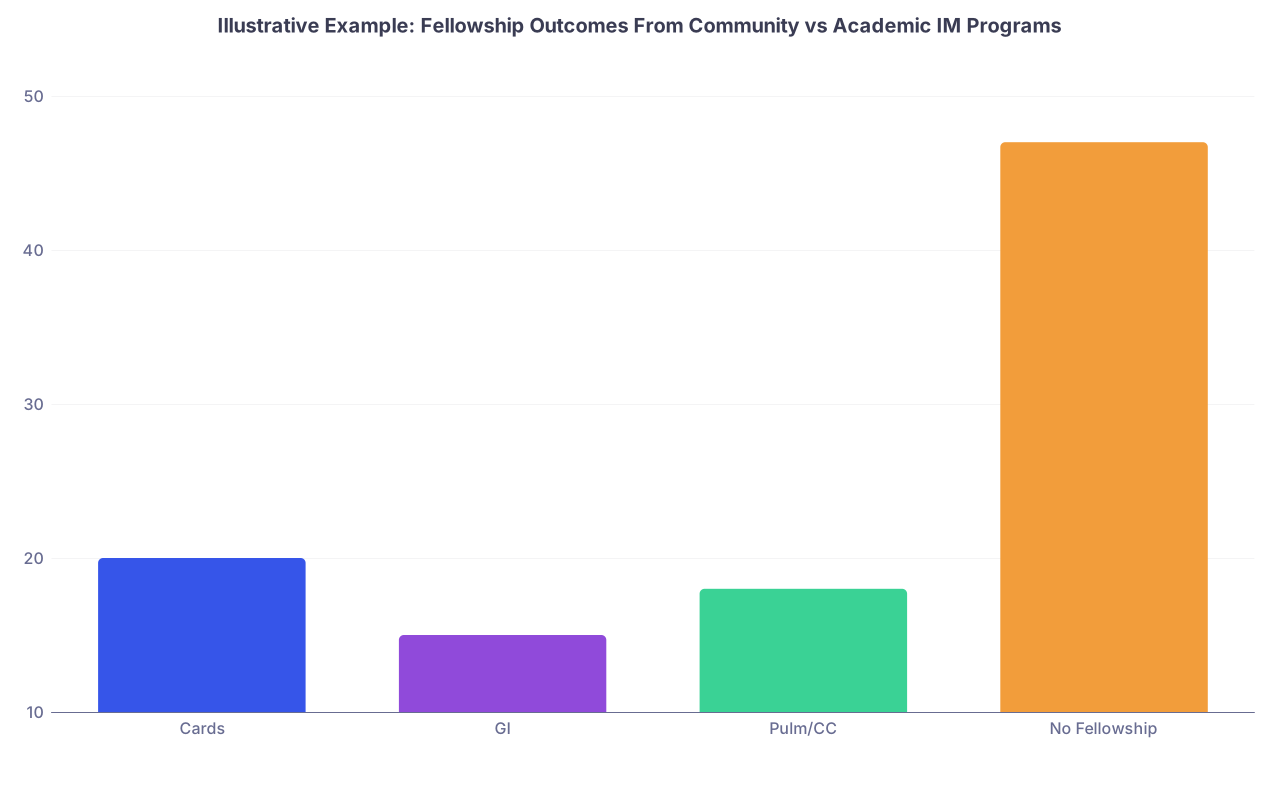
| Category | Value |
|---|---|
| Cards | 20 |
| GI | 15 |
| Pulm/CC | 18 |
| No Fellowship | 47 |
Let’s say a combined group of residents (from both a well-regarded community IM program and a mid-tier academic IM program) go into these paths over a few years. That’s roughly the kind of distribution you actually see. Not “all university people match, all community people vanish.”
Outcomes are way more mixed and dependent on individual performance than your anxiety wants to admit.
What Actually Gets You Judged (Spoiler: Not Your Love for Community)
If PDs judge you for anything, it’s usually:
- Poor professionalism
- Bad interviews (disengaged, vague, arrogant, disorganized)
- Red flags in letters or narratives
- Incongruence between what you say you want and what your record shows
Saying, “I’m really drawn to strong community-based programs with high-volume clinical training,” is not a red flag. It’s a preference.
Saying, “I want a heavy research career,” with zero research, weak letters, and no coherent explanation? That’s a red flag.
Choosing a community program because you:
- Want earlier autonomy
- Care about continuity with underserved populations
- Have family or support systems nearby
- Know academia doesn’t match your temperament
…those are grown-up, rational decisions. Not failures.
Quick Sanity Check: How NRMP Wants You to Rank
NRMP is painfully clear about this: you’re supposed to rank programs in your true order of preference. Not by where you “think you belong,” not by what looks best to others.
The algorithm is literally designed to favor applicant preference.
Trying to outsmart it because you’re ashamed of preferring a community program is how people end up mismatched—or unmatched.
So if your honest list starts:
- Community Program A
- University Program B
- Community Program C
That’s fine. That’s legal. That’s what the system is built for.
You will not get a call on Match Day saying, “We reviewed your preferences and found them unserious.”

FAQ – Exactly What Your 2 a.m. Brain Is Asking
1. Will ranking mostly community programs make academic PDs think I wasn’t competitive?
No, because they never see your rank list. They don’t get a report that says, “This applicant preferred Community Hospital X over University Y.” What they see is your application, your interview, maybe your post-interview communication. That’s it. Your preferences are invisible to them.
2. If I match at a community program, will it hurt my chances for fellowship?
It can make some ultra-competitive academic fellowships a bit steeper to reach, but it’s not disqualifying. Solid boards, strong letters, some scholarly work, and respected mentors can get you very far from a community base. I’ve watched residents from community programs match cards, GI, pulm/CC, heme/onc, you name it. It just may require more intentional hustle.
3. Should I lie and say I’m really into research to impress academic PDs, even if I prefer community?
Don’t. They can usually smell the disconnect. Saying you’re “very interested in research” when your CV is empty or minimal just makes you sound either insincere or confused. It’s better to be honest: “I’m open to research if it supports my clinical development, but my primary focus is becoming a strong clinician.” That’s not a weak answer. It’s a truthful one.
4. What if my classmates judge me for matching at a community program?
Some will. Quietly, with their little ranking of who “did best” on Match Day. And then real life happens. Salaries, jobs, burnout, competence. Five years out, no one cares where your residency badge came from. They care if you’re good, reliable, and not a nightmare to work with. Your classmates’ judgment is loud now and almost irrelevant later.
5. Are there community programs that are actually stronger than some university programs?
Absolutely. Some large community or county-affiliated programs have insane volume, amazing teaching attendings, and strong reputations in specific regions or specialties. A mid-tier university label does not always mean better training than a powerhouse community site. Residents talk. Fellows talk. Ask around. The name is not the full story.
6. I’m still scared I’ll regret not choosing the “prestige” option. What do I do?
Then ask yourself this: if both programs closed tomorrow and you had to repeat residency, which type of experience would you wish you had taken—a big-name, high-pressure academic environment, or a high-volume, hands-on community one? Base your choice on the life you’re about to live, not the line you’re about to add to your CV. Regret usually stings most when we choose for other people’s approval instead of our own reality.
Years from now, you won’t remember the mental gymnastics you did comparing “community” and “university.” You’ll remember whether you walked into work as the kind of doctor you actually wanted to become.