
Most residents are choosing programs without any real understanding of how the promotion track will lock in—or limit—their future.
Let me be blunt: “academic promotion” vs “community partnership” is not just branding. It is two different operating systems for your career. If you match into the wrong environment for the way you are built, you will spend five to ten years fighting upstream.
You are applying to residency now. This is exactly when you need to understand the mechanics, not three years into fellowship when your “track” quietly determines your income, schedule, and promotion ceiling.
I will break this down like I would with a senior resident who shows up in my office saying, “I like teaching, but I don’t want my life to be grant deadlines. What does that actually mean for where I should train?”
1. What “Academic Promotion” Really Means (Not the Brochure Version)
Forget the glossy website language. Academic promotion tracks are built around one simple engine: documented, reproducible scholarly output over time. Teaching is nice. Clinical excellence is expected. Neither, by itself, moves you up the ladder.
Most medical schools and large academic health systems have some version of this ladder:
| Rank | Usual First Appointment | Time-in-Rank Expectation |
|---|---|---|
| Instructor | New grads, fellows | 1–3 years |
| Assistant Professor | Early faculty | 5–7 years |
| Associate Professor | Mid-career | 5–7 years |
| Full Professor | Senior | Variable (often 10–15+) |
Where it gets tricky is track:
- Tenure / tenure-eligible (less common in purely clinical departments now)
- Clinician-investigator / physician-scientist
- Clinician-educator
- Clinician-administrator / quality & safety–focused
Each has its own weighted criteria. But they all share the same backbone: you must generate something that can be counted, listed, and reviewed by a promotions committee.
Typical buckets:
- Peer-reviewed publications
- Grants (as PI or significant co-investigator)
- Invited talks, regional/national leadership roles
- Curriculum development with evidence of impact
- Documented teaching excellence (evaluations, awards, leadership roles)
You can be the most beloved ward attending in the hospital. If, on paper, this translates to “great clinical teacher, high RVUs, nice person,” your promotion dossier will stall.
That is academic promotion.
How this shapes resident experience
In a promotion-driven environment, your attendings are juggling two jobs: patient care and their portfolio. You feel it as a resident:
- Every rotation has some “project you can join.”
- You hear phrases like “this will be great for your CV” weekly.
- Noon conferences are curated, evaluated, and sometimes studied.
- Quality improvement is not just “fix the pager workflow”; it is framed as publishable work.
If your long-term goal is to be on an academic ladder, this is gold. You see the rules early, and you watch people play the game.
If your long-term goal is to be a high-volume clinician with a stable schedule and strong community footprint, this can feel like noise. Sometimes, like pressure to care about things you do not.
2. What “Community Partnership” Actually Is (And Why It Confuses Applicants)
Community partnership tracks and community-affiliated programs sit on the other side of the spectrum. They are built to produce practice-ready clinicians and to serve a defined patient population or health system, not to feed a promotions committee.
Two important distinctions here:
- “Community-based” vs “university-based” residency
- Within a university-based department, a “community practice/partnership track” vs an “academic track” for attendings
You will see both during the application season, often blurred together.
Community partnership programs typically:
- Are embedded in large health systems, county hospitals, or regional networks
- May have an academic sponsor (university name somewhere in the letterhead) but day-to-day reality is service-heavy, research-light
- Have faculty whose promotions (if they exist at all) are uncoupled from traditional scholarly metrics and tied instead to:
- RVUs / clinical productivity
- Local leadership roles (clinic director, site lead)
- System-level quality metrics
- Community outreach and partnerships
Promotion here—if there is a formal ladder—looks more like corporate advancement than classic academic promotion.
How this shapes resident experience
You notice different things on day one:
- Residents talk about efficiency, throughput, billing, and documentation more than abstracts and grants.
- Procedures and “can I do this in practice?” questions get answered quickly.
- You may have a few research or scholarly faculty, but they are often visitors or a small cadre, not the norm.
- M&M and quality conferences are very operational: “How do we prevent this next week?” Not “How do we publish this in BMJ Quality?”
If your goal is to work in a similar system after training, this is a direct preview. If you crave a life structured around study sections, advanced trial design, or education theory, you will feel underfed.
3. Side‑by‑Side: What Changes For You As a Resident
Let me put this in concrete, applicant-facing terms. When you rank programs, you are implicitly choosing between two different gravitational centers.
| Feature | Promotion-Driven Academic Programs | Community Partnership–Oriented Programs |
|---|---|---|
| Primary faculty incentives | Publications, grants, education portfolios | RVUs, local leadership, system metrics |
| Resident project pipeline | Frequent, structured, mentored | Variable, often self-initiated |
| Visibility to national orgs | High (faculty on committees, guidelines) | Lower, depends on a few connected individuals |
| Clinical volume | Moderate to high, avoids pure service tracks | Often very high, real-world practice volume |
| Evaluation culture | Formal, documented, committee-driven | Often more informal, tied to service and teamwork |
Now, let me walk through key domains and what they actually feel like.
A. Research and Scholarship
In an academic-promotion environment:
- You will constantly hear about abstracts, posters, manuscripts, and “the next step for this project.”
- Many programs have resident research requirements built into graduation.
- You will see junior faculty obsessed with getting from 5 papers to 10, from “local invited talk” to “national invited talk,” because promotion dossiers demand it.
- You are more likely to see structured things like:
- Protected research blocks
- Resident research tracks
- Formal mentorship committees
In community-partnership environments:
- You may still have scholarly requirements (ACGME insists you do something), but projects skew toward:
- QI work rooted in this exact clinic or hospital
- Clinical projects with simple methods and local impact
- Case reports or small series, not multicenter RCTs
- Faculty may have less time, less infrastructure, and less pressure to publish. If they are productive, it is because they personally care, not because a dean is chasing them.
Neither is “better.” They are optimized for different destinies.
If you want a competitive subspecialty fellowship at a top-tier academic center (GI at UCSF, Cards at Duke, Heme/Onc at MSK), the academic-promotion environment is often a more direct runway. Not because community programs produce weaker doctors, but because fellowships recognize and trust the scholarly “signals” those places generate.
If you want to be the go-to clinician in a large multispecialty group, community-centered scholarship (real-world QI, EMR optimization, throughput redesign) is arguably more relevant.
4. Promotion Mechanics vs Partnership Mechanics
Let us get painfully specific about how these two systems actually function for attendings—because this is the world you are training to join.
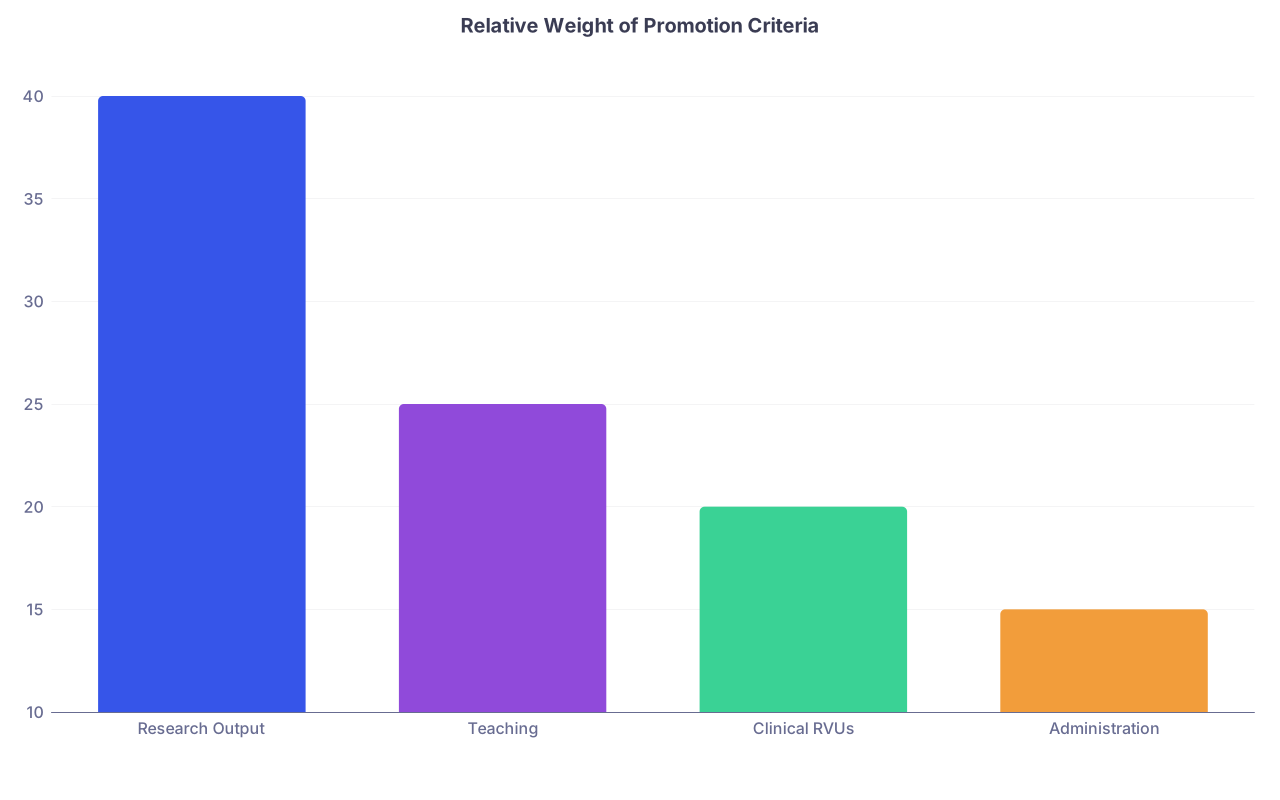
| Category | Value |
|---|---|
| Research Output | 40 |
| Teaching | 25 |
| Clinical RVUs | 20 |
| Administration | 15 |
That bar chart is roughly how a classic academic department thinks about promotion for a clinician-investigator. Research dominates. Teaching helps. RVUs and admin keep you employed, but are rarely the primary driver for rank.
In a community partnership model, if you built the same graph for advancement, it might look like:
- 10% research / scholarship
- 20–30% teaching and “good citizen” behavior
- 40–50% clinical productivity and quality
- 20–30% leadership in the local system
Viewed from your chair as a resident, this plays out as:
- Academic promotion track faculty are pulled toward grants, extramural committees, and multi-site projects.
- Community partnership faculty are pulled toward clinical leadership roles: medical director of the ED, chief of hospital medicine, quality lead for sepsis, etc.
If you ask, “Who gets promoted faster?” the answer depends on the environment:
- In promotion-centric cultures, a heavily clinical, low-scholarship faculty member hits a ceiling.
- In partnership-centric systems, a brilliant but low-volume, grant-focused attending may be seen as a luxury, not the future CMO.
You are not just choosing where you learn. You are choosing whose incentives you will normalize.
5. How This Should Change Your Application Strategy
Here is where residents usually get burned: they treat “academic vs community” as a vibe, not an operational system.
Do not do that.
When you interview, you want to interrogate mechanics.
Questions I would actually ask on interview day
To PDs and faculty:
- “How are your core teaching faculty evaluated and promoted?”
- “For someone who is mostly clinical but loves teaching, what does career progression look like here?”
- “Can you give me an example of a recent faculty promotion and what their portfolio looked like?”
- “For residents who have gone into academic careers in the last 5 years, what helped them the most here?”
- “If I wanted a heavily community-based career after residency, how similar is the day-to-day here to that?”
To residents:
- “Do your attendings talk about promotion, grants, and publications a lot, or more about RVUs, clinic growth, and leadership roles?”
- “How easy is it to get plugged into a project with a realistic path to presentation or publication?”
- “Who are your role models, and where did they end up? Academic jobs? Community systems? Private groups?”
- “If someone is research-focused here, do they feel supported or like they are swimming against the tide?”
Ignore the single shining star faculty member who did a K award in a community program. Every ecosystem has outliers. You are trying to assess what is “normal” behavior and incentive structure.
6. Match Outcomes: Does Track Type Really Affect Your Fellowship Chances?
Short answer: yes, but not as rigidly as people think.
I have watched residents from strong community programs match into elite fellowships. I have also watched residents from big-name academic hospitals fail to match because they never converted potential into documented output.
What matters is alignment between:
- Your program’s default environment, and
- Your personal initiative and goals
Still, the baseline probabilities differ.
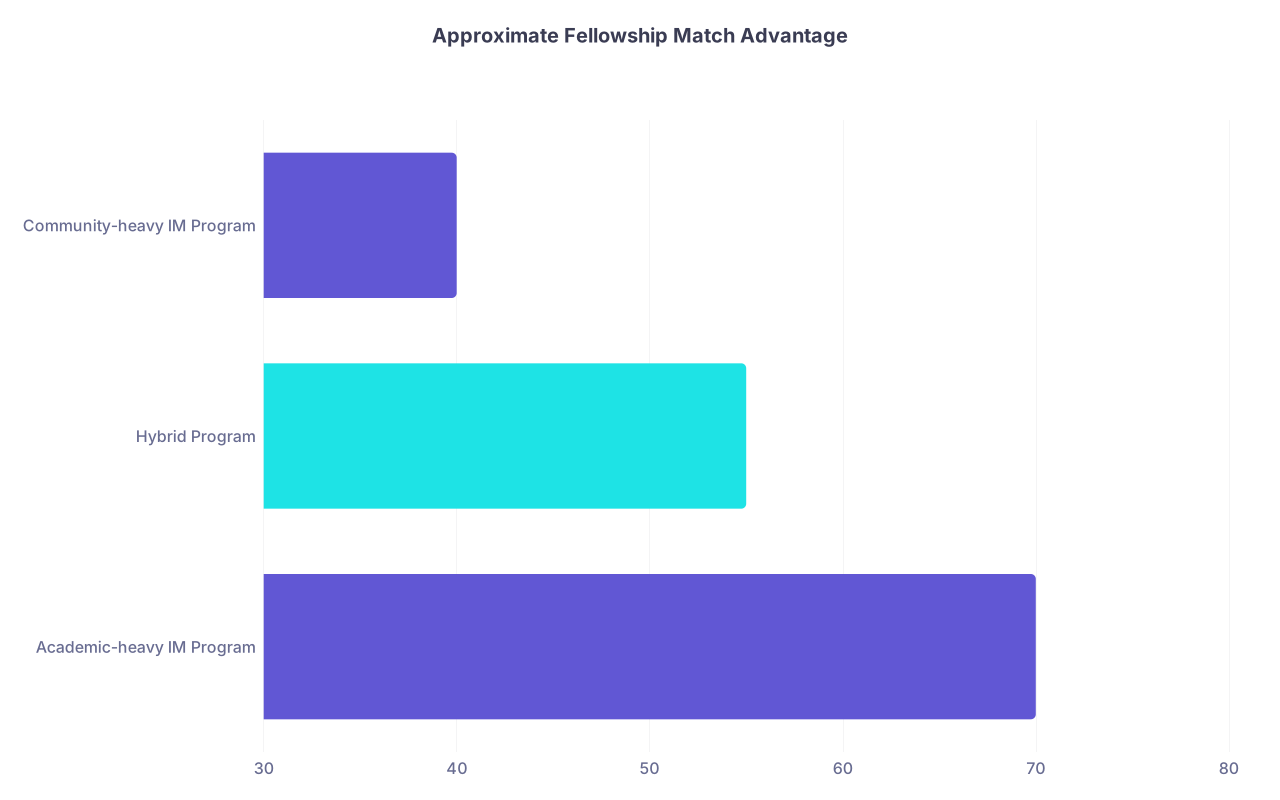
| Category | Value |
|---|---|
| Academic-heavy IM Program | 70 |
| Hybrid Program | 55 |
| Community-heavy IM Program | 40 |
Those percentages are not data; they are directional reality from watching years of match lists and letters.
Academic-heavy programs tend to confer advantages because:
- Their faculty write letters that fellowship directors instantly recognize and trust.
- They are used to packaging residents for subspecialty applications: timelines, abstract deadlines, letters, national meetings.
- They have built-in visibility at conferences and through cooperative trials.
Community-heavy programs can close much of that gap if:
- They deliberately identify fellowship-bound residents early.
- They partner with academic centers (shared clinics, electives, co-mentorship)
- They build small but serious research/QI infrastructure.
If you are absolutely set on a hyper-competitive academic fellowship (derm, rad onc, IR, some surgical subspecialties), bias your rank list toward environments where academic promotion pressure is high. You will ride the same tailwind.
If you are open to generalist practice, hospitalist roles, or non-university fellowships, a strong community or hybrid program can be an excellent choice, often with more hands-on clinical exposure.
7. The Hidden Lifestyle and Burnout Differences
People pretend this is all about CV lines. It is not. The track culture shapes how and when faculty burn out. Which shapes how they supervise you.
In high-promotion academic environments:
- Faculty often carry the triad: clinical, research, and teaching. At least two full-time jobs.
- You will see grant cycles dictate their mood. Manuscript deadlines bleed into weekends.
- Mentors will sometimes tell you, quietly, “Do not do what I did. If you want time with your family, pick a different track.”
In community partnership settings:
- Burnout is more tightly tied to volume: number of patients, call burden, EMR pain, weekend coverage.
- When systems are well-run, faculty can have stable, predictable schedules and relatively insulated lives.
- When systems are poorly run, residents see chronic frustration with administration, production pressure, and “just one more patient” days.
You pick your poison:
- Do you want intellectual and scholarly pressure with high upside if you succeed?
- Or operational and volume pressure with solid compensation and local impact?
You can absolutely carve out a sane path in either. But you need to be honest about your temperament.
8. Practical Red Flags and Green Flags on Interview Trail
Let me give you some quick pattern recognition. This is the stuff people only say to you over coffee when the formal tour is done.
Green flags for a strong academic-promotion culture (good if you want that):
- Junior faculty proudly discussing their promotion timeline and portfolios, not just survival.
- PD can name 3–5 recent residents now in academic posts and exactly what they did to get there.
- There is a structured system: resident research day, internal grant competitions, methodologic support (biostats, IRB infrastructure).
Red flags if you think you want academic careers but see this:
- “We encourage research,” but all the examples they give are single case reports.
- Faculty shrug when asked about promotion criteria: “I do not really know, I just see patients now.”
- Residents say, “If you want research, you kind of have to figure it out on your own.”
Green flags for a strong community partnership environment:
- Clear pathways for residents into local health system roles: chief resident to hospitalist to associate medical director.
- Faculty with titles like “Director of Population Health,” “Quality and Safety Lead,” “Clinic Medical Director” talking concretely about career satisfaction.
- Strong, longitudinal continuity clinics with real responsibility and meaningful QI work embedded.
Red flags for community-focused careers:
- Residents say, “Honestly, we work like crazy, but no one talks with us about sustainable jobs after graduation.”
- Faculty frequently mention being “trapped” by non-competes or under-compensated for their volume.
- No structured mentorship around contracts, RVUs, and real-world practice.
9. So Which Track Should You Bias Toward?
Let me give you some archetypes. See where you fit. Be honest.
The Future Academic Subspecialist
You light up at journal club. You already have a first-author paper. You enjoy writing and asking narrow questions deeply.
→ You should favor residency programs embedded in promotion-driven academic departments, ideally with a strong track record in your future field.The Clinician-Educator in the Making
You love teaching more than pipetting. You spend time refining how you explain things. You could see yourself as a PD or clerkship director.
→ You want an academic environment where education counts for promotion and is not just lip service. Look explicitly for “clinician-educator” tracks and real education scholarship.The High-Volume Community Clinician
You like moving, seeing patients, solving concrete problems fast. You do not want a life full of grant deadlines and manuscript revisions.
→ You will thrive in community partnership programs that show you exactly how modern group practice works, with good role models in large systems or private groups.The Systems and Leadership Person
You cannot stop thinking about throughput, staffing models, EMR templates. You are the one on the team talking about “why the system is like this.”
→ Either environment can work. In academic settings, you trend toward quality/safety and operations leadership tracks. In community systems, you move toward service line leadership and CMO-type roles. Pick the setting whose outcomes you actually admire.
If you are genuinely unsure—and many MS4s are—prioritize hybrid programs:
- University-affiliated but with strong community rotations
- Multiple faculty who live partial lives in both worlds
- Residents over the last 5 years who have gone to both academic fellowships and community jobs
That buys you maximal optionality.
10. Timeline: When Track Mechanics Start To Matter
You will feel some of this as an intern. By PGY-2, the differences are obvious. By the time you are applying for fellowship or jobs, the track you trained in will have shaped your options more than you realize.
Here is the rough progression.
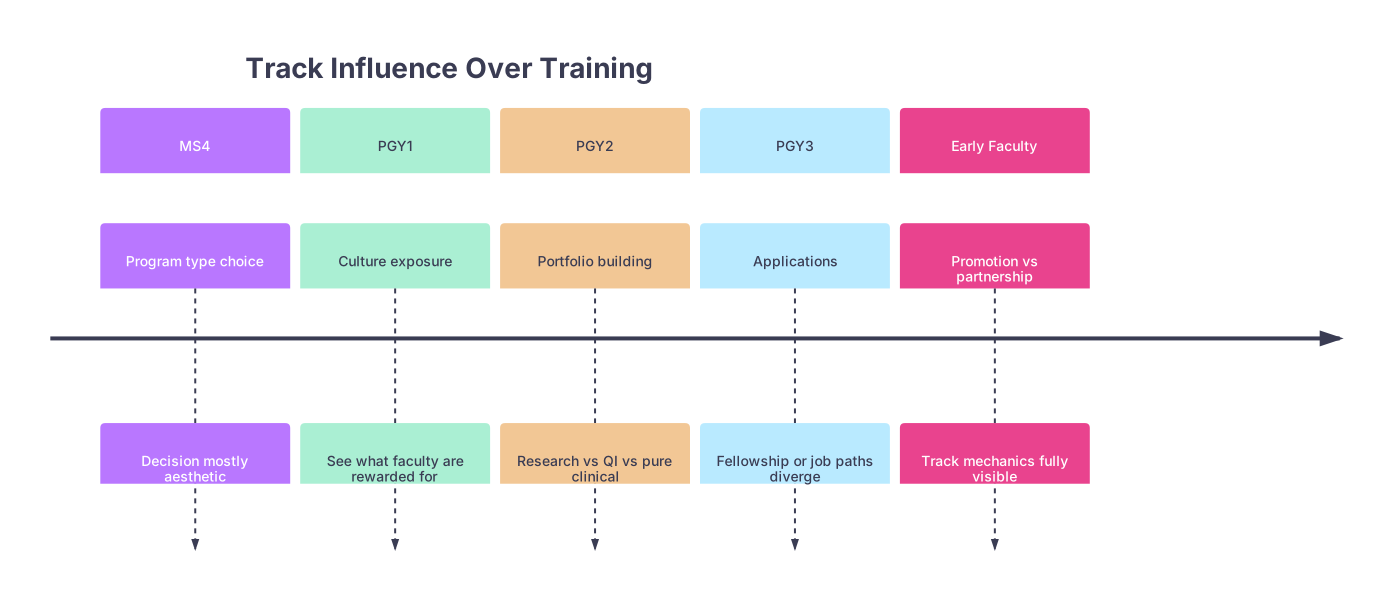
| Period | Event |
|---|---|
| MS4 - Program type choice | Decision mostly aesthetic |
| PGY1 - Culture exposure | See what faculty are rewarded for |
| PGY2 - Portfolio building | Research vs QI vs pure clinical |
| PGY3 - Applications | Fellowship or job paths diverge |
| Early Faculty - Promotion vs partnership | Track mechanics fully visible |
You do not need a perfect 20-year plan right now. But you do need enough self-awareness to avoid an obviously wrong ecosystem.
FAQ (Exactly 4 Questions)
1. If I train at a community program, am I shut out of academic careers?
No, but the path is steeper. You will likely need to: find mentors with academic connections, take electives at academic centers, build strong scholarship (even if it is QI-focused), and be strategic about conferences and networking. It is doable; it is just not the default current.
2. Are “community tracks” inside academic departments lower status or second-tier?
Not inherently. They are optimized for different outputs. The trap is when departments label something “community track” but treat it internally as a dumping ground for clinically overworked, under-resourced faculty with no meaningful advancement path. Ask how those faculty are evaluated, paid, and promoted. The details will tell you if it is respected or not.
3. For fellowship applications, what matters more: big-name academic program or strong letters and actual output?
Strong, specific letters backed by real work win. A big-name program can multiply the impact of that work, but it cannot rescue a flat file. Fellowship directors read for: concrete accomplishments, clinical excellence, independence, and potential. A first‑author paper with a clear role description plus a well-written letter from a known mentor will beat “resident in Famous Program, no products” almost every time.
4. How early in residency should I commit to an ‘academic’ vs ‘community’ direction?
You do not need to sign your life away in July of intern year. But by late PGY-1 or early PGY-2, you should start leaning: am I building a scholarly portfolio or am I doubling down on clinical and systems skills? Promotion and partnership tracks both reward longitudinal commitment. Dabbling in everything without finishing anything is the only reliably bad strategy.
Takeaway: Academic promotion and community partnership tracks are not superficial labels; they are completely different incentive structures. Choose a residency where the default behaviors of faculty match the kind of doctor you want to become.
And remember: the best program for you is the one whose outcomes—careers, not just match lists—you would be genuinely content to inherit.