The biggest myth applicants believe about QI is that “academic = better projects.” That is flatly wrong. What changes between community and academic programs is not whether you can do quality improvement. It is how you will find projects, who will push them forward, how visible your work becomes, and how much friction you will fight to get anything approved.
Let me break this down specifically, because QI is one of the most misunderstood parts of residency applications and training.
The Core Reality: QI Exists Everywhere, But the Ecosystem Is Different
Every hospital that bills Medicare has QI requirements. Every residency program, community or academic, must show the ACGME that residents participate in quality and patient safety. So you will have “QI projects” no matter where you go.
But the ecosystem is very different.
Academic centers tend to have:
- Bigger infrastructure
- More formal committees
- More layers of approval
- More people claiming “ownership” of problems
Community programs tend to have:
- Flatter structure
- Fewer bureaucratic steps
- More direct impact on day-to-day workflow
- Less built‑in support for turning projects into posters/papers
So when you ask on the interview trail, “What QI opportunities do you have?”, you are really asking four separate questions:
- How easy is it to find a project?
- How easy is it to implement change?
- How easy is it to present/publish it?
- How much will this actually matter for my career path?
If you do not separate those pieces, you will get vague answers and pick the wrong program for your goals.
Structural Differences: How QI Work Is Organized

| Step | Description |
|---|---|
| Step 1 | Resident |
| Step 2 | Formal QI Curriculum |
| Step 3 | Multiple Committees |
| Step 4 | Research Office Support |
| Step 5 | Lean Local Teams |
| Step 6 | Direct Access to Leadership |
| Step 7 | Limited Research Infrastructure |
| Step 8 | Academic Hospital |
| Step 9 | Community Hospital |
Academic Programs: Built Like a Machine… With a Lot of Gears
At an academic center, QI usually sits inside a formal structure:
- Hospital‑wide Quality and Safety department
- Multiple subcommittees (sepsis, CLABSI, readmissions, perioperative, transitions of care, etc.)
- Residency QI curriculum with required projects
- Safety event reporting platforms (RL Solutions, Quantros, etc.)
- Data analytics staff who can pull reports for you
Concrete example: A mid‑size university internal medicine program might require each PGY‑2 to join a QI team, complete an A3, pre/post data analysis, and present at an annual QI day. The hospital quality team provides run charts, help with control charts, and maybe a statistician.
Upside: infrastructure, data, pre‑existing projects, mentors who know the A3 / PDSA language, institutional QI priorities you can plug into.
Downside: You are one of 200 residents. Getting a project and having your name mean something can be tricky. You may be “the fifth resident” to work on central line documentation, with limited ownership. Approvals can be slow and political, especially if your change touches EHR, billing, or nursing workflows.
Community Programs: Less Machinery, More Direct Lines
Community hospitals usually have:
- A smaller Quality department (sometimes 3–6 people for the whole hospital)
- Fewer formal committees, often directly chaired by the CMO or CNO
- Less rigid QI curriculum; sometimes a basic workshop, sometimes nothing beyond a required “project”
- Shorter distance from frontline idea to leadership conversation
You might hear: “If you see a problem on the medicine floor, talk to the quality nurse and we will see if we can test a change next month.” That is not marketing fluff. In many community hospitals, the person designing the intervention is the same person you run into in the cafeteria.
Upside: You can own a problem end‑to‑end. You propose, design, implement, and present it. Less territoriality. You see impact faster.
Downside: Data is harder. No in‑house statistician. Quality team might be buried in Joint Commission prep. If you want academic‑style output (abstracts, manuscripts), you will probably build that infrastructure yourself or find an off‑site mentor.
Types of QI Projects: What You Actually End Up Doing
Most applicants hear “QI” and think “handwashing posters” or “order set tweaks.” The reality is broader.
Let’s categorize the common project types and look at how they differ in community vs academic settings.
| Project Type | Academic Center Typical Focus | Community Hospital Typical Focus |
|---|---|---|
| Order set / EHR optimization | Complex, multi‑service builds | Targeted, workflow‑driven tweaks |
| Process redesign (throughput) | Large, multi‑department pathways | ED–floor or clinic–ED handoffs |
| Safety event reduction | CLABSI, CAUTI, falls, pressure ulcers | Same, but smaller patient volumes |
| Guideline adherence | Specialty‑aligned protocols | Core measures, CMS/HEDIS metrics |
| Transitions of care | Discharge summaries, follow‑up clinics | Readmissions, SNF / home health links |
Academic: Subspecialty‑Heavy, System‑Wide
Examples I have seen at academic IM programs:
- “Improving adherence to lung cancer screening guidelines in a resident clinic”
- “Reducing inappropriate telemetry on general medicine floors”
- “Standardizing VTE prophylaxis for orthopedic surgery patients”
These often require:
- Multi‑disciplinary meetings (medicine, nursing, case management, IT)
- Engagement from subspecialty attendings (oncology, cardiology, etc.)
- Alignment with ongoing institutional projects (e.g., hospital is being penalized for readmissions)
They are great for:
- Residents targeting fellowships (cards, heme/onc, pulm/crit) who want subspecialty‑aligned QI
- Posters at regional/national academic meetings
They are weaker for:
- Fast, resident‑driven bedside improvements
- Projects that deviate from institutional “priority lists”
Community: Throughput, Efficiency, and Real‑World Bottlenecks
At a solid community program, your project examples look more like:
- “Reducing ED‑to‑floor admission time for patients handed off to the night float”
- “Improving medication reconciliation accuracy at admission in a small resident clinic”
- “Standardizing sepsis bundle initiation in the ED for floor‑bound patients”
These are usually:
- Very close to daily pain points you feel on call
- Piloted quickly on a single unit or with a single team
- Measured using simpler metrics (time stamps, binary compliance)
They are perfect for:
- Applicants who actually care about operations, hospital medicine, or administration
- Building a portfolio of tangible, implemented changes you can articulate in interviews
They are less ideal for:
- Pre‑packaged “CV ornaments” where the main goal is a PubMed line
Data Access and Analytics: The Boring Part That Actually Decides Everything
You cannot do meaningful QI without data. Here is where the community vs academic gap is very real.
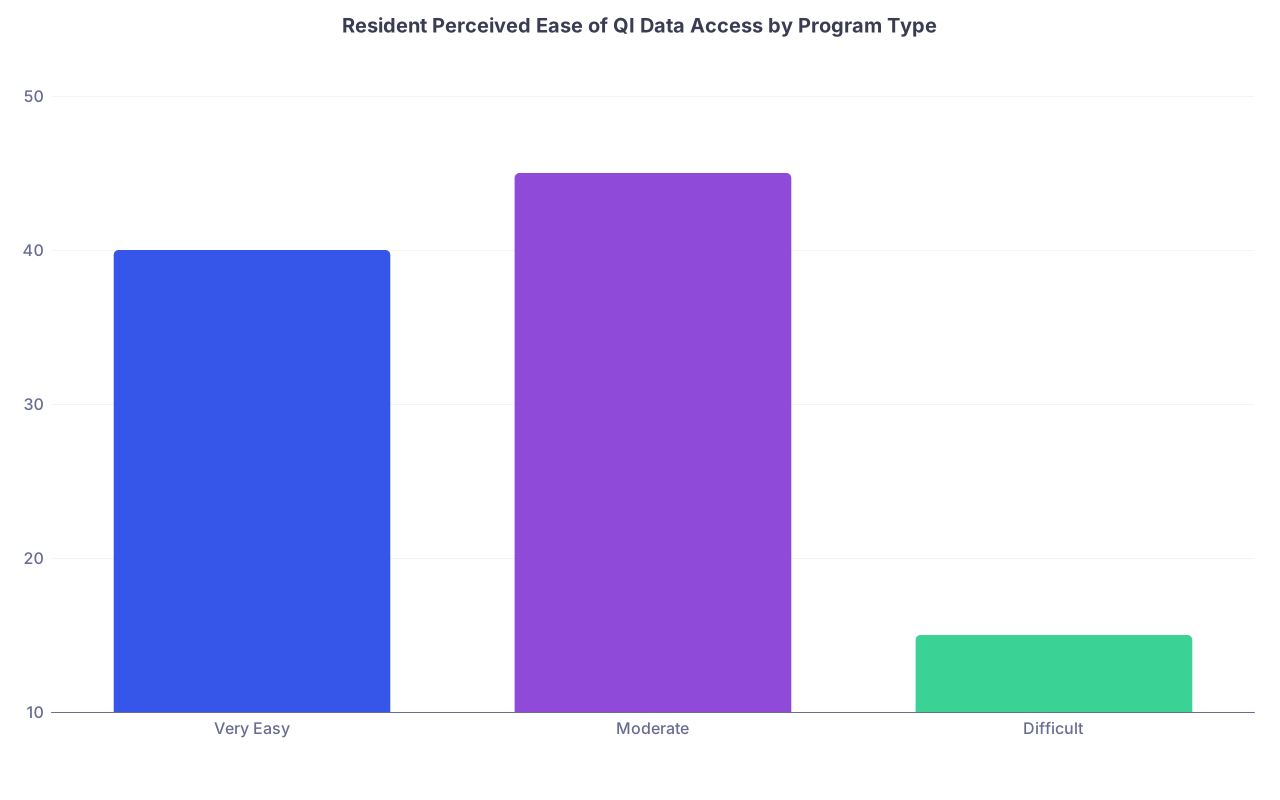
| Category | Value |
|---|---|
| Very Easy | 40 |
| Moderate | 45 |
| Difficult | 15 |
(Interpret this as: at strong academic centers, a plurality of residents describe data access as “moderate” rather than “very easy”; in many community places it is “difficult” unless you know who to ask.)
Academic Programs: Data Rich, Access Controlled
At academic hospitals you usually have:
- Enterprise data warehouses
- Dedicated quality analysts
- Automated dashboards (e.g., readmissions, CLABSI, door‑to‑needle, etc.)
But:
- Residents do not have direct access.
- Every data pull is a request. Sometimes triaged. Sometimes delayed weeks.
- If your project is off the hospital’s priority radar, your request drops to the bottom.
Good programs partially fix this. They:
- Pre‑define resident QI “menus” with standing data reports
- Assign a named analyst to work with the residency
Mediocre programs leave you chasing “IT” for three months, then you present “we did an intervention but have no reliable data.”
You need to ask on interviews:
- “How do residents get data for QI projects? Who helps them?”
- “Can you give a recent example of a resident project and how they obtained pre/post metrics?”
Specific, program‑level example types to listen for:
- “We have a resident dashboard with CLABSI, CAUTI, sepsis bundle compliance by team.”
- Or the opposite: “We typically have the chief residents manually audit 20 charts per cycle.” (Translation: expect pain.)
Community Programs: Data Scarce, Relationships Critical
In community settings:
- There may be one or two analysts who handle everything (regulatory, finance, QI)
- EHR reporting tools may be limited or poorly configured
- The hospital’s main obsession is often regulatory metrics (Core Measures, CMS star ratings, readmissions)
This sounds bad, but there is a twist.
If your project aligns with something the hospital already cares about—say, 30‑day CHF readmissions—you might get priority access and even leadership attention. If it does not, you will be doing manual chart reviews or pulling crude EHR reports yourself.
To suss this out:
- Ask, “Do residents have access to EHR reporting tools like SlicerDicer (Epic) or similar?”
- Ask, “Who pulls run charts for resident projects—residents, chiefs, or the quality department?”
If the answer is essentially “you audit 50 charts in your free time,” adjust your expectations.
Mentorship and Ownership: Who’s Actually Going to Help You?
This is where the community/academic divide hits hardest for your day‑to‑day experience.
Academic Programs: Many Mentors, Variable Attention
Pros:
- Multiple faculty with QI training, CPHQ certifications, or formal roles (Associate Chief Quality Officer, etc.)
- Some departments have dedicated QI tracks with protected time
- Easier to find subspecialty‑aligned mentors (QI in heart failure, COPD, transplant, etc.)
Cons:
- You can become “the fifth resident on Dr. X’s CLABSI project.”
- Senior fellows may own the work; you are a cog
- Faculty are busy; many QI “mentors” are mentors in name only, signing forms and showing up at the final presentation
The sign of a good academic setup:
- Named QI faculty for each PGY class
- Regular, scheduled QI check‑ins (not “email me if you need anything”)
- Recent resident projects that became accepted abstracts at recognizable meetings (SGIM, SHM, ATS, etc.) with residents as first authors
Community Programs: Fewer Mentors, More Space
Pros:
- Less competition for mentorship; you are the QI person in your niche
- Chiefs and core faculty may be highly invested in helping you implement practical changes
- Hospital administrators (CMO, quality director) often know residents personally and will co‑lead projects
Cons:
- Limited QI “theory” depth; some faculty think PDSA is just “we tried something”
- Few people comfortable with turning your project into an abstract or manuscript
- If you want an academic QI career, you will need to seek external mentors (partner academic institution, system‑level QI director, etc.)
On the interview trail, concrete questions:
- “Can you name 2–3 recent resident QI projects and what happened to them after the initial presentation?”
- “Who would you say is the go‑to person for residents who want to do more advanced QI work?”
Listen for actual names and outcomes. “We encourage all residents to do QI” is fluff.
Presentation, Publishing, and How This Plays into Fellowship
This section matters if you care about competitive fellowships, hospitalist leadership paths, or a future in health systems.
Academic Programs: Easier Path to Posters and Manuscripts
You will typically see:
- Annual departmental QI day with judges and awards
- Encouragement (or funding) to submit to:
- SHM, SGIM, ACP, specialty‑specific meetings
- Institutional IRB that understands QI vs research boundaries
This does not guarantee you a PubMed line. But the pipeline exists.
What fellowship PDs actually look for:
- Evidence you completed at least one coherent QI project
- Clear description of your role: “designed the intervention,” “led data collection,” “analyzed pre/post outcomes,” not just “participated”
- Any regional/national presentation shows you can follow through
Academic programs make this easier because:
- Mentors already submit stuff; your name gets added
- There are local research offices to help with abstract formatting, deadlines, etc.
Community Programs: Implementation Heavy, Academic Output Optional
Many community residents:
- Do impactful QI that decreases LOS, improves throughput, or hits core measures
- Present at local hospital meetings or system‑wide QI days
- Stop there
If you are fellowship‑bound, this is a missed opportunity.
In a good community program with academic awareness, leadership will:
- Partner with a nearby academic department
- Co‑sponsor projects and send residents to joint QI conferences
- Encourage residents to submit to SHM/ACP with basic guidance
When you interview, you want to hear specific examples:
- “Last year one of our residents reduced ED boarding times, presented at SHM, and matched into a competitive pulm/crit slot.”
- Not just, “We support residents who want to present.”
If you hear silence or vague enthusiasm, assume you will need to drive the academic side yourself.
Day‑to‑Day Resident Experience with QI
Enough theory. What does this actually feel like in residency?
In an Academic Program
Realistic scenarios:
- You are assigned to a QI project in PGY‑2 as part of a small group. The problem is chosen for you (e.g., “Improve discharge summary quality in the resident clinic”).
- Monthly meetings. A faculty mentor appears intermittently. A quality nurse attends every session and drives things.
- Mid‑year, you realize the hospital already has three other groups working on discharge summaries. Integration is messy.
- You do a pre/post chart review, throw together a poster, present at your local QI day, maybe submit to ACP.
If you are proactive:
- You find a subspecialty mentor (e.g., heart failure director) and bolt your QI work onto their clinical program.
- You get real, multi‑year data and possibly a publication.
- But you are competing with fellows and junior faculty, and your project has to fit their agenda.
In a Community Program
Realistic scenarios:
- On nights, you notice admissions from one clinic always arrive without med lists, slowing everything down.
- You mention this in morning report. The PD says, “Let’s make that your QI project.”
- You map the current process, talk directly to clinic nurses, pilot a simple pre‑admission med list protocol.
- Within 2–3 months, the floor nurses and residents are actively lobbying to keep your change because it made their lives easier.
- Data collection is crude—manually tracking a sample of admissions each week—but the improvement is obvious.
If you are proactive:
- You get the CMO or quality director to co‑author a poster.
- You reach out to a regional academic partner, present at a system‑wide meeting, and leverage it for fellowship applications.
You had more control, less infrastructure.
How To Evaluate QI Opportunities During Interviews
Most applicants ask, “Do residents do QI?” Programs say “Yes.” Useless.
Ask targeted, uncomfortable questions instead:
- “Are QI projects assigned or resident‑driven? Can you give 2–3 examples from this year?”
- “What data systems do residents actually use for QI? Dashboards, EHR self‑built reports, or manual audits?”
- “How many resident QI projects have been presented externally (regional or national) in the last 2–3 years?”
- “If I wanted to do advanced QI or a QI chief resident year, what would that look like here?”
- “Can I talk to a current resident who has done a significant QI project?”
You are looking for:
- Specific project titles
- Named mentors
- Concrete outcomes (changed protocol, new order set, abstract accepted)
Hand‑wavy enthusiasm means the infrastructure is weak or unused.
Community vs Academic: Which Is Better for QI?
You want a blunt answer. Here it is.
If your priority is:
- A career in academic medicine with a QI/PS or health systems research focus
- Multiple posters/papers
- Structured mentorship and formal QI curriculum
Then a strong academic program with visible QI output is the better fit.
If your priority is:
- Actually changing how patients move through a hospital
- Learning real operations and leadership in a smaller ecosystem
- Preparing for hospitalist work or community leadership roles
A high‑functioning community program can give you better QI experience, with more ownership and less bureaucracy.
The crucial point: there are excellent and terrible QI environments in both settings. The “academic vs community” label is not enough. You have to interrogate the specifics.
FAQs
1. Will a lack of “big academic” QI projects hurt my chances for a competitive fellowship?
Only if you let it. Fellowship directors care more about:
- Whether you can clearly explain a meaningful project
- Your role in design, implementation, and analysis
- Evidence of follow‑through (completion, presentation, impact)
A well‑executed, resident‑owned community project that reduced readmissions and was presented at SHM is more impressive than being “one of many” on a vague academic initiative you barely understand. If you are in a community program, you just need to be intentional about packaging and presenting your work.
2. Do community programs really have fewer QI opportunities?
No. They have fewer formal opportunities and less academic packaging. The real‑world opportunities—broken workflows, bad handoffs, throughput problems—are everywhere. What they sometimes lack is:
- Structured curricula
- Easy analytic support
- An automatic pipeline to conferences
You can compensate for that if you are proactive and if leadership is supportive.
3. How many QI projects should I aim for in residency?
For most residents, one solid project that:
- Has a real, measurable outcome
- Involves a clear intervention
- Ends with at least a local or regional presentation
is enough. If you are fellowship‑ or QI‑career‑oriented, 2–3 substantial projects, preferably in a coherent theme (e.g., transitions of care, sepsis, heart failure), is ideal. Chasing six superficial “mini‑projects” is a waste of time.
4. Should I avoid programs that assign QI topics instead of letting residents choose?
Not automatically. Assigned topics can be fine if:
- They align with genuine institutional priorities
- You still have ownership of the intervention and data
- You can influence how the project is executed
Red flag is when projects are pre‑cooked, data is pre‑pulled, and residents just present slides. That is theater, not education. In that case, you will want to find additional, resident‑driven work.
5. How early in residency should I get involved in QI?
PGY‑1: focus on learning the system, noticing patterns, and logging problems that bother you. Maybe do a small PDSA if your program requires it.
Late PGY‑1 or early PGY‑2: commit to one serious project:
- Get a mentor
- Define a clear aim statement
- Secure data access and leadership buy‑in
PGY‑3: if you are fellowship‑bound or leadership‑oriented, either deepen your existing project (scale it, sustain it, publish it) or do one more targeted initiative. But do not cram a rushed project into the last 6 months solely “for the CV.” Program directors can smell that a mile away.
Key takeaways:
- QI is everywhere; what changes between community and academic is infrastructure, data access, mentorship density, and bureaucracy, not the existence of opportunities.
- Academic programs are better for structured curricula and academic output; community programs often give you more ownership and faster, tangible impact.
- On the interview trail, stop asking “Do you have QI?” and start demanding specific examples, data pathways, and outcomes. That is how you find a program where QI actually means something.