The way subspecialty clinic time is structured in residency is one of the sharpest, most under‑discussed differences between community and academic programs. It changes your day‑to‑day life, what you actually learn, and how fellowship directors read your application.
Let me break this down specifically.
1. What “Subspecialty Clinic Time” Really Means
First, definitions. Programs throw around “subspecialty exposure” in very loose ways on interview day.
When I say subspecialty clinic time, I mean:
- You are scheduled into a non‑primary care, outpatient clinic
- With a board‑certified subspecialist (cards, GI, heme/onc, rheum, ID, pulm, etc.)
- Seeing patients in that subspecialty, not just doing generic follow‑up or “complex medicine”
- On a recurring basis (weekly, biweekly, or as a 2–4 week block), not just one random “elective afternoon” once a year
Programs will advertise this in three main formats:
- Longitudinal half‑day clinic (e.g., “Wednesday afternoons in cardiology clinic for 6 months”).
- Block rotations with clinic as the core (e.g., “2 weeks of GI clinic only”).
- Hybrid: inpatient consult or service + assigned clinic half‑days in the same subspecialty.
Now, here is where the academic vs community distinction bites: who owns that clinic, who controls the schedule, and whether you are an asset or a burden to that clinic.
2. Structural DNA: Academic vs Community Outpatient Worlds
Academic and community programs are built on different financial and educational engines. Subspecialty clinic is where you feel that difference most viscerally.
Academic Centers: Clinic as a Teaching Platform
In a typical academic IM program (think: big university hospital plus faculty practice):
- Subspecialty clinics are faculty‑run, teaching is expected.
- RVU pressure is real, but there is institutional tolerance for slower clinics with learners.
- Fellows are usually present, which often means a tiered teaching structure.
- Templates are explicitly set aside as “resident clinic,” “fellow clinic,” or “attending only.”
Practically, that means:
- More structured case mix: “new patient” vs “return” slots are assigned with teaching in mind.
- More pre‑clinic didactics (“cards clinic conference,” “rheum imaging review,” etc.).
- Documentation often goes resident → fellow → attending, with time built in for review.
- You may have protected time to pre‑chart or meet briefly before clinic.
Academic centers treat clinic as an educational mandate. Not perfectly, but the culture is there.
Community Programs: Clinic as a Business First
In many community programs (especially those based in private‑group practices or hospital‑employed groups):
- Subspecialty clinics are productivity machines. The primary metric is volume and access.
- The subspecialist’s schedule was full before residents showed up. You are an add‑on.
- Teaching is often voluntary, squeezed between back‑to‑back 15‑min follow‑ups.
- There may be no fellow, just attending + mid‑level providers and you.
Here, clinic structure tends to:
- Prioritize short follow‑up visits, medication checks, chronic management.
- Use residents mostly as shadowers or to “room” and pre‑chart, unless the attending is committed to teaching.
- Have limited time for formal feedback or extended counseling visits.
- Be tightly controlled by front‑desk and billing templates; changing anything is painful.
None of that is inherently bad. But it is different. Academic clinics are designed to accommodate trainees. Community clinics usually tolerate them.
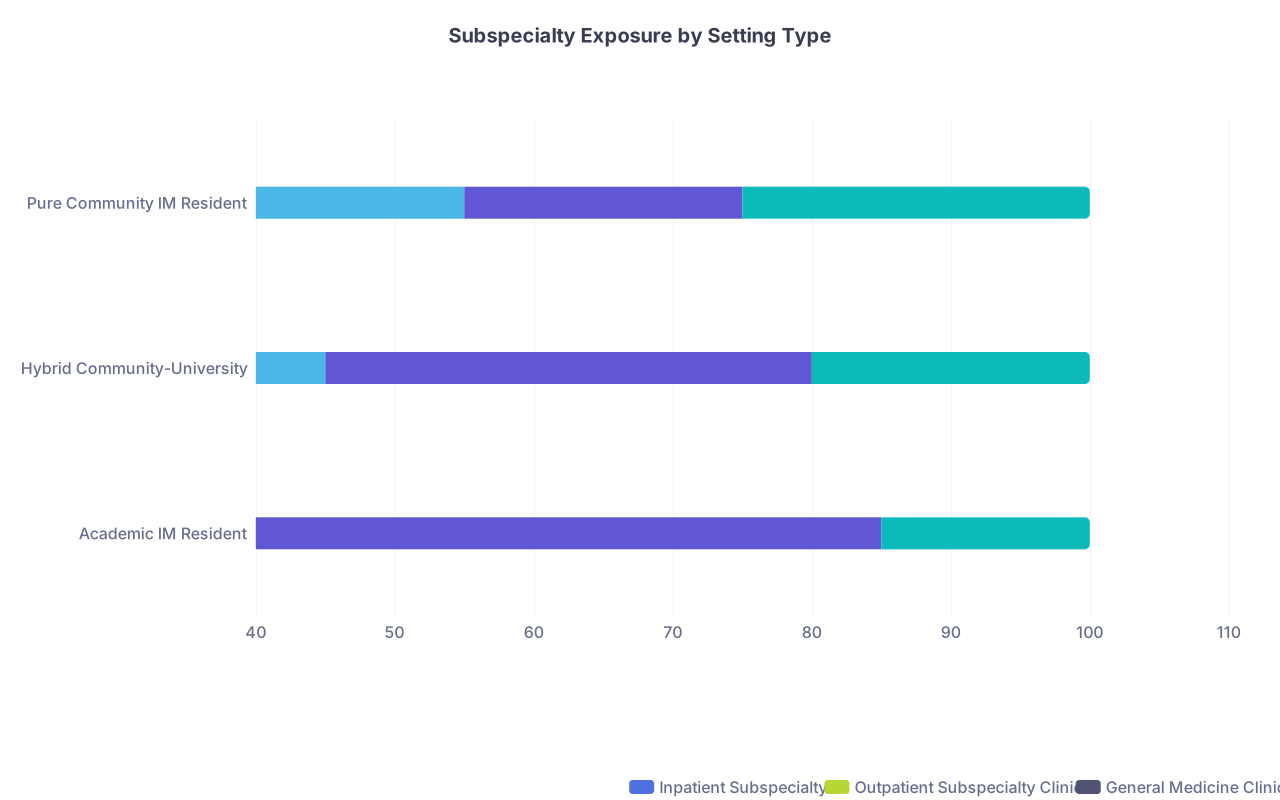
To visualize the typical distribution of your subspecialty exposure:
| Category | Inpatient Subspecialty | Outpatient Subspecialty Clinic | General Medicine Clinic |
|---|---|---|---|
| Academic IM Resident | 40 | 45 | 15 |
| Hybrid Community-University | 45 | 35 | 20 |
| Pure Community IM Resident | 55 | 20 | 25 |
The broad pattern: academics lean heavier on structured outpatient subspecialty; pure community programs tilt toward inpatient consult exposure.
3. How Clinic Schedules Are Built: Templates, Volume, and Control
The template is reality. Whoever controls the template controls your day.
Academic Templates
In many university‑based clinics:
- Residents are booked for fewer patients per session, explicitly.
- There may be caps: 4–6 patients per half day for PGY‑2, 6–8 for PGY‑3.
- Complexity is intentionally mixed: 1–2 new patients, some follow‑ups, maybe a “teaching case” routed specifically to the trainee.
- Patients are often “assigned” to resident or fellow lists in the EMR, not just randomly dropped onto the attending.
You will see things like:
- Specialty clinics (e.g., “pulmonary hypertension clinic,” “IBD clinic,” “advanced heart failure only”).
- Pre‑allocated “no show buffer” slots that get filled by same‑day add‑ons if the afternoon is light.
- Time blocked for “post‑clinic wrap‑up” (actually used in some places, lip service in others).
Busy, yes. But intentionally busy.
Community Templates
In community subspecialty practices you will often walk in and see:
- 20–30 patients scheduled for the attending in a half‑day.
- Mixed new and follow‑up, but skewed heavily to brief follow‑ups.
- The EMR schedule has no “resident” column. You are essentially paired with the attending’s column.
- If you get your own rooms in the EMR, it is often because someone fought for it, not because the system expects it.
Your role commonly falls into one of three patterns:
- Shadowing only: you follow the attending, maybe see a patient or two independently if they have time.
- “Pre‑visit” work: you go in first, gather HPI, review meds, present in the hall; attending re‑enters and finalizes plan.
- Productivity assist: you take straightforward follow‑ups (HFpEF check, INR management, stable RA on biologic) to free the attending for procedures and complex new consults.
The key difference: in academic clinics, the schedule is often built around educational roles. In community clinics, your role is adapted to a pre‑existing schedule.
4. Breadth vs Depth: Case Mix and Diagnostic Thinking
This is where your future fellowship director quietly cares.
Academic Subspecialty Clinics: Edge Cases and New Referrals
Academic clinics tend to attract:
- Rare diseases, refractory cases, and “second/third opinion” referrals.
- Complex multi‑morbid patients (e.g., cirrhosis + transplant eval + renal disease in one person).
- A high proportion of new visits for puzzling diagnoses.
So in academic rheum clinic, you see:
- Undifferentiated inflammatory arthritis, seronegative spondyloarthropathy, vasculitis work‑ups.
- Multi‑system autoimmune disease that actually requires board‑level reasoning.
- Coordination with other departments (nephrology for GN, pulm for ILD, derm for cutaneous lupus).
The educational consequence:
- You are forced to understand diagnostic criteria, guideline algorithms, and gray‑zone situations.
- You see how subspecialists think about pre‑test probability and test yield, not just which biologic to refill.
- You get exposed to “clinic as decision lab” rather than “clinic as refill factory.”
Community Subspecialty Clinics: Chronic Disease Management at Scale
Community clinics skew toward:
- Established chronic disease with long‑term follow‑up.
- Bread‑and‑butter subspecialty issues: stable CAD, COPD, HF, diabetes complications.
- Less often: rare diseases or transplant‑level complexity (those get referred out to academic centers).
So in community cardiology clinic, a typical half‑day might be:
- 8 follow‑ups for stable CAD, tweaking statins and beta blockers.
- 4 HF follow‑ups assessing fluid status and meds.
- 2 new referrals for “chest pain” that are moderate probability at best.
- 1 or 2 AFib anticoagulation visits, maybe a post‑procedure follow‑up.
The upside:
- You genuinely learn how these patients are managed long‑term in the real world.
- You see what happens after the inpatient admit or post‑procedure discharge.
- You pick up practical skills: coding, prior auths, device checks, managing polypharmacy.
The downside for your training portfolio:
- Less exposure to the weird cases that generate fellowship‑level research questions.
- Diagnostic thinking may become “pattern + protocol” rather than “build a differential from scratch.”
Neither environment is automatically better. But they produce different muscles.
5. Teaching Culture: Who Actually Teaches You in Clinic?
Resident experience changes dramatically depending on who sits between you and the attending.
Academic: Fellow Buffer and Multi‑Layer Teaching
Common academic pattern:
- You staff with a fellow first.
- Fellow already knows attendings’ preferences and clinic flow.
- Attending swoops in for key decision points and physical exam confirmation.
This has pros:
- You get closer, safer teaching (“I screwed this up as an intern; here is how to avoid it …” from a fellow).
- Feedback is more realistic to your level; attendings sometimes forget what PGY‑2 actually means.
- You see career paths: how did that fellow get into that exact subspecialty?
But also cons:
- You may present to fellow, then repeat abbreviated version to attending: double work.
- Some attendings let the fellow do almost all of the talking and decision‑making; you risk becoming an observer.
- Clinic throughput can slow down further; time pressure may mean your own independent H&P gets cut.
Community: Direct Attending Contact, Variable Teaching
In pure community subspecialty clinics:
- No fellow. It is you and the attending.
- Teaching depends almost entirely on that attending’s temperament and schedule.
- Some are phenomenal: they slow down, ask you questions, pull up UpToDate with you.
- Others treat you as an extra set of hands and an audience, not a trainee.
Common scenarios I have seen repeatedly:
- Heme/onc doc who loves teaching: blocks two “teaching patients” each clinic for you to see alone, then debriefs.
- Very busy GI doc: you shadow, get brief “pearls” between rooms, do minimal documentation.
- Pulm doc in a hospital‑employed group: has you see 50% of follow‑ups independently, then staff quickly.
You get more direct attending exposure, which is priceless if they are strong educators. But there is no institutional safety net if they are not.
6. Procedural and Longitudinal Opportunities
Fellowship applications are not only about letters and research. Concrete experience matters. Here’s how clinic structure shapes that.
Procedures Linked to Clinic
In academics:
- Many subspecialty procedures are separated from clinic (e.g., endoscopy suite, cath lab, PFT lab) but strongly integrated in scheduling and decision‑making.
- You see the full referral pipeline: clinic consult → procedure indication → post‑procedure follow‑up back in clinic.
- As a resident, you might scrub only occasionally, but you understand when and why procedures are chosen.
In community:
- Procedures sometimes happen in the same physical space as clinic or immediately adjacent.
- Volume may be high, but resident involvement is often limited or ad hoc.
- Subspecialist may be under pressure to “move cases,” making teaching scrubbing less common.
Where community clinics sometimes shine:
- Device management: pacemaker/ICD clinics, anticoagulation clinics, infusion centers integrated into the practice.
- Chronic long‑term follow‑up of post‑procedure patients (e.g., post ablation AFib patients, post‑stent CAD).
So if you care about, say, advanced heart failure or interventional GI, academics will give more exposure to the sophisticated, tertiary‑care procedures. If you care about pragmatic chronic management after interventions, community will show you how things actually run.
Longitudinal Continuity
Academic subspecialty clinics:
- Often set up specific “resident continuity” slots.
- But residents rotate off services, scheduling changes, EMR templates get updated — continuity can be uneven.
- Still, you are more likely to follow 1–3 patients over substantial time for a given complex condition.
Community subspecialty clinics:
- Patients live locally and are loyal to that practice. Continuity is excellent — with the attending.
- Your own continuity depends completely on whether the office is willing to re‑book patients “with resident.” Many offices do not bother.
- If they do, you get some of the best longitudinal experience you can imagine: seeing your HF patient every 3 months for 2 years is different from 3 visits in one academic block.
For fellowship, being able to say “I followed a cohort of X patients longitudinally in Y subspecialty clinic” plays well. Academic programs are more likely to build that intentionally; some strong community programs do it well informally.
7. Evaluation, Letters, and How PDs Read Your Clinic Experience
Fellowship PDs and selection committees implicitly grade your clinic environment when they read your file. They will not say this out loud, but they infer a lot from where and how you trained.
Academic Background
Assumptions (fair or not):
- You have seen complex, tertiary‑care outpatients.
- You have worked with subspecialty attendings who are known quantities.
- Your letter writer’s name might be recognizable or at least affiliated with a division that the PD knows.
- Your clinic experience likely included exposure to research questions, trials, and guideline‑level discussion.
So when an application says:
“Resident spent one half‑day per week for 12 months in our advanced heart failure/transplant clinic.”
They read: this person has at least a baseline understanding of the outpatient side of advanced HF, may have seen LVAD/transplant eval, has some idea how fragile these patients are.
Community Background
Assumptions (again, fair or not):
- Your subspecialty experience may be heavy on bread‑and‑butter, light on esoteric pathology.
- If your letter is from a private‑practice doc, the PD has no prior relationship with that person.
- They wonder: is this just a volume clinic, or did the attending actually teach?
This is why specifics matter. Fellowship PDs care less about “university vs community” as a label and more about what you actually did.
If you are coming from a strong community program, your job is to remove ambiguity:
- Name specific clinic types: “HF clinic,” “HIV clinic,” “IBD clinic,” not just “cardiology clinic.”
- Quantify longitudinal exposure: “weekly for 6 months,” “2 blocks of 4 weeks, all outpatient, PGY‑2 and PGY‑3.”
- Highlight teaching elements: pre‑clinic conference, case presentations, QI projects rooted in that clinic.
On their side, PDs mostly want to avoid this pattern: a resident who has only ever seen their target subspecialty on inpatient consults, with zero sense of outpatient realities.
8. Concrete Examples: What a Week Can Look Like
Let’s make this real. Same aspiring cardiology fellow, two different training settings.
Academic IM Resident (Cards‑Interested) – Representative Week
Monday
- AM: CCU
- PM: Inpatient cardiology consults
Tuesday
- AM: Cards clinic (general + HF mix; resident sees 4–6 patients independently, staffs with fellow then attending)
- PM: Echo conference + image review with staff
Wednesday
- AM: General IM clinic
- PM: Protected research time in cardiology lab
Thursday
- AM: Step‑down tele unit
- PM: EP conference, EP attending clinic shadow
Friday
- AM: HF teaching rounds
- PM: Cards clinic again (continuity patients + new consults)
You live the subspecialty all week: clinic feeds into conferences, which feed into research, which ties into inpatient work.
Community IM Resident (Cards‑Interested) – Representative Week
Monday
- AM: Hospitalist inpatient service
- PM: Discharges + admissions
Tuesday
- AM: Hospitalist rounds
- PM: Community cardiology clinic (shadowing plus seeing a few HF/CAD follow‑ups independently)
Wednesday
- AM: Hospitalist service
- PM: General IM clinic
Thursday
- AM: Step‑down or cross coverage
- PM: Same community cardiology clinic; heavy on established patients, some pre‑op and consults
Friday
- AM: Inpatient, maybe some cards consult exposure
- PM: Documentation / admin / occasionally extra clinic if attending requests help
It is more segmented. Still valuable. But the density of specialty‑focused teaching and the integration between inpatient/outpatient environments is thinner.
To compare elements side by side:
| Feature | Academic Program | Community Program |
|---|---|---|
| Clinic template control | Residency/division influence | Practice/administration driven |
| Typical patients per half-day | 4–8 per resident | 15–30 per attending (resident variable) |
| Fellow involvement | Common | Rare |
| Complexity of cases | Higher (referrals, rare dx) | Moderate (chronic, bread-and-butter) |
| Longitudinal continuity | Structured but imperfect | Excellent for attending, variable for resident |
| Pre/post-clinic teaching | More common | Highly attending-dependent |
9. How to Evaluate Subspecialty Clinic When You Apply
Here is where most applicants sleepwalk through interviews. They ask generic questions about “fellowship match,” not about the actual training environment that produces those fellows.
You need to interrogate subspecialty clinic specifically. Not aggressively. Just precisely.
Questions That Actually Expose Differences
When talking to academic programs:
- “For residents interested in subspecialty X, what longitudinal clinic opportunities exist beyond the standard continuity clinic?”
- “Do residents ever have their own patient panel in X clinic, or do they mostly see patients pre‑staffed to fellows?”
- “Roughly how many patients do residents see per half day in subspecialty clinic, and do they document the encounter themselves?”
When talking to community programs:
- “Are resident clinic patients scheduled specifically with us, or do we mostly see the attending’s pre‑booked patients?”
- “Do residents follow the same subspecialty clinic over time, or are clinics mainly short elective blocks?”
- “How often do residents see patients independently before the attending, and are we expected to write the note and billing?”
You are probing for:
- Control over clinic lists.
- True independence vs shadowing.
- Volume expectations and documentation responsibility.
And then you listen for the hedging. A PD who cannot answer this concretely probably is not prioritizing your outpatient subspecialty training.
10. Strategic Takeaways for Fellowship‑Bound Applicants
Let us stop being polite and talk strategy.
If you are targeting a highly competitive subspecialty (cards, GI, heme/onc, pulm/crit, rheum):
- Academic programs give you a built‑in advantage for complex outpatient exposure, big‑name letters, and research‑adjacent clinic environments.
- A strong community program can absolutely still get you there, but you will have to be more intentional about documenting and amplifying your clinic experience.
If you are less fellowship‑focused and more “solid hospitalist with comfort handling chronic subspecialty disease”:
- A well‑run community program with heavy bread‑and‑butter subspecialty clinic exposure can make you extremely competent in the realities of outpatient medicine.
- Academic programs sometimes over‑optimize for zebras and under‑expose you to the grind of high‑volume clinics.
For everyone:
- Do not just ask “Do you have subspecialty clinics?” Every program will say yes.
- Ask “How is resident time in those clinics structured, documented, and evaluated?” Many programs will suddenly become vague.
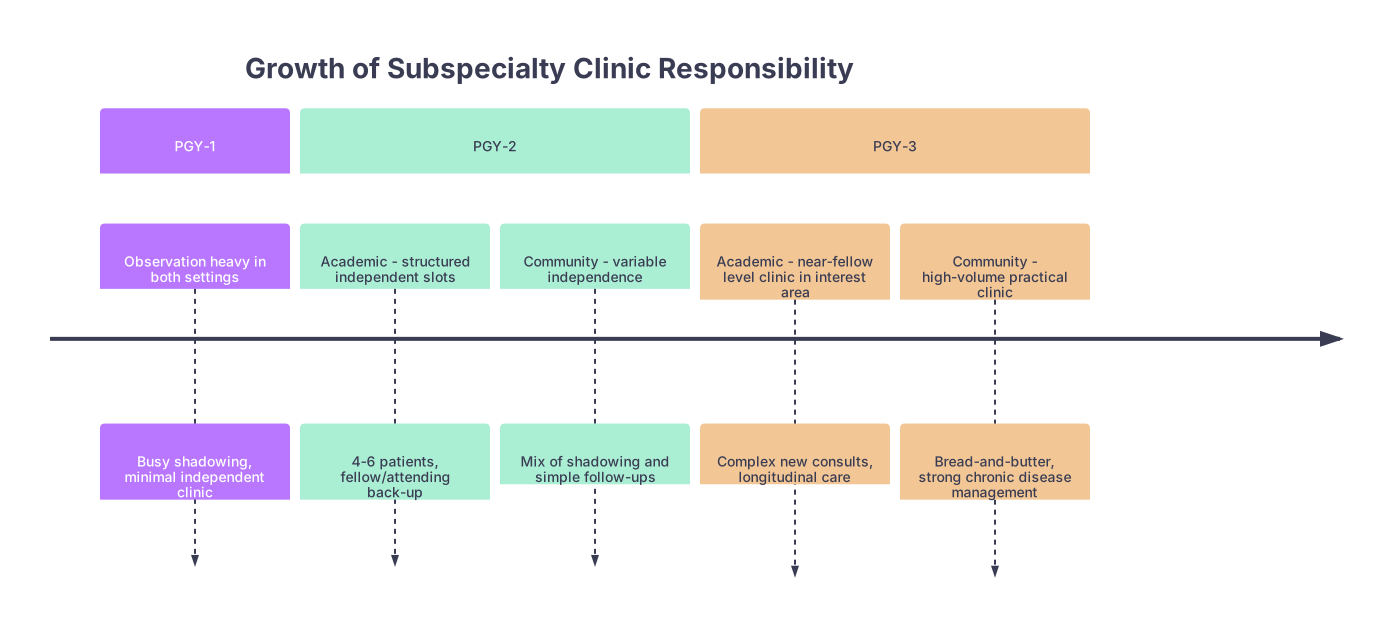
If you want a mental model of how these differences feel over time:
| Period | Event |
|---|---|
| PGY-1 - Observation heavy in both settings | Busy shadowing, minimal independent clinic |
| PGY-2 - Academic - structured independent slots | 4-6 patients, fellow/attending back-up |
| PGY-2 - Community - variable independence | Mix of shadowing and simple follow-ups |
| PGY-3 - Academic - near-fellow level clinic in interest area | Complex new consults, longitudinal care |
| PGY-3 - Community - high-volume practical clinic | Bread-and-butter, strong chronic disease management |
You are deciding which curve you want to be on.
11. How to Present Your Clinic Experience on Applications
One last practical piece. You can have a great subspecialty clinic experience and then undersell it completely on your ERAS and during interviews.
Frame it with specifics, not labels.
Weak description on a CV or personal statement:
“Participated in cardiology clinic and developed interest in heart failure.”
Much stronger:
“Attended a weekly heart failure clinic for 12 months (PGY‑2–3), independently seeing 4–6 patients per session including new consults and longitudinal follow‑ups for advanced HF and device therapy. Presented cases at monthly HF conference and developed a QI project on GDMT optimization based on clinic population data.”
Notice the elements:
- Frequency and duration (“weekly,” “12 months”).
- Role (“independently seeing 4–6 patients”).
- Case mix (“new consults,” “advanced HF,” “device therapy”).
- Educational integration (conference + QI).
This format works whether you are at a big‑name university or a smaller community program. You are translating your clinic time into something fellowship committees can actually evaluate.
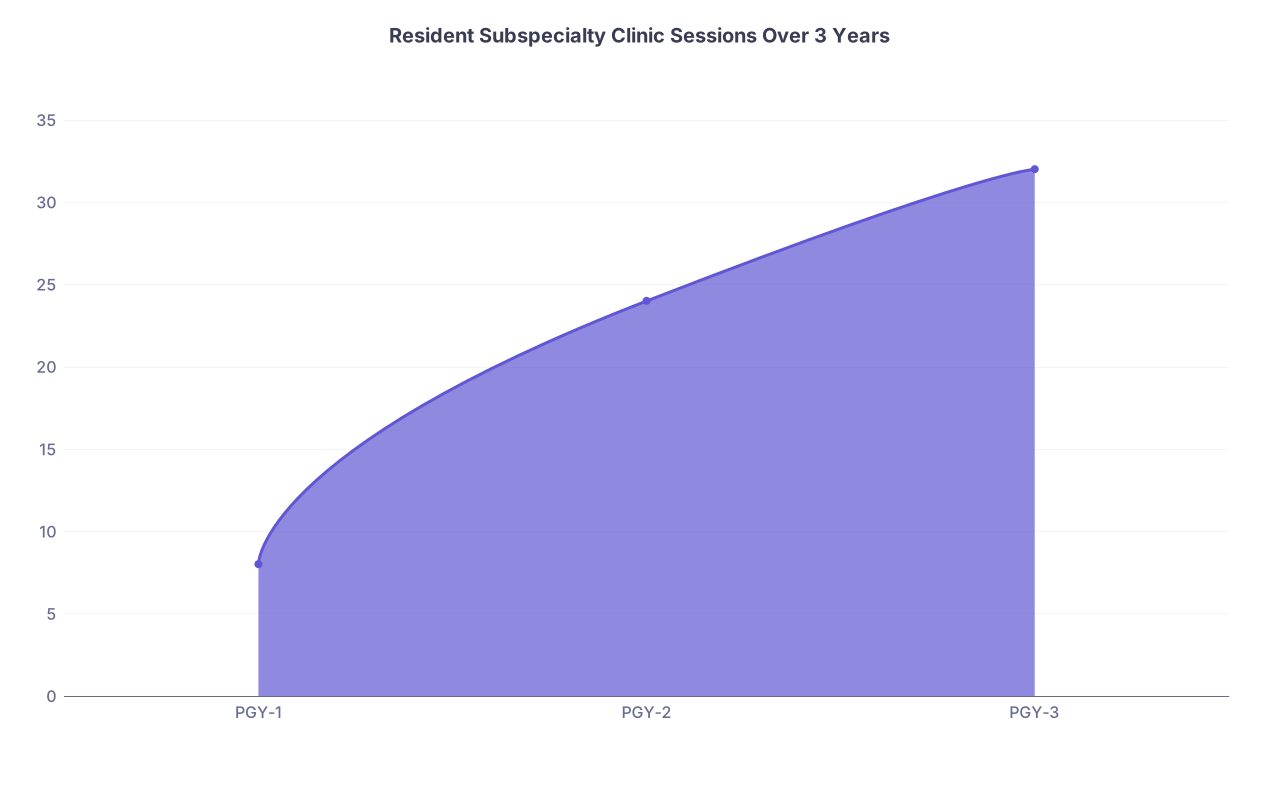
You can even pull simple numbers from your clinic logs and reflect them visually yourself. For example, if you tracked your subspecialty clinics over residency:
| Category | Value |
|---|---|
| PGY-1 | 8 |
| PGY-2 | 24 |
| PGY-3 | 32 |
Being able to casually say, “Over residency I completed about 60 subspecialty clinic half‑days in rheumatology, with increasing independence each year” sounds very different from “I did some rheum electives.”
Key Points
Subspecialty clinic in academic programs is usually a planned teaching environment with controlled volume, more complex referrals, and often fellows as an intermediate layer. Community clinics are productivity‑driven practices where your role depends heavily on local attendings and templates.
Academic clinics tend to emphasize diagnostic complexity and guideline‑level decision‑making; community clinics emphasize chronic disease management at scale and real‑world logistics. Both are valuable, but they produce different strengths for fellowship and practice.
When evaluating programs and later presenting yourself on applications, move past labels like “community” and “academic” and describe exactly how often you were in subspecialty clinic, what you actually did there, and how independently you managed patients. That level of detail is what serious fellowship directors care about.