
Most applicants misunderstand resident teaching roles so badly that they pick programs that do not match their career plans.
Let me be blunt. If you want to become a strong clinician-educator and you match into the wrong type of “teaching” environment, you will spend 3 years being a workhorse instead of an educator. Conversely, if you actually want a high-volume, efficiency-focused community hospitalist job and you chase an academic, education-heavy residency, you may graduate frustrated and unprepared for the pace and autonomy of community practice.
This split usually surfaces as: community hospitalist vs academic clinician-educator. People talk about it like a personality preference. It is not. It is a structural difference in how teaching, supervision, and resident roles are built into the system.
Let me break this down specifically.
1. Core Identity: What Each Role Actually Is
Forget the buzzwords for a moment. Here is the clean distinction.
A community hospitalist (in the way residents experience them) is:
- A clinician whose primary job is high-volume inpatient care, usually in a non-university or affiliate community hospital.
- Measured on throughput, length of stay, readmissions, patient satisfaction, maybe RVUs.
- Often participates in teaching, but teaching is secondary to service and efficiency.
- Less protected time for curriculum design, medical education research, or formal teaching development.
An academic clinician-educator is:
- A faculty member at a teaching hospital or academic center whose job explicitly includes teaching as a major component of their role.
- Evaluated not only on clinical productivity but also on educational contributions: lectures, curriculum, learner evals, mentorship, scholarship in education.
- Often has protected time for teaching, faculty development, and academic projects.
Now, why does this matter for you as a residency applicant?
Because your day-to-day teaching impact as a resident depends heavily on which model dominates your program.
At a community-heavy program, you may:
- See fewer med students.
- Have more direct attending-patient interactions with minimal layering.
- Do more “see 18 patients and move quickly” and less “build a chalk talk series.”
- Learn efficient, pragmatic medicine with less emphasis on educational theory.
At a clinician-educator–dense academic program, you may:
- Teach students almost every day.
- Present at morning report, noon conference, and formal teaching venues.
- Get mentored in how to give feedback, design sessions, and maybe present at a national meeting (SGIM, APDIM, etc.).
- Be evaluated and coached explicitly on your teaching.
You cannot “fix” this mismatch after Match Day. You have to read it correctly now.
2. How Resident Teaching Actually Looks Different on the Wards
Residents love to say, “We do a lot of teaching.” That statement is almost meaningless without context. I watch applicants believe that line every interview season and then email me during PGY-2 saying, “This is not what I expected.”
Let’s get concrete.

Academic Clinician-Educator Environment
Typical medicine ward team at a university hospital:
- 1 attending (clinician-educator)
- 1 senior resident
- 1–2 interns
- 1–3 medical students (often 3rd years, sometimes sub-I’s)
- Maybe a PA/NP student, pharmacy student, or resident joining
What happens on rounds:
- Attending expects the senior to run the list, synthesize, and teach.
- The resident is explicitly asked: “What is the teaching point for this patient?” daily.
- “Walk rounds” with bedside teaching and micro-skills: exam findings, counseling, interprofessional communication.
- After rounds: 10–20 minute chalk talk from the senior on a topic relevant to cases.
Resident teaching responsibilities:
- Direct bedside teaching with students (history, exam, presenting).
- Feedback on notes, presentations, and clinical reasoning.
- Leading portions of rounds, assigning reading, running “mini-morning report” for the team.
- Often presenting at noon conference or morning report multiple times a year.
You are structurally positioned as a teacher.
Community Hospitalist-Dominated Environment
Typical medicine service at a community hospital (even if technically “academic-affiliated”):
- 1 attending hospitalist
- PGY-2 or PGY-3 resident (may be solo or with 1 intern)
- 0–1 medical student (and some months: none)
- Often a large “uncovered” census because there are no fellows and fewer residents
What happens on rounds:
- Attending and resident move quickly: 12–18 patients is common. Sometimes more.
- Much more “drive-by” teaching: a few minutes per patient for key decisions.
- Students, if present, often “shadow” more and carry fewer patients.
- Teaching is unstructured, opportunistic, and usually clinical-pearls-based.
Resident teaching responsibilities:
- Orienting the rare student to the EMR and unit.
- Basic feedback on presentations and notes.
- Occasional case presentation to the team, but not a formal expectation.
- Less frequent scheduled teaching roles (e.g., you might give 1–2 formal talks a year, if that).
You are structurally positioned as a service provider first, teacher second.
3. Metrics and Incentives: Who Gets Rewarded for Teaching?
If you want to predict how much teaching happens at a program, look at what your attendings are rewarded for.
| Domain | Community Hospitalist Focus | Academic Clinician-Educator Focus |
|---|---|---|
| Primary metric | RVUs / Census / LOS | Teaching evals + clinical quality |
| Protected time | Rare | Common for education |
| Promotion criteria | Mostly clinical volume | Education, scholarship, service |
| Required teaching | Variable, often minimal | Built into job description |
| Faculty development | Limited | Formal teaching-skills programs |
At a community hospital, leadership priorities sound like:
- “We need to keep length of stay down.”
- “We have to cover this many beds.”
- “Can we add another hospitalist to help with night coverage?”
Teaching is “nice to have” but rarely tied to salary, promotion, or contract renewal. So you will see a few genuinely passionate teachers who go above and beyond, but the system does not push everyone in that direction.
At an academic center, especially where the clinician-educator track is real (not just a fancy label):
- Promotion and contract renewal include teaching evaluations.
- Faculty must demonstrate educational contributions for promotion (resident evals, course director roles, curriculum, sometimes med-ed research).
- Many have mandated teaching hours or formal teaching responsibilities.
When the system rewards teaching, you feel it as a resident. You get:
- Structured feedback on your teaching.
- Intentional mentorship on career paths in education.
- Faculty who care whether you can lead a case discussion or counsel a patient effectively.
That difference is not subtle once you live it for a year.
4. How This Plays Out in Residency Training: Day-to-Day and Over 3 Years
You are in the Residency Match and Applications phase. So what you care about now is not just the job titles, but how this shapes your 3-year training environment.
Daily Reality: Who Are You Teaching and How Often?
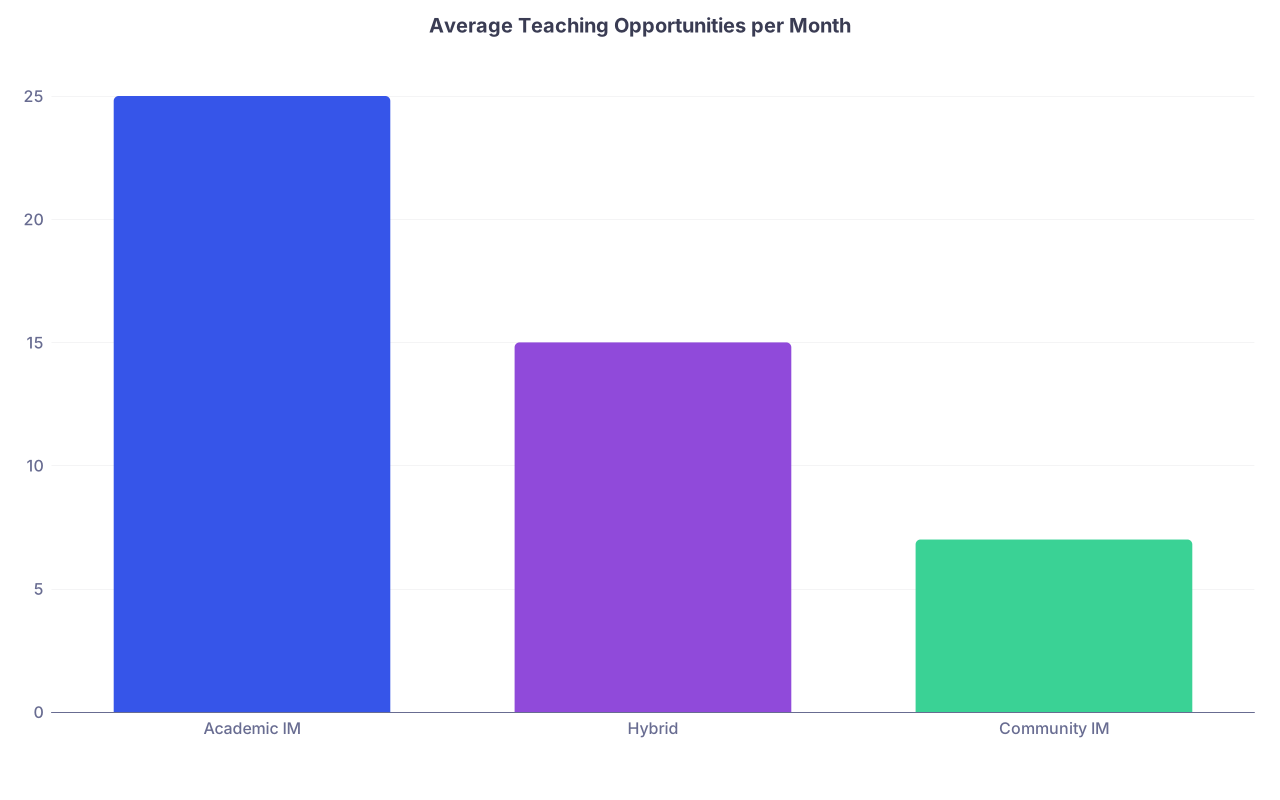
If you want to be a strong clinician-educator, frequency and variety of teaching matter.
| Category | Value |
|---|---|
| Academic IM | 25 |
| Hybrid | 15 |
| Community IM | 7 |
That bar chart is roughly what I have seen:
- Academic internal medicine program: You might formally teach (students, colleagues, conferences) 20–30 times a month between wards, clinic precepting, morning reports, and informal sessions.
- Hybrid programs: Somewhere in the middle.
- Pure community: A handful of structured teaching events each month.
Longitudinal Growth as a Teacher
In an academic clinician-educator–rich program, by PGY-3 you often have:
- A teaching portfolio: list of talks, evaluations, maybe a teaching certificate.
- Multiple letters specifically addressing your teaching ability.
- Comfort leading multi-learner groups, running chalk talks, giving feedback.
- Some involvement in an education project: survey study, new curriculum, assessment tool, etc.
In a community-oriented program, by PGY-3 you often have:
- Excellent efficiency and independence.
- A reputation for being a “solid resident” who can handle a high census.
- Anecdotal praise for being “good with students” but very little formal documentation or structured evaluation.
- Limited exposure to med ed frameworks (Miller’s pyramid, feedback models, bedside teaching micro-skills, etc.).
Neither path is “wrong.” But they are not interchangeable if you know you want to be a clinician-educator in an academic job later.
5. Application Strategy: Reading Programs Correctly (and Asking the Right Questions)
Most program websites blur this distinction with vague marketing language. “We are a community-based, academically oriented program with strong emphasis on teaching.” Translation: could mean anything from genuinely hybrid to “we have noon conference.”
You have to interrogate the structure.

| Step | Description |
|---|---|
| Step 1 | Program claims strong teaching |
| Step 2 | Likely academic clinician-educator density |
| Step 3 | Community or hybrid program |
| Step 4 | Higher resident teaching exposure |
| Step 5 | Limited teaching, service heavy |
| Step 6 | University primary site |
| Step 7 | Student presence on wards |
Concrete Questions to Ask on Interview Day
You should not accept hand-waving answers here. Ask specifics:
Medical students on wards
- “How many medical students are typically on each ward team?”
- “Are there months when there are no students?”
Resident teaching expectations
- “Do residents have required teaching responsibilities (e.g., morning reports, noon conferences, workshops)?”
- “How many talks does a typical PGY-2 or PGY-3 give each year?”
Faculty roles
- “How many faculty are on a clinician-educator track?”
- “Do any of the core faculty have formal roles in undergraduate or graduate medical education (course directors, clerkship directors, APD/PD)?”
Teaching skills training
- “Are there resident-as-teacher workshops or curricula?”
- “Is there a teaching certificate or distinction pathway?”
Protected time and support
- “Do senior residents get protected time for teaching preparation, curriculum projects, or med-ed scholarship?”
If they cannot give you numbers or clear structures, assume teaching is opportunistic, not embedded.
Red Flags That Signal a Service-Heavy Community Model
- The main hospital is not a primary teaching site for a medical school, and they have students only a few months a year.
- Residents tell you: “Students are nice when we have them, but we are usually too busy.”
- Faculty titles: most are “Hospitalist” or “Nocturnist” with no mention of associate program director, clerkship director, or med-ed leadership roles.
- Noon conference attendance is low or often canceled for “service needs.”
True Hybrid Programs
There is a third category: hybrid community–academic programs where:
- Main training hospital is community-based but tightly affiliated with a med school.
- There are always students on wards.
- Key faculty actually have med school appointments and protected time.
- Residents have required teaching roles and get formal feedback.
Examples in internal medicine might include large community affiliates with strong academic ties (think places like some well-known university-affiliated community hospitals in the Northeast and Midwest). These can be excellent if you want balance: strong autonomy and volume plus real teaching experience.
You need to sort out whether “hybrid” is genuine or just marketing.
6. Career Trajectory: Where Each Path Tends to Lead
You are not just picking a training environment. You are picking which doors will open more easily after residency.
| Category | Value |
|---|---|
| Academic Clinician-Educator | 60 |
| Hybrid Program Graduate | 40 |
| Community-Focused Graduate | 15 |
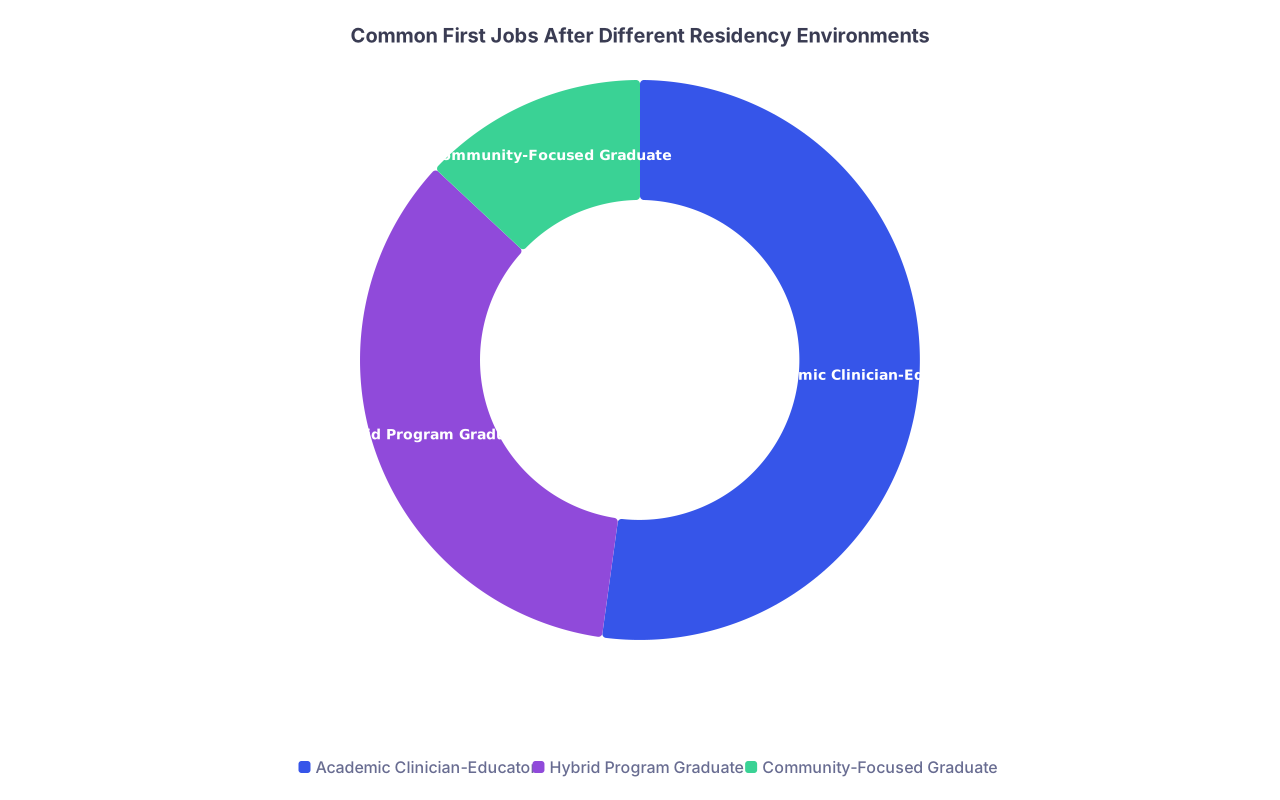
Interpretation (approximate, based on what I see repeatedly):
- Graduates from clinician-educator heavy academic programs: A majority who want academic jobs get them, often starting as assistant professor hospitalists, primary care clinician-educators, or subspecialty fellows in academic centers.
- Graduates from hybrid programs: About half can swing either way with some hustle. They can land academic clinician-educator roles, especially at less hyper-competitive institutions, but may need extra effort to build teaching portfolios.
- Graduates from service-heavy, community-focused programs: They match extremely well into community hospitalist jobs and outpatient groups. Academic clinician-educator positions are possible but require additional work: extra teaching, scholarship, often a fellowship that bridges the gap.
If You Want Academic Clinician-Educator Jobs
You want residency features like:
- Formal resident-as-teacher curriculum.
- Heavy student presence.
- Faculty with national med-ed involvement (APDIM, SGIM, AAIM, etc.).
- Opportunities to present education work at regional or national meetings.
- At least some faculty whose titles explicitly say “Clinician-Educator” or “Director of Clinical Education.”
Your goal is to exit residency with:
- Documented teaching excellence.
- Some educational scholarship or at least structured projects.
- Multiple letters that focus on teaching and academic potential.
If You Want Community Hospitalist Jobs
You want:
- High census, lots of autonomy.
- Direct, unfiltered experience managing admissions, discharges, cross-cover.
- Exposure to typical community workflows: SNF discharges, hospitalist group meetings, quality metrics.
- Attendings who actually practice in the type of job you want.
Teaching still matters—it makes you a better communicator and team leader—but it is not the primary selection criterion.
7. Putting It Together: Choosing Programs That Match Your Teaching Goals
So how do you actually use this when ranking programs?
Think across three dimensions:
- Teaching volume – How often will you actually teach?
- Teaching structure – Are you being trained and evaluated as an educator?
- Teaching culture – Do faculty and leadership truly value education?
If your goal is to become an academic clinician-educator, put heavy weight on:
- Constant learner presence (students, interns, fellows).
- Formalized teaching roles and evaluations for residents.
- Faculty med-ed leadership and evidence of promotion criteria tied to teaching.
- Existence of teaching certificates, “educator tracks,” or similar.
If your goal is community hospitalist practice with some local teaching on the side:
- Make sure you are not drowning in lectures and committees at the expense of clinical autonomy.
- But do still pick a place that respects teaching enough that you are not socially penalized every time you slow down to explain something to a student.
You cannot be everything everywhere. Programs cannot either. Own the trade-offs.
FAQ (Exactly 4 Questions)
1. Can I still become an academic clinician-educator if I train at a community-focused residency?
Yes, but the path is steeper. You will likely need to deliberately seek out teaching opportunities (especially in later years), get involved in any available med-ed projects, and strongly consider a fellowship at a more academic institution where you can build a teaching and scholarship portfolio. You will also need letters that speak explicitly to your teaching ability, not just your efficiency.
2. Are hybrid community–academic programs “worse” than big university hospitals for future clinician-educators?
Not necessarily. Some hybrid programs are outstanding for teaching development because you get real autonomy plus consistent exposure to students and structured teaching curricula. They may actually give you more chances to lead and teach as a resident because there are fewer fellows and less hierarchy. The key is whether education is formally valued and supported, not whether the hospital calls itself “university.”
3. How can I tell from a website whether a program truly values medical education?
Look for concrete signals: explicit resident-as-teacher curricula, teaching awards for residents and faculty, mention of clinician-educator tracks, faculty with titles like “Director of Medical Education” or “Clerkship Director,” and descriptions of residents leading morning report or teaching conferences. If the education section is a single paragraph of vague praise, assume little structure. Use interviews to confirm.
4. During interviews, should I explicitly say I want to be a clinician-educator? Could that hurt me?
At programs that value teaching, saying you want to be a clinician-educator is a net positive. It signals alignment with their mission. At heavily service-driven community programs, it may fall flat or be politely ignored, but it rarely hurts you directly. The bigger risk is self-deception: telling yourself a program will support that path when their structure plainly does not. Your job is not to impress everyone. It is to match where your goals and their incentives actually line up.
With that clarity on resident teaching roles, you are better equipped to see through the marketing and rank programs that fit your future. The next step is learning how to signal your interests on your application and in interviews so the right programs recognize you as “one of theirs.” But that is a conversation for another day.