Future employers will care a lot less about “community vs academic” than you think—and a lot more about whether you’re competent and not a headache to hire.
But that doesn’t stop this from gnawing at you, right?
You picture yourself in a few years, sitting in some group’s conference room, partner-track job on the line, and someone quietly thinking: “Oh… they’re from a community program.”
And your brain fills in the rest:
They’ll think I’m undertrained.
They’ll assume I couldn’t match “better.”
They’ll pick the university person over me.
Let’s walk through what’s actually true, what’s semi-true, and what’s just your anxiety talking.
The Ugly Truth: Name Brand Helps… at the Beginning
Let me just say the uncomfortable part out loud: yes, training at a big-name academic center can open some doors more easily. Especially early.
If you’re applying to ultra-competitive fellowships, research-heavy faculty jobs, or “elite” coastal groups, sometimes the conversation in the back of the room really is:
“Do we want the resident from MGH or the one from Random Community Hospital?”
But here’s the part that people on Reddit conveniently forget to emphasize:
That matters a lot in:
- Fellowship recruitment at super-academic places
- Research/tenure-track positions
- Niche subspecialties with very few spots
It matters much less in:
- Bread-and-butter private practice jobs
- Hospital-employed generalist positions
- Most outpatient/clinic jobs
- Rural and suburban groups that just want someone who can hit the ground running
I’ve watched this play out over and over. The “University Famous Name MD” and the “Solid Community Program MD” both apply to the same hospital-employed job. The hiring committee asks:
- Who interviews better?
- Who seems less likely to bounce in 1–2 years?
- Who has clean references?
- Who seems like they’ll get along with the staff?
If you think they’re spending 45 minutes dissecting the academic pedigree of your residency… they’re not. They’re looking at: “Can this person safely manage a full patient panel next month?”
What Employers Actually Look At (That You’re Probably Ignoring)
There’s this fantasy that every employer is some admissions committee 2.0, zooming in on where you trained and what that “means.”
In reality, most of them are tired, overworked physicians or administrators asking very practical questions.
| What You Obsess Over | What Employers Actually Prioritize |
|---|---|
| Community vs academic label | Can you work independently and safely? |
| Program name recognition | References from attendings and chiefs |
| Prestige of your hospital | How you interview and communicate |
| Research output | Your productivity and reliability |
| Step scores & clerkship honors | Whether you need handholding or not |
Do some practices care about names? Sure. Especially in competitive metro areas or super “prestige-conscious” markets. But among the people who actually sign contracts and cover call?
They’re asking:
- Will you take your share of nights and weekends without constant drama?
- Can the ICU/ED trust you alone at 2 a.m.?
- Are you going to bury the clinic in complaints?
- Am I going to regret giving you privileges?
If your community program gives you:
- High clinical volume
- Strong autonomy (within reason)
- Exposure to common pathology and decent complex cases
- Mentors who’ll go to bat for you
Then you’re giving employers what they actually care about: someone who can do the job without being a liability.
Where Community Training Can Bite You (If You’re Not Careful)
Let’s not sugarcoat this. There are real pitfalls.
The “community vs academic” label is a lazy shorthand people sometimes use to hide what they’re actually worried about:
Underexposure to complex/rare cases
If your hospital ships out anything that blinks funny, employers might question your comfort with sick patients. This hits harder for EM, ICU-heavy IM, anesthesia, surgery.Weak reputation in your specialty
Some programs are known by name among department chairs and fellowship directors—for good or bad. A small, unaccredited, or chronically under-resourced program raises red flags. “Community” doesn’t automatically mean this, but some are frankly rough.Lack of subspecialty faculty
Want cards, GI, heme/onc, PCCM? If your community IM program has zero in-house fellowships, minimal subspecialty clinics, and almost no research, you’re swimming upstream for academic fellowships.
This is where academic programs have a built-in advantage.
It’s not just the brand—it’s the infrastructure: ICU, transplant, subspecialty services, research, big-name mentors.
If your anxiety is: “Will this community program close doors forever?” The honest answer is: it can close some doors by default—if you don’t make up for the gaps.
But permanent? No. Salvageable? Very often, yes.
Where Community Programs Quietly Win
Here’s the part nobody tells you when you’re doomscrolling through SDN:
A lot of employers actually like community-trained grads. Especially for hospital-employed or private jobs.
Why?
Because community training often means:
- You’ve seen real-life chaos, not perfectly filtered tertiary-referral cases.
- You’re used to limited resources, fewer consults, and more “figure it out.”
- You’ve worked shoulder-to-shoulder with APPs, nurses, and case managers in a non-academic hierarchy.
- You’ve done actual volume. On call. At night. Without an army of fellows.
That looks really good to:
- Community hospitals that want generalists who know how to function without 10 subspecialty teams.
- Groups that can’t babysit a brand-new attending for 12 months.
- Rural systems where you are the specialist at 3 a.m.
I’ve watched partners in a large community group flat-out say:
“The university grads sometimes know more theory but need more time to adjust. The community grads usually hit the ground faster.”
Do they care that you came from a community program? Yes.
But often in a positive way—if your training was solid.
If You Want a Competitive Fellowship or Academic Career
Now, if your anxiety is less “Will someone hire me?” and more “Will I be punished forever for not going academic?”—that’s different.
You’re right that for certain fellowships and academic careers, training at a strong academic program helps. They have:
- More research
- More subspecialty exposure
- Nationally known mentors
- A stronger track record of sending people to top fellowships
But community program ≠ no chance. It just means you’ll need to be intentional and a bit scrappy.
Here’s what I’ve seen actually work from community residents who matched good fellowships:
Get early, honest intel
Ask PD and recent grads: “Where did people match for fellowship in the last 5–10 years?” If the answer is “mostly didn’t apply” or “local only,” you know you’ll have to hustle.Seek external mentorship
Email or connect with academic faculty at regional universities. Ask to collaborate on research, QI, or even just regular case discussions. It’s awkward. Do it anyway.Make conferences your second home
Posters, abstracts, case reports—yes, even the small stuff. This is how you build a CV that looks “academic enough” despite your home base.Crush your letters
A killer letter from a well-known specialist you rotated with as a visiting resident can neutralize “small community program” concerns fast.
You’re not doomed. You’re just not on “easy mode,” that’s all.
The Reputation Question: How Much Does Your Program’s Name Stick?
Here’s a harsh but oddly comforting truth: after a few years in practice, almost nobody cares where you trained unless you make it your personality.
The timeline usually looks like this:
PGY-3/4 to 1–2 years out:
People skim your CV, notice the program, maybe think “Oh that’s a community place” or “Nice, big academic name.” It colors first impressions a bit.3–5 years out:
What matters more is: What have you actually done? Outcomes, productivity, are you Board certified, any lawsuits, reputation with nurses, and whether other docs like working with you.Beyond that:
You’re judged almost entirely on your work and your word-of-mouth reputation. “Dr. X is solid, takes care of their patients, doesn’t dump on the ED” is worth more than “trained at Fancy University.”
If you want the anxiety-sanitized version:
Your residency name is loud early, faint later, and mostly irrelevant after that—unless there’s something really off about your program.
How to Tell If a Community Program Will Hurt You
So the real question isn’t “Will employers care that it’s community?”
It’s “Is this a good community program or a dysfunctional one that’ll actually set me back?”
Red flags:
- Very low board pass rates
- Chronic under-staffing and “service over education” with zero correction
- No feedback, no structure, constantly changing leadership
- Residents struggling to find jobs or scrambling to get decent placements
- PD dodges direct questions about graduates’ outcomes
Green-ish flags:
- Graduates consistently pass boards and find solid jobs
- Some grads land decent fellowships (maybe not top-5, but good programs)
- Attendings are invested in teaching, not just using you as a warm body
- You get true autonomy with supervision, not unsafe abandonment
- The hospital sees you as trainees, not cheap labor
If the program is strong, “community” is a descriptor, not a curse.
Mental Strategy: How To Stop Spiraling About This
Your brain loves binary thinking:
Academic = success.
Community = failure.
Reality is messy:
- There are phenomenal community programs that train beasts.
- There are mediocre academic programs coasting on old reputations.
- There are employers who don’t care at all and just want someone who’ll show up and not implode.
If you end up at a community program, here’s how to keep your future options alive without losing your mind:
Own it in your narrative.
In interviews later, don’t apologize for it. “I trained at a high-volume community hospital where I learned to manage X, Y, Z and developed comfort with independent practice.” Confident. Direct.Fix what your program lacks.
No research? Create small projects. No exposure to some subspecialty? Do away rotations or visiting electives. Weak academic name? Build strong relationships and letters.Keep your eye on the real metric.
In the end, employers hire you to solve one problem: patient care coverage. If you can safely and efficiently do that—and not be a nightmare to work with—you’re already 90% there.
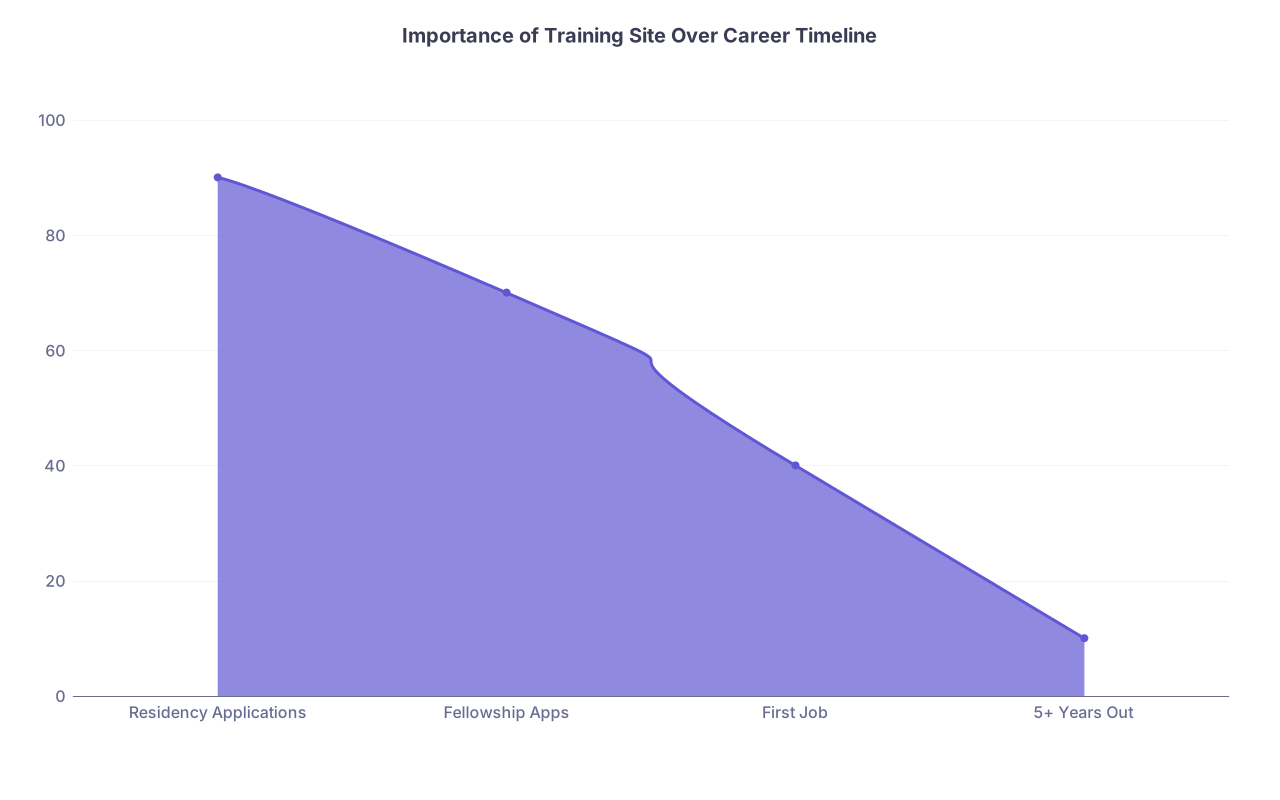
| Category | Value |
|---|---|
| Residency Applications | 90 |
| Fellowship Apps | 70 |
| First Job | 40 |
| 5+ Years Out | 10 |

| Step | Description |
|---|---|
| Step 1 | Community Residency |
| Step 2 | Good Clinical Skills |
| Step 3 | Competitive for Jobs |
| Step 4 | Possible for Fellowships |
| Step 5 | Training Gaps |
| Step 6 | Harder Job Search |
| Step 7 | Needs Extra Mentorship |
| Step 8 | Academic or Hybrid Career |
| Step 9 | Community or Private Practice |
| Step 10 | Strong Program? |
FAQs
1. Will employers automatically think less of me because I trained at a community hospital?
No, not automatically. Some will notice the difference, but most are much more interested in whether you’re competent, board-certified, safe, and not a disaster personality-wise. If your community program is solid and you can talk clearly about your training, it’s not a scarlet letter.
2. Am I screwed for competitive fellowships if I don’t go to an academic residency?
You’re not screwed, but you’re not on the easiest path either. You’ll need stronger letters, more hustle for research or projects, and often some external mentorship. People from community programs match competitive fellowships every year—it just takes more deliberate effort.
3. Will my residency name still matter 5–10 years into practice?
Very little. Early on, it colors first impressions. Later, your real-world track record takes over: outcomes, references, job stability, and reputation with colleagues. By mid-career, nobody is hiring you because of your residency name—they’re hiring you because of who you are now.
4. How can I “sell” my community training in future job interviews?
Be specific and confident. Talk about case volume, autonomy with supervision, managing limited resources, and being comfortable with bread-and-butter and moderately complex cases. Frame community training as hands-on, practical preparation for exactly the kind of patients that hospital or group sees.
5. Should I rank a weaker academic program over a strong community program just for the name?
No. That’s how people end up miserable and undertrained. A strong, well-run community program usually beats a disorganized, malignant academic one. If the academic place is significantly better for your specific goals (especially research/fellowship), sure, consider it. But never pick “brand” over actual training quality.
Key takeaways:
Your future employers will care far more about whether you’re competent, safe, and decent to work with than whether your badge once said “University Hospital” or “Community Medical Center.” A good community program can absolutely set you up for a strong career—jobs, fellowships, and beyond—as long as you’re honest about its gaps and deliberate about filling them.