You’re sitting in the library at 11:47 p.m., ERAS open, CV in front of you. You scroll past “Publications and Presentations” and it’s just… blank. A graveyard. Everyone around you is throwing around lines like “my first-author paper” and “I’m submitting to Chest” and you’re over here wondering if you’re destined to only match at some random community program in the middle of nowhere because you have exactly zero publications.
And the question that keeps looping in your head is brutal:
“I have zero publications—does that mean I have to go community only?”
Let me answer that directly:
No. Having zero publications does not automatically mean “community only.” But it does change how you play the game, especially if you’re aiming at research-heavy academic places.
Let’s untangle this before you spiral any further.
First: What Programs Actually Care About Publications?
Not every “academic” program is the same. Some obsess over research; some just like the word “academic” on their website.
Rough breakdown:
- A handful of top-tier, research-obsessed programs basically expect publications
- A large chunk of academic programs like research but don’t treat it as religion
- Many community programs don’t care at all, or barely care, about publications
Here’s the part you’re scared to hear, so I’ll just say it:
If you’re applying to something like MGH IM, UCSF Neuro, or Hopkins Derm with zero pubs and very average stats? Yeah, that’s rough. Those places bathe in high H-indexes. That’s their thing.
But that is a tiny slice of all “academic” programs.
Most university-affiliated programs are not filtering you out solely for “no pubs.” They’re looking at the whole application: scores, grades, letters, fit, and yes, potential to do research, even if you haven’t done it yet.
Community vs Academic: What Actually Differs (Not the Instagram Version)
Let’s be practical for a second. “Community” vs “academic” gets thrown around like a moral hierarchy, and it’s not that simple.
| Program Type | Typical Research Expectation | Zero Pubs a Dealbreaker? |
|---|---|---|
| Elite Academic (Top 10-ish) | Multiple pubs, posters, often first-author | Usually yes |
| Mid-tier University | Some research exposure preferred | Usually no |
| University-Affiliated Community | Nice to have, but flexible | Rarely |
| Pure Community | Minimal to none | Almost never |
So where does “zero publications” actually hurt you?
- The super competitive, research-heavy academic programs
- Certain fellowships down the line (if you never build a research record)
Where does it not destroy you?
- Most solid mid-tier academic programs
- University-affiliated community programs
- Community programs with strong clinical reputations
- Any place that values clinical performance, letters, and Step scores more than PubMed
Zero Publications vs Zero Research: Not the Same Thing
This is the part people screw up in their heads.
No publications ≠ No research
No research ≠ No potential
No potential = the real red flag
Programs care more about:
“Has this person ever tried to ask a question, collect data, work on a project, present something?”
than
“Is this person already a PubMed demigod at 24?”
If you can say any of these, you’re already in better shape than your brain is telling you:
- “I did a poster at a regional conference”
- “I helped with a QI project but it didn’t get published”
- “I’m on a retrospective chart review that’s in progress”
- “I contributed to data collection, not on the author list yet”
Those things count. Programs know a lot of student projects die in “manuscript pending” purgatory forever.
If you truly have:
- No pubs
- No posters
- No abstract
- No QI
- No “in progress” anything
Then yes, you’re going in as a zero-research applicant. That still doesn’t sentence you to community only, but it does limit the top of the academic ladder, especially in hyper-competitive fields.
Specialty Matters More Than You Want It To
Let me be blunt. Specialty changes everything.
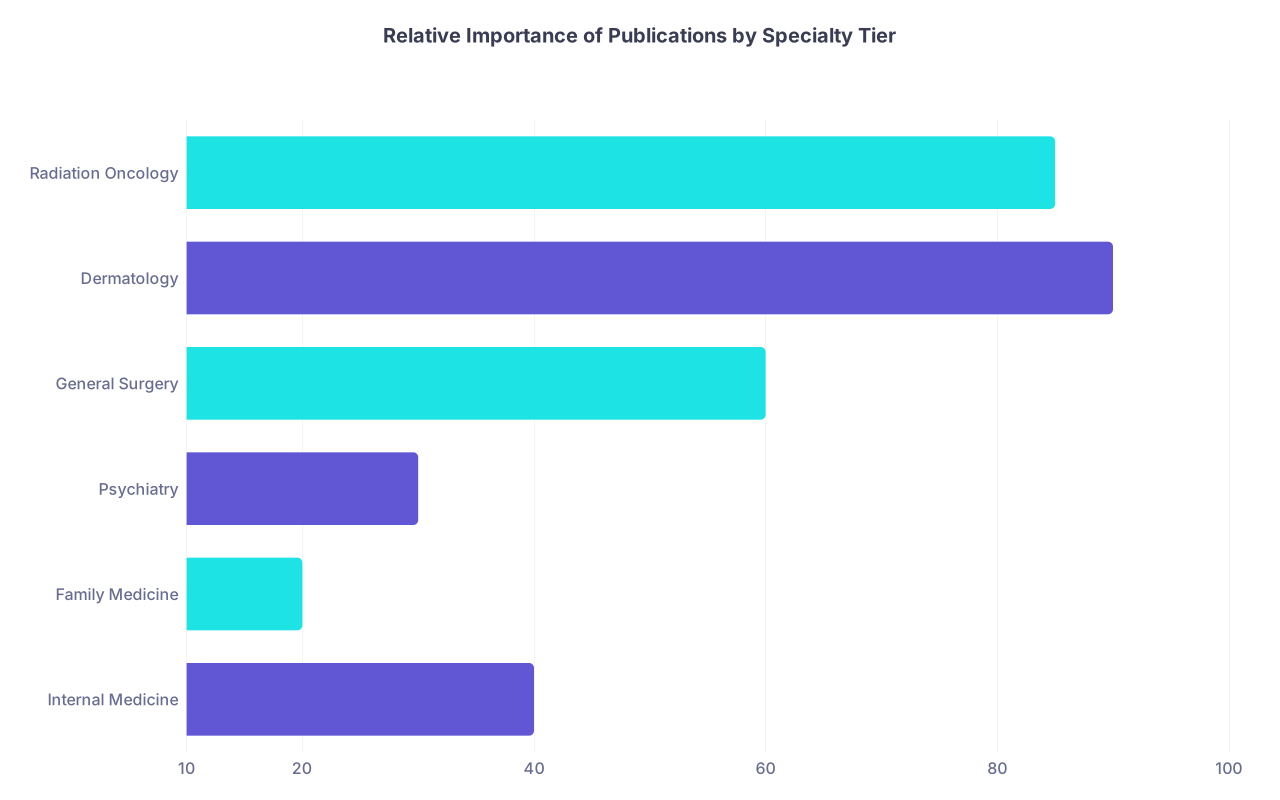
| Category | Value |
|---|---|
| Internal Medicine | 40 |
| Family Medicine | 20 |
| Psychiatry | 30 |
| General Surgery | 60 |
| Dermatology | 90 |
| Radiation Oncology | 85 |
(Scale: 0 = nobody cares, 100 = basically mandatory for top programs)
If you have zero publications:
- FM, Psych, Peds, IM (non-elite): Totally possible to match academic with strong clinical metrics
- Gen Surg, EM, OB/Gyn, Anesthesia: Research helps more, but not always required
- Derm, Plastics, Rad Onc, Ortho (top tier): Zero pubs? You’re probably not touching the big-name academic programs unless everything else is insanely strong
So no, “zero pubs = community only” is not the rule. It’s more:
“Zero pubs + low scores + mediocre letters + competitive specialty = okay, now we’re in trouble.”
But that’s not a publications problem. That’s an entire-application problem.
How Academic Programs See a “Zero Pubs” Applicant
Imagine you’re on a selection committee for a mid-tier academic IM program.
Candidate A:
- Step 2: 252
- Strong letters
- Honors in medicine
- No publications, one QI project that never made it past a poster
Are they rejected just for that? No. Not even close.
Candidate B:
- Step 2: 224
- Pass in medicine
- Generic letters
- No research, nothing in progress
No pubs is part of their problem, but it’s not the problem.
Academic PDs care about:
- Are you going to pass boards?
- Are you going to show up and not be a disaster on day 1?
- Are you coachable?
- If they’re a research-leaning program: Are you at least open to research and capable of some scholarly work?
Zero publications doesn’t answer “no” to those questions. It just doesn’t help you answer “yes.”
Can You Still Get an Academic Spot With Zero Pubs? Yes—If You Do This
This is what you actually care about: “Okay, what do I do now, realistically?”
Here’s what matters more than whether you have a PubMed ID:
Clinical performance Be the student every attending wants on their team. Honors, strong evals, especially in your specialty of interest. PDs read those comments closely.
Letters that sound like the writer actually knows you You want:
“This student is in the top 10% I’ve worked with in the last 10 years.”
Not:
“They were punctual and read about their patients.”Step 2 and exams With Step 1 pass/fail, Step 2 is more important. A solid score can compensate for a thin research CV at many academic programs.
Signal interest in academic stuff, even if you have no pubs
- M4 elective at the home academic program or away rotation
- Mention academic interests in your personal statement (with specifics, not vague fluff)
- Join a project now, even if it’s late in the game—“in progress” looks better than “never tried”
The “In Progress” Lifeline (Yes, It Counts)
If you’re not in ERAS submission week yet, you still have time to not be a complete zero.
And before you say “it’s too late,” I’ve seen students:
- Join a QI project on an inpatient unit in M4 fall
- Get on a retrospective chart review two months before ERAS
- Help with a case report that’s submitted but not accepted yet
On ERAS, you can list:
- “In preparation”
- “Submitted”
- “Provisionally accepted”
- “Accepted”
No, it’s not as shiny as a fully published PubMed paper. But it changes the story in PDs’ heads from “never did anything scholarly” to “started engaging, but it’s early.”
That’s a huge difference.
What If You Actually End Up at a Community Program?
Let’s say worst case in your head happens. You match at a community program. Not the “academic dream,” no big-name PI, no NIH grants. Does that permanently kill any chance of academic career or fellowship?
No. It makes it harder. But not impossible.
You can still:
- Collaborate with nearby universities on projects
- Do QI, case reports, retrospective studies
- Hustle during residency to build a research record for fellowship
I’ve watched people match community IM → build a research portfolio during residency → match academic GI/cardiology/fellowship at name-brand places. It’s harder. You work more. But you’re not dead in the water.
How To Build an Academic-Enough Profile Without Publications
You’re probably thinking, “Okay, but if I want academic, what can I do besides panic?”
A few concrete moves:
- Do an away rotation at an academic program you’d realistically match at (not just the top 5)
- Talk to residents there: “What do they actually care about? How research-obsessed are they really?”
- Ask if there are small projects you can help with—chart reviews, case series, simple QI
- Get letter writers who are known in your field, even if your CV is light
And in your personal statement + interviews, don’t pretend you’ve been grinding in a lab for four years. PDs can smell that. Instead:
- Own that your school/situation didn’t lend itself to heavy research (if that’s true)
- Emphasize your interest in teaching, QI, or clinical excellence
- If you’re starting late research, say so: “I recently joined a QI project on X because I’m interested in improving Y. It’s early, but I’m excited to keep doing this kind of work in residency.”
Honest but not pathetic. That’s the line.
The Ugly Truth People Don’t Say Out Loud
There’s a lot of ego wrapped up in “academic vs community.” More than anyone admits.
Med students treat “community program” like an insult. So when you’re sitting there with no pubs, it feels like a character judgment. Like you didn’t grind hard enough. Like everyone will know you “failed.”
Reality check:
- A ton of “academic” residents are miserable and never touch research again
- A ton of “community” residents are clinically excellent and end up teaching, doing QI, even publishing later
- Most patients do not care where you trained, as long as you know what you’re doing and don’t treat them like a lab rat
So no, zero publications does not mean “community only.” And even if you do end up at a community spot, it doesn’t mean “game over.”
Quick Visual: Where Zero Pubs Actually Hurts Most
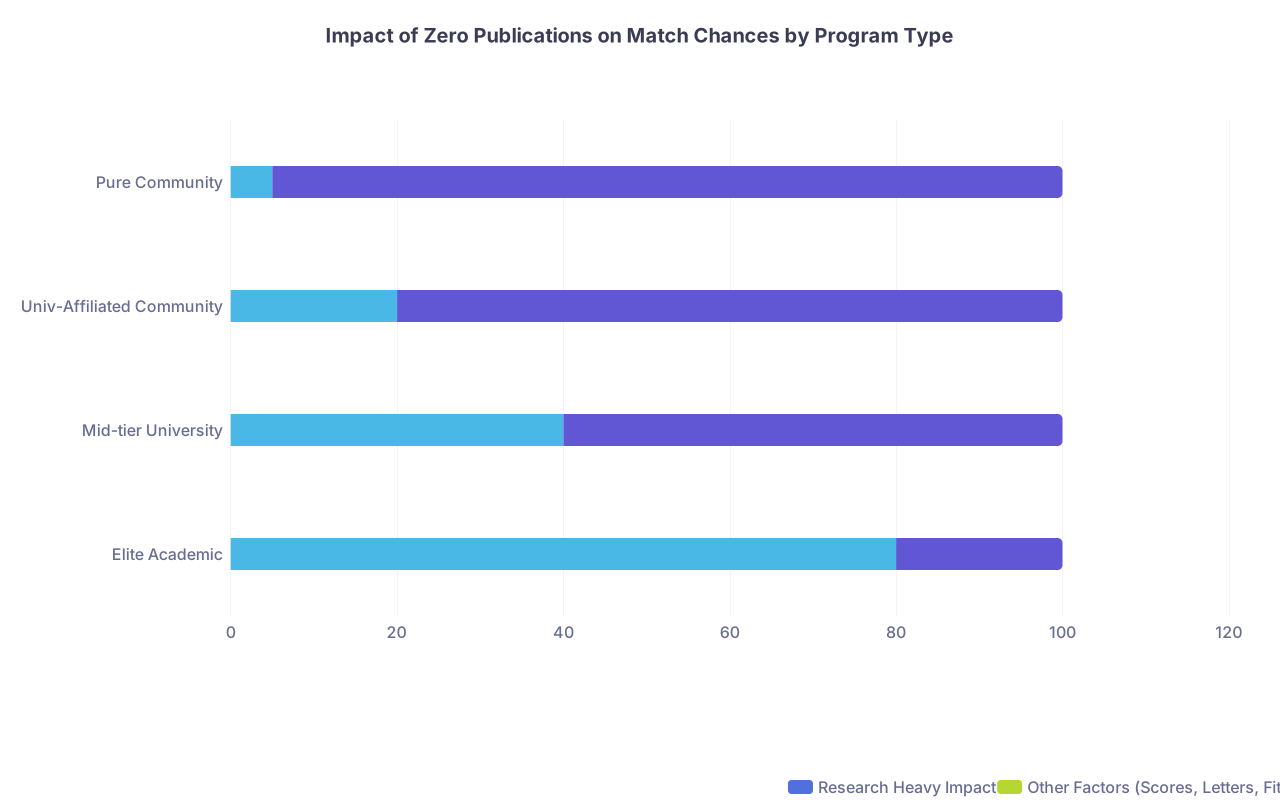
| Category | Research Heavy Impact | Other Factors (Scores, Letters, Fit) |
|---|---|---|
| Elite Academic | 80 | 20 |
| Mid-tier University | 40 | 60 |
| Univ-Affiliated Community | 20 | 80 |
| Pure Community | 5 | 95 |
Read that as: at elite academic places, research carries a brutal amount of weight. Everywhere else, it’s one factor among many.
Mental Game: How To Not Let This Eat You Alive
You can do everything “right” and still not have pubs. Maybe your school had no infrastructure. Maybe every project you joined stalled. Maybe you were working or taking care of family and research wasn’t realistic.
You’re allowed to feel behind. But don’t start writing your own rejection narrative.
Focus your energy on what’s still modifiable now:
- Programs you pick
- How you frame your story
- Whether you add even one small-in-progress project
- Getting the best possible letters
And then accept this: some doors may be closed (hello, Harvard Derm), but 90% of doors are not.

| Step | Description |
|---|---|
| Step 1 | Zero Publications |
| Step 2 | Emphasize Projects and Potential |
| Step 3 | Strengthen Clinical and Scores |
| Step 4 | Narrow to Realistic Academic Targets |
| Step 5 | Apply Broadly Academic and Community |
| Step 6 | Consider Backup Community Programs |
| Step 7 | Match and Build CV During Residency |
| Step 8 | Any Research Experience? |
| Step 9 | Specialty Highly Competitive? |
FAQ (Exactly 6 Questions)
1. Do I have any shot at an academic IM program with zero publications?
Yes. Absolutely. If you’ve got solid Step 2, good clinical grades (especially in medicine), and strong letters, you’re still in the running at a lot of academic IM programs. The top 5 research monsters might be out of reach, but there are dozens of university and university-affiliated programs that take residents every year with no publications.
2. Should I even bother listing “in progress” projects, or does that look fake?
List them. Programs know not every student paper gets published. “In preparation” or “submitted” is normal on ERAS. Just don’t lie or massively exaggerate your role. If they ask in an interview and you can’t explain what the project is about, that’s when it looks fake. Otherwise, it actually helps show initiative.
3. Will I be filtered out automatically by academic programs for having zero publications?
Most programs don’t hard-filter on research. They filter on things like Step scores, visa status, or whether you’re an AMG/IMG. Zero pubs might hurt you at very research-heavy places, but at the majority of academic programs, you’re not getting insta-deleted just for that.
4. Is it better to rush a low-quality poster now or wait for a possible better project later?
At this stage (close to application season), a simple, clean, honest QI or case report poster is worth more than some theoretical “better” project that never materializes. Programs don’t care that much about the prestige of your med student poster. They care that you can follow through and that you’re at least familiar with basic scholarly work.
5. If I match to a community program, am I locked out of academics or fellowship?
No. You’re just not handed the same ready-made pipeline. Plenty of people come from community IM to GI, cards, pulm/crit at academic centers. The price is hustle: you’ll need to seek out projects, maybe connect with outside institutions, and intentionally build a scholarly record during residency. Hard? Yes. Impossible? No.
6. Should I rewrite my personal statement to explain why I have no research?
Don’t turn your personal statement into a defensive essay. A brief, honest line like “My school had limited formal research infrastructure, so my focus was on clinical work and small QI efforts” is fine if it’s true. But don’t spend 500 words justifying it. Use the bulk of your statement to show who you are clinically, what kind of resident you’ll be, and what you want from an academic environment (teaching, QI, patient care), not to apologize.
Key points:
- Zero publications does not equal “community only,” especially outside of the ultra-competitive, research-obsessed programs.
- Your overall application—scores, letters, clinical performance, and basic scholarly engagement—matters way more than just a PubMed count.
- Even if you end up at a community program, you’re not shut out of academic paths or fellowships; it just means you’ll need to build your research story later instead of now.