
The way program directors react when they see you ranked only academic programs is not what your classmates think it is.
They are not flattered. They are not impressed by your “ambition.” They are making very fast, very unromantic inferences about your risk tolerance, your self-awareness, and whether you understand how this game actually works.
Let me walk you through what really happens on their side of the screen.
The Quiet Calculation Behind Your Rank List
Here’s the part no one spells out: once your application is in, your risk is mostly in your rank list. PDs already have your scores, your MSPE, your letters. By the time lists are being certified, they are not still “figuring out who you are.” They’re figuring out the board scores of their incoming class, coverage needs, call schedules.
But almost every academic PD I know does the same thing at least once in late February: they sit in front of the NRMP interface, open your “Ranked Programs” tab, and just…scroll. Not everyone. But enough that you should assume it happens.
What they’re looking for is simple:
- Did you rank widely, or recklessly?
- Are you clearly overreaching or anchored in reality?
- What type of programs did you rank? All academic? Mix of academic and community? Safety nets?
And here’s the uncomfortable truth: if your file is borderline for academic programs and you ranked only academic places, multiple PDs will quietly assume you do not understand your odds. They will not call you to explain this. They will not rescue you from your own rank list.
They just move on.
How Academic vs Community Signals Read to PDs
At the table, directors and associate PDs think in patterns, not individual snowflakes. One of those patterns is this: “Applicant only ranked academic programs.”
They mentally group you into one of three buckets.
Bucket 1: The Clearly Competitive Academic Applicant
This is the person with honors in most core rotations, strong letters from recognizable academic names, solid or high Step 2, usually some research. They interviewed at 12–18 academic programs, a few of them name-brand.
When a PD sees that this type of applicant ranked only academic programs, the reaction is basically:
“Fine. That makes sense.”
There’s no extra halo. They don’t think, “Wow, what grit.” They think, “They want a certain career path; they’ll land somewhere. Not my problem if they overshoot our program.”
What they do not do is “protect” you because you aimed high. The myth that being “loyal” to academics wins you secret points is exactly that: a myth. The rank list on the program side is locked in long before they ever see your ranking behavior.
Bucket 2: The Borderline Academic Applicant
This is where most of you live. Decent but not spectacular. Maybe:
- Step 2 in the low to mid 220s for IM, low 230s for more competitive fields
- A couple of Honors, mostly High Pass/Pass
- Research “adjacent”: one poster, maybe a case report
- Solid but not glowing letters
This applicant gets 8–12 interviews, mostly at mid-tier and lower-tier university programs and a few community-affiliated hospitals.
When a PD looks and sees this person ranked only academic programs, the subtext they hear is:
- “They don’t understand how thin their margin is.”
- “If the music stops and they don’t have a chair, they’re going to be one of those ‘I can’t believe I didn’t match’ emails in March.”
From the director’s perspective, that’s not their emergency. Their rank list is already built. But it absolutely colors how they talk about you when your name comes up in a borderline discussion.
I’ve heard these exact phrases in rank meetings:
“He only ranked big academic places? With that Step 2? That’s…optimistic.”
“She didn’t even put any of the strong community programs on there. I don’t think she understands how competitive this has gotten.”
They’re not being cruel. They’re doing pattern recognition from years of watching similar applicants go unmatched.
Bucket 3: The Overreaching, Poorly Advised Applicant
Everyone in academic medicine knows this archetype:
- Mediocre clinical evaluations
- Step 2 barely above the passing line or red flags
- Minimal or no research, lukewarm letters
- Yet applied mostly to academic-heavy lists and then ranked only academic programs, often in major cities
When PDs realize this, they don’t get angry. They just label you in their head: poorly mentored or unrealistic. If your file was borderline to begin with, that can be enough to nudge you down when they’re trimming their rank length.
Is that “fair”? No. Is it how it works? Yes.
Why Academic-Only Rank Lists Make PDs Nervous
Not for their sake. For yours.
Program directors, especially at academic programs, have seen this story so many times it has its own energy in the room. They know exactly what happens when the SOAP list drops and that nice, enthusiastic MS4 they met in January is suddenly in the unmatched spreadsheet.
I’ve watched PDs scroll through the SOAP list and say:
“I remember him. I bet he ranked only university programs.”
They’re usually right.
To be blunt: when you rank only academic programs and you are not obviously competitive for them, what PDs see is a future cautionary tale. Not a bold visionary.
Remember, academic PDs live in an ecosystem:
- They sit on medical school promotions committees.
- They talk to UME deans who later have to clean up the unmatched aftermath.
- They teach M3s and M4s who will be traumatized for months if things go badly.
So when they see risk blindness in an applicant, it quietly lowers the “maturity” and “judgment” score in their heads, even if no one writes that on the rubric.
You think you’re “showing commitment to academics.”
They think you’re “underestimating the downside.”
The Real Differences Between Academic and Community Programs (Through PD Eyes)
You keep hearing: “academic vs community” like they’re clean categories. They aren’t. The directors know that.
Let me spell out how they actually sort these programs, because it matters for how they read your choices.
| Type | Core Identity | Typical Applicant Signal |
|---|---|---|
| Flagship University | Research, prestige | Fellowship-driven, academic CV |
| Mid-Tier University | Balanced | Mix of academic + clinical |
| University-Affiliated | Heavy clinical | Practical, open to variety of paths |
| Large Community | Service, volume | Clinically focused, fewer research |
| Community with Niche | Specific strength | Targeting one niche (e.g. cards) |
Now, what happens in PD brains when they see your rank list?
If you ranked:
- Only Flagship and Mid-Tier University programs → they see you as trying to lock in an academic identity.
- Mix of University, Affiliated, and strong Community → they see you as realistic, adaptable, probably well-advised.
- Only Academic + major cities → they see the “location + prestige” bias and start to wonder if you’ll be happy anywhere.
Here’s the twist: many community PDs are themselves faculty at academic centers, hold teaching titles, and send people to fellowships all the time. They know they’re not second-class training. So when they see you ignored strong community options you interviewed at, they do not feel “honored” that you’re chasing university logos. They think you have a narrow or outdated view of what makes a good residency.
I’ve heard a community PD say, about an applicant who canceled on them after getting academic interviews:
“She’ll end up at a university where the fellow puts in all the central lines and she won’t touch a procedure. Then she’ll come back to us for a job later.”
That wasn’t bitterness. That was pattern recognition.
How Rank Lists Actually Interact with Program Decisions
There’s a persistent fairy tale that if you “show love” to academic programs by ranking them exclusively or very highly, some PD will reciprocate by moving you up on their list.
No.
Here’s the sequence that actually happens:
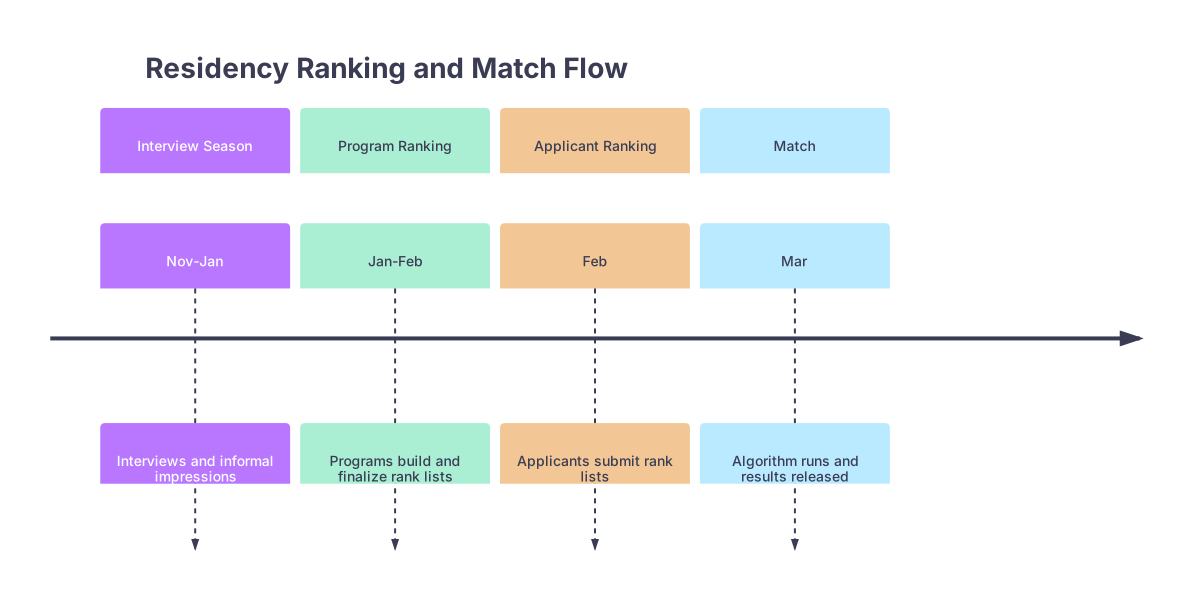
| Period | Event |
|---|---|
| Interview Season - Nov-Jan | Interviews and informal impressions |
| Program Ranking - Jan-Feb | Programs build and finalize rank lists |
| Applicant Ranking - Feb | Applicants submit rank lists |
| Match - Mar | Algorithm runs and results released |
Programs do not see your rank order when they construct theirs. By the time you’re submitting your list, theirs is essentially frozen except for rare extreme updates (major red flag, catastrophic communication, etc.).
Where your rank behavior matters is:
- For how they remember you if you end up unmatched and come back later for SOAP or employment.
- For how they generalize about your school’s advising and applicant maturity.
- For how other PDs, especially at your own school, perceive your decision-making.
I once watched a home institution PD pull up an unmatched student’s rank list in a debrief with the dean. All academic. All big names. No community backups.
The dean’s comment was brutal and accurate: “We failed her by not making it clear that this was suicidal.”
Yes, the student made the list. But the faculty around her nodded; they had seen the warning signs and didn’t push hard enough.
What PDs Actually Respect in a Rank List
Let me say this clearly: program directors respect judgment. Not posturing.
Judgment looks like this:
- A realistic spread of program “tiers” based on your actual file.
- A mix of academic and strong community programs if you’re not a slam-dunk academic candidate.
- Willingness to leave your favorite city if your metrics require it.
- Recognizing that training quality is not determined solely by the NIH funding report.
When a PD sees a rank list where you’ve interviewed at, say:
- 6–8 academic programs
- 4–6 university-affiliated community programs
- 3–5 large, solid community programs
…and you rank across that spectrum in a way that matches your stated goals, the subtle conclusion is: “This person gets it.”
The people sitting in that room know that the applicant who trains at a very strong community-based program, crushes their boards, and builds a clinical reputation will very often end up with a better job, more confidence, and more autonomy than the one who barely scrapes into a name-brand institution, spends three years hiding behind fellows, and graduates terrified.
They’ve watched that play out dozens of times.
The Academic Ego Trap: What You Don’t See From the Student Side
Medical schools, especially academic heavy ones, sell prestige. It’s part of their business model. They highlight alumni in big-name residencies. They send you emails when someone matches MGH or UCSF. They do not send a blast about the graduate who is quietly thriving as a community hospitalist in a mid-sized city, paid very well, with actual weekends off.
So you internalize this idea that community = fallback, academic = success. Then you build a rank list that broadcasts that insecurity.
PDs read that. They were once you.
I’ve heard academic faculty say, privately, after reviewing an all-academic rank list from a clearly middle-of-the-road student:
“They’re trying to outrun their own imposter syndrome with a logo.”
Harsh? Maybe. Wrong? Not usually.
The irony is that some of the most “academic” lives I’ve seen—teaching, bedside education, QI projects, local guideline development—are lived by people in “community” settings where there’s room to actually do the work.
Academic PDs know this. They watch their own exhausted residents flee to those settings after training.
So when you seem to believe that anything outside the university logo is beneath you, their respect for your judgment slips a notch.
How To Want an Academic Career Without Looking Naive
You can absolutely be honest about wanting academics without playing roulette with your future. Here’s how the insiders do it.
First, understand what PDs actually listen for on your interviews and in your application:
- Do you have any real scholarship? Even small stuff.
- Do you understand what an academic career actually involves (teaching, QI, admin, not just “doing research”)?
- Are you flexible about geography and brand-name obsession?
Then, construct a rank list that says:
“I take my goals seriously, but I’m not delusional, and I’m not too proud to train where I’ll get excellent clinical experience.”
That might mean:
- Ranking your best-fit academic places at the top.
- Including university-affiliated and strong community programs that have solid teaching, decent fellowship match (if that matters to you), and good volume.
- Accepting that your first job, not your residency logo, will do most of the work in shaping your long-term academic presence.
PDs are pattern-matchers. When they see that pattern—ambitious but grounded—they react very differently than they do to the all-ivory-tower list from a marginal applicant.
A Visual of How PDs See Your Risk
Here’s roughly how risk perception changes with your interview portfolio and rank behavior:
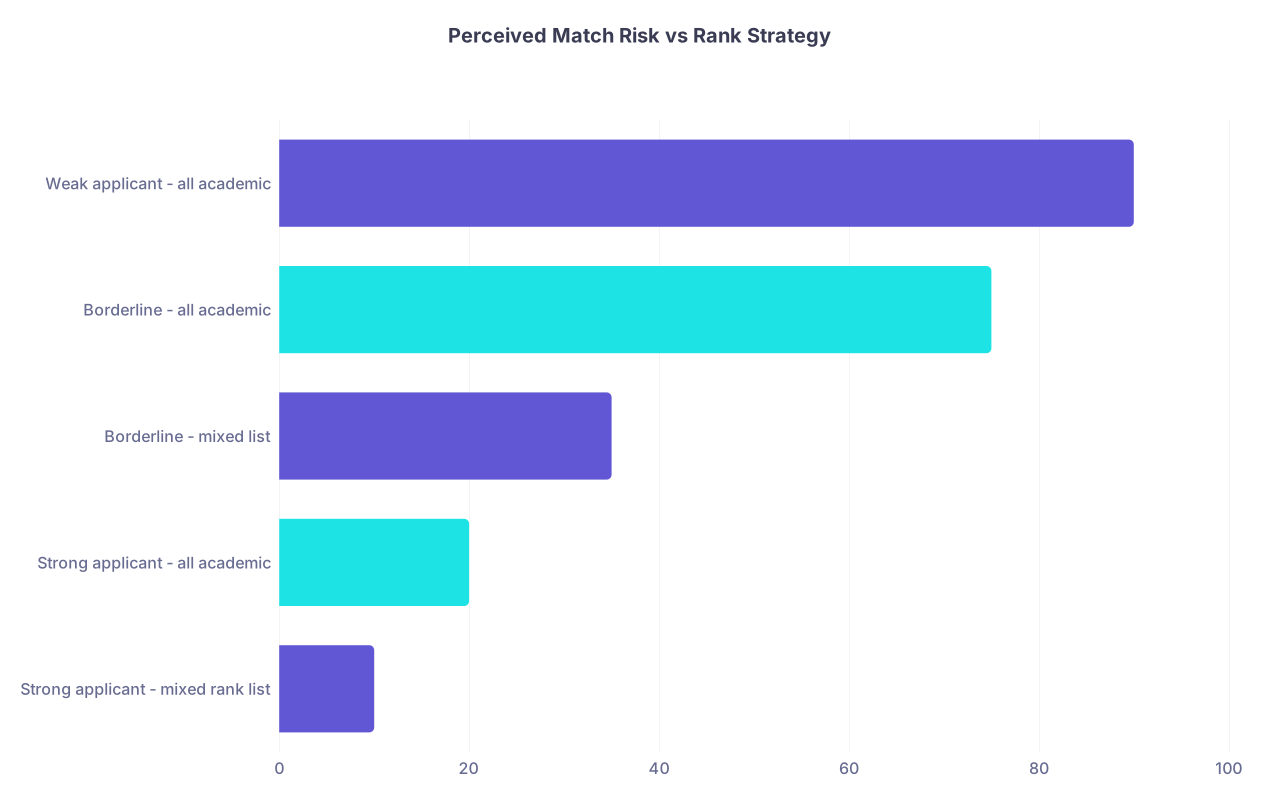
| Category | Value |
|---|---|
| Strong applicant - mixed rank list | 10 |
| Strong applicant - all academic | 20 |
| Borderline - mixed list | 35 |
| Borderline - all academic | 75 |
| Weak applicant - all academic | 90 |
Those “risk” numbers aren’t from a paper. They’re from years of hallway comments and gut reactions that are remarkably consistent across institutions.
Strong applicant, all academic? Mildly risky but probably fine.
Borderline, all academic? Now PDs are quietly bracing to see your name in the unmatched list.
The Bottom Line: What They Really Think
When you rank only academic programs, no one at those programs is sitting there applauding your love for ivory towers. They see a signal. And they interpret it through years of watching what happens to students like you.
The quiet, unspoken reactions:
- “I hope someone told them how this usually ends.”
- “Their file doesn’t support that level of selectivity.”
- “This looks like ego or bad advising, not strategy.”
And from the more experienced, more jaded PDs:
- “We’ll see them again. Either in SOAP or when they apply here for a job after training somewhere else.”
You never hear those lines. But they are said. Every year.