You can build a serious research portfolio in a community program with zero labs and zero PhD scientists down the hall. People who tell you otherwise are wrong—or lazy.
I have watched residents match cards, GI, pulm/crit, even heme/onc from small community programs whose “research infrastructure” was a shared printer and an overworked librarian. They did it by dropping the academic fantasy and playing the community game correctly.
You are not getting bench science in a community hospital. Stop chasing it. You are getting volume, chaos, and access to real patients and messy systems. That is more than enough to build a strong research story—if you are systematic.
Here is the step‑by‑step playbook.
Step 1: Stop Waiting for a Lab and Decide What You Are Building
First fix your mindset. You are not “doing a little research.” You are building a portfolio with a purpose.
Ask yourself three questions on paper, not in your head:
- What do I want my application to say?
- “Future academic cardiologist with strong QI and clinical outcomes background”
- “Future hospitalist leader with operations and education scholarship”
- “Future oncologist focused on disparities and symptom management”
- How many tangible outputs do I want by end of residency?
- Intern start: aim for 3–5 items (mix of abstracts, posters, manuscripts)
- PGY‑2 start: aim for 2–3 solid items (1 paper + 1–2 abstracts) is still realistic
- What types of work fit my environment?
- You probably have:
- High patient volume
- EMR with exportable data
- QI projects for ACGME milestones
- M&M conferences
- A few research‑minded attendings (often under‑used)
- You probably do not have:
- Wet labs
- NIH grants
- Dedicated statisticians on call
- You probably have:
You need a portfolio that screams: “This person took a resource‑limited environment and still produced.”
That means:
- Quality over fake volume (no one is impressed by 10 useless case reports)
- Project selection that actually leads to something publishable
- Clear alignment with your target specialty or career lane
Write a one‑sentence goal and tape it above your desk. For example:
“By the end of PGY‑3, I will have 1 first‑author peer‑reviewed paper, 2–3 conference presentations, and at least one project clearly aligned with cardiology.”
Now everything else you do needs to justify its time cost against that sentence.
Step 2: Map Your Actual Resources (Not the Ones You Wish You Had)
Community programs are wildly variable. Some are “community with academic flavor,” others are “you and the night float."
You need a brutally honest inventory. This should take one weekend afternoon.
A. People: Who Can Co‑Sign Your Ambition?
Make a list (literally a list) of:
- Program director and APDs
- Chiefs
- Attendings who:
- Trained at academic centers
- Talk about “QI,” “ED throughput,” “readmission rates,” “sepsis bundle data”
- Present frequently at noon conference with data slides
- Hospital roles:
- Quality improvement office
- Infection control / antimicrobial stewardship
- Case management leadership
- IT / data analytics
- Librarian / medical library
Then do two things:
- Ask seniors directly:
- “Who are the attendings that actually get residents on papers or posters?”
- “Who here has presented at national meetings in the last 3 years?”
- Email or talk to those people with a specific, respectful ask:
- “I am very interested in building a research and QI portfolio during residency. Do you have any ongoing projects where a motivated resident could help, or ideas you think are feasible in our setting?”
You do not need 10 mentors. You need 1–2 people who:
- Answer email
- Are willing to attach their name to your work
- Have any history of getting things across the finish line
B. Data: What Can You Actually Access?
Forget huge multi‑center datasets. Your core tools:
- EMR reports (Epic, Cerner, Meditech, etc.)
- Quality dashboards (sepsis, readmissions, LOS, CLABSI, CAUTI)
- Pharmacy data (antibiotic usage, anticoag audits)
- Tumor board lists if you are in a place with oncology
- Stroke/MI registries if you are a chest pain/stroke center
Your key question to IT / quality:
“What patient‑level or unit‑level data is already being pulled regularly, and in what format can I access it for de‑identified QI or research use?”
You are looking for:
- CSV or Excel exports
- Standard metrics already defined (you do not want to build them from scratch)
- Time frames (e.g., last 3 years of sepsis cases)
You will be shocked how much is already sitting in quality reports that no one has ever written up.
C. Presenting Platforms: Where Can You Show Work?
Do not aim for NEJM from day one. Aim for a ladder you can climb.
| Level | Venue Type |
|---|---|
| Local | Hospital QI day, M&M |
| Regional | State ACP or specialty |
| National | ACP, SHM, CHEST, ASH |
| Publication | Community journals, QI |
Your goal: each serious project should have at least one presentation target selected at the start. That forces you to scale the project appropriately and respect deadlines.
Step 3: Pick the Right Project Types for a No‑Lab Community Program
Certain project types are almost impossible without academic infrastructure. Do not waste energy there. Bench science? Forget it. Complex RCTs? Highly unlikely.
Here is the project menu that works in community settings.
1. Clinical QI with Real Outcomes
These are gold for community residents. They:
- Align with ACGME requirements
- Use data you already have
- Can be done in 6–12 months
- Look very good to fellowship PDs if done well
Examples that I have seen work:
- Reducing 30‑day readmissions for CHF by improving discharge education and early follow‑up
- Improving sepsis bundle compliance and tracking mortality, ICU transfer, or LOS
- Decreasing unnecessary telemetry usage on general medicine floors
- Optimizing VTE prophylaxis ordering and measuring DVT/PE events and prophylaxis adherence
Basic structure:
- Define the problem (with baseline data)
- Plan an intervention (education, order set change, checklist)
- Implement (PDSA cycles)
- Re‑measure (same outcome metrics)
- Present locally
- Turn into abstract and short manuscript
2. Retrospective Chart Reviews
This is your bread and butter if you use EMR well.
Good use cases:
- “Characteristics and outcomes of COVID‑19 patients at a community hospital”
- “Evaluation of anticoagulation practices in AF patients admitted to a community setting”
- “Outcomes of COPD exacerbation admissions before and after guideline implementation”
Key is tight scoping:
- One main question
- Clear inclusion/exclusion criteria
- Feasible sample size (e.g., 200–600 patients over a few years)
- Outcomes you can actually measure (mortality, LOS, readmission, ICU transfer, complications)
These are publishable in:
- Community or regional journals
- Specialty‑specific but lower‑impact journals
- QI or practice‑oriented publications
3. Case Reports and Small Case Series (With Strategy)
Yes, case reports are the bottom of the research pyramid. But they:
- Are fast to produce
- Teach you the mechanics of submission and revision
- Can be built into small series if you are alert
The key is not to waste them:
- Prioritize cases that are:
- Truly rare or have a twist in diagnosis/management
- Related to your intended specialty
- Have good imaging or labs that illustrate the point
- Where possible, cluster:
- “Three cases of X presenting atypically at a community hospital”
- “Case series of Y managed without subspecialty coverage overnight”
Use these as your “early wins” while your bigger projects are in progress.
4. Education and Curriculum Projects
If you like teaching or are thinking chiefs/hospitalist track, these can be powerful.
Examples:
- Implementing a new intern boot camp and measuring impact on error rates or pages to senior overnight
- Introducing a point‑of‑care ultrasound curriculum and evaluating competency scores
- Switching to a new handoff tool and measuring I‑PASS adherence and perceived safety
Structure them like QI:
- Problem → Intervention → Outcome → Iteration → Dissemination
Present first at your own noon conference, then at regional education meetings.
Step 4: Build Projects That Actually Finish (6–12 Month Cycles)
Residents fail not because they lack ideas but because their projects are structured like never‑ending sagas.
You need projects that fit into residency rotations, not PhD timelines.
Use a Simple Project Blueprint
For each project, write a one‑page plan:
Research question
- One sentence, testable, specific.
- Example: “Does implementing a standardized heart failure discharge checklist reduce 30‑day readmission rates in patients admitted to our community hospital?”
Design and scope
- Type: QI vs retrospective cohort vs case series
- Time frame: “Jan 2022–Dec 2023 admissions”
- Setting: “General medicine units at Hospital X”
Data and variables
- Main outcome: 30‑day readmission (yes/no)
- Key predictors: age, EF, presence of follow‑up within 7 days, etc.
- Data source: EMR, quality database
Team
- You (resident lead)
- 1 attending sponsor
- 1 co‑resident or student
- IT/quality contact
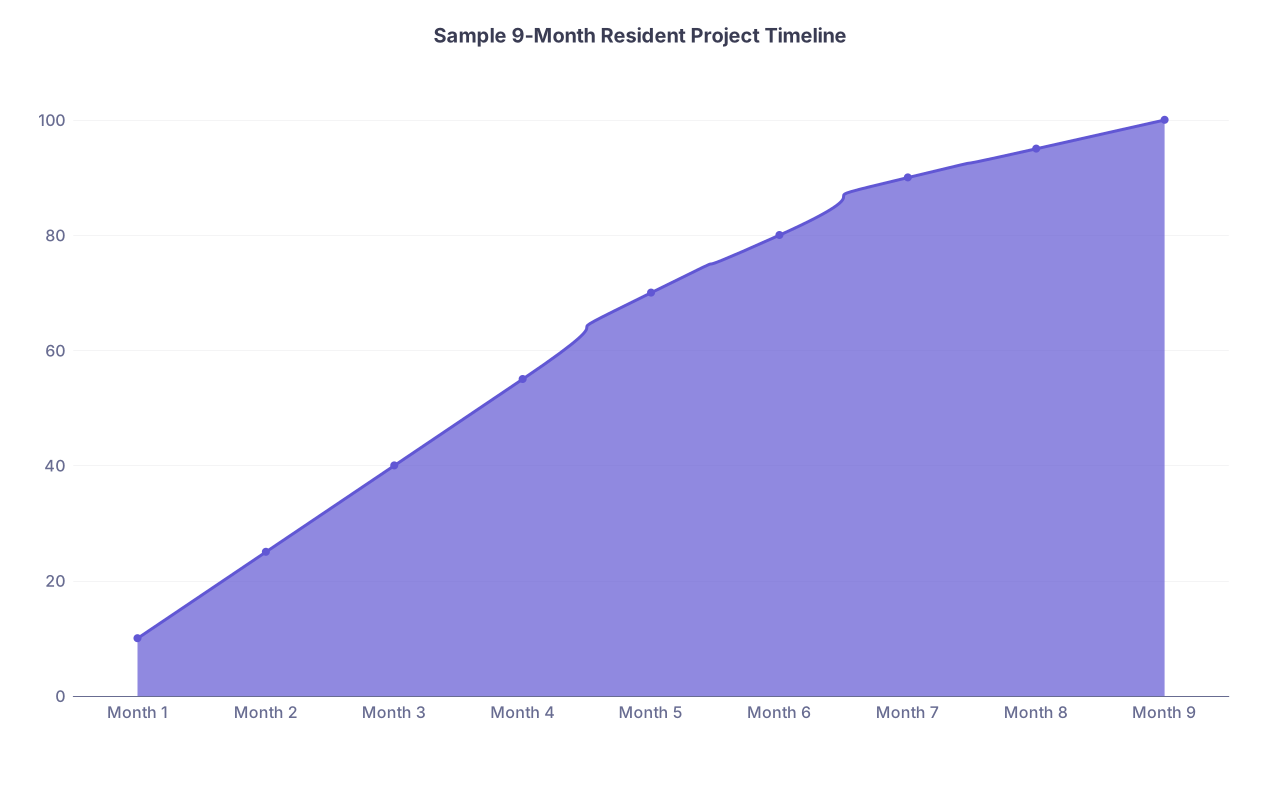
Timeline (month by month)
| Category | Value |
|---|---|
| Month 1 | 10 |
| Month 2 | 25 |
| Month 3 | 40 |
| Month 4 | 55 |
| Month 5 | 70 |
| Month 6 | 80 |
| Month 7 | 90 |
| Month 8 | 95 |
| Month 9 | 100 |
Interpretation: cumulative % of project completed if you stick to the plan.
Example timeline:
- Months 1–2: IRB/QI determination, literature review, protocol finalization
- Months 3–4: Data pull and cleaning
- Months 5–6: Analysis and initial write‑up
- Month 7: Abstract submission
- Months 8–9: Manuscript drafting and submission
If your plan does not fit in 9–12 months, shrink it or split it into phases.
Step 5: Navigate IRB and “Is It QI or Research?” Without Losing a Year
Community hospitals often have confusing or slow IRB processes. You cannot afford to be ignorant here.
Get Clear on QI vs Research
You want as many projects as possible classified as QI or “exempt” so they move fast.
General pattern (check your local rules):
QI:
- Aim: improve care at your institution
- No randomization
- Using data from routine care
- Often does not require full IRB, sometimes only a QI determination form
Research:
- Aim: produce generalizable knowledge
- May change standard of care or involve extra risk
- Usually needs IRB review
Most QI can still be presented and published. Journals often accept QI with IRB exemption letters or QI determination documents.
Action steps:
- Ask your PD or QI office: “Who is the IRB / QI contact for resident projects?”
- Send that person a short email with a 1‑paragraph description and ask explicitly:
- “Would this be considered QI or research at our institution, and what is the simplest pathway for approval?”
- Use templates:
- Many hospitals have standard QI templates. Use them. Do not start from scratch.
Step 6: Build a Small, Functional Team Instead of Doing Everything Alone
Solo projects die on call nights. You need redundancy.
People you should pull in:
- Co‑resident:
- Helps with data abstraction and write‑up
- Co‑presenter at conferences
- Medical student:
- Fantastic for chart review, literature search, table building
- You give authorship + mentorship, they give you labor
- Attending:
- Protects the project politically
- Helps with IRB, data access
- Improves your credibility at submission
- Data/quality analyst:
- Does initial data extracts
- Helps double‑check your definitions
Be clear about roles and credit early:
- Agree on first author (usually you if you drive it)
- Decide who is presenting at which meeting
- Keep a shared file with contribution notes
Worst thing you can do is loosely promise authorship to 6 people then miss every deadline because nobody owns the work.
Step 7: Leverage What You Already Have to Create Multiple Outputs
Community residents often underestimate how much usable content is hiding in day‑to‑day work.
Sources of easy wins:
- M&M presentations
- Interesting admissions that became teaching cases
- QI requirements from the program
- Grand rounds you helped prepare
Your rule:
- Anything you present internally should be evaluated for external presentation or publication.
Examples:
- M&M on delayed diagnosis of PE:
- Convert to case report or case series
- Extract teaching points into a brief clinical review
- Floor project on reducing unnecessary labs:
- QI poster for state ACP
- Short article for a hospital medicine journal
You are not reinventing the wheel every time. You are repackaging and polishing.
Step 8: Track and Organize Your Portfolio Like It Matters (Because It Does)
PDs can tell instantly who actually did research and who “participated in projects.”
You want to walk into interviews with a clean, credible record.
Create:
- A simple spreadsheet (Google Sheets works) with columns:
- Project name
- Type (QI, retrospective, case report, etc.)
- Role (first author, second author)
- Status (idea, data, analysis, draft, submitted, accepted, presented)
- Output (poster, podium, publication)
- Target venue/journal and deadline
- A folder system:
- /Projects/ProjectName/Data
- /Projects/ProjectName/Drafts
- /Projects/ProjectName/IRB_QI
This is boring admin work. Do it anyway. Chaos is how you lose first‑author spots or miss abstract deadlines.
Step 9: Translate a Community Portfolio into a Competitive Application
Now you are in ERAS season. You need to present your work so it looks intentional, not accidental.
Emphasize These Angles in Your Application
Resourcefulness
- “In a community hospital without traditional research infrastructure, I initiated and led QI and clinical outcomes projects addressing X and Y.”
Impact
- Put numbers in your descriptions:
- “Reduced 30‑day CHF readmissions from 22% to 16% over 9 months.”
- “Improved sepsis bundle compliance from 54% to 81%.”
- Put numbers in your descriptions:
Alignment with target specialty
- Cards applicant:
- Projects in HF readmissions, MI care, AF anticoag
- Heme/onc applicant:
- Work on transfusions, VTE in cancer, palliative care triggers
- Pulm/crit:
- ICU transfers, sepsis, ventilator days, COPD/asthma
- Cards applicant:
Progression
- Show that you did not just dabble:
- PGY‑1: case reports, small QI start
- PGY‑2: major QI/retrospective project launch
- PGY‑3: abstract presentations and manuscripts submitted
- Show that you did not just dabble:
Prepare How You Talk About It
Program directors smell fluff instantly. You need to be able to answer:
- What exactly was your question?
- How did you define your outcomes?
- What surprised you in the data?
- If you had another year, how would you improve the project?
If you can answer those cleanly, it stops mattering that you did not pipette anything in a lab.
Step 10: Avoid the Common Failure Patterns
I have watched a lot of community residents try to “do research.” Most fail in predictable ways.
Here is what goes wrong and how to fix it:
The Over‑Ambitious RCT Fantasy
- “We will randomize to two discharge protocols and measure outcomes.”
- No, you will not. You will get stuck at IRB and nothing will happen.
- Fix: Start with observational + QI. Leave trials to institutions with coordinators.
The Serial Case Report Trap
- 7 case reports, all on random topics unrelated to future specialty.
- Fix: Use 1–2 early on, then move to projects with real data and outcomes.
The Ghost Mentor
- Attending who “has tons of research experience” but never answers emails and has 9 half‑finished projects.
- Fix: Judge mentors on output, not on talk. If nothing moves in 2 months, pivot.
The Data Hoarder
- Resident spends a year collecting 1000 charts, then never analyzes or writes.
- Fix: Build analysis and writing milestones into the plan from day one. Smaller, finished project beats giant unfinished one every time.
The IRB Black Hole
- Draft languishes with IRB because no one owns it.
- Fix: Sit down once, fill everything completely, and have an attending co‑sign. Then follow up every 2 weeks until you get a decision.
A Concrete 2‑Year Plan Example (PGY‑1 to PGY‑3)
To make this fully real, here is how a motivated resident at a pure community IM program could reasonably build a strong portfolio for a competitive fellowship.
PGY‑1
- Q1–Q2:
- 1 case report in desired specialty
- Identify 1–2 research‑friendly attendings
- Q3–Q4:
- Start small QI: e.g., improve VTE prophylaxis ordering
- Submit internal QI proposal, get QI determination
- Begin retrospective project planning with mentor
PGY‑2
- Q1:
- Data extraction for retrospective project (e.g., COPD readmissions)
- Q2:
- Analyze data with mentor / basic stats support
- Draft abstract for regional/national meeting
- Q3:
- Submit abstract to specialty meeting
- Present QI project at hospital QI day
- Q4:
- Submit QI project as QI paper to a community or specialty journal
PGY‑3
- Q1:
- Present retrospective project poster at national meeting
- Turn abstract into full manuscript
- Q2:
- Submit manuscript
- If time, launch a smaller, focused PGY‑3 project (often education‑focused)
- Q3–Q4:
- Update ERAS with accepted/published items
- Talk coherently in interviews about QI, outcomes, and practice improvement
You leave residency with:
- 1–2 first‑author papers
- 2–3 posters
- A coherent, specialty‑aligned story
- All from a “no lab” community program
That is not theoretical. I have seen that exact arc multiple times.
Final Takeaways
You do not need a lab; you need a plan. Community residencies can produce strong portfolios built on QI and real‑world outcomes if you are deliberate.
Start small, finish fast, and scale smart. A couple of early case reports and a tightly scoped QI or retrospective project beat a mythical, never‑completed “big study.”
Sell your environment as a strength. Fellowship and job applications should highlight that you improved care and produced scholarship in a resource‑limited, high‑volume setting—and that you will do even more with academic tools later.