
The myth that you “cannot get good mentorship in community programs” is lazy thinking. You can get excellent mentorship there—but you have to negotiate it deliberately instead of waiting for it to be handed to you.
You are not choosing between “mentorship” and “no mentorship.” You are choosing between:
- Systems where mentorship is built in by structure (big academics), and
- Systems where mentorship is built by you (most community programs).
If you treat those two the same during residency applications, you will get burned.
This is a playbook for how to negotiate mentorship support in resource-limited community programs—starting before you ever rank them, and continuing into PGY-1.
1. Understand What Community Programs Actually Struggle With
Stop assuming “community” means “bad” or “inferior.” That is lazy and wrong.
Community programs have real advantages:
- High clinical volume
- Earlier autonomy
- Less bureaucracy
- Often more direct access to attendings in day-to-day work
Where they usually fall short is structured academic mentorship:
- Fewer subspecialists and fewer “famous names”
- Less protected time for faculty to mentor, write letters, or do research
- No or limited NIH-level infrastructure, statisticians, or full-time coordinators
- Fewer in-house fellowships, so less natural pipeline support
What that means for you:
- Nobody is going to “assign” you a perfect mentor.
- Faculty are often clinically exhausted and mentoring on their own time.
- Great support absolutely exists—but it is hidden in the cracks of the schedule and depends on how you ask.
You are not just evaluating “Do they have mentorship?”
You are evaluating “Can I realistically negotiate and secure the mentorship I need here?”
2. Get Specific About What Mentorship You Actually Need
You cannot negotiate support if you cannot articulate what you need.
If you walk into interviews saying “I care a lot about mentorship,” you will get a fake smile and a generic answer. If you walk in saying “I want to graduate with X, Y, Z,” now we can talk.
Break mentorship into four buckets:
Career Direction
- Choosing community vs academic practice
- Fellowship vs hospitalist vs private group
- Long-term career positioning (leadership, QI, education)
Academic / Scholarly Support
- Case reports, QI projects, retrospective studies
- Getting something on your CV every year
- Letters from people recognized beyond their own hospital
Day-to-Day Professional Development
- Feedback on presentations, notes, communication
- Help managing conflict with nurses, co-residents, or attendings
- Time management, burnout prevention
Fellowship / Competitive Pathway Coaching
- Subspecialty strategy (cards, GI, ortho, derm, EM-critical care, etc.)
- Connections to people at other institutions
- Help curating a realistic, smart application list
Be explicit with yourself:
- “I need at least 2 strong letters from mentors who know me well.”
- “I want 1–2 small but real scholarly products each year.”
- “I want at least quarterly check-ins on career goals.”
Once you can say that clearly, you can go to a community program and ask, “How do residents here achieve this?” Now you are negotiating reality, not vibes.
3. What To Ask During Interviews (And How To Read Between the Lines)
You will not see “Mentorship Quality: 7/10” on FREIDA. You have to pull this out in real time.
Here is a blunt structure you can use on interview day.
A. With Program Leadership
You are not just making small talk. You are probing infrastructure.
Ask specifically:
- “How is mentorship structured here?”
Follow-ups:- “Are mentors assigned, or do residents choose them?”
- “Is there a formal mentorship program with scheduled check-ins, or is it informal?”
- “Does faculty get any protected time or recognition for mentoring residents?”
Red flags:
- “We are like a family; everyone mentors everyone.” (Translation: No structure.)
- “You can always just reach out to anyone you like.” (Translation: 100% on you, with no expectations on them.)
Better answers:
- “Interns are paired early with a faculty advisor, and we re-evaluate at 6 months.”
- “We schedule at least two formal mentorship meetings per year and track this.”
- “Faculty get teaching/mentoring credit in their evaluations.”
- “How do residents interested in [your goal] get support?”
Plug in your goal: cardiology, GI, EM-admin, critical care, rural practice, etc.
Follow-ups:
- “Can you give me an example of a recent resident with similar goals and how they were supported?”
- “Who typically mentors residents interested in that path?”
If leadership cannot produce a concrete example, assume you will be paving a new road yourself.
- “If I want a structured mentorship plan starting PGY-1, how would we set that up?”
Watch their response.
- If they say “we can absolutely do that; here is how we usually approach it,” good sign.
- If they look surprised that you are even asking and give vague answers, expect to do more heavy lifting.
B. With Current Residents (Your Most Honest Source)
Residents will tell you the truth, often in the hallway or during the “unofficial” parts of the day.
Ask:
- “Who are the three best mentors here, and why?”
- “If you needed a strong letter for a competitive fellowship, who would you go to?”
- “How many residents got [your desired fellowship / academic job / specific goal] in the last 3 years? How did they do it?”
- “Do attendings actually meet with you outside of clinical work, or is all ‘mentorship’ hallway chat?”
- “If I emailed Dr. X about working on a paper or QI project, what realistically happens next?”
You are listening for:
- Concrete names; not “everyone is approachable.”
- Actual stories: “Dr. S meets with us monthly to review drafts,” “Dr. M helped me get in touch with her fellowship director at Big Academic.”
- Whether mentorship is happening during paid, scheduled time or only by faculty who stay late as volunteers.
C. With Subspecialists and “Academic-Lite” Faculty
These people are your leverage in a community setting.
Ask direct questions:
- “How many residents have you mentored in the last 2–3 years?”
- “What kind of projects do you typically do with residents—case reports, QI, retrospective work?”
- “How do you like residents to approach you if they want mentoring or projects?”
- “Do you have collaborators at academic centers that residents can connect with?”
If someone says, “I love working with residents but do not have a system; you just have to ask,” this is opportunity. You now know this is a person you will approach early and intentionally.
4. Compare Community vs Academic Mentorship Realistically
You are making a trade, not a moral judgment. Use a simple comparison to anchor your thinking.
| Aspect | Community Program (Resource-Limited) | Academic Program (Large University) |
|---|---|---|
| Formal mentorship structure | Variable, often minimal | Common, usually defined |
| Faculty protected time | Limited, mostly clinical | More likely, especially in key mentors |
| Research infrastructure | Sparse, resident-driven | Built-in (IRB office, statisticians, coordinators) |
| Name recognition for letters | A few local or regional names | More national figures |
| Ease of getting projects | Requires you to initiate and organize | Often pre-existing projects to plug into |
| Flexibility to build roles | High, if you push for it | Moderate; more bureaucracy |
The smart move is not “always pick academic.”
The smart move is: if you choose community, you compensate by negotiating structure for yourself.
5. How To Negotiate Mentorship Before You Rank a Program
Yes, you can start this before Match.
You are not signing a contract yet; you are testing how they respond to a high-expectation applicant who cares about mentorship.
Step 1: Signal Your Priorities Early
On interview day or in follow-up emails:
- “My long-term goal is [X]. For that, I know I need consistent mentorship, at least one or two scholarly products, and strong letters. I want to be somewhere that will help me make that realistic.”
This does three things:
- It separates you from the generic “I just want good training” script.
- It forces them to think concretely about supporting you.
- It gives you a preview: do they lean in and start brainstorming with you, or do they sidestep?
Step 2: Ask For a “Mentorship Plan Sketch”
You are not asking them to sign anything. You are saying:
- “If I matched here, how would we structure my mentorship? Who do you see as potential mentors for me? How often would we realistically be able to meet?”
If a PD replies 2–3 days later with:
- “I spoke with Dr. A and Dr. B—both would be happy to work with you on [interest]. We usually set up quarterly meetings and tie goals to your semiannual evaluation.”
That is signal. This program is workable.
If you get:
- “We have an open-door policy; you will find lots of support.”
That is spin. You can still make it work, but assume you will be building the system yourself.
6. Once You Match: First 3–6 Months Mentorship Strategy
You matched a community program with limited resources. Good. Now here is how you build your own mentorship scaffolding.
Step 1: Identify 3 Types of Mentors You Need
Do not put all your eggs in one attending.
You want:
Career Mentor
- Helps decide fellowship vs job, practice type, long-term strategy
- Ideally someone who has done what you want to do or is well connected
Academic or Project Mentor
- Helps you actually produce something: poster, QI project, case report, paper
- Knows how to get things through IRB, or at least has done this a few times
Day-to-Day Support / “Utility” Mentor
- A senior resident or junior faculty who will give fast feedback on notes, presentations, and culture issues
- Someone you are comfortable emailing or texting
Ideal is 2–3 mentors total, with roles overlapping. You do not need a committee. You need people who will pick up your email and show up.
Step 2: Use a Direct, Professional Ask
Do not wander up after rounds and mumble, “If you ever need help with research…” That is not a mentorship ask.
Send an email that looks like this:
Dr. Smith,
I am a new PGY-1 in internal medicine with a strong interest in cardiology and quality improvement. I know from speaking with residents that you have mentored them on several QI and case report projects.
My goals by the end of PGY-2 are:
• To complete at least one QI or retrospective project suitable for a regional meeting
• To have at least one strong letter from a cardiology mentor who knows my work wellWould you be open to meeting for 20–30 minutes in the next few weeks to discuss whether it might be a good fit for you to mentor me in this area? I am happy to prepare a brief outline of ideas beforehand.
Best,
[Your Name]
You are:
- Respectful of time
- Clear about goals
- Asking for a defined meeting, not an open-ended commitment
- Framing mentoring you as useful and targeted, not a vague burden
Step 3: Set Expectations in the First Meeting
You do not leave the first mentorship meeting without clarity.
Bring:
- A one-page document with: goals, timeline, your interests, any prior work
- 3–4 concrete questions
Ask:
- “How do you prefer mentees to communicate—email, phone, in-person check-ins?”
- “What cadence of follow-up makes sense to you? Every 2–3 months?”
- “What types of projects have worked best with residents in the past?”
Then say plainly:
- “By the end of this year I would like to have [X outcome]. Does that seem realistic here, and what would I need to do on my side to make that happen?”
Now you have something you can hold yourself to—and gently remind your mentor about later.
7. Turn Resource Limitations into Leverage
Community programs are “resource-limited,” not “opportunity-limited.” There is a difference.
Here is how you work around the usual bottlenecks.
A. Problem: No Built-In Research Infrastructure
Fix:
Focus on low-infrastructure projects:
- Case reports and small series
- Chart review with simple endpoints
- QI projects using data that already exists (door-to-needle time, readmits, etc.)
Use simple tools:
- RedCap (if available), or even Excel/Google Sheets
- Free statistics help: online tutorials or collaborating with a biostats contact from your med school or another institution
Leverage external mentors:
- Ask your local mentor: “Do you have any academic contacts who might advise on methods if needed?”
- Cold-email former med school faculty: “I am now at [Community Hospital], working on [project]. Would you be open to a brief consult on the design?”
B. Problem: Faculty Are Overworked and Overbooked
Fix:
Do the heavy lifting yourself.
- Write first drafts
- Prepare data cleanly
- Send short, clear emails with specific questions
Time-block meetings:
- “I would like to review a draft figure and the abstract—would a 20-minute meeting work next Thursday between 12–2?”
- Show up early, end on time.
Make it easy to say “yes”:
- Propose discrete tasks: “Could you review this one-page proposal?” instead of “Can you help with my research?”
When mentors see that you respect their time and produce work consistently, they invest more. I have watched very busy community attendings completely re-arrange their day for residents who operate this way.
C. Problem: No Name-Brand Letters
Fix:
You need quality and detail more than brand. A community attending who has worked closely with you on several projects can write an outstanding letter.
Expand your letter network:
- Use your community mentor’s connections: “Would you be willing to introduce me to your colleague at [Academic Center] for a rotation or project? I am hoping to have at least one letter from someone connected to a fellowship program.”
- Schedule an away / visiting elective at an academic site aligned with your fellowship goal and perform at your maximum level.
Now you have:
- One or two detailed, punchy letters from community mentors
- One letter from a recognizable academic name where you rotated or collaborated
That combination is powerful.
8. Maintain and Repair Mentorship Relationships
Mentorship is not “set it and forget it.” Especially in community settings.
Maintain:
Quarterly check-ins
Send a brief email: what you have done, what is next, one or two questions.Visible progress
Even small wins: “We submitted the case report,” “QI project proposal is drafted,” “Presented at noon conference.”Public credit
When you present something or get accepted:- “This work was done with Dr. X’s mentorship.”
People like working with trainees who acknowledge their help.
- “This work was done with Dr. X’s mentorship.”
When Things Stall:
If a mentor goes quiet for months:
- Don’t whine. Recalibrate.
Send something like:
Dr. Smith,
I know your schedule has been very busy. I wanted to briefly update you:
• I have completed data collection on [project]
• I attached a draft abstract for your reviewWould you prefer that I continue to drive this forward and copy you for key decisions, or would it be better to bring in an additional faculty collaborator to help move it along more quickly? I want to be respectful of your time.
Best,
[Your Name]
This:
- Signals you are serious and not stuck
- Gives them an easy out without burning the bridge
- Creates space for a second mentor to join if needed
9. Decide When a Community Program Is Not Enough For Your Goals
Hard truth: some community programs simply will not support certain trajectories, no matter how hard you push.
You need to recognize that before you rank them.
If all of these are true:
- No residents in the last 3–5 years matched into your target fellowship or path
- No faculty with a track record of mentoring into that path
- Leadership gives vague, aspirational answers when you ask about building that pipeline
- Residents consistently say “If you want that, you need to go academic”
Then stop trying to force it. Rank somewhere else higher.
Ambition is fine. Magical thinking is not.
10. A Simple Mentorship Plan Template You Can Reuse
If you want a concrete structure, here is a bare-bones template you can adapt after you match.
Year 1 (PGY-1)
Identify 2–3 potential mentors and meet each at least once
Lock in:
- One primary career mentor
- One project mentor with a feasible QI/case report idea
Goals:
- 1–2 small scholarly outputs drafted
- Clear fellowship vs job leanings
- One mentor who can already comment on your clinical performance for early letters if needed
Year 2 (PGY-2)
Execute:
- Complete and submit at least one project to a local/regional meeting
- Start or continue a slightly larger project (retrospective, educational, or QI)
Position:
- Do away/visiting rotations at target fellowship type (if applicable)
- Get to know at least one external mentor or fellowship PD
Letters:
- Ask your strongest mentors early (late PGY-2) so they can write detailed, thought-out letters
Year 3 (PGY-3)
Focus:
- Wrap up open projects
- Present at least once (poster, oral, grand rounds)
- Use mentors for mock interviews, application strategy, contract review (if job hunting)
Transition:
- Ask mentors how to maintain the relationship post-residency (email check-ins, occasional calls)
You can draw this out clearly for your program director early on. That alone often nudges them to help you build the connections you need.
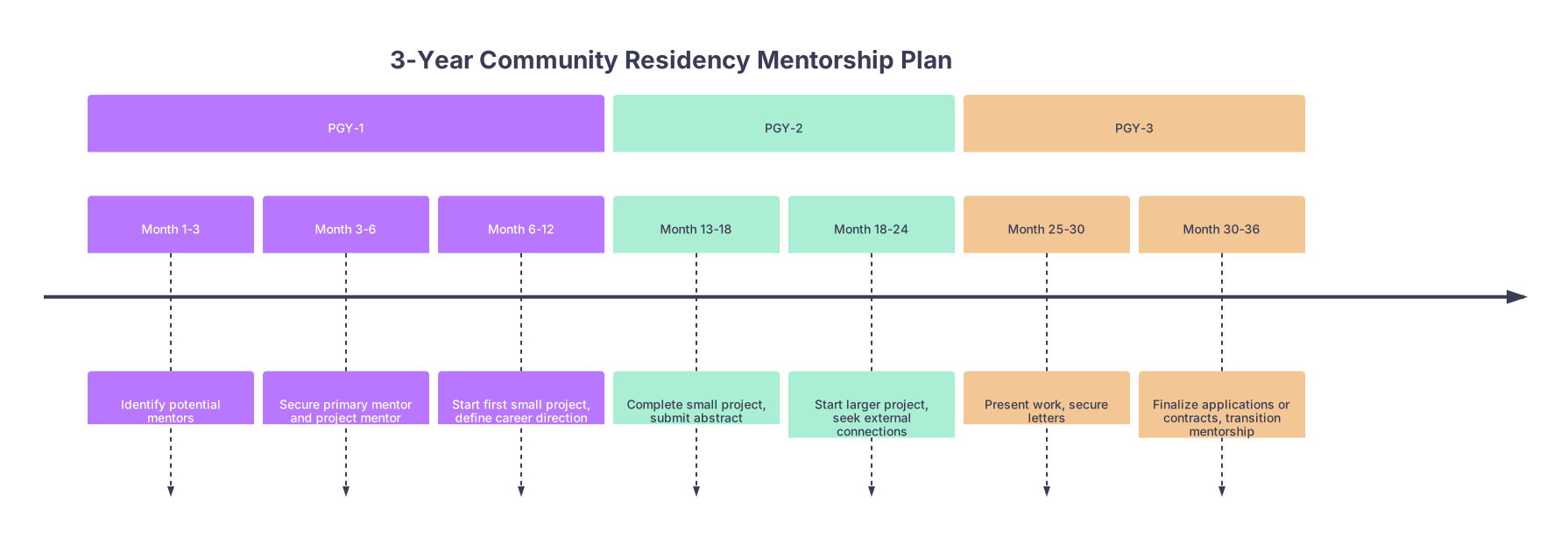
| Period | Event |
|---|---|
| PGY-1 - Month 1-3 | Identify potential mentors |
| PGY-1 - Month 3-6 | Secure primary mentor and project mentor |
| PGY-1 - Month 6-12 | Start first small project, define career direction |
| PGY-2 - Month 13-18 | Complete small project, submit abstract |
| PGY-2 - Month 18-24 | Start larger project, seek external connections |
| PGY-3 - Month 25-30 | Present work, secure letters |
| PGY-3 - Month 30-36 | Finalize applications or contracts, transition mentorship |
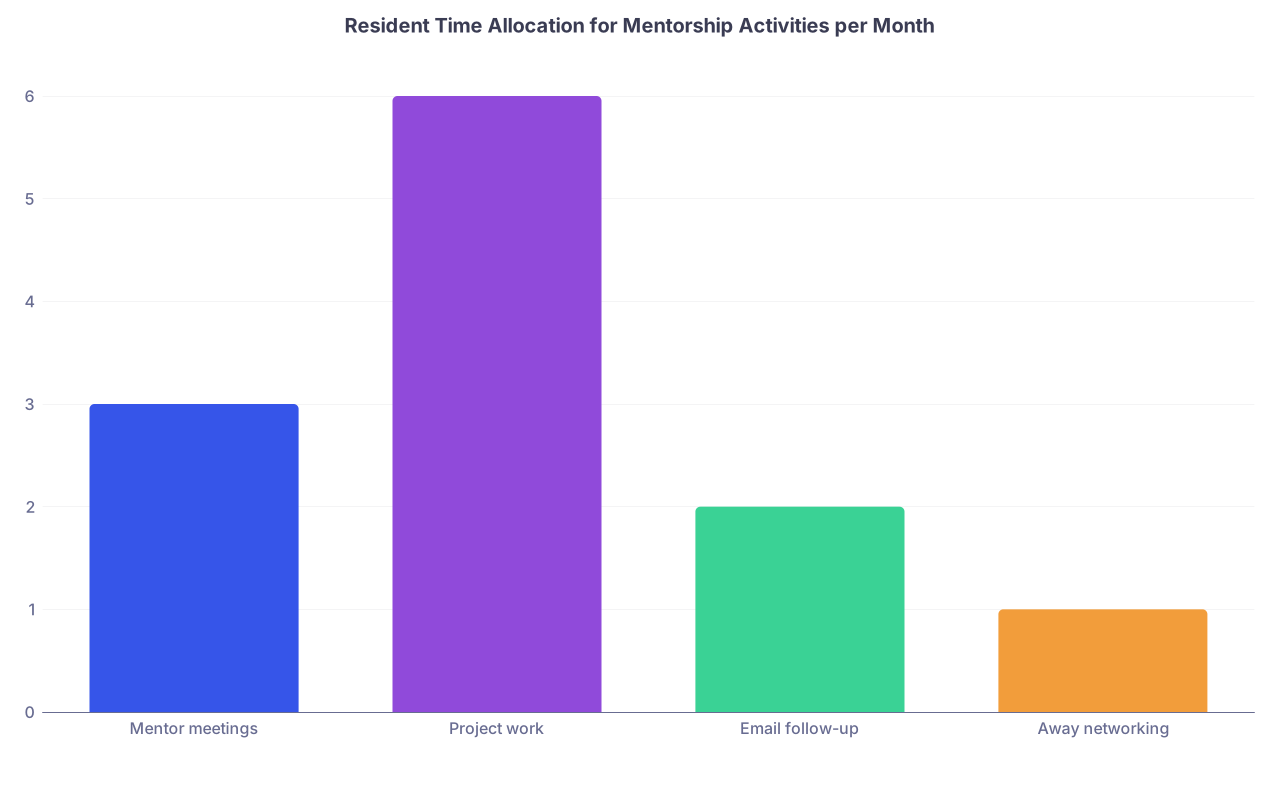
| Category | Value |
|---|---|
| Mentor meetings | 3 |
| Project work | 6 |
| Email follow-up | 2 |
| Away networking | 1 |


Three points to leave with you:
- Community programs do not doom you to bad mentorship; they just force you to negotiate and build it yourself.
- Strong mentorship starts before Match—through specific questions, explicit goals, and testing how programs respond to your expectations.
- Once you match, you need a concrete, time-bound plan with 2–3 mentors, small but real projects, and consistent follow-up. That is how you turn a “resource-limited” program into a launchpad instead of a dead end.