The belief that you must train at a big-name academic center to get a good fellowship is outdated – and frankly, lazy thinking.
You can absolutely match competitive fellowships from a community residency. But you do not get the same margin for error. At a community program, you need a deliberate strategy from day one instead of hoping prestige will carry you.
Here is the step-by-step playbook I wish more residents followed.
1. Get Real About What “Community” vs “Academic” Actually Means
First, stop lumping all “community” programs together. Some are essentially academic-lite. Others are service factories with zero fellowship pipeline.
You need to know which you are dealing with.
| Feature | Pure Community | Hybrid Community-Academic | Academic |
|---|---|---|---|
| Faculty titles | Mostly clinical, few professorships | Many with academic titles | Mostly academic |
| Research infrastructure | Minimal | Moderate | Strong |
| Fellows on site | None | Some specialties | Many specialties |
| Conference culture | Variable | Structured, regular | Highly structured |
| Name recognition | Local/regional | Regional/national | National/international |
Here is the blunt truth:
- Coming from pure community with no fellowship track record → uphill, but not impossible. You must be strategic and proactive.
- Coming from a hybrid community-academic program → very realistic to match good fellowships if you execute.
- Coming from a big academic center → more automatic name recognition, but you can still sabotage yourself.
Your job right now: figure out exactly where your program sits.
Do this this week:
- Pull the last 3–5 years of your program’s “where our grads matched” data (it exists; your chief or coordinator has it).
- Track:
- Who got fellowships
- In what specialties
- Which programs
- Ask a senior resident straight up:
“Be honest with me. From this program, who actually gets cards/GI/CC/etc, and what do they usually have on their CV?”
If no one can answer that clearly, that is your first warning sign. You will need to build your own structure.
2. Decide Early: Are You Truly Fellowship or Just Fellowship-Curious?
Vague interest does not cut it from a community program.
If you might want fellowship “later,” you will sleepwalk through PGY-2, and you will be behind your academic peers by the time applications open.
You need a binary decision by the end of PGY-1:
- I am all-in on fellowship and will plan my 3 years around it
- OR I am not committed and will treat fellowship as a bonus if it happens
Why so harsh? Because competitive fellowships want a track record, not last-minute enthusiasm.
Here is what “all-in” actually looks like from a community program:
- You know which specialty you are targeting by early PGY-2 (cards, GI, heme/onc, pulm/crit, etc.)
- You can name 3–4 programs where people like you (community IM/FM/etc, normal-ish Step scores) have matched before.
- You start accumulating:
- A mentor in that specialty
- At least 1–2 posters/abstracts by ERAS opening
- Clear letters from recognizable subspecialists
If you are still deciding between, say, cards vs GI vs pulm in middle of PGY-2, you are late. Not dead. But late.
3. Map the Fellowship Pathway From Your Program
This is where community residents either win or disappear.
You cannot just copy advice from your friend at a big academic center. Your structure and leverage are different.
Step 3A: Audit Your Program’s Existing Pipeline
Sit down and build a simple map:
- List recent grads who matched fellowship in your field of interest.
- For each:
- Where did they match?
- What did their CV look like? (ask them if needed)
- Who wrote their letters?
- Did they have outside rotations?
Pattern recognition is gold here. You will see:
- The same 2–3 faculty mentioned over and over
- The same “friendly” fellowship programs
- The same types of research (retrospective chart reviews, QI, etc.)
That pattern is your starting blueprint.
Step 3B: Classify Your Program Type for Fellowship Strategy
Ask yourself:
Are there fellows on-site in your target specialty?
- Yes → You can piggyback on their conferences/projects and use their attendings for letters.
- No → You must build external connections and use electives strategically.
Does your program have any formal research infrastructure (IRB, QI office, statistician, research director)?
- Yes → Use it aggressively.
- No → Your projects must be simple, low-friction, and realistic for 80-hour weeks.
You are not trying to become a fake academic center. You are trying to use what you actually have.
4. Build a Fellowship-Oriented CV From a Community Base
Stop aiming for “impressive.” Aim for “credible and targeted.”
From a community program, fellowship committees are asking:
“Can this resident handle our academic environment, or are they only a workhorse?”
Your CV must answer that with evidence.
, Exam scores/boards prep](https://cdn.residencyadvisor.com/images/articles_svg/chart-typical-effort-allocation-for-fellowship-bound-com-9900.svg "Typical Effort Allocation for Fellowship-Bound Community Residents")
| Category | Value |
|---|---|
| Clinical performance | 40 |
| Research/QI | 25 |
| [Networking/mentors](https://residencyadvisor.com/resources/community-vs-academic-residency/networking-for-fellowships-different-tactics-in-community-vs-academic) | 20 |
| Exam scores/boards prep | 15 |
4.1 Clinical Performance: The Floor You Cannot Neglect
Non-negotiables:
- Strong in-service exam scores (top 1/3 of your class, ideally)
- Consistently solid evaluations
- No professionalism issues, late notes, or chronic tardiness
You can be “just okay” clinically at a big-name program and still get looks. From community, “just okay” is disqualifying unless your research is spectacular.
Do this on every rotation in your target area:
- Tell the attending on day 1:
“I am aiming for [cards/GI/etc] and would really value pushback on where I need to improve to be fellowship-ready.” - End of rotation, explicitly ask:
“Would you be comfortable writing a strong letter for a [cards/GI/etc] fellowship application?”
If they hesitate, that is a no. Move on.
4.2 Research and Scholarly Work: Keep It Ruthlessly Simple
You are not going to publish an NEJM RCT from a small community program. Stop pretending.
Aim for achievable:
- Retrospective chart reviews
- Case series / interesting case reports in your target field
- QI projects that you actually complete and present
You want:
- 1–3 posters/abstracts at regional or national meetings in your specialty
- 0–2 publications or in-press manuscripts (case reports, retrospective studies)
That is enough. From community, you are not trying to out-publish Harvard. You are proving that you understand and can function in academic culture.
How to start a project in 30 days:
- Identify one attending in your target field who has done any research at all.
- Send a short email:
- “I am a PGY-1/2 very interested in [specialty]. I would like to get involved in a small, realistic project – even a case series, chart review, or QI – that we can finish before next summer’s application cycle. Can we meet 15 minutes to discuss ideas you already have that need a worker?”
- At the meeting, force specificity:
- Timeline
- Your role
- Who writes the abstract
- Where you will submit
If the attending is vague, say “I want to be sure we pick something that is doable during residency. Can we pick one concrete project with a clear end-point and start there?”
5. Use Rotations and Electives as Weapons, Not Vacations
Electives at a community program are your secret weapon. Most residents waste them on “cush” rotations or random interests.
You do not have that luxury if you are serious about fellowship.

| Step | Description |
|---|---|
| Step 1 | Start PGY1 |
| Step 2 | Core Rotations |
| Step 3 | Schedule targeted electives PGY2 |
| Step 4 | Shadow subspecialties briefly |
| Step 5 | PGY2 subspecialty elective at home |
| Step 6 | PGY2 away or academic elective |
| Step 7 | PGY3 repeat elective at top choice |
| Step 8 | Fellowship interest clear by mid PGY1 |
5.1 Internal Electives at Your Own Hospital
Goals:
- Be the best resident that department has seen in years.
- Work directly with letter-writers.
- Get involved in ongoing projects.
On those electives:
- Show up early, pre-round thoroughly, own your patients.
- Ask: “Are there any ongoing charts or databases I can help clean up or analyze?”
- Volunteer for small academic tasks:
- “Can I help prep a case for conference?”
- “Can I present one of the journal club articles?”
You are not just learning medicine. You are auditioning.
5.2 Away Rotations and Academic Affiliations
From a community base, well-chosen away time can change your trajectory.
High-yield scenarios:
- Your community program is affiliated with a nearby academic center → Ask explicitly about doing a 2–4 week subspecialty elective there.
- No formal affiliation → Apply for visiting resident electives at your realistic fellowship targets.
The away rotation’s jobs:
- Get 1–2 letters from academic faculty in your specialty.
- Make sure your name is recognized by the PD and key faculty when your application appears.
- Show you can function in an academic system.
Bad move:
Doing an away at a hyper-elite program that never takes community residents, just so you can say you rotated there.
Better move:
Doing an away at a mid-to-upper tier academic program that:
- Has actually interviewed or matched your residents before
- Is geographically/logistically realistic for you
Ask your PD:
“If I could do one away rotation in [specialty], which 2–3 programs are most likely to actually consider me for fellowship?”
6. Letters of Recommendation: The Currency You Cannot Fake
From a community program, your letters matter more because they compensate for lack of brand-name residency.
You want a mix of:
- Home program letters that say:
- “This resident is in the top 5–10% I have worked with in the last 5–10 years.”
- “They elevated the level of our program.”
- Academic letters (from away rotations or research collaborators) that say:
- “They function at or above the level of our own residents.”
- “I would be happy to have them in our fellowship.”
Common mistake: three generic letters from nice but unconnected community attendings saying you are “hardworking and pleasant.” Useless.
Ask early. Be specific:
“Dr. X, I am applying for [specialty] fellowship and would be honored to have a strong letter from you. Do you feel you know my clinical work and potential well enough to write that?”
If yes:
- Send them:
- Your updated CV
- Personal statement draft
- Bullet list of cases or interactions that stood out
- Gently remind them 4–6 weeks before ERAS opens and again 2 weeks before.
If no or hesitant → thank them and move on. Do not argue.
7. Crafting Your Application So “Community” Becomes an Asset, Not a Liability
You cannot hide that you trained at a community program. Nor should you.
Your angle is simple:
“I did more with less.”
Your application should paint this picture:
- You handled high-volume, front-line pathology.
- You still carved out time for academic work.
- You showed initiative that was not handed to you.
Concrete moves:
- In your personal statement:
- One short, specific paragraph on what your community training gave you:
- Autonomy
- Breadth of disease
- Procedural experience
- Then shift to:
- Why that foundation makes you ready for an academic fellowship
- One short, specific paragraph on what your community training gave you:
- In your CV:
- Do not hide the community nature of your program
- Highlight any:
- Teaching awards
- Chief roles
- Committee work
- QI or hospital initiatives
Fellowship directors are not allergic to community programs. They are allergic to residents who look passive, untested academically, or entitled.
Make sure you look like none of those.
8. Targeting Programs That Will Actually Rank You
This is where people torpedo themselves.
The fellowship match is littered with community residents who applied like they were at Mass General, then “mysteriously” did not match.
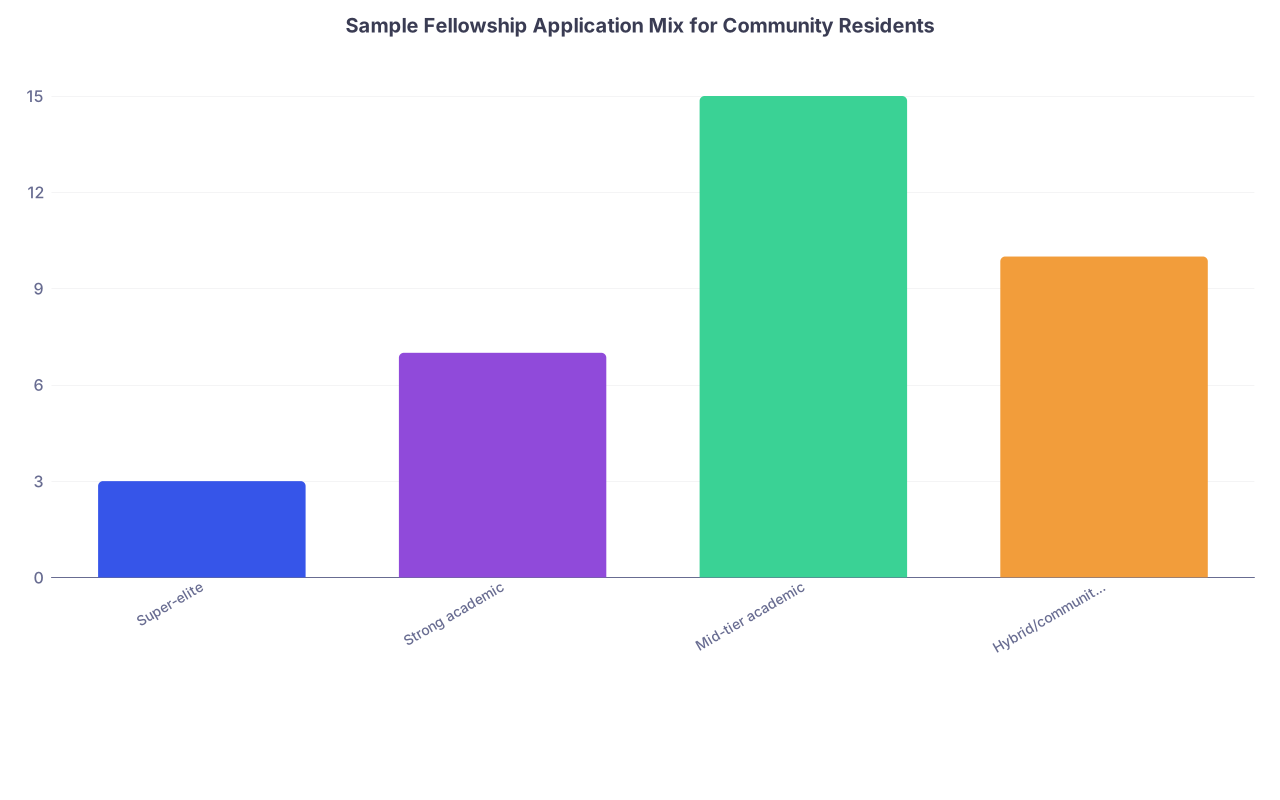
| Category | Value |
|---|---|
| Super-elite | 3 |
| Strong academic | 7 |
| Mid-tier academic | 15 |
| Hybrid/community-based | 10 |
For most community residents:
- 3–5 reach programs (top-tier, heavy research focus)
- 10–15 realistic academic/hybrid programs
- 5–10 community/hybrid fellowships that have historically taken residents like you
How to build that list:
- Look at current fellow rosters:
- Where did they do residency?
- Any community programs on there?
- Talk to recent grads from your own program:
- “Which programs seemed genuinely interested in you?”
- Ask your mentors:
- “If you were me, which 10–15 programs would you absolutely apply to?”
If you see that a program’s current fellows are all from UCSF, Hopkins, Penn, etc., and there has not been a single community resident in 5 years, that is probably a lotto ticket unless your CV is exceptional.
9. Interview Strategy: Fix the “Community” Question Before They Ask It
You will get some version of:
“So, tell me about your training at [Community Hospital X]. How do you think that prepared you for our fellowship?”
There are wrong answers:
- Overcompensating: “We are basically an academic center.” (You are not. They know it.)
- Defensive: Over-explaining why you did not go academic.
- Apologetic: “I know it is not a big-name place…”
You want a calm, clear, confident answer:
Something like:
“Training at [Hospital] has given me a very high-volume, hands-on experience. I manage a broad spectrum of [IM/FM/etc] pathology with significant autonomy. I did not have the built-in research engine of a university hospital, so I had to be very intentional – seeking out mentors, initiating projects, and arranging electives at [X/Y]. That combination of real-world volume and self-directed academic work is why I feel ready for a more research-oriented fellowship like yours.”
That answer:
- Acknowledges reality
- Shows self-awareness
- Frames community as a deliberate choice you maximized, not a fallback you resent
Practice that narrative. Out loud. Multiple times.
10. Common Failure Patterns – And How To Avoid Them
I have watched this play out more often than I like.
Here are the 5 classic failure modes from community residents, and the fix:
“I will decide on fellowship later”
- Result: Scrambling PGY-3, no research, weak letters → unmatched.
- Fix: Force a decision by end of PGY-1. If uncertain, lean in and prepare as if you will apply. You can always back out. You cannot time-travel.
Random, unfocused CV
- Result: A couple of scattered case reports in unrelated areas, no coherent story.
- Fix: Once you pick a field, align electives, projects, and letters to that field.
No outside exposure
- Result: Only letters from unknown community attendings, no one vouches for you in academic circles.
- Fix: Get at least one rotation or formal collaboration at an academic site in your target specialty.
Overreliance on “I work hard”
- Result: Application screams “solid worker bee,” but not “future subspecialist.”
- Fix: You still need scholarly output and leadership roles, not just long hours.
Delusional application list
- Result: 20 applications, all hyper-elite programs with no track record of taking community grads. → No interviews.
- Fix: Use a balanced list and your mentors’ pattern recognition.
11. Month-by-Month Action Plan (If You Are Somewhere in Residency Now)
To make this practical, here is a condensed timeline. Adjust based on your current year.
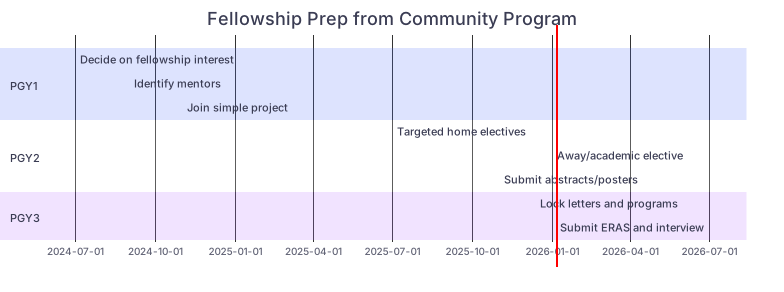
| Task | Details |
|---|---|
| PGY1: Decide on fellowship interest | a1, 2024-07, 4m |
| PGY1: Identify mentors | a2, 2024-09, 3m |
| PGY1: Join simple project | a3, 2024-11, 4m |
| PGY2: Targeted home electives | b1, 2025-07, 6m |
| PGY2: Away/academic elective | b2, 2026-01, 2m |
| PGY2: Submit abstracts/posters | b3, 2025-11, 6m |
| PGY3: Lock letters and programs | c1, 2026-06, 3m |
| PGY3: Submit ERAS and interview | c2, 2026-07, 6m |
If you are already PGY-2 or PGY-3, compress aggressively:
- Prioritize:
- Letters
- Away/academic exposure (if still possible)
- One completed project with a poster or manuscript, even if minor
FAQ (Exactly 4 Questions)
1. Is it realistic to match very competitive fellowships (like GI or cards) from a pure community program?
Yes, but only with a disciplined strategy. You will usually need:
- Strong board/in-training scores
- Clear subspecialty focus starting early
- Several pieces of meaningful scholarly work (posters, at least a manuscript or serious QI)
- At least one letter from a recognized academic subspecialist, ideally from an away or collaborative project
You will not have the same odds as a top academic center applicant, but you can absolutely land at mid-to-upper tier programs that regularly consider strong community grads.
2. What if my community program has zero research support and no one in my target specialty?
Then you must externalize your academic development:
- Use regional/national society projects (e.g., ACC, ACG, ATS) and join committees or trainee groups.
- Find an external mentor at a nearby academic center or even via email who is open to remote chart review or database projects.
- Use electives to rotate at a site that does have your specialty, and explicitly ask to plug into existing simple projects.
You are proving adaptability and initiative more than volume of publications.
3. How much does my program’s name really matter to fellowship directors?
It matters, but less than residents think. From a community program, your name recognition handicap can be offset if:
- Your letters are detailed and enthusiastic.
- Your interview performance is mature and grounded.
- Your CV shows you squeezed everything you could out of your environment.
Directors remember outstanding individuals from low-profile programs much more than average trainees from famous ones.
4. I already matched a community residency and now regret not going academic. Is it too late to fix?
No. But you must stop mourning the counterfactual and treat your current situation like a project:
- Map your program’s real fellowship outcomes.
- Identify the 2–3 highest-yield faculty and rotations for your target field.
- Get a concrete project started within the next 30 days, no matter how small.
- Schedule at least one away or academic elective in your target field if any time remains.
You do not need to become “academic” on paper. You need to become the resident who obviously outgrew the limitations of a community program.
Open your calendar right now and block 30 minutes this week to meet with one subspecialty attending and one recent grad who matched fellowship. Ask them specific questions, write down the patterns you hear, and build your first draft 12–18 month plan from that. Then adjust every 3 months and keep moving.