The bias against community programs is real—and you can beat it.
If you trained at a procedural-heavy community residency and want an academic career, you are starting from behind on paper. Less research. Fewer name-brand mentors. Limited subspecialty exposure. Program directors will not automatically see you as “academic material.”
Fine. Then you stop relying on the default narrative and build a new one. On purpose.
This is how you turn a community, hands-on, workhorse residency into a CV that belongs in academic medicine.
Step 1: Accept the Reality of the Gap—Then Define Your Angle
Programs will not say this quietly in emails, but they say it out loud in conference rooms:
“Good procedural exposure, but where is the academic potential?”
You need to know exactly what you are up against.
| Dimension | Community Procedural Program | Classic Academic Program |
|---|---|---|
| Research output | 0–2 abstracts, maybe 1 publication | 3–10 abstracts, multiple publications |
| Procedural volume | Very high (lines, scopes, etc.) | Moderate |
| Teaching culture | Variable, often informal | Structured, documented |
| Protected academic time | Minimal | Built into schedule |
| Name-recognition | Low to moderate | High |
You are not going to magically “match” those numbers. Stop trying to compete on raw research volume if you started late. You will lose.
Instead, you reposition. You sell what an academic program actually needs but struggles to find:
- Fellows and junior faculty who:
- Can run a real service without collapsing.
- Can teach in the trenches, not just in a conference room.
- Can execute projects and QI that actually change workflow.
- Bring a niche skill set (ultrasound, procedures, clinical operations).
Your procedural-heavy background is not a liability by default. It is a raw asset that needs structure, labeling, and proof.
Your mindset from now on:
“My CV is not just a list of things I did. It is evidence that I can function as an academic clinician-educator / clinician-innovator with a procedural edge.”
Pick that identity now. You cannot be “everything”; you are too late for that. Choose a lane.
Step 2: Convert “Workhorse” To “Clinical Expertise Portfolio”
You probably did something like this:
- 200+ central lines
- 150+ paracenteses
- 50+ thoracenteses
- Tons of airway participation
- Heavy ICU time or night float
Right now, that is sitting in your brain and a vague line on your CV: “Extensive procedural experience.” Useless. Everyone says that.
You are going to formalize it into a clinical expertise portfolio.
2.1. Quantify and Categorize Your Experience
Make a running log (if you have not):
- Number of each procedure (approximate but honest ranges)
- Complication rates
- Any protocols you followed or helped standardize
Turn this into something that looks academic:
- “Performed >250 ultrasound-guided central venous catheter placements with no documented line-related bloodstream infections in final 12 months of residency.”
- “Primary proceduralist for bedside paracentesis and thoracentesis on hospitalist-run service; performed >180 combined procedures.”
On your CV, use a dedicated section:
Procedural Expertise (PGY2–PGY3)
- Central venous catheter placement (IJ, subclavian, femoral): >200
- Arterial line placement: >80
- Thoracentesis: >60
- Paracentesis: >120
- Lumbar puncture: >20
- Ultrasound-guided peripheral IVs: >150
This matters for two reasons:
- Academic divisions increasingly need proceduralists (ultrasound, high-acuity wards, procedure services, advanced hospitalist roles).
- It lets you later build teaching and QI off that base (we will do that next).
Step 3: Reframe Your Work as Scholarship (Without Faking Research)
You may not have a PhD-level research portfolio. That is fine. But if you leave residency with zero academic artifacts, that is on you, not the program.
You are going to mine your day-to-day work for scholarly outputs.
3.1. Identify “Academicizable” Activities
Look at your last year:
- Did you:
- Change how your team does lines, sedation, or time-outs?
- Help create a checklist or template?
- Develop a teaching handout or sim session for interns?
- Clean up a workflow that was dangerous or inefficient?
Any of those can become:
- Case presentations
- QI posters
- Educational workshops
- Short communications
Here is a simple conversion formula:
- Problem → Intervention → Outcome → Product
Example:
- Problem: Frequent delays in getting ultrasound-guided paracenteses on medicine service.
- Intervention: You created a standardized “paracentesis kit cart” + checklist and trained residents.
- Outcome: Time-to-procedure decreased, fewer incomplete orders, better documentation.
- Product: “Standardizing Bedside Paracentesis Workflow on a Community Hospitalist Service” – poster or QI abstract.
You are going to do this explicitly for 2–3 issues you have actually addressed.
3.2. Turn One Project into Multiple Line Items
From a single practical project, you can create:
- 1 QI poster at your hospital or regional ACP meeting
- 1 teaching talk/mini-workshop for residents
- 1 manuscript (if you can collect decent pre/post data), even if it ends up as a brief report
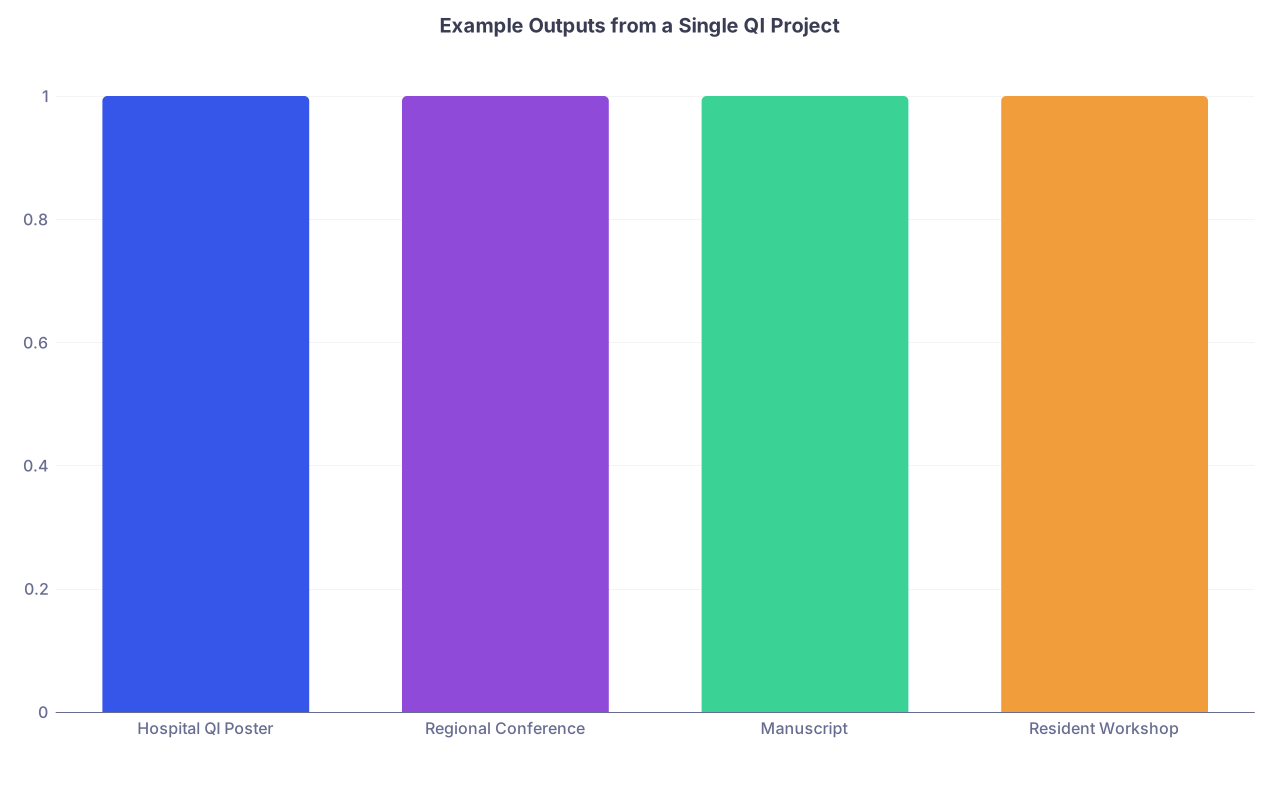
| Category | Value |
|---|---|
| Hospital QI Poster | 1 |
| Regional Conference | 1 |
| Manuscript | 1 |
| Resident Workshop | 1 |
On your CV that becomes:
- Smith J, Your Name, etc. “Standardizing Bedside Paracentesis Workflow…” Hospital Medicine QI Day, 2025. Poster.
- Your Name, Smith J. “Teaching Procedural Safety to Interns Using a Simple Checklist.” Department of Medicine Noon Conference, 2025. Invited educational session.
No, this is not NEJM. It does not have to be. PDs want to see:
- You find problems.
- You systematize solutions.
- You present and share them.
That is academic behavior.
Step 4: Build a Teaching Identity Out of What You Already Do
Most community residents teach constantly:
- Interns on nights
- New hires on the floor
- Nurses asking about tapping that 11 L belly safely
The problem: none of that is documented. If it is not documented, it might as well not exist to a fellowship director.
You will fix that.
4.1. Formalize Your Teaching Roles
You want specific, named, recurring activities. Examples:
- “PGY-3 Leader, Procedure Teaching Rounds”
- “Resident Instructor, Intern Procedure Bootcamp”
- “Co-facilitator, Ultrasound Skills Workshop for IM Residents”
If your program does not have these, you create them. Script it like this with your chief or PD:
“We do a lot of ad-hoc teaching on procedures. I would like to formalize a monthly 45-minute ‘Procedure Pearls’ mini-session for interns and students. I can design 3–4 sessions, run them, and track attendance and evaluations.”
That is now a discrete teaching activity.
4.2. Capture Feedback and Evaluation
Academic programs love evidence. Not just “I teach a lot.”
Ask for:
- Brief eval forms after sessions (Google forms are fine)
- Collated feedback from your chief or APD each quarter
- One formal teaching evaluation from a faculty mentor
Then on your CV:
Teaching Experience
- Resident Instructor – Intern Procedure Bootcamp (2025)
Designed and delivered 4-session series (central line basics, paracentesis, thoracentesis, consent and complications). Average learner rating 4.7/5 across 26 evaluations.
That line competes with legitimate academic teaching experiences.
Step 5: Plug the Research Hole Strategically (Without Wasting a Year)
Here is the brutal truth:
If you want a research-heavy fellowship at a top program (cards, GI, heme/onc at big names) and you have no research now, you are likely doing at least one research year. That is reality.
But many people do an inefficient, badly structured “research year” that turns into one poster and nothing more. Useless.
If you are still in residency (PGY-2 or early PGY-3), you have two tracks:
Track A: In-Residency Lightweight Research Build
You can often get to a minimally acceptable research profile without a full extra year, if:
- You start now, not “after boards”
- You pick realistic projects that can be completed in 6–12 months
Target outputs:
- 1–2 case reports (fastest; not high-impact but counts)
- 1 QI project with data and a regional/national poster
- 1 retrospective chart review / small observational study
How to do this in a community setting:
Find a hungry or research-oriented attending (often younger or recently fellowship-trained).
Say this verbatim:
“I want to apply to academic [specialty] programs. I trained in a procedural-heavy community program and know I am light on research. I am reliable and can do the grunt work. What is one doable project we can start this month that leads to a poster by [specific conference]?”
Accept non-sexy projects. Hemoglobin trends, readmission rates, coding issues, procedure outcomes. Boring is fine. Completed beats glamorous.
Build a weekly research block in your calendar (2–4 hrs protected personal time).
Track B: Intentional Research Year (If You Aim High-Compete)
If you are chasing very competitive academic fellowships (e.g., MGH cards, UCSF GI, MSK heme/onc) and are starting from near-zero research, you probably need:
- 12–24 months of structured research under a known mentor at an academic center.
Key word: structured. Not “hanging out in a lab.”
Your checklist:
- A clear PI with grant funding and a track record of getting trainees publications.
- A written 1-page plan: projects, timelines, expected abstracts/manuscripts.
- At least 2–3 planned first- or second-author projects.
And you explicitly highlight your community background when approaching them:
“I can run the clinical side of projects efficiently because I know how workflows actually operate on busy services. I am comfortable handling procedural datasets, complications, and process mapping.”
That is your angle. Not “I am basically a mini-PhD already.” You are not.
Step 6: Build Bridges to Academic People While Still in a Community Hospital
You do not become “academic” in a vacuum. You become academic by being known by academic people.
If your residency is not attached to a big-name med school, you must manufacture these connections.
6.1. Use Conferences as Networking Force Multipliers
Do not just go to conferences. Go with a plan.
Pick 1–2 meetings aligned with your goals:
- SHM (hospital medicine)
- CHEST (pulm/crit)
- ACG/AGA (GI)
- ACC (cards)
- ASH/ASCO (heme/onc)
- SGIM (general IM, academic)
Your priority:
- Submit a poster (even if local QI-level)
- Attend:
- Fellowship interest sessions
- Early-career or trainee workshops
- Any session run by program directors from programs you like
Then you execute a script you will repeat:
“I am a senior resident at a community program with heavy procedural and clinical experience. I am building my academic CV through QI and teaching, and I am looking for mentorship on how to position this for [fellowship/academic hospitalist] roles. Would you have 10–15 minutes during or after the conference for advice?”
You are not asking for a job. You are asking for advice and positioning. That is how relationships start.
6.2. Remote Collaboration from a Community Base
You can attach yourself to an academic group even if you do not work there physically yet.
Approach:
- Identify faculty with multi-center or database-heavy projects where your contribution can be remote (chart review, data cleaning, drafting).
- Send a concise email:
- Who you are
- Your procedural-heavy background
- Your specific academic interest (QI, education, outcomes, operations)
- What you can realistically do (e.g., 4–5 hrs/week for 6 months)
Many academic attendings are drowning in half-finished projects. A reliable resident who actually pushes something across the finish line is gold.
Step 7: Rewrite Your CV to Tell a Coherent Academic Story
Most residents treat the CV as a dump. That is a mistake. You need a structure that highlights your transformation from “community proceduralist” to “academic clinician-educator/innovator.”
Structure it like this:
Education & Training
- Include your residency with a one-line descriptor if helpful:
“Internal Medicine Residency – Community-based, high-volume procedural and critical care exposure.”
- Include your residency with a one-line descriptor if helpful:
Academic Interests (2–3 bullets)
- Procedural safety and outcomes on inpatient services
- Resident education in ultrasound-guided procedures
- Quality improvement in high-acuity general medicine units
Publications & Abstracts
- List anything, even accepted posters.
Quality Improvement and Projects
- Short bullets with Problem → Intervention → Outcome.
Teaching Experience
- Formal roles with dates, audience, and frequencies.
Clinical Expertise / Procedural Experience
- Quantified, grouped by type.
Leadership & Service
- Chief resident roles, committee work, M&M leadership if any.
Conferences & Courses
- Any ultrasound courses, procedural workshops, or academic skills sessions.
Your CV should make it almost impossible for a PD to miss the message:
“This applicant comes from a community setting but has deliberately built academic skills—teaching, QI, some research—on top of legitimately heavy clinical and procedural experience.”
Step 8: Write Your Personal Statement Like a Rebuttal Brief
Your personal statement is not a memoir. It is your argument against the unspoken objection:
“Community program. Probably service-heavy, light on scholarship.”
You counter that directly.
Your structure:
Opening: One specific story that shows your procedural-heavy world and your reflective mindset.
Example: A near-miss complication that led you to redesign how you teach consent or time-outs.Middle:
- Acknowledgement: “My training has been in a busy community hospital where clinical and procedural demands are high and formal research infrastructure is limited.”
- Pivot: “This context forced me to become intentional about building my academic skillset.”
- Evidence: 2–3 concrete examples:
- QI project
- Structured teaching
- Early research attempts
Future:
- Clear articulation of how you plan to combine:
- Procedural-clinical strength
- Academic role (educator, QI leader, clinical researcher)
- What you are specifically looking for in an academic program (mentorship, resources, specific areas).
- Clear articulation of how you plan to combine:
You are not apologizing for being community-trained. You are showing that you squeezed every academic drop from that environment and now need the next level of infrastructure.
Step 9: Prepare to Defend Your Background—Calmly and Confidently
In interviews, you will get some version of:
- “Tell me about your residency program.”
- “How did your training prepare you for an academic career?”
- “You come from a community program—what challenges did that create?”
Bad answer: Defensive, rambling, or pretending it was basically an academic center.
Good answer format:
Acknowledge reality:
“We are a community-based program without a large embedded research enterprise.”Highlight strengths:
“The upside was extremely high procedural and clinical exposure. I routinely performed [X, Y, Z] and managed complex patients with relatively limited subspecialty backup.”Show how you self-corrected the weakness:
“Because formal research infrastructure was limited, I built my academic experience through QI, resident teaching, and targeted collaborations. For example, I led a project on […], presented it at […], and am now working on a manuscript with Dr. […].”Pivot to future:
“I am looking for a program like yours where I can maintain a strong clinical and procedural role but integrate into a structured academic environment with mentorship in [education/outcomes research/QI].”
You are not asking for pity. You are demonstrating adaptability and initiative.
Step 10: A 6-Month Action Plan If You Are Late in the Game
If you are PGY-2 or PGY-3 and feel “behind,” here is a blunt, realistic 6-month protocol.

| Step | Description |
|---|---|
| Step 1 | Month 1 - Audit and Mentor |
| Step 2 | Month 2 - Start QI Project |
| Step 3 | Month 3 - Launch Teaching Role |
| Step 4 | Month 4 - Submit Abstract |
| Step 5 | Month 5 - Build Research Collab |
| Step 6 | Month 6 - Rewrite CV and PS |
Month 1: Audit and Mentor
- List:
- All procedures with approximate numbers
- Any informal teaching you already do
- Any past QI or workflow changes you were involved in
- Identify:
- 1 local mentor (program director, APD, QI chief)
- 1 external mentor (via conference, med school, or cold-email)
Month 2: Launch One QI/Education Project
- Pick a small, winnable target around procedures or inpatient care.
- Define:
- Baseline metric
- Simple intervention
- 3–4 month timeline
- Register it with your hospital QI committee if possible.
Month 3: Create a Formal Teaching Activity
- Propose a short, recurring teaching series (procedures, consent, ultrasound basics).
- Schedule 2–3 sessions.
- Create simple eval forms.
Month 4: Turn Work into an Abstract
- Draft an abstract for:
- Local QI day
- Regional ACP/SGIM/SHM
- Submit something. Imperfect is acceptable. Untouched data are not.
Month 5: Research Collaboration
- Email 3–5 academic attendings (local affiliate or external) with a specific ask to join an ongoing project.
- Commit to 3–4 hrs/week, reliably, for 3 months.
Month 6: Overhaul CV and Personal Statement
- Add:
- QI project description
- Teaching series
- Abstract submissions
- Any collaboration started
- Rewrite personal statement with your new story.
By the end of those six months, you are no longer “just” a procedural workhorse from a community program. You are a clinician with:
- Defined procedural portfolio
- Clear teaching roles
- QI and/or early research output
- Academic mentors who know your name
That is enough to get taken seriously by many academic programs—even very competitive ones if the rest of your file (scores, letters) is strong.

FAQs
1. Do I have to do a research year coming from a community program if I want an academic fellowship?
No. You only “have to” consider a research year if:
- You are targeting very research-heavy, top-tier programs in ultra-competitive fields and
- You currently have near-zero meaningful research or scholarly output.
If your goals are:
- Academic hospitalist
- Clinician-educator fellowship
- Or mid-tier academic fellowships in most specialties
You can often get there by:
- 1–2 solid QI projects with outcomes and posters
- A couple of manageable research projects (case reports, retrospective studies)
- Strong letters that explicitly speak to your academic potential
A research year is a tool, not a requirement. Use it only if the gap between your current CV and your target programs is clearly too wide to close with in-residency projects.
2. My community program has almost no research culture and limited support. Is it even realistic to aim for academic medicine?
Yes, but you must stop waiting for the program to “provide” an academic pathway. You will:
- Manufacture opportunities:
- Create your own teaching sessions
- Start your own small QI project
- Track your own procedural data
- Borrow infrastructure:
- Partner with an affiliated med school or academic center
- Attend conferences and network deliberately
- Collaborate remotely with research groups
I have seen residents from tiny, non-name community programs land at solid academic fellowships and hospitalist jobs because they did exactly this. They did not look “accidental.” They looked intentional.
Your next move is simple: pick one of the 6-month plan steps and do it today.
Start with this: open your CV and add a “Procedural Expertise” section with approximate numbers. Once that is real on paper, you will see exactly where to build next.