
Most residents choose between community and academic programs backwards. They look at labels, vibes, or prestige first—and only then try to justify how it fits their future. That is the wrong direction.
You start with your career goals. Then you force every program—community or academic—to prove it can get you there.
Here is a five‑step, brutally practical way to do that.
Step 1: Get Uncomfortably Clear on Your Actual Career Goals
Do not start with “I think I want something broad” or “I just want good training.” That kind of vagueness is how people end up miserable two years into residency.
You need real, testable statements. Things that could be right or wrong.
Ask yourself these questions and write down answers that are specific, not aspirational fluff:
Fellowship or no fellowship?
- Do you strongly want fellowship, mildly want it, or only “if I do not feel ready”?
- What type of fellowship? Competitive (cards, GI, heme/onc, derm, ortho subspecialty) or less competitive?
Academic vs private practice vs hybrid career?
- Do you picture yourself:
- Teaching med students and residents regularly?
- Writing papers and going to conferences to present work?
- Leading QI initiatives, guidelines, or hospital policy?
- Or do you imagine high-volume clinical work, short notes, getting home earlier?
- Do you picture yourself:
Scope and style of practice
- Do you want:
- Very complex, tertiary/quaternary care patients?
- Bread‑and‑butter community pathology at scale?
- Mostly outpatient? Mostly inpatient? Procedural heavy?
Your honest preferences here matter a lot more than the sticker on the hospital sign.
- Do you want:
Lifestyle and geography priorities
Rank these 1–4 in importance:- Geographic location (family, partner, kids, support system)
- Schedule and lifestyle
- Training rigor / academic environment
- Prestige / future opportunity
Long‑term nonclinical interests
Circle any that genuinely excite you (not just look good on a CV):- Research
- Medical education
- Administration / leadership
- Public health / policy
- Entrepreneurship / innovation
Now convert all that into 3–5 sentences. Example:
“I want to be a general internist in a mid‑sized city, mostly outpatient, with time for teaching residents. No strong desire for research. I do not care about big‑name prestige, but I do care that graduates feel confident and not burned out. I want at least the option of a noncompetitive fellowship, but not something like cards or GI.”
That paragraph is far more useful than “I think I like academic programs.”
Step 2: Translate Your Goals into Program Features That Actually Matter
Now you turn those goals into filters. Not “academic vs community” yet—into features any program might or might not have.
Here is what you should map:
A. If you want fellowship (especially competitive)
You need:
- Strong subspecialty presence (cards, GI, heme/onc, etc.)
- Recent fellowship match list with:
- People matching into your specialty
- From that program, not just “someone once matched somewhere good”
- Access to research or at least strong letters from recognizable faculty
- Enough elective time to build a portfolio (research, away rotations, networking)
Academic programs are more likely to have this infrastructure. Some large community programs do, but it is very program‑specific.
B. If you want academic career / teaching / research
Look for:
- Established clinician‑educator pathways or teaching tracks
- A medical school on site or strong student presence
- Protected educational time actually honored in practice
- Real research infrastructure:
- IRB support
- Mentors who publish
- Ongoing projects you could join
Pure community programs can support teaching (sometimes strongly) but rarely have deep research support. Hybrid “community‑academic” or university‑affiliated community programs may hit the sweet spot.
C. If you want broad, independent clinical practice quickly
You should prioritize:
- High patient volume and autonomy (especially senior residents truly running teams)
- Minimal fellows “crowding out” resident procedures
- Community exposure—multiple sites, including smaller hospitals
- Graduates who go straight into practice and feel ready
This often tilts toward strong community programs. Academic centers can produce excellent generalists, but you must verify they do not offload all bread‑and‑butter work to hospitalists, APPs, or community sites where residents are barely present.
D. If lifestyle or location is king
In that case:
- Be honest: You are choosing a place to live as much as a place to train.
- Look at:
- Call frequency and intensity
- Night float vs 24‑hour calls
- Culture of “staying late just because”
- How many residents transfer or leave
Here, community programs can be gentler, but not always. I have seen brutal community call schedules and surprisingly humane academic ones. Assumptions are dangerous—read the schedule.
Step 3: Understand the Real Differences Between Community and Academic Programs
Time to clear up some fantasy thinking. The label “academic” or “community” does not guarantee anything. You are looking at tendencies, not universal laws.
Typical Academic Program Features
Common characteristics:
- Large tertiary / quaternary care center
- Many subspecialty divisions and fellowships
- Heavy presence of:
- Research
- Grand rounds
- Conferences
- Visiting lecturers
- More layers in the team:
- Med students, interns, residents, fellows, attendings
- More formal expectations for:
- Scholarly activity
- Teaching
- Participation in departmental projects
Upside:
- Strong for competitive fellowships and academic careers
- Deep exposure to rare diseases and complex management
- Easier to find research and mentors for niche interests
Downside:
- Sometimes less autonomy early on (fellows do complex stuff)
- Can feel bureaucratic:
- Policy approvals
- Layers of administration
- Residents may feel like cogs in a big academic machine
Typical Community Program Features
Common characteristics:
- Smaller to mid‑sized hospitals, often:
- Suburban
- Regional referral centers
- Fewer or no fellows in many specialties
- More direct attending–resident interaction
- Patient mix:
- More bread‑and‑butter cases
- Less zebra pathology (but plenty of sick patients)
Upside:
- More procedures and autonomy for residents (no fellow “competition”)
- Faster path to seeing independent practice realities
- Often strong preparation for private practice and hospitalist jobs
Downside:
- Limited research infrastructure
- Fewer national‑name mentors for ultra‑competitive fellowships
- Less exposure to very rare or cutting‑edge treatments
Where Community and Academic Overlap
The real trap: many programs are not pure anything. You may see:
- “Community‑based academic affiliates” (community hospital + university faculty)
- University programs with heavy community sites
- Community programs that recruit research‑heavy faculty to build reputation
That is why you must drill down to features, not labels.
Here is a quick comparison to keep in front of you:
| Feature | Academic Program Tendency | Community Program Tendency |
|---|---|---|
| Competitive fellowship prep | Strong | Variable |
| Research infrastructure | Strong | Limited to moderate |
| Resident autonomy | Variable | Often higher |
| Complexity of cases | Very high | Moderate to high |
| Teaching opportunities | Strong (students, fellows) | Moderate (fewer learners) |
| Lifestyle predictability | Variable | Variable |
Use this table as a starting hypothesis, then test it against each program.
Step 4: Build a Simple 5‑Category Scoring System for Each Program
You want a method that prevents “shiny object syndrome.” A name like “Mass General” or “Cleveland Clinic” or “Top‑tier community program in an amazing city” will short‑circuit your decision‑making if you let it.
So you create a scoring matrix.
Step 4A: Define Your Five Categories
Use these five and weight them differently based on your goals:
- Fellowship / career advancement
- Clinical training and autonomy
- Teaching / academic environment
- Lifestyle / schedule
- Location / personal factors
Now assign each category a weight from 1–3:
- 3 = critical
- 2 = important
- 1 = nice but not central
Example for someone targeting GI fellowship and academic career:
- Fellowship / career advancement – 3
- Clinical training / autonomy – 2
- Teaching / academic environment – 3
- Lifestyle / schedule – 1
- Location / personal – 1
Example for someone aiming for general community practice near family:
- Fellowship / career advancement – 1
- Clinical training / autonomy – 3
- Teaching / academic environment – 1
- Lifestyle / schedule – 3
- Location / personal – 3
Step 4B: Score Programs 1–5 in Each Category
During interview season and program research, you rate:
- 1 = Poor for this category
- 3 = Acceptable / neutral
- 5 = Excellent for this category
Then multiply by your weight. Quick example:
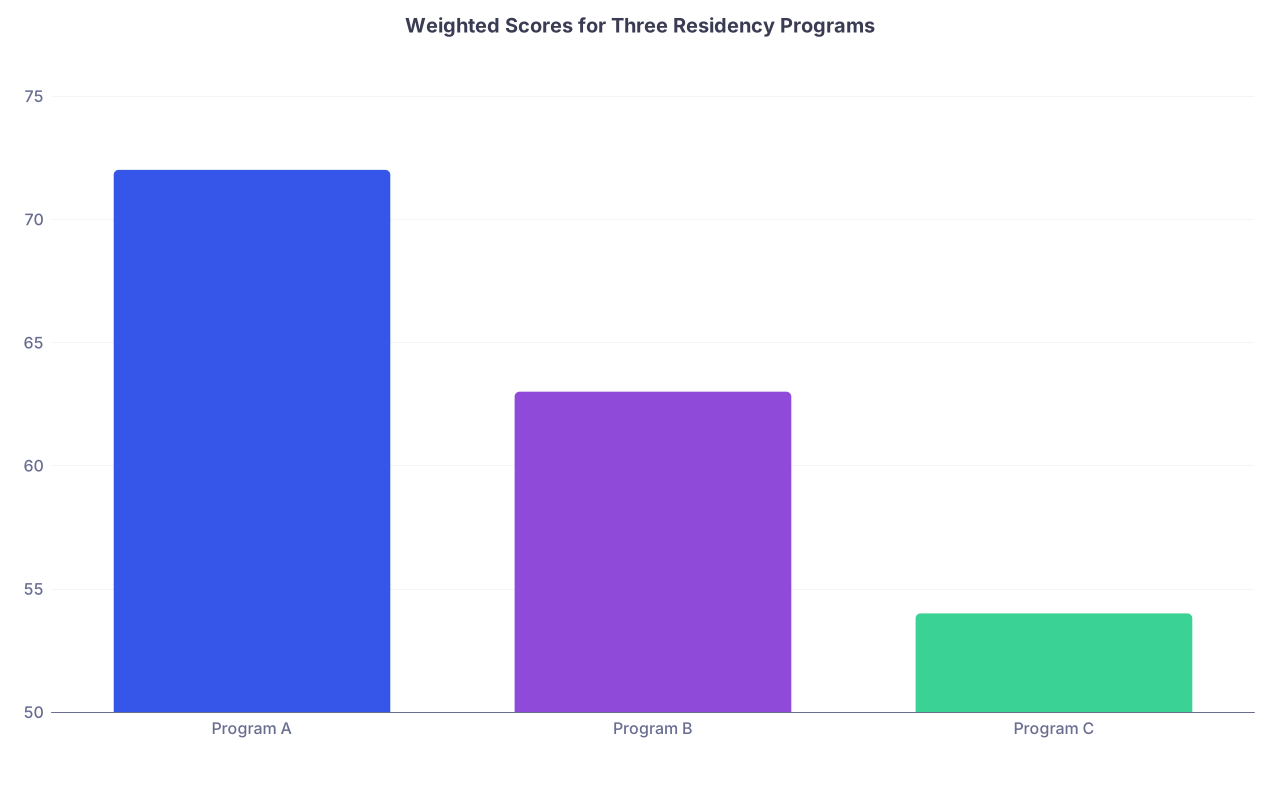
| Category | Value |
|---|---|
| Program A | 72 |
| Program B | 63 |
| Program C | 54 |
That bar chart represents your total weighted score after doing the math (I will walk through how to get those numbers next).
Step 4C: Do the Math on a Real Example
Let us say you care about:
- Fellowship – weight 3
- Clinical training – weight 2
- Teaching – weight 2
- Lifestyle – weight 2
- Location – weight 1
You rate three programs (academic, hybrid, community):
Program A – Big academic center
- Fellowship – 5 → 5×3 = 15
- Clinical – 3 → 3×2 = 6
- Teaching – 5 → 5×2 = 10
- Lifestyle – 2 → 2×2 = 4
- Location – 3 → 3×1 = 3
Total = 38
Program B – University‑affiliated community
- Fellowship – 4 → 4×3 = 12
- Clinical – 4 → 4×2 = 8
- Teaching – 4 → 4×2 = 8
- Lifestyle – 3 → 3×2 = 6
- Location – 4 → 4×1 = 4
Total = 38
Program C – Pure community, great city
- Fellowship – 2 → 2×3 = 6
- Clinical – 5 → 5×2 = 10
- Teaching – 2 → 2×2 = 4
- Lifestyle – 4 → 4×2 = 8
- Location – 5 → 5×1 = 5
Total = 33
Notice something important: Program A (big academic) and Program B (hybrid) tie overall. Depending on your personality, you may strongly prefer one, but the numbers will stop you from chasing logos without thinking.
Step 5: Use Interviews and Data to Test Your Assumptions
This is where most applicants get lazy. They ask generic questions (“What is your favorite thing about the program?”) and then wonder why all programs sound the same.
You need targeted questions that connect directly to your five categories.

| Step | Description |
|---|---|
| Step 1 | Define Career Goals |
| Step 2 | Choose 5 Categories |
| Step 3 | Assign Weights |
| Step 4 | Research Programs Online |
| Step 5 | Interview Day Questions |
| Step 6 | Score Each Program |
| Step 7 | Create Rank List |
A. Questions to Ask About Fellowship and Career Outcomes
For programs that claim “strong fellowship placement,” push for receipts:
Ask residents:
- “In the last 3 graduating classes, how many residents applied to [your target fellowship] and how many matched?”
- “Did anyone here match into [competitive specialty] from this program? Where?”
- “If you wanted to do research in [your area], who would you work with specifically?”
Ask PD / APD:
- “How does the program support applicants for competitive fellowships?”
Watch if they mention:- Letter‑writing support
- Dedicated mentors
- Protected time
- Research infrastructure
B. Questions About Clinical Training and Autonomy
Ask seniors:
- “On night float as a PGY‑2 or PGY‑3, what decisions are you expected to make before calling the attending?”
- “Who does central lines, intubations, and other procedures—residents, fellows, or anesthesia?”
- “Do you feel ready to practice independently if you go straight into practice after graduation?”
You are listening for:
- Real autonomy vs paper autonomy
- Whether fellows take over all complex work
- How often attending presence crowds out independent decision‑making
C. Questions About Teaching and Academic Culture
Ask residents:
- “How often do you teach med students? Is it structured or informal?”
- “Is there protected time for academic half‑day, and is it truly protected?”
- “Do residents present at regional or national conferences? How common is that?”
Ask about:
- Required scholarly activity
- Whether those requirements are realistic or just extra burden
- Who actually mentors those projects
D. Questions About Lifestyle and Culture
You can ask this more bluntly than you think.
Ask:
- “What is the latest you stayed on a non‑call day in the last month?”
- “How often do people need to stay 1–2 hours past sign‑out to finish notes?”
- “If you are sick, what happens? Is coverage supported or resented?”
- “How many residents left the program in the last 3 years, and why?”
If they dodge, that tells you something.
E. Questions About Location and Personal Fit
This is subjective, but do not ignore it.
Ask:
- “Where do residents live? How long is the commute?”
- “Is there time for hobbies or family? What do residents actually do on days off?”
- “Are most residents from this region or did many move in from out of state?”
You want to know whether you will have a community, not just a hospital.
Putting It All Together: A Simple Workflow
You do not need a 30‑page spreadsheet. You need a clean, repeatable workflow.
Before interview season
- Write your 3–5 sentence career goal statement.
- Choose and weight your 5 categories.
While researching programs
- Use websites + FREIDA + Doximity cautiously. Note:
- Fellowship match lists
- Program size
- Presence of fellows
- Research blurbs (real or just marketing?)
- Use websites + FREIDA + Doximity cautiously. Note:
During interviews
- Ask 2–3 targeted questions per category.
- Immediately after each interview, write down:
- Pros and cons
- 1–5 scores for each category
- Any red flags
After interviews
- Plug scores into your matrix.
- Multiply by category weights.
- Sort by total score.
Then—and only then—adjust for gut feeling
If two programs are within a few points, it is reasonable to let your gut, partner’s needs, or city preference break the tie. Just be honest with yourself that you are doing that.
Common Bad Assumptions You Should Ignore
Let me be blunt about a few myths that keep circulating:
“You cannot match a competitive fellowship from a community program.”
Wrong. You can. It is just harder and more dependent on:- Strong letters
- Networking
- Often doing research or rotations at where you want to end up
“Academic programs always have worse lifestyle.”
Also wrong. Culture and workload distribution matter far more than the logo.“Community programs are automatically more ‘hands‑on.’”
Sometimes. Sometimes they under‑resource residents and call it autonomy. Look at actual supervision and burnout.“Prestige will fix everything.”
No. If your day‑to‑day training and support are bad, a famous name will not cure your burnout or make you a better clinician overnight.
Quick Case Studies
Two short examples I have actually seen variations of:
Case 1: The Future Hospitalist Who Chased Prestige
- Goal: Work as a hospitalist near family, no strong research interest, wants good lifestyle.
- Chose: Big‑name academic program with heavy research culture, congested city, brutal commute.
- Result:
- Excellent but niche clinical exposure not useful for eventual job
- Minimal attention to hospitalist career development
- Burned out, delayed job search, ended up near family anyway—but miserable during training
Case 2: The Aspiring Cardiologist in a Strong Community Program
- Goal: Cardiology fellowship, willing to move anywhere for training, likes hands‑on clinical work.
- Chose: High‑volume community program with:
- Strong cardiology attendings
- Documented recent cards matches
- Supportive PD who hustles for letters and networking
- Result:
- Heavy clinical experience
- 1–2 solid research projects with cardiology mentors
- Matched to a good academic cardiology fellowship
The difference was not community vs academic. It was alignment vs misalignment.
Final Checkpoint Before You Rank
Before you lock in your rank list, stand back and answer three blunt questions for each program:
If I finish residency here and nothing magical happens—no surprise fellowship, no dream job—am I still okay with the kind of clinician I will be and the life I will have?
Does this program clearly support at least one viable path to the career I actually want, not the one that sounds good in interviews?
Would my future self thank me more for the training I get here or the city / lifestyle I had here? Which one am I really choosing?
If you can answer those without flinching, you are probably making a good call.