The prestige gap between community and academic backgrounds is real—but it is absolutely fixable if you approach it systematically.
If you are coming from a community medical school or community-heavy residency and you want a strong shot at academic programs, you cannot just “hope they see your potential.” You need to engineer your file so that an academic PD looks at your application and thinks: “This is one of us.”
Here is how you do that—step by step.
1. Understand the Prestige Gap You Are Actually Fighting
You cannot fix what you misdiagnose. Programs do not reject you because of the word “community” on your letterhead. They reject you because of what they assume “community” implies.
The unspoken biases usually boil down to:
- Less rigorous clinical evaluation
- Weaker research culture and output
- Less exposure to complex pathology / tertiary care
- Fewer well-known letter writers
- Unclear trajectory toward academic work
You fix the prestige gap by attacking those assumptions head‑on.
What academic programs actually care about
Forget the marketing language. When an academic PD is screening community-background applicants, they are scanning for:
Proof you can operate at an academic level
- Strong standardized scores (Step 2, in‑training)
- Strong, specific letters from people they trust
- Evidence you have worked in or with academic centers
Evidence you understand and can contribute to scholarship
- Abstracts, posters, manuscripts
- QI projects with data and outcomes
- Clear research trajectory tied to your career goals
Signals you are not “stuck” in community practice mode
- Electives or away rotations at academic programs
- Involvement in teaching, curriculum, or resident education
- Professional memberships and national-level engagement
So your strategy is simple: convert your community background into an academic-compatible portfolio by building those signals deliberately.
2. Build an “Academic Spine” into a Community Training Path
You do not need to become a completely different person. You just need to add a spine of academic markers through what is currently a community-heavy story.
Here is the framework I use with residents who feel “too community” for the places they want:
- Academic exposure (where you work and who sees you work)
- Academic output (what you produce)
- Academic mentorship (who is willing to vouch for you)
- Academic narrative (how you tell the story)
We will go through each and I will show you what to actually do this year, not in some fantasy five‑year plan.
3. Step One: Increase Your Academic Exposure—Now
If you stay entirely inside a community bubble until you hit “submit” on ERAS, you are asking programs to take a risk on you. Many will not.
You fix that by getting academic eyes on your work before you apply.
A. Academic electives / away rotations
If you are still in medical school or early in residency, you should be thinking in blocks, not years: “Which 2–4 week block will I convert into an academic signal?”
Concrete actions:
Identify target institutions and divisions early
- Look for programs with a track record of taking community grads.
- Identify divisions that match your interest (e.g., GI, pulm, EM ultrasound).
Request electives with a clear ask
Your email should sound like this, not like a vague fishing expedition:Dear Dr X,
I am a PGY-2 in Internal Medicine at [Community Hospital], very interested in pursuing a fellowship and an academic career in [field]. I would like to arrange a 4‑week elective on your [specialty] service in [month/year], with a particular interest in getting involved in ongoing clinical or quality improvement projects during that time.I have attached my CV and recent in‑training exam scores. I would be very grateful for any opportunity to work with your team.
Sincerely, …On elective, behave like a junior fellow, not a tourist
- Show up pre‑rounded, know every patient cold.
- Offer to give a short talk (15–20 min) on a topic they care about.
- Ask directly on week 2–3: “Is there any ongoing project I can help with, and continue remotely after I leave?”
Those 4 weeks can produce:
- One or two strong academic letters
- A project or abstract
- A line on your CV that screams “academic exposure”
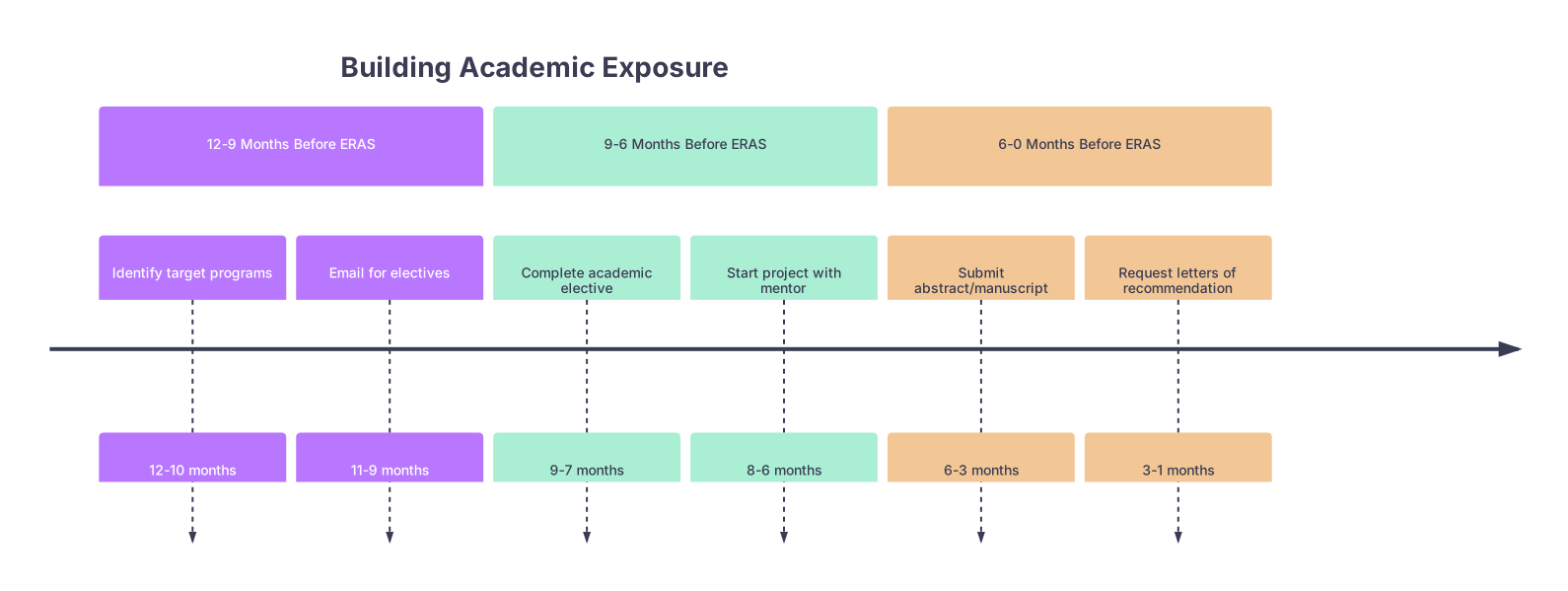
| Period | Event |
|---|---|
| 12-9 Months Before ERAS - Identify target programs | 12-10 months |
| 12-9 Months Before ERAS - Email for electives | 11-9 months |
| 9-6 Months Before ERAS - Complete academic elective | 9-7 months |
| 9-6 Months Before ERAS - Start project with mentor | 8-6 months |
| 6-0 Months Before ERAS - Submit abstract/manuscript | 6-3 months |
| 6-0 Months Before ERAS - Request letters of recommendation | 3-1 months |
B. Shared clinics or rotations at an affiliated academic center
Many “community” programs have informal or formal ties with a university hospital. Often nobody tells you clearly; you hear about it from the one resident who took advantage.
You need to hunt this down:
- Ask your PD directly: “What academic rotations or clinics have residents done in the last 3 years?”
- Ask senior residents specifically: “Who supervises us there? Who writes letters?”
- If nothing exists, you ask: “Could we create a 2‑week elective at [nearby university hospital] in my PGY-2/3 year?”
If your PD sees this as you chasing prestige, you frame it differently: “I want to bring back academic connections and potential collaborative projects to our program.” That line works more often than you think.
4. Step Two: Turn Your Community Work into Academic Output
Academic programs do not care that you say, “I like research.” They care that you can actually finish academic work. From anywhere.
Community environments are not a research death sentence. They just require more initiative and more ruthless scoping of projects.
A. Choose winnable projects
Your goal is not to design the next NEJM trial. Your goal is to generate 2–4 legitimate, completed outputs that show you understand the research / QI process.
Categories that are realistic in most community settings:
Chart review projects
- Example: “Characteristics and outcomes of patients admitted with [condition] at our community hospital over the last 3 years.”
- You can present at regional or national meetings. Academic PDs respect that.
Quality improvement projects with data
- Example: “Reducing unnecessary telemetry use on the general medicine floor.”
- Pre‑ and post‑ intervention data, basic statistics.
Case reports and clinical vignettes
- On their own they are weak, but they are good first projects and conference bait.
- The trick is volume and venues: 1–2 cases are noise; 4–6 across different settings shows sustained engagement.
Educational scholarship
- New curriculum, simulation scenarios, or teaching interventions with evaluation.
- Submit to MedEdPORTAL or specialty education meetings.
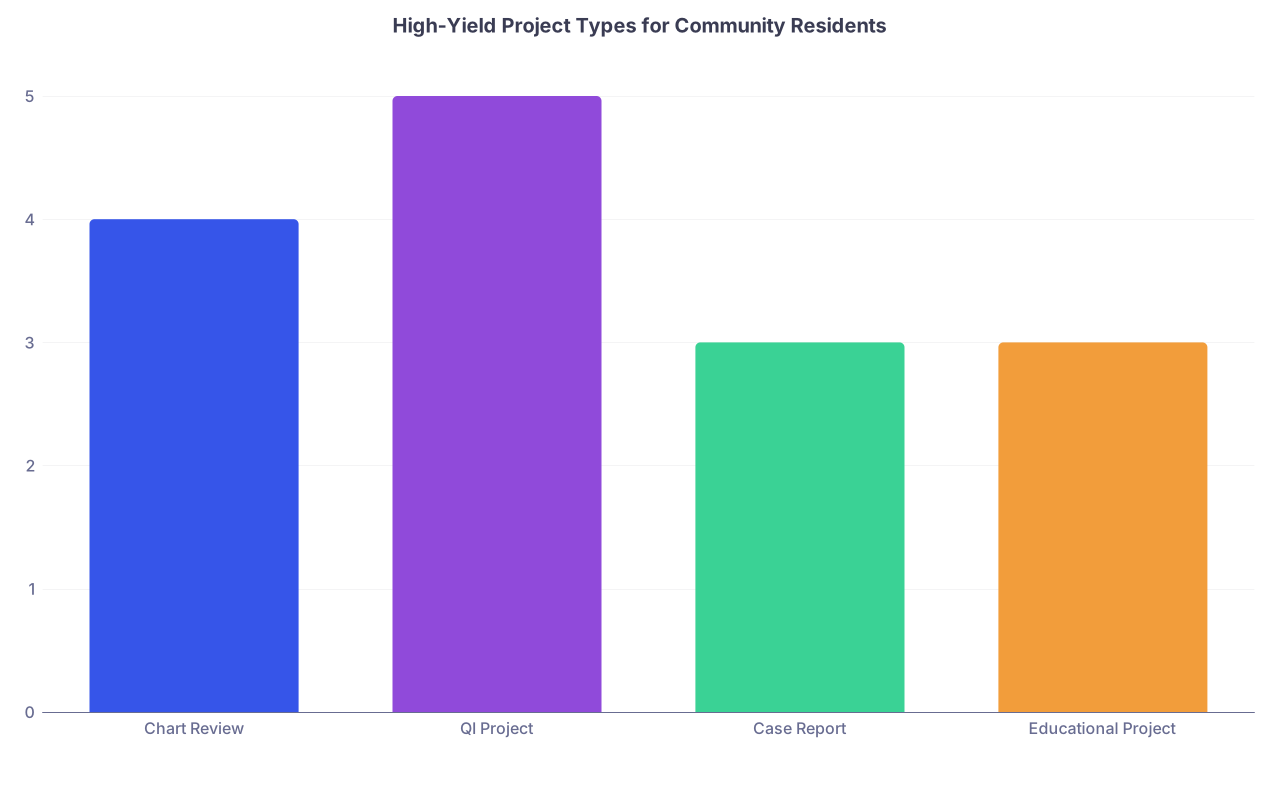
| Category | Value |
|---|---|
| Chart Review | 4 |
| QI Project | 5 |
| Case Report | 3 |
| Educational Project | 3 |
(Scale 1–5: how attractive these usually look to academic PDs when done well.)
B. Stop waiting for a “research infrastructure”
You are the infrastructure.
Step‑by‑step way to bootstrap a project in a community program:
Find a clinical annoyance that has numbers behind it
- Excess imaging.
- Boarding times in the ED.
- Readmissions for the same problem.
Find the one faculty member who complains about the same thing
You say: “I want to turn this into a QI project that we can write up. Would you be willing to be faculty sponsor if I do the grunt work?”Lock in a small, clear question
Bad: “Improve sepsis outcomes at our hospital.”
Better: “Decrease time to first antibiotic in ED sepsis patients by 20% over 6 months.”Get IRB or QI approval early
Even if it is exempt, get documentation. Academic people like seeing those words.Collect data in a spreadsheet you actually control
Date, key interventions, outcomes. Nothing fancy. Just usable.Write while you work
- Intro and methods can be mostly written before you have final data.
- Aim first for a poster at a regional or national meeting; turn the poster into a manuscript later if there is enough signal.
By Match season, the label that matters on your CV is not “community vs academic.” It is “has multiple projects with outcomes, IRB, and presentations.”
5. Step Three: Get the Right People to Vouch for You
Academic programs do not know your community attendings. That is your core handicap. You need at least one, ideally two letter writers with academic credibility.
A. Build 2–3 anchor relationships
These are not transactional “I need a letter” relationships. They are: “This is the person who can honestly say I work at an academic level.”
Where to find them:
- Electives at academic centers
- Subspecialty clinics run by faculty with university appointments
- Regional/national societies where you volunteered on a committee
How to convert contact into mentorship:
Show them your work product regularly
- Drafts of abstracts
- Slide decks for talks you are giving locally
- Short updates: “Here is what we found at 50 patients.”
Explicitly articulate your goal
You say something like:“My long‑term plan is to be in academic [specialty] with a focus on [area]. I am at a community program now and I am trying to make sure I build a competitive academic profile. I would appreciate your guidance on whether my current trajectory is enough for [fellowship / academic residency / hospitalist position].”
Ask for a letter only after they have seen sustained work
That letter needs specific content: “I have seen this resident lead a QI project from idea to implementation,” not vague praise.
B. Get at least one letter with national recognition
If you can, you want one letter from someone who:
- Has publications in your area of interest
- Is known in your specialty, or at least has some national roles
- Can say, “I would rank this person in the top [X]% of residents I have worked with”
Often you get this from:
- An away elective
- A collaborative project with an academic center
- A national society committee
If you do not know whether someone is “known,” look them up on PubMed and on your specialty society’s website. If they have multiple publications and any leadership roles, they count.
6. Step Four: Fix How Your Application Looks on Paper
You might have done good work already, but if it is buried on page 3 of a chaotic CV, program directors will not see it.
You need to structure your file so that in 30 seconds, an academic PD can tell: “This person is trained in a community setting but has a clear academic spine.”
A. Structure your CV for academic impact
Reorder your CV sections to foreground academic content.
Better order for someone with a community background:
- Education and training
- Academic appointments or affiliations (if any)
- Publications and manuscripts
- Abstracts, posters, and presentations
- Quality improvement and scholarly projects
- Teaching experience
- Awards and honors
- Clinical experience and leadership
- Professional memberships
Do not hide your good stuff behind generic “Activities.”
| Aspect | Weak CV Example | Strong CV Example |
|---|---|---|
| Early sections | Education → Work → Hobbies | Education → Publications → Presentations |
| Project labeling | "QI project" buried in bullets | Separate "Quality Improvement" section |
| Elective exposure | List of rotations only | Specific "Academic Electives" subsection |
| Teaching | One line under "Misc activities" | Full "Teaching and Education" section |
| Leadership | "Resident rep" mentioned once | Clear "Leadership Roles" with outcomes |
B. Personal statement: explicitly flip the “community = weak” narrative
Your personal statement should not apologize for your background. It should weaponize it.
Three things you must do:
Name your setting honestly, then pivot to its strengths
- “Training in a busy community hospital without subspecialty fellows forced me to take primary responsibility for complex patients early.”
- Then immediately link that to academic goals.
Show how you built an academic trajectory despite the environment
- “Because our program had limited research infrastructure, I partnered with [name] at [academic center] to develop a project on [topic]. This has become the foundation of my academic interest in [field].”
Draw a straight line from what you have done to what you will do in their program
- “I want an academic home where I can expand this work in [specific area], and I am particularly drawn to your program’s [lab, center, track].”
If your statement reads like generic “I love teaching and research,” you have wasted your best opportunity to reframe your community training as an asset.
7. Use the Match Application Strategically if You Are “Too Community”
This part is blunt. Some people need to hear it.
A. Calibrate your list like an adult
If you are at a community program with:
- Solid Step 2 (or in‑training) scores
- A few posters, maybe a publication
- Good letters but only one academic big‑name
You do not build a list of all top‑10 academic programs. That is fantasy football.
You aim for a portfolio of:
- A few reach academic programs (especially where you have direct connections)
- A solid core of mid‑tier academic and hybrid community‑academic programs
- Some strong community programs with academic tracks / fellowships
Look for programs that:
- Take community grads regularly
- Have explicit research tracks for residents
- Send their graduates to fellowships you actually want
B. Exploit hybrid and safety‑perceived programs
Many academic programs that are not “brand‑name famous” still have excellent research and fellowship placement. They are more open to community backgrounds, especially if you show genuine interest.
You put more effort into those applications:
- Direct emails to faculty in your interest area
- Mention specific program features in your PS or supplemental responses
- Ask current residents (via email or social media) what kind of applicant thrives there
8. During Interviews: How to Talk About Your Community Background Without Sounding Defensive
Interviewers will not always say it out loud, but the question in their head is: “Why should I take someone from a less academic environment over the dozens from top‑tier programs?”
You answer it before they ask.
A. Core story you want to deliver
You want your story to roughly sound like this, in your own words:
- “My community training gave me high‑volume, high‑responsibility clinical experience.”
- “I realized early that I wanted an academic career, so I deliberately built that into my path.”
- “Here is the concrete academic work I have done and what I want to build next.”
Specific phrases that work:
- “Because we do not have fellows, I have had to manage [type of case] more independently, which has made me comfortable with [skill].”
- “Recognizing that research resources were limited locally, I reached out to [academic mentor] and developed a project on [topic]. That experience confirmed that I want research to be a core part of my career.”
- “I see my community background as a foundation of strong clinical judgment that I now want to layer with more formal academic training.”
B. Handle the “Why this academic program?” question the right way
Do not say: “I want more research exposure.” Everyone says that.
Say:
- “I have already started work in [subfield] and I need a place with [specific lab/registry/center] where I can expand that.”
- “Your residents’ outcomes—especially [fellowship match, publication numbers]—align with how I want to develop my career.”
- “I am particularly drawn to your [XYZ track] because it would structure my interests in [area] into a coherent academic path.”
The person across from you must walk away believing: This is not a prestige‑chaser. This is someone who has a plan and will use our resources well.
9. If You Are Very Late in the Game: Triage Mode
If you are 3–6 months from ERAS and just now realizing your community background might hold you back, calm down. You cannot build Rome, but you can still move the needle.
Here is what you prioritize, in this order:
Perfect your letters
- Meet with your strongest potential letter writers.
- Give them an updated CV and a 1‑page “academic goals” summary.
- Ask them to explicitly address your academic potential and compare you to residents they have seen go into competitive fellowships or academic jobs.
Salvage and package any half‑done projects
- Convert unfinished projects into at least an abstract or local presentation.
- Get them on your CV as “submitted” or “in progress” with clear roles.
Add at least one academic exposure line
- If you cannot do a full elective, do:
- A few co‑authored cases with an academic mentor
- A brief visiting rotation (even 1–2 weeks) if allowed
- Virtual collaboration with academic teams
- If you cannot do a full elective, do:
Fix your narrative across CV, PS, and interviews
You might not be able to change what you have done, but you can drastically improve how it reads.
10. Quick Reality Checks and Non‑Negotiables
A few things I tell residents that are sometimes uncomfortable:
- If your letters are generic, I do not care how much “potential” you think you have. Fix that first.
- If you have zero scholarly output by the time you apply to an academic‑heavy field, you are asking for trouble. Fix that yesterday.
- If you are applying to top‑tier academic programs with no academic mentor who knows them or their world, your odds are low. Not zero, but low.
Non‑negotiables if you want to seriously “cross over” from community to academic:
- At least 2–3 real projects (QI, chart review, education, etc.), not just “I helped gather data” once.
- At least one letter from an academically credible mentor who has seen you do scholarly work.
- Clear, coherent explanation of your career goals and how academic training fits into that.
Key Takeaways
- The “prestige gap” is not about the word “community.” It is about missing academic signals. You can manufacture those signals with deliberate electives, projects, and mentorship.
- You must restructure your CV, letters, and personal statement so a busy academic PD can see—within 30 seconds—that you have an academic spine despite a community background.
- Stop apologizing for where you trained. Use your community experience as proof of clinical strength, then show how you have already started building the academic career you are asking them to invest in.