Most residents network for fellowships the wrong way because they copy tactics from the wrong environment. Community and academic programs are two different planets. You cannot use the same playbook and expect the same results.
Let me be blunt: if you ignore where you are training and how that shapes your networking strategy, you will quietly sabotage your own fellowship chances. I have watched very smart residents do exactly that—terrible emails, wrong people, wrong timing—then blame “the match” when they do not match their target fellowship.
You are not doing that. You are going to be deliberate.
This is the practical, step‑by‑step blueprint: how to network for fellowships from a community program versus from an academic program, and how to fix your approach starting this month, not “later.”
1. The Core Reality: Your Program Type Dictates Your Networking Map
Stop pretending all residencies are equal for fellowship networking. They are not.
Here is the key difference:
Academic residency = you are inside the pipeline.
The people who control fellowship spots (or influence them) are often in your building or one Zoom call away.Community residency = you are outside the pipeline.
You must build bridges to that pipeline—on purpose, repeatedly, and early.
Neither is “better” automatically. I have seen community residents match GI, cards, heme/onc at top places. They just work differently. Different routes. Different levers.
To get your head straight, look at this comparison:
| Factor | Community Program | Academic Program |
|---|---|---|
| On-site fellowship | Often none or very limited | Usually multiple fellowships |
| Faculty publications | Few to moderate | Moderate to high |
| Name recognition | Variable, often regional | Often stronger nationally |
| Built-in networking | Low–moderate | High |
| Need for external outreach | Very high | Moderate |
Your tactics must match this landscape. If you are at a community program and behave like you are at Mass General, you lose. If you are at an academic program and just “blend in,” you also lose.
2. Universal Fellowship Networking Fundamentals (Everyone Needs This)
Before we split into community vs academic tactics, the baseline rules are the same:
Start 18–24 months before you apply.
For competitive subspecialties (cards, GI, heme/onc, pulm/crit), that means PGY‑1 or early PGY‑2. For less competitive fellowships you can get away with a bit later, but earlier is still better.Clarify your target tier and geography.
Not “I’ll apply everywhere.” No. Pick:- 5–10 aspirational programs
- 10–15 realistic programs
- 5–10 safety programs
You network into these buckets differently.
Know your story.
You need a coherent 1–2 sentence explanation of:- Why this subspecialty
- Why you are credible (interests, projects, skills)
- What kind of fellow/program you are looking for
Capture every interaction.
Keep a simple tracking sheet. If you do not track, you will forget names, lose threads, and drop opportunities.
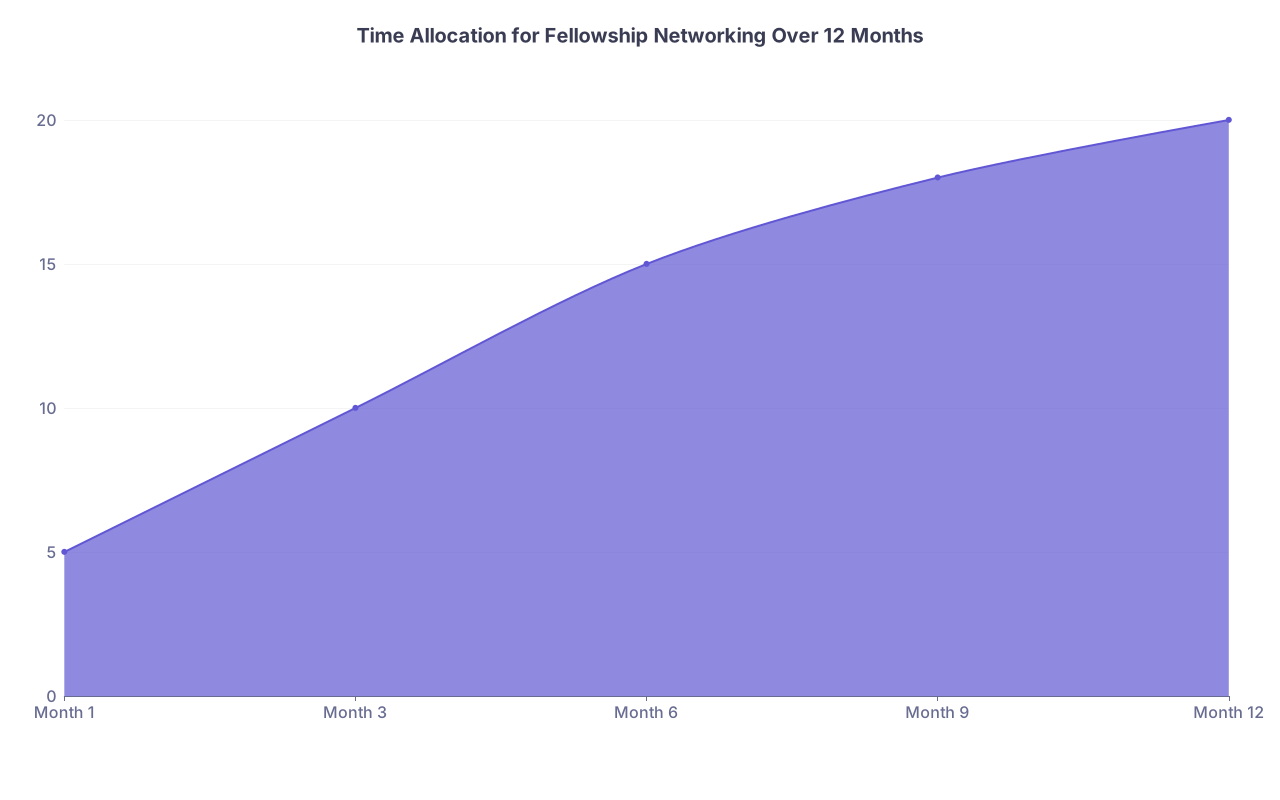
| Category | Value |
|---|---|
| Month 1 | 5 |
| Month 3 | 10 |
| Month 6 | 15 |
| Month 9 | 18 |
| Month 12 | 20 |
The numbers here are “networking hours per month” I have seen in residents who matched into solid fellowships. Not insane. Just consistent.
3. Community Programs: How to Build the Network You Do Not Inherit
If you are at a community program, you are not doomed. You are just not handed a network on a silver platter. You must manufacture it.
3.1 Your Primary Assets in a Community Program
You probably have:
- Attendings who used to be fellows at academic centers
- A few part‑time or visiting academic faculty
- Referring relationships with tertiary care centers
- Clinical autonomy and strong letters emphasizing “ready to work day one”
Your job is to turn those into names, emails, and advocates.
Step 1: Create Your Fellowship Target Map
Sit down one evening and actually write this out. Do not keep it in your head.
- List your target subspecialty and rough region(s).
- Under each target city, list 2–3 programs.
- For each program, try to identify:
- Program Director (PD)
- Associate PD
- Key faculty aligned with your interest (e.g., advanced heart failure, IBD, stem cell transplant)
Check:
- Program websites
- Recent publications (PubMed)
- Society directories (ACC, ASH, ATS, etc.)
This becomes your “who do I need to be known by” list.
Step 2: Mine Your Own Faculty for Connections
You probably underestimate how many connections your current attendings have.
Do this:
Ask your PD and APD in a scheduled meeting, not in the hallway:
“I am very interested in [subspecialty] and planning to apply in [cycle year]. I would value any guidance on programs you think would fit my profile, and any colleagues you know at those places who might be open to a quick email introduction.”Ask subspecialty attendings directly:
- “Where did you train?”
- “Do you still know anyone there?”
- “Are there programs you’d particularly recommend or know people at?”
Be ready with a one‑page CV and a clean email they can forward.
Here is how you make it easy for them (this matters):
“Dr. Smith, if you are comfortable, I can draft a short 3–4 sentence introduction email that you could modify and forward. I know you are busy and want to make this as easy as possible.”
That is how you actually get intros, instead of vague “Yeah, I know some people there” that never goes anywhere.
Step 3: Use Rotations as Auditions
If your program sends you to a tertiary center for:
- ICU
- Subspecialty rotations
- Night float at a larger academic hospital
Treat those as month‑long interviews.
Your goals:
- Identify 1–2 faculty in your subspecialty who actually notice your work.
- Ask to present a case or a short talk.
- Offer to help with small retrospective projects.
Then, near the end of the rotation, say:
“Dr. Lee, I have really enjoyed this month and I am strongly considering [subspecialty] fellowship. I am at [your program], which is more community‑based, so I am being proactive about building connections. Would you be open to my staying in touch by email and maybe discussing projects or advice as I move closer to application season?”
You are not asking for a letter yet. You are asking for a relationship. Different thing.
3.2 External Networking Tactics From a Community Program
From a community program, conferences and cold outreach are not optional. They are core strategy.
Conferences: You Must Show Up and Use Them Correctly
For competitive subspecialties, go to at least one major national and one regional meeting before you apply.
Expected tactics:
Submit something. Even a small poster. Case series. QI project. Do not show up empty‑handed if you can avoid it.
Email people ahead of time.
Example: 3–4 weeks before the meeting, send:- Subject: “Prospective [Year] [Subspecialty] applicant – brief intro and question”
- In 4–5 sentences:
- Who you are and where you train (say “community‑based” plainly, do not hide it)
- Your interest focus
- That you will attend the conference and noticed they are at [Institution]
- Ask if they would have 10 minutes for an informal chat or coffee during the meeting
At the conference, do not cling to your co‑residents.
Attend sessions by your target programs. Introduce yourself clearly:- “I’m [Name], PGY‑2 IM resident at [Hospital] in [City]. It is a community‑based program with strong [X]. I am applying to [subspecialty] next cycle and very interested in [their program / their research area].”
Collect business cards or emails and write a same‑day note:
- “Thank you for speaking with me about [X]. I appreciated your insight on [Y]. I will keep you updated as I move toward application season.”
Cold Emailing Without Being Annoying
From a community program, you will cold email more. That is fine. But you must respect signal vs noise.
Basic rules for a clean cold email to faculty at a target program:
- Keep it under ~150 words.
- Show you did your homework.
- Have one very specific ask:
- Brief call for advice
- Feedback on your profile for their program
- Possibility of remote research collaboration
Bad: “I’m interested in anything you have going on.”
Better: “I read your recent paper on [X] and I am particularly interested in [specific angle]. I have some protected time and experience with [data tasks / chart review / basic stats]. If there are any small pieces of work in that area where an extra pair of hands would help, I would be very keen to contribute.”
Track your outreach. Follow up once after 10–14 days. If no response after that, move on.
4. Academic Programs: How to Stand Out Inside a Crowded Pipeline
If you are at an academic program, your problem is not access. Your problem is competition and visibility. Every other resident around you is thinking “cards fellowship,” “GI fellowship,” “heme/onc fellowship” too.
You win by being clear, early, and useful.
4.1 Map Your Internal Ecosystem
Your advantage: the fellowship leaders, division chiefs, and big‑name researchers are within reach.
Your first three months (or the first 3 months after you decide your subspecialty), do this:
Identify:
- Fellowship PD and APD
- Division chief
- 3–5 research‑active faculty in your specific interest niche
Show up where they are:
- Subspecialty conferences
- Journal clubs
- Grand rounds
- Research meetings (even if you are mostly listening at first)
Ask for 15–20 minute “career chats”:
- “I am [PGY level] in [program], very interested in [subspecialty], and I admire the work you have done in [area]. Would you have 15–20 minutes sometime this month for me to ask a few questions about building a competitive profile for fellowship?”
You are not begging for a project. You are asking how to be excellent in their world. People respond to that.
4.2 Use Research for Visibility, Not Just Lines on CV
Academic residents often make one classic error: collecting random low‑impact projects with no narrative. PDs smell this a mile away.
Do this instead:
Pick a theme within your subspecialty:
- Cards: advanced heart failure, EP, structural
- GI: IBD, hepatology
- Heme/Onc: lymphoma, leukemia, benign heme
Attach yourself to 1–2 faculty in that theme, not 5–6 all over the place.
Prioritize:
- One or two substantive projects (retrospective cohort, meta‑analysis, QI with measurable impact)
- A few quick wins (case reports, small chart reviews) that you can present early
Your research is now a networking tool:
- You interact regularly with faculty.
- You get introduced to their collaborators at other institutions.
- You present at regional/national meetings where people meet you attached to a PI they recognize.
At poster sessions, your badge plus your PI’s name is your introduction.
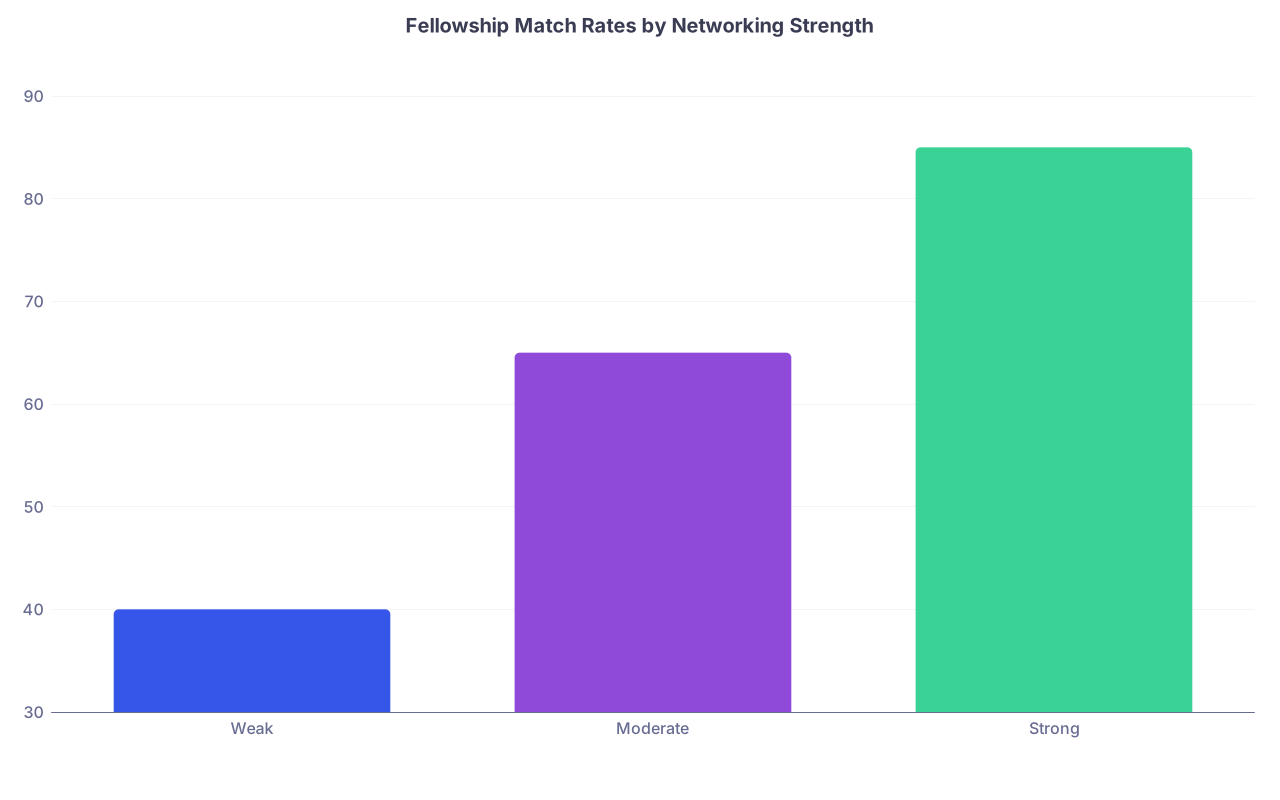
| Category | Value |
|---|---|
| Weak | 40 |
| Moderate | 65 |
| Strong | 85 |
I am not making up the exact numbers, but this pattern is real: residents with strong, intentional networking and visible projects match at dramatically higher rates than those who “just apply.”
4.3 Internal Politics You Cannot Ignore
At academic programs, fellowship slots are often politically constrained. Examples I have actually heard in workroom whispers:
- “Cards tends to take 2–3 of our own each year, but liver takes almost none.”
- “They love applicants who did a research year with Dr. X.”
- “If you are not on rounds with the PD at least once, you are invisible.”
You need to understand the unwritten rules at your institution.
How:
- Ask senior residents who matched into your target:
- “What do you think actually made the difference for you?”
- “Are there any landmines I should avoid?”
- Ask trusted attendings:
- “What have you seen separate residents who successfully match into [subspecialty] from those who struggle?”
Once you know the local rules, you can decide:
- Lean into being a “strong internal candidate.”
- Or network more heavily to be a strong external candidate if your program rarely takes its own.
5. Tactical Differences You Must Respect: Community vs Academic
Let us put the two playbooks side by side so you can stop using the wrong one.
| Dimension | Community Resident Focus | Academic Resident Focus |
|---|---|---|
| Primary challenge | Limited built-in network | Standing out in a crowded pool |
| Main networking lever | External outreach & conferences | Internal visibility & research |
| Most critical allies | Outside mentors, rotation faculty | Fellowship PDs, division chiefs, key PIs |
| Emails to send | Cold/introduction + project offers | Internal career chats + follow-up on work |
| Conferences used for | Creating first impressions and connections | Reinforcing existing relationships |
Now, what this looks like day‑to‑day.
5.1 Weekly Networking Habits: Community vs Academic
You do not have days to waste scrolling fellowship program websites. You need specific weekly actions.
From community:
- 1–2 emails per week:
- To external faculty (cold or warm intros)
- To update prior contacts with progress
- 1 specific ask per month from your PD:
- “Are there any colleagues at X or Y you think I should meet?”
- 1–2 conference abstracts per year:
- Even small, but targeted to your subspecialty
From academic:
- Attend your subspecialty conference every week you can.
- Every month:
- 1 meeting with mentor / PI
- 1 small step forward on a project (submit abstract, finish data extraction)
- Every rotation with a potential letter writer:
- Signal your interest early
- Ask for feedback midway, not just at the end
6. Letters of Recommendation: Different Strategies for Community vs Academic
Letters are networking in written form. They are how your advocates speak when you are not in the room.
6.1 For Community Residents
Your letters must do two especially important things:
Validate that your community training is not a liability:
- “Despite training in a community setting, [Name] has actively sought exposure to complex tertiary‑level cases through [external rotation / tele‑consults / cross‑institution conferences].”
Emphasize your work ethic and independence:
- “I trust [Name] to manage high‑acuity patients with a level of autonomy I would expect from a fellow.”
Ideal mix:
- 1–2 strong letters from your home institution:
- PD or APD
- Subspecialist who has seen you on multiple rotations
- 1–2 letters from academic faculty elsewhere:
- From outside rotations
- From collaborative research
You must ask for letters early. 3–4 months before ERAS submission, at least.
How to ask nicely but directly:
“Dr. Patel, I have valued working with you on [rotation/project], and your perspective as an academic [subspecialty] physician would be extremely meaningful in my application. Would you feel comfortable writing a strong letter of recommendation for my [year] fellowship applications?”
You need the word “strong” in there. If they hesitate, you pivot and do not push.
6.2 For Academic Residents
From an academic program, your risk is generic letters: “hard‑working, a pleasure to work with, will do well in fellowship.” Death by faint praise.
You want:
- At least one letter from someone with a national name in your field.
- At least one letter that speaks to your research and intellectual potential.
- One strong clinical letter from:
- PD / APD
- Or a ward attending who saw you in action over time.
To get non‑generic letters:
- Give your letter writers:
- Updated CV
- A 1–2 page “brag sheet” of specific cases, projects, or interactions with them
- A short paragraph on your career goals and what you hope they can emphasize
Then say:
“It would be particularly helpful if you could comment on my [clinical reasoning / independence / teaching ability / work on X project], since those are areas I hope to bring into fellowship.”
Guide the content. They will appreciate it.

7. How to Recover if You Started Late
Many residents wake up in late PGY‑2 and realize, “I should have started this a year ago.” Fine. Late is not dead. But you must compress the strategy.
If you are at a community program and late:
- Immediately meet with PD and subspecialty attendings:
- Ask candidly what tier of fellowship programs is realistic this year.
- Focus on:
- External letters (via rapid, high‑intensity rotations or tele‑electives)
- At least one quick‑turnaround project tied to a recognizable academic partner
- Double down on:
- Regional programs more likely to know your institution
- Programs where your faculty have strong personal relationships
If you are at an academic program and late:
- Pick one subspecialty and stop “exploring” others right now.
- Attach yourself quickly to 1–2 key faculty:
- Volunteer for “annoying but necessary” data tasks that can lead to a fast abstract.
- Make sure:
- PD and fellowship leadership know your interest and timeline by the next 2–3 weeks.
- Apply more broadly:
- Do not only shoot for the biggest names; you have less time to build deep relationships.
Either way: late means no wasted moves. Every new person you talk to should be able to help you directly or connect you to someone who can.
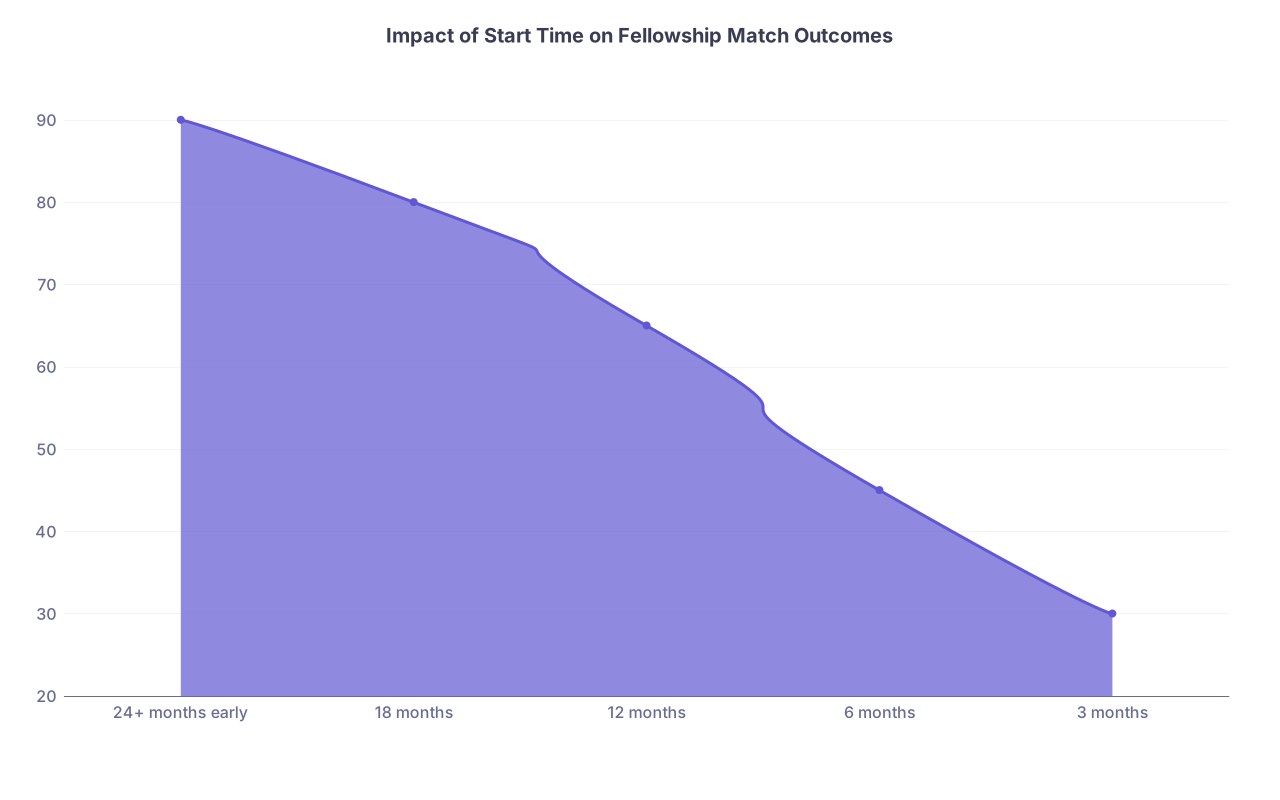
| Category | Value |
|---|---|
| 24+ months early | 90 |
| 18 months | 80 |
| 12 months | 65 |
| 6 months | 45 |
| 3 months | 30 |
The exact percentages vary, but the direction is not negotiable. Earlier networking means more options.
8. Concrete 30‑Day Action Plan: Community vs Academic
Let us end with what you should do this month. Not “someday.”
If You Are in a Community Program
Over the next 30 days:
- Schedule:
- 1 meeting with your PD
- 1 meeting with a subspecialty attending
- Build:
- A 1‑page CV
- A simple spreadsheet of:
- Target programs
- PD / APD / key faculty
- Contacts your faculty might know
- Send:
- 2–3 initial emails:
- One to a contact your attending introduces
- One to a faculty you worked with on an away/tertiary rotation
- One cold email to a target program faculty based on shared interests
- 2–3 initial emails:
- Commit:
- To submitting at least one abstract to a regional or national meeting in your field.
If You Are in an Academic Program
Over the next 30 days:
- Attend:
- Every subspecialty conference and journal club you can.
- Schedule:
- 2 career chats with key faculty (PD, research‑active faculty, division chief).
- Join:
- At least one concrete research or QI project with a named mentor.
- Clarify:
- A working list of fellowship programs in three tiers and check with at least one mentor on how realistic it looks.

Open your calendar right now and block 30 minutes in the next 48 hours labeled:
“Fellowship Networking – First Moves.”
Use that slot to send one email, schedule one meeting, and start one tracking sheet. If you do those three things this week, you are already ahead of the residents who will wait until ERAS season and hope their applications “speak for themselves.”