
The biggest myth about fellowship letters is that “a strong chair letter is a strong chair letter.” That’s wrong. Academic chair letters and community chair letters are read completely differently by fellowship PDs, and the people on the other side of ERAS know exactly which one they’re looking at.
Let me walk you through what they actually write, what they really think, and how your program type quietly tilts the playing field.
How Fellowship PDs Read Your Chair’s Letter
Before we get into the wording, you need to understand the mentality on the other side of the screen.
Academic fellowship PDs instinctively sort letters into three buckets the second they see them:
- Academic chair at a well-known institution
- Academic chair at a mid‑tier or regional program
- Community chair (even if your place feels “quasi-academic” to you)
They’re not supposed to admit that, but they do. I’ve sat in these meetings; I’ve heard it:
- “This is from [big-name academic chair], read that carefully.”
- “Community letter, OK, adjust the curve.”
- “Local academic chair, solid, but not a kingmaker.”
They know the calibration of each writer. An academic chair at a big-name institution has written hundreds of fellowship letters. Their scale is known. A community chair might only write a handful per year, and their enthusiasm is often…uncontrolled.
So the same exact adjectives mean different things depending on who wrote them.
What Academic Chairs Really Write (And Why)
Academic chairs, especially at university-based programs, write with three things in mind:
- They need to protect their credibility.
- They know other PDs personally.
- They’re signaling within a shared code.
They don’t write in plain English. They write in code they all understand. That’s the insider piece you’re missing as an applicant.
The Standard Academic Chair Template
Here’s the skeleton almost all academic chairs use, whether it’s GI, Cards, Heme/Onc, you name it:
- Paragraph 1: Who I am / how I know the applicant / program context
- Paragraph 2–3: Clinical performance, fund of knowledge, work ethic
- Paragraph 4: Research and academic potential
- Paragraph 5: Professionalism / teamwork / “resident you want in your program”
- Closing: Rank phrase and fellowship potential
Let’s translate what those paragraphs really look like when written by an academic chair.
Decoding Academic Phrases
Here are phrases you’ll see again and again and what they truly mean in the academic world:
| Phrase | What It Actually Signals |
|---|---|
| "Ranks in the top 5% of residents" | True standout, interview strongly |
| "Among the top residents I have worked with" | Very strong, likely interview |
| "Excellent resident" | Solid, but not elite |
| "Very good resident" | Middle of the pack |
| "I recommend without hesitation" | Baseline positive, not a superlative |
| "I give my highest recommendation" | Strong endorsement (watch context) |
Now layer on the program context. When the letter is from an academic chair at a known university program, here’s what’s going through a fellowship PD’s head:
“Top 5% at [strong academic IM program]”
Translation: This person is probably better than the average fellow we already have.“Excellent resident with strong clinical skills” but no percentile or rank comparison
Translation: Capable, safe, probably not a star.“I give my unqualified highest recommendation” without specific comparative language or detail
Translation: Generic boilerplate. Chair probably didn’t really know them well.
Here’s what academic chairs will do that community chairs almost never do:
They stratify their residents. Explicitly. On paper.
They’ll say things like:
- “In our current class of 18 residents, I would rank her in the top 3.”
- “He is in the top 10–15% of residents I have worked with over my 20 years here.”
When an academic chair doesn’t do this and just lists adjectives, experienced fellowship PDs assume the applicant is mid-tier in that program.
What They Don’t Put in Writing
The really damning stuff rarely shows up as “concern” or “red flag.” Academic chairs are too savvy for that. You’ll see:
“With continued mentorship, he has the potential to grow into a strong academic clinician.”
Translation: Not there yet. Not really ready for a top-flight academic fellowship.“She will flourish in a supportive training environment.”
Translation: Needs hand-holding. Not an independent workhorse.“He has made steady improvement over the course of residency.”
Translation: Rough start, potential judgment or knowledge issues earlier. We’re subtly warning you.
I’ve sat in rank meetings where a PD reads a letter line like that and immediately says, “They’re telling us there were issues early on.”
You’ll never see “He had professionalism concerns” in a serious academic letter unless it was catastrophic. Instead you’ll see:
- “There were early challenges with time management that have improved with feedback.”
- “She is continuing to develop her skills in multitasking and handling high census loads.”
You think that sounds mild. They hear “We had problems. Proceed carefully.”
What Community Chairs Really Write (And How It’s Read)
Community chairs are playing a different game.
Most of them don’t live in the world of R01s, NIH study sections, and grand rounds politics. Their currency is: “Do I like working with this resident? Do patients love them? Do they show up and take care of business?”
They’re usually proud of their residents. Rightly so. But they overestimate how their words will be interpreted.
The Tone Difference
Community chair letters almost always sound more glowing on first read. They’re warmer. More narrative. Sometimes a little lyrical.
Examples you’ll see all the time from community chairs:
- “It is an absolute pleasure to recommend Dr. X for your fellowship program.”
- “Without reservation, I can say Dr. X is one of the most compassionate and hard-working residents we’ve had.”
- “Our program is small, but Dr. X has risen to every challenge and become a leader among their peers.”
Now here’s the uncomfortable truth: fellowship PDs automatically apply a discount.
They know most community programs don’t stratify aggressively, don’t write cutting letters, and often use superlatives for anyone above waterline. So “one of our best” gets mentally translated as, “Probably an above-average resident in a community setting.”
The Calibration Problem
Compare how the same phrase is heard in different contexts:
| Phrase | Academic Chair at Major Center | Community Chair at Regional Hospital |
|---|---|---|
| "Top 5% of residents" | Serious elite candidate | Maybe top half / enthusiastic writer |
| "Hard-working and compassionate" | Baseline traits, nothing exceptional | Baseline traits, nothing exceptional |
| "Strong clinical skills" | Safe, but not necessarily brilliant | Probably the best thing they can confidently say |
| "I recommend without hesitation" | Standard positive closing | Standard positive closing |
Fellowship PDs don’t say this out loud on Zoom, but the thinking is there:
“Community chairs are nice. Academic chairs protect their reputations.”
So the same adjectives have different weights.
What Community Chairs Often Miss
Three big things undermine community letters without the chair realizing it:
Lack of comparison
“An excellent resident” with no class ranking or historical context reads as vague. Fellowship PDs are asking: “Excellent compared to whom?”Overemphasis on personality
Long paragraphs about being “a joy to work with,” “always smiling,” “gets along with everyone” with minimal detail on clinical reasoning scream: low bar, nice person, unsure about academic horsepower.Thin academic content
If the only “academic” line is: “He presented an interesting case at our noon conference,” that tells every academic PD: this is not an academically oriented resident, regardless of how great they are clinically.
Where Academic and Community Letters Quietly Diverge
Let me show you how two chairs might describe the same resident and how they’d be interpreted.
Scenario Resident
- Solid clinical skills
- Above-average fund of knowledge
- One poster at a regional meeting
- No major professionalism issues
- Not the superstar of the class, but well-liked and reliable
Now listen to the two voices.
Academic chair version:
“Dr. A is an excellent resident who has developed into a reliable and knowledgeable clinician. In our current class of 18 residents, I would place her in the upper third with respect to clinical acumen and work ethic. She has demonstrated a steady fund of knowledge, performing in the high 60th percentile on recent in-training examinations.
Academically, she completed a case-based poster presented at our regional ACP meeting and has expressed interest in further scholarly work. While not yet deeply engaged in independent research, she has shown the discipline and curiosity necessary to grow in this area.
Dr. A will be a strong addition to a clinically oriented fellowship program and will take excellent care of patients.”
Community chair version:
“It is my absolute pleasure to recommend Dr. A for your fellowship program. She is one of the most compassionate and hard-working residents I have had the privilege to work with. Patients routinely praise her bedside manner, and she consistently volunteers to stay late to ensure her patients are well cared for.
Dr. A has taken full advantage of the opportunities in our busy community program, managing high patient volumes and complex cases with maturity and professionalism. She has engaged in scholarly work, presenting a case at a regional meeting, and she is eager to continue developing academically.
I give Dr. A my highest recommendation. She will be an asset to any fellowship program that is fortunate enough to have her.”
Now, how do fellowship PDs read that?
- Academic version: “Upper third at a known academic program, decent ITEs, one poster, not research-heavy. Good for solid clinical fellowship spots.”
- Community version: “Nice, hard-working resident at a community program, minimal objective comparison, one regional thing, unknown where she stands relative to peers.”
Exact same resident. Different valuation.
How Your Program Type Affects Your Ceiling
Here’s the part nobody explains to you when you match into a community vs academic residency:
The letter writer’s reputation becomes part of your file.
Fellowship PDs track this. Not officially. But informally.
They remember:
- “Every letter from Dr. X at Midstate University has been dead-on accurate.”
- “Community Hospital Y calls everyone ‘one of our best.’ Adjust accordingly.”
- “That small academic program in the Midwest consistently underrates their residents; their ‘top third’ are actually very strong.”
Over 5–10 years, patterns get built. Your letter isn’t just about you; it’s about the historical behavior of your writer.
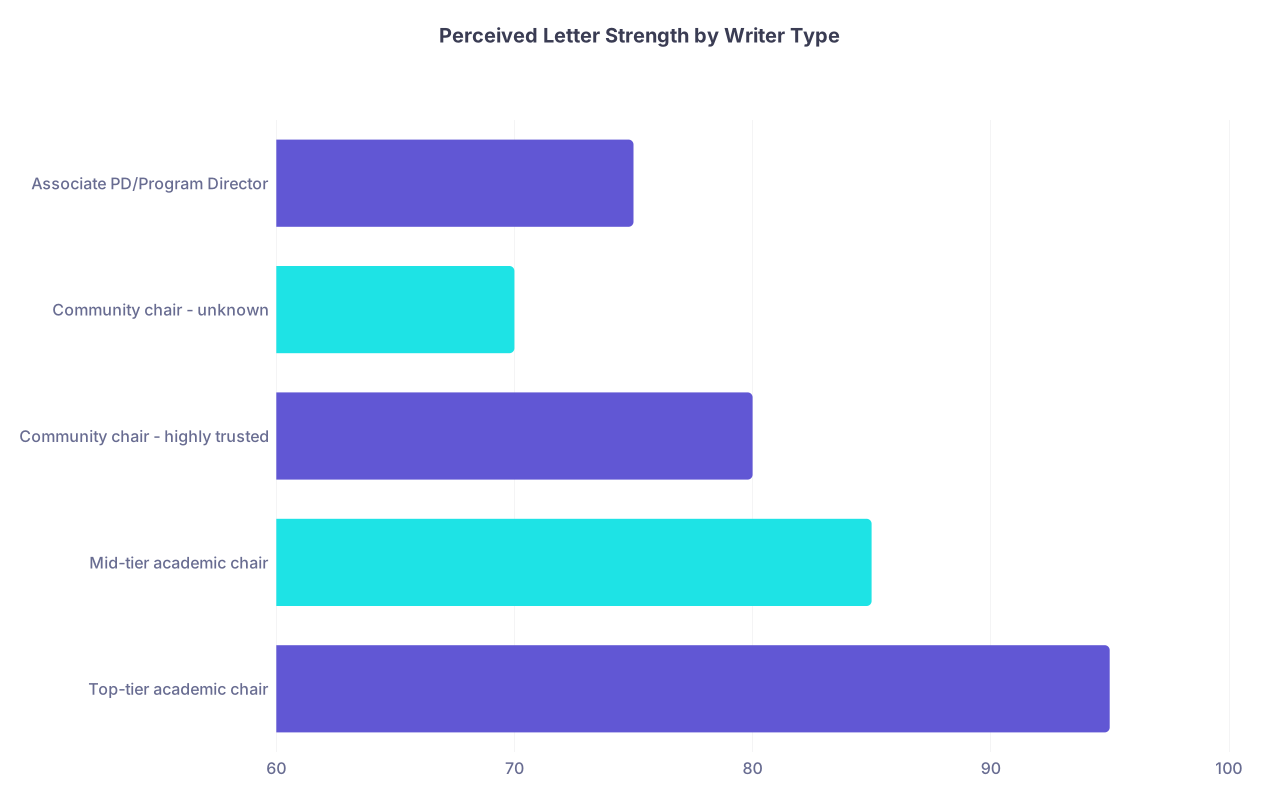
| Category | Value |
|---|---|
| Top-tier academic chair | 95 |
| Mid-tier academic chair | 85 |
| Community chair - highly trusted | 80 |
| Community chair - unknown | 70 |
| Associate PD/Program Director | 75 |
Those numbers are made up, but the phenomenon is not. The “trust score” of the writer is real in the minds of PDs.
Academic Residents: Hidden Advantages
If you’re at a decently known academic program:
- Your chair can place you within a large cohort. That comparative language carries real weight.
- Your research looks more legit by default. “Multi-center trial,” “R01-funded lab,” “JACC abstract” — those phrases open doors.
- Even a modestly supportive chair letter can carry you into good fellowships if the program name is strong.
But there’s a catch. Academic chairs are stingier with top praise. They don’t call everyone “top 5%.” So if your letter is generic, PDs assume you’re middle of the pack even at a strong place.
Community Residents: Hidden Landmines
If you’re at a community program:
- A glowing, narrative-heavy letter without concrete metrics is discounted.
- Your chair might not know what “top 5%” really means in a national sense, but PDs think they do.
- If research is thin or local, the chair’s enthusiastic description might not move the needle much.
However, there is an upside. A few community chairs have built real reputations for writing honest, calibrated letters. When they say “top 5%,” PDs believe them. You want to figure out if your chair is one of those.
How to Optimize Your Letter Depending on Your Program Type
You can’t change where you train. You can influence what ends up in that letter more than you think.
If You’re at an Academic Program
Your biggest risk is being anonymous.
Chairs in big academic departments don’t know every resident well. Often they’re writing from a composite: PD input, CCC notes, a quick glance at your CV, maybe a brief meeting.
To avoid the “generic excellence” letter:
- Make sure your PD and key faculty know specific stories about you: tough cases, leadership moments, times you went beyond. Those stories trickle up.
- Hand your PD a short, bullet-point accomplishments sheet that includes hard data: ITE percentiles, abstracts, QI outcomes. Chairs love data; it feels objective.
- If you’re strong, you actually want comparative language. “Top 5%,” “best in 10 years,” “top 3 of current class.” That language is gold.
Don’t be shy about asking your PD directly (not the chair):
“I’m hoping for a letter that clearly indicates how I compare to my peers, if that’s appropriate.”
They know the code.
If You’re at a Community Program
Your risk is mis-calibration.
You don’t want a warm, fluffy letter that sounds great to you but weak to PDs.
Here’s what you can do:
Educate your writer gently.
When you meet with your chair/PD, bring examples of language from academic letters (you can find examples online or from friends at university programs) and say:
“I’ve heard fellowship PDs really respond to specific comparative statements and concrete details. If you feel comfortable, would you be able to comment on where I stand in our program in that way?”Give them hard numbers.
- ITE percentiles
- Number of posters, presentations, pubs
- Any leadership roles (chief, QI lead, hospital committee)
Numbers cut through the “community discount” a bit.
Ask them to address the program context.
A powerful move is when a community chair says:
“Although we are a community-based program, our residents consistently manage high-acuity patients with significant autonomy, and Dr. X has thrived in this demanding environment.”
That gives PDs something concrete about the training environment.Line up at least one academic letter if possible.
Away elective, research mentor at a university, subspecialist who is known. Even one serious academic letter alongside a community chair letter can recalibrate how PDs see you.
What PDs Look for Across Both Letter Types
Let me strip away the fluff. Regardless of academic vs community origin, fellowship directors are scanning for a few core things in a chair letter:
- Comparative ranking among peers
- Evidence of independent clinical reasoning
- Reliability and professionalism (preferably described with specific incidents)
- Authentic interest and trajectory in that specialty
- Any major red flags, even if coded
They are not moved by:
- Length of the letter
- Flowery adjectives without examples
- Generic “will be an asset anywhere” finales
- Descriptions that could apply to literally any functioning resident
If your letter contains:
“hard-working,” “compassionate,” “team player,” and nothing about where you stand relative to others, your letter is filler. It won’t hurt you, but it won't open doors either.
A Quick Visual: Typical Content Balance
Here’s how the emphasis of content tends to differ between academic and community chair letters:
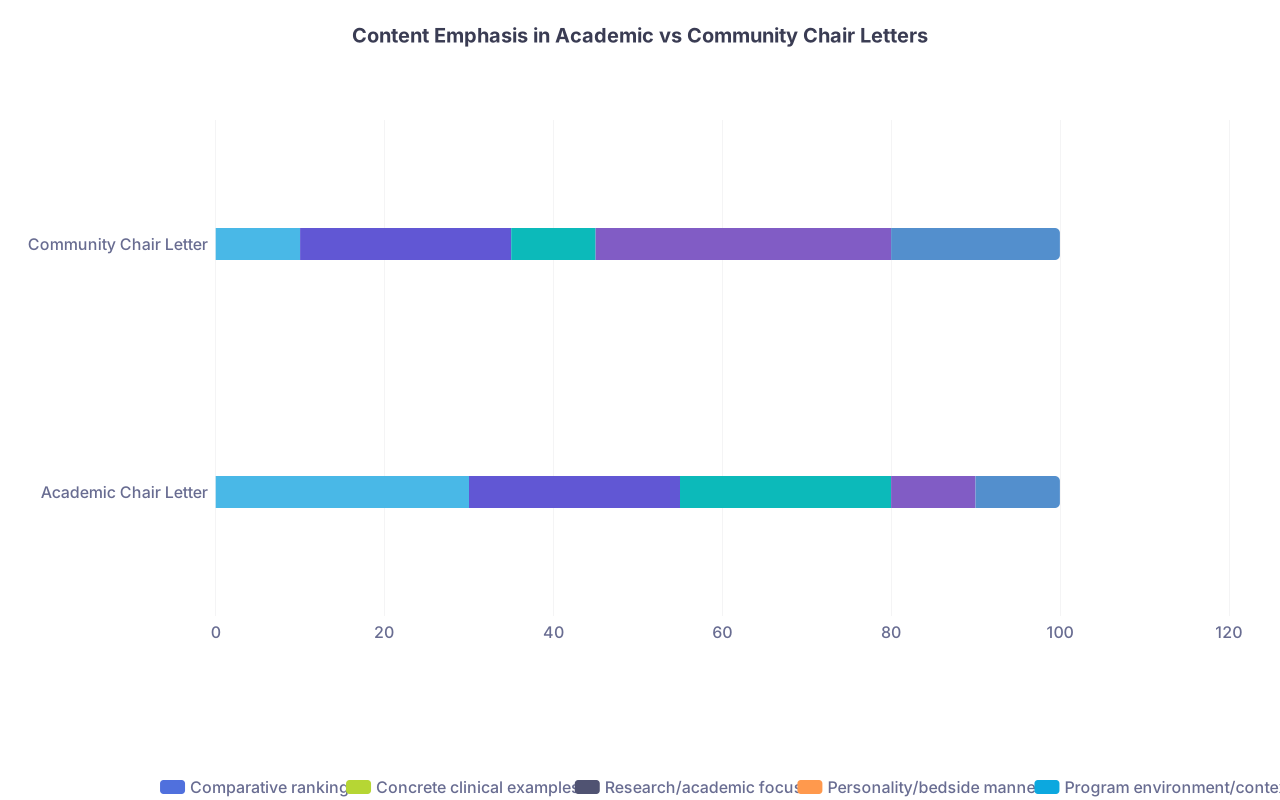
| Category | Comparative ranking | Concrete clinical examples | Research/academic focus | Personality/bedside manner | Program environment/context |
|---|---|---|---|---|---|
| Academic Chair Letter | 30 | 25 | 25 | 10 | 10 |
| Community Chair Letter | 10 | 25 | 10 | 35 | 20 |
You want your own letters, whatever the source, to push more weight toward the top three categories.
FAQ (Exactly 4 Questions)
1. If I’m at a community program, am I automatically at a disadvantage for competitive fellowships?
Not automatically, but you are starting a few yards behind on the track. The name of your program and the typical calibration of community letters mean PDs begin more skeptical. You overcome that with: one or two strong academic letters from away rotations or research, a community chair who uses specific comparative language and program context, and a file that’s clearly stronger than your environment might suggest (ITE scores, research, leadership). Residents from well-run community programs match into competitive fellowships every year. They just don’t do it on generic glowing letters alone.
2. Should I ever not get a chair letter if my program allows it?
For most fellowships, especially competitive ones, a chair or PD letter is expected. Skipping it looks odd unless your specialty explicitly doesn’t care. If your relationship with the chair is weak, you can mitigate that by making sure your PD and associate PDs know you well and feed into that letter. The only time you’d consider avoiding a chair letter is if there’s open conflict or you know, via trusted sources, that the chair will be tepid or negative. Even then, you’d talk with your PD about strategy before you make that call.
3. How can I tell if my chair is a “trusted” writer in the fellowship world?
Ask upper-levels who’ve matched where you want to go. They’ve heard the off-the-record comments. You’ll hear things like, “Yeah, when Dr. Smith writes ‘top third,’ they really mean it and programs know that,” or, “Our chair calls everyone outstanding—fellowship PDs know to take it with a grain of salt.” If your graduates routinely match at good fellowships, your leadership’s letters likely have some weight. If they rarely do despite strong residents, calibration may be part of the problem.
4. What’s one concrete thing I should do this year to improve my future chair letter?
Make sure your PD can tell a specific story about you that illustrates your value. Not a vague “good worker,” but “the resident who took over a collapsing night float system and made it safe,” or “the person who led the QI project that cut readmissions on the service by 15%.” Those stories are what chairs borrow when they need concrete evidence. If all anyone can say is that you showed up, wrote notes, and were nice—your letter will be fine, but forgettable.
Key takeaways:
Academic and community chairs are graded on different curves, and fellowship PDs know exactly which curve they’re reading. The same adjectives mean radically different things depending on who wrote them and where. Your job is to engineer letters—through your relationships, your performance, and the information you feed your writers—that contain concrete comparisons, specific examples, and real context. That’s how you turn a “nice letter” into one that actually moves your rank on a fellowship list.