
The worst residency decision you can make when you’re tied to one city is pretending program type does not matter. It does. A lot.
If you must stay in one metro area and you’re staring at “Local Community Hospital” vs “Big Name University Medical Center,” this isn’t a vibe check decision. It’s a career-shaping one. And the constraints change the rules.
I’m going to walk you through exactly how to choose between them when moving is off the table. Not in theory. In real-life, “I have a mortgage / spouse job / kids in school / visa issue / caregiving duty” reality.
Step 1: Admit Your Constraint Changes the Game
If you’re bound to one city, your strategy is not the same as the average applicant spraying 60 ERAS apps across the country.
You’re dealing with:
- A tiny N of options (maybe 1–2 university programs, 1–3 community programs)
- Very asymmetric power (they have choices; you don’t)
- Long-term geographic consequences (where you train strongly affects where you can work afterward in that same city)
So you cannot just say “I’ll see where I match and decide then.” If you rank blindly and end up stuck at a terrible fit, you do not get a do-over without massive cost.
Your goal is simple and brutal:
Maximize future options while minimizing the risk you do not match at all.
That means you have to think in two tracks at once:
- “Where will I be trained well and be happy enough not to burn out?”
- “How do I keep my floor (worst-case scenario) acceptable, not catastrophic?”
Step 2: Understand What “Community vs University” Actually Means in Your City
Stop thinking in generic stereotypes:
- “Community = chill, more procedural, less research.”
- “University = academic, malignant, more prestige.”
Sometimes that’s roughly true. Sometimes it’s completely wrong. You need to figure out what it means where you are, for your specialty.
Here’s a quick comparison framework you should literally fill out for each local program you’re considering:
| Factor | Local Community | Local University |
|---|---|---|
| Reputation in city | ? | ? |
| Fellowship access | ? | ? |
| Service vs education | ? | ? |
| Research/support | ? | ? |
| Autonomy/hands-on | ? | ? |
You’re not trying to label one as “good” and one as “bad.” You’re trying to see what each one is actually optimized for.
Then match that to your reality:
- Need fellowship? University often helps, but a strong community-heavy program with a history of sending people to that specific fellowship can be just as powerful.
- Want to be a community attending in this city? Sometimes the community program is the pipeline; university grads are seen as “over-academic” or flight risks.
- Need a predictable, stable schedule for family? A chaotic “prestige at all costs” academic ICU machine might wreck your life.
Step 3: Get Real About Your Specialty and Competitiveness
Your choice is narrower if your specialty is competitive and you’re not a superstar applicant.
For example:
- Dermatology, plastics, ENT, ophtho, urology: If your city even has one program, university is probably the only option. Community programs in these fields are rare.
- Internal medicine, family med, peds, psych, EM, general surgery: Often both community and university options exist, but competitiveness still matters.
If your Step 2/Level 2 score is mediocre and you’ve got red flags (failed exam, extended time, no home letter), “I’m only ranking this one university program because I like it more” is a fast path to soap week.
You don’t have the luxury to be purely aspirational.
You have to weigh:
- Probability of matching each program
- Cost of not matching at all
- How bad your worst acceptable option is
I’ve seen this play out the hard way:
- Student tied to a city, wants IM. Applies to local big-name university IM and local community IM. Loves the university. Ranks it #1. Ranks community #2 but constantly trashes it in their head. Matches #2.
Three years later? They’re a solid hospitalist in that same city, happy, respected, and nobody cares where they trained except the credentialing office and their malpractice insurer.
And I’ve seen the opposite:
- Student tied to city, EM hopeful, decides “I’d rather go unmatched than be miserable at that community program.” Ranks just the one university EM. Doesn’t match. Ends up doing a scramble prelim + reapply circus that wrecks their mental health and finances.
You need to be smarter than both of them.
Step 4: Map Out What You Want Five Years After Residency
Forget the next three years for a moment. Where do you want to be five years after finishing residency, given you’re basically anchored to this city?
Write down one of these (or your variant):
- “Hospitalist at a mid-sized community hospital around here”
- “Academic subspecialist with clinic + teaching, maybe research”
- “Outpatient-only primary care in this metro”
- “Private practice subspecialist doing procedures”
- “EM attending working 0.8–1.0 FTE, stable shop, likely local”
Now ask: In this city, which of the local programs has the better track record of placing grads into that job type?
Do not guess. Go find out.
- Check program websites for alumni placements (yes, they’re selective, but still useful).
- Ask residents on interview day, “Where have recent grads ended up working, especially those who stayed local?”
- Call / email a recent alum from your school now at those programs and ask concretely: “If I train there, what kind of job am I realistically set up for in this city?”
Patterns are very local:
- In some cities, the main university program dominates hospitalist and specialist positions across the city.
- In others, community grads are the backbone of the local workforce; university grads either leave the region or fight over a small academic slice.
You’re not choosing “community vs university” in the abstract. You’re choosing “feeder to jobs I want” vs “feeder to jobs I don’t.”
Step 5: Do a Brutally Honest Program Quality Check
You can tolerate some misalignment with your personality. You cannot tolerate truly bad training.
A mediocre but functional program will still graduate you competent. A toxic, disorganized, or chronically understaffed one will chew you up.
Here’s how to assess both the local community and university options on the ground:
Look for these red flags
At either type of program, I get worried if:
- Residents say “we’re like family” but can’t answer basic questions about:
- Board pass rates
- Procedure opportunities
- How feedback is given
- No clear schedule for didactics, or “our attending teaching depends on the day.”
- Constant talk about “service needs” with no balancing language about education.
- High PGY-2 or PGY-3 attrition that’s brushed off as “they just weren’t a good fit.”
- Residents look exhausted and flat, not just tired.
If the only selling point of a community program is lifestyle or being “chill,” that’s not enough. If the only selling point of the university program is prestige, also not enough.
You want:
- Enough volume to get competent
- Enough supervision early and autonomy later
- Enough support that you’re not constantly in survival mode
If one local program clearly fails this standard, that matters more than whether it’s labeled community or university.
Step 6: Factor in Family, Commute, and Controllable Misery
When you’re tied to one city, geography inside the city becomes a big deal. This is where people get blindsided.
Two programs, same city:
- University hospital: 50–60 minute commute each way in traffic, parking nightmare, call rooms in the basement, older facilities.
- Community hospital: 15 minutes door-to-door, easy parking, you can actually get home post-call to see your kids before they sleep.
Over three years, the commute difference alone is hundreds of hours of your life. That’s the equivalent of weeks of free time given back or stolen.
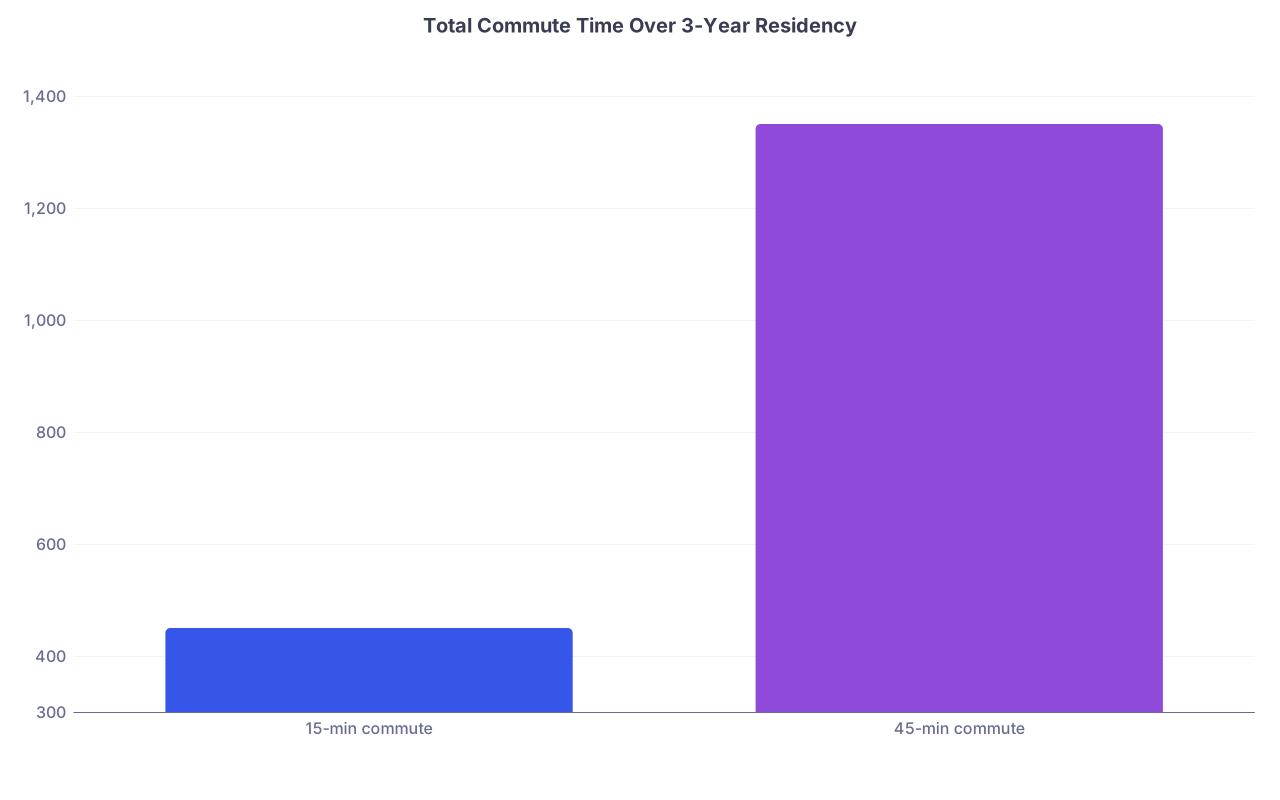
| Category | Value |
|---|---|
| 15-min commute | 450 |
| 45-min commute | 1350 |
(Assuming 5 round-trips/week x 50 weeks/year x 3 years. That’s 450 vs 1350 hours.)
If you’re the primary parent, caretaker, or you’re already stretched thin, that commute and schedule matter more than whether the hospital logo is fancy.
Ask very specific lifestyle questions:
- “How many weekends per month are you in the hospital as PGY-1 vs PGY-3?”
- “What’s your average number of 24-hour calls or night shifts per month?”
- “How reliably do you get your post-call days off?”
- “How often do you get your requested vacation weeks?”
Sometimes the answer is: the community program is less prestigious but far more livable. For some of you, that’s not nice-to-have. It’s the difference between keeping your marriage intact and watching it crack.
Step 7: Use Shadowing and Away Rotations Strategically (If You Still Can)
If you’re still early enough (MS3/MS4 phase), spend real time in both environments before committing your soul to one.
At the university program:
- You’ll see:
- Tertiary-quaternary pathology
- More subspecialists
- More layers in the hierarchy (student → intern → resident → fellow → attending)
- Pay attention to:
- How attendings treat residents when things are busy
- How fellows treat residents (huge in surgical and IM subspecialties)
- Whether residents feel like owners or cogs
At the community program:
- You’ll see:
- Often more autonomy, especially nights and weekends
- More bread-and-butter, less “zebra” pathology (with exceptions)
- Attendings often more hands-on clinically (no fellow buffer)
- Pay attention to:
- Whether autonomy is supported or just abandonment
- Whether there’s enough complexity and volume to keep you sharp
- How comfortable senior residents look handling codes, admits, consults alone
If you already rotated and hated the social climate at one place? Don’t ignore that. You’re not visiting; you’re signing a multi-year lease.
Step 8: Align Program Type with Your Career Trajectory
Let’s get specific. Here’s how I’d advise if you told me you’re stuck in one city and:
Scenario A: You want fellowship and a semi-academic career
- Strong university program in your city?
Rank it high unless it’s truly malignant or your chances of matching there are objectively low. - Community program with a documented pipeline into the fellowship you want (especially at that same university)?
This can be almost as good, sometimes better (more hands-on, more patient ownership, you stand out more as “the academic one”). - No pipeline, no research, no mentorship in that field at the community site?
Now you’re fighting an uphill battle for fellowships, especially competitive ones. Not impossible, but harder.
Scenario B: You want to be a community attending locally
If your dream is to be the doc everyone in town knows at the mid-sized hospital 20 minutes away, a strong community program with good clinical training and strong local reputation may be perfect.
Ask:
- “What proportion of your graduates stay in this city?”
- “How are grads perceived by local groups and hospitals?”
- “Do local hospitalist/EM/PCP groups prefer your residents for hires?”
Sometimes university grads are considered over-trained for the actual market or are expected to leave. A community program could be your golden ticket into stable, lucrative local jobs.
Scenario C: You’re unsure what you want
Then you should prioritize optionality.
Which program gives you:
- More credible letters (for fellowship or jobs)
- More exposure to different practice models
- More networking in both community and academic spheres
Often this is the university program. But not always. In some mid-sized cities, the community program is actually the “hub” that interacts with all the local satellites.
Step 9: Rank List Strategy When You Only Have a Few Local Options
Here’s where most people panic.
Let’s say in your city you have:
- University IM program (more competitive, stronger fellowship funnel, heavier workload)
- Community IM program (less competitive, more lifestyle, limited research)
You’re tied to the city. You prefer university. You’re not a lock.
My rule is simple:
- Rank programs in your true order of preference as long as
- The lowest-ranked program on your list is still a life you can accept
- And you have a realistic (not fantasy) chance of matching somewhere on that list
If your academic record puts you on the borderline for the university program, you still rank it above the community one. You do not “game” it by ranking the safer program first. That’s not how the algorithm works.
You only leave a local program off your list entirely if:
- The training is so weak it genuinely threatens your competence
- Or the culture is so toxic you’re risking serious harm to your mental/physical health
Everything else goes on the list. Yes—even if it’s not your dream. Because not matching at all is usually worse than three annoying years at a decent-but-uninspired program.
Step 10: Reality Check Your Ego vs Your Life
I see a lot of this:
“My classmates will judge me if I pick the community program over the university name.”
Those classmates won’t be there when you’re post-call, staring at your kid’s soccer game on FaceTime because your commute doubled your time away from home.
They won’t be the ones trying to get a local job with a CV poorly aligned to your city’s job market.
You choose the program you can live with, in the life you actually have, not the imaginary med-student fantasy life where prestige solves everything.
Ask yourself two blunt questions:
- If I woke up matched to the community program tomorrow, could I build a decent life and career from there?
- If I woke up matched to the university program tomorrow, could I survive the workload and culture without destroying my health or closest relationships?
If both answers are “yes,” then rank by career alignment and gut preference.
If one answer is “no,” that program should not be at the top, no matter how shiny.

| Step | Description |
|---|---|
| Step 1 | Must stay in one city |
| Step 2 | Prioritize university or community with strong fellowship pipeline |
| Step 3 | Lean toward stronger community program with solid training |
| Step 4 | Prioritize university |
| Step 5 | Prioritize community |
| Step 6 | Need fellowship or academic career |
| Step 7 | Need predictable lifestyle for family or health |
| Step 8 | Local job market favors one type |
A Quick Example to Anchor This
Let me give you a composite but very real scenario.
You:
- MS4, mid-range Step 2/Level 2, no major red flags
- Married, partner has a stable job in the city
- One kid in elementary school
- You want IM, maybe cards or GI, but not sure
- City has:
- University IM: big, busy, name recognition, lots of fellows, 60–70% of grads do some fellowship
- Community IM: smaller, good local reputation, strong hospitalist pipeline, 20–30% fellowship, minimal research unless self-driven
Here’s how I’d tell you to think:
- You do have a realistic shot at university, but you’re not a slam dunk.
- You could be happy as a hospitalist if fellowship doesn’t work out.
- Your partner’s job and your kid’s stability matter a lot. Commute difference 45 minutes vs 15 minutes.
If your gut leans academic but you’re not obsessive about big-name fellowships, I’d say:
- Rank: 1) University IM, 2) Community IM
- But go into interviews at the community program genuinely interested, not treating it like a backup prize. Ask heavily about:
- How they support fellowship applicants
- What scholarly work previous residents have done
- How many grads stay local and in what jobs
If, on the other hand, you’re utterly sure you never want fellowship and family stability is your north star, I wouldn’t blink if you said:
- “I’m ranking the community program first. I’d rather have three saner years, more time with my kid, and a direct pipeline into local hospitalist groups.”
That’s not cowardice. That’s knowing your actual life.
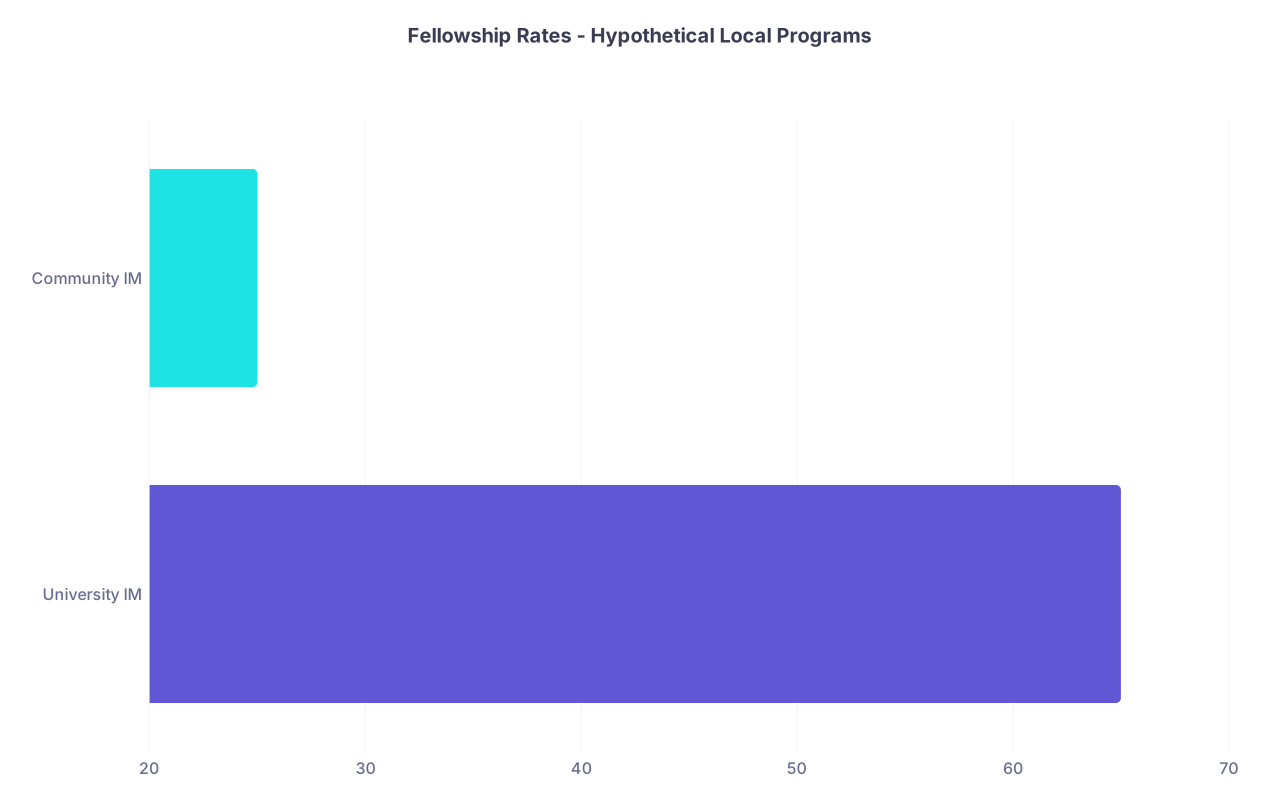
| Category | Value |
|---|---|
| University IM | 65 |
| Community IM | 25 |



Bottom Line: How to Decide If You’re Tied to One City
Keep these three points straight:
Local reality beats stereotypes.
Don’t assume “university good, community bad” or the reverse. In your city, for your specialty, one may clearly be better aligned with your five-year goals. Do the legwork to find out.Acceptable floor > perfect fantasy.
Rank in honest order of preference, but only among programs that give you competent training and a life you can tolerate. Not matching at all is usually worse than matching at a non-ideal but solid community or university program.Train for the life you actually have.
Factor in commute, family obligations, job market, and your true career ambitions. Prestige won’t tuck your kids in, fix your burnout, or guarantee the exact job you want in that city. A good fit, at either community or university, might.