
The worst residency advice dual‑career couples get is this: “Just go where the best program is; your partner will figure it out.” That’s how people end up burned out, resentful, and stuck for years in the wrong city.
If you and your partner both have careers, you’re not just choosing between community and academic programs. You’re choosing between:
- Reasonable commutes vs brutal daily logistics
- One person thriving vs both barely hanging on
- Short‑term prestige vs long‑term relationship stability
Let me walk you through this like we’re literally sitting with your spreadsheets open.
Step 1: Get Honest About Whose Career Is Movable
Before you look at a single program website, you need one hard conversation: whose job is more geographically flexible over the next 3–7 years?
Not whose work “matters more.” Not whose income is higher. Who can actually get hired in more places.
Common patterns I’ve seen:
- Partner is in tech/remote‑friendly fields → They can often work from anywhere with good internet and a big enough city.
- Partner is in academia or higher ed → Often tied to universities; academic medical centers may be better.
- Partner is a teacher, nurse, therapist, or similar → Stronger options in mid‑size/large cities; some small community towns are brutal.
- Partner is in niche industry (film, finance, fashion, certain startups) → Only a few cities realistically work.
Write this out explicitly. Not in your head. On paper.
| Partner Field Type | Geographic Flexibility | Usually Better Match With |
|---|---|---|
| Remote-capable tech | High | Either, larger metros |
| University/academic | Low–Medium | Academic centers |
| Healthcare (non-MD) | Medium | Both, but larger cities |
| K-12 education | Medium | Larger communities/cities |
| Niche industry | Low | Big academic cities |
Now the rule:
If one career has narrow geographic options, that career gets more weight on where you look first. Then you layer on your community vs academic preferences, not the other way around.
People who skip this step end up in “great programs” where their partner is underemployed, isolated, and miserable. That seeps into everything.
Step 2: Understand Community vs Academic Through a Partner Lens
You already know the classic differences: academics = research, fellowships, complexity; community = more autonomy, hands‑on, often better lifestyle. That’s med student stuff.
Here’s how those differences hit a dual‑career couple.
Location Reality
Academic programs are often in or near:
- Larger cities
- University hubs
- Regions with more diverse industries
-
- In smaller cities or suburbs
- Attached to regional health systems
- Sometimes in towns with 1–2 major employers outside healthcare
For your partner, that often means:
Academic center pros:
- More employers within a 30–45 minute radius
- Stronger university/education ecosystem
- Better odds for niche fields (biotech, research admin, arts, NGOs, etc.)
Community program pros:
- If near a major metro/suburb, housing is cheaper and commute can be shorter
- If isolated? Might be a serious career dead spot for your partner
If your partner needs a big labor market, an isolated community program is a hidden landmine.
Step 3: Map Cities, Not Just Programs
You’re not choosing “University of X vs St. Y Community Hospital.” You’re choosing “Cleveland vs Hartford vs Sacramento as a household.”
Do this before your rank list even exists.
List 5–10 cities/regions where:
- You can find a reasonable mix of academic and community residencies in your specialty
- Your partner has at least 5–10 plausible employers in commuting range
For each city, quickly scan:
- Does it have an academic medical center?
- How many community programs exist in your specialty within 45 minutes?
- What does your partner’s job market look like there? Not vibes. Actual job postings.
This is where you realize things like:
- “In City A, I’d only have one academic option and zero community. In City B, I’d have two academic and three community, and my partner has tons of options.”
- “This fancy academic program is in a city where my partner’s industry basically does not exist.”
That second realization is where smart couples pivot away from “dream programs” that would quietly wreck them.
Step 4: Evaluate Programs Using a Dual-Career Filter
Now we actually talk community vs academic.
Here’s what you look at—practically—through the lens of your partner’s job and your life together.
1. Schedule Predictability
Academic programs:
- Often heavier inpatient rotations, nights, and call
- More variability with research, conferences, electives
- Some services are punishing; others excellent
Community programs:
- Often more structured scheduling (not always, but often)
- Fewer “random” obligations—less committee work, less “come in for this research thing”
Dual-career angle: If your partner’s job is rigid (8–6, client-facing, can’t work remote), chaotic residency scheduling hits harder. A reliable-ish schedule makes childcare, commuting, and basic life logistics less insane.
If you have or plan to have kids during residency, a well-run community program can be the difference between functioning and constantly being in crisis mode.
2. Commute + Housing Triangle
You need to solve the triangle:
- Your hospital
- Your partner’s job market
- Housing you can afford and tolerate
In many academic cities:
- You live further out to afford rent
- You commute into a dense hospital core
- Your partner might be in a completely different part of town
In many community settings:
- Hospital may be closer to normal housing
- But your partner might have to drive 45–60 minutes to the nearest job cluster
Now the ruthless question: who is commuting more? Who is miserable?
Healthy pattern I see:
- The resident accepts a slightly longer commute than ideal to keep the partner’s commute reasonable and access to childcare/schools sane.
- Or, if partner is remote, the resident anchors housing near the hospital and the partner adjusts.
When a resident is commuting an hour each way for an “elite” program while the partner drives 75 minutes to the nearest job, they both suffer. The badge prestige stops mattering around month three of I‑95 traffic.
Step 5: When Academic Makes More Sense For Your Partner
Sometimes the correct answer for a dual‑career couple is: you pick the academic program even if you personally like the vibe of community better.
Pick academics when:
Your partner needs a university or major corporate hub
- They’re in higher ed admin, lab science, engineering, policy work, arts, media, etc.
- Academic medical centers live in cities that actually have these jobs.
You want or need fellowship in a competitive field
- Cards, GI, heme/onc, derm, ortho, etc.
- Being in an academic center with strong mentors may shorten the overall training journey (and move you faster to a more flexible attending life where you then move for your partner).
Your partner’s earning potential or career trajectory is steep
- Walking them off that path for a random mid‑size community town can be a huge long‑term hit.
The big mistake here is underestimating how much easier your partner's job search is in an academic city.
I’ve watched couples where:
- Resident matched at a mid‑tier academic IM program in a “B‑tier” city
- Partner stepped into a solid job in their field within 2–3 months
- By PGY‑2 they had a stable routine, a friend group, and a livable life
While the couple who chased a slightly “better community program” in a much smaller city? Partner spent 8 months piecing together part‑time work outside their field, isolated, and seriously regretting the move.
Step 6: When Community Is The Right Play For The Relationship
On the flip side, community can be the smarter dual‑career move—even when everyone around you worships academic prestige.
Community often wins when:
Lifestyle is the limiting factor
- You or your partner have chronic health issues
- You’re primary caretaker for kids or another family member
- You burn out easily and know a brutal academic schedule is not sustainable
Your partner’s work is location‑flexible but time-sensitive
- They may work freelance, client‑based, or shift‑based
- Having you predictably home for evenings or certain days matters more than you being in a big city
The community program is in a metro area with a legit job market
- Not every community program is in the middle of nowhere
- Some are in suburbs of major cities (best of both worlds: manageable schedule for you, plenty of jobs for them)
You’re applying in a specialty where community training is fully accepted
- FM, IM (if not chasing ultra-competitive fellowships), EM, peds, psych, anesthesia etc.—plenty of respected community grads
What I see work well:
- Resident at a busy but well‑run community hospital 25 minutes from home
- Partner working a normal 9–5 in a nearby business district
- Evenings and weekends that are actually…evenings and weekends, at least some of the time
You may give up a shiny name. You gain five years of not constantly apologizing to your partner for missing everything important.
Step 7: Couples Matching and the “Two Maps” Problem
If you’re couples matching (both in medicine), the academic vs community decision gets more tangled, but the principle is the same: you’re still trying to build one life, not two parallel careers that occasionally intersect.
Here’s how I’d structure it:
For each city, sketch:
- Academic + Academic option
- Academic + Community option
- Community + Community option
- And whether each combo is even realistic for your specialties
Then apply the dual‑career lens:
- Who is more fellowship‑dependent? That person might lean academic.
- Who is more lifestyle‑fragile (burnout, health, caregiving)? That person might lean community.
A very common winning pattern:
- One partner at the big academic flagship
- The other at a nearby strong community program within 20–30 minutes
They share a metro area, maybe not a parking lot. It still works.
Step 8: Use Interviews To Reality‑Test Partner Compatibility
Stop treating interviews like isolated academic auditions. They’re reconnaissance missions for your whole life.
On interview day (or virtual follow‑ups), bluntly ask:
- “How many residents here have partners working outside medicine?”
- “Where do partners typically find work?”
- “Do residents usually live near the hospital or commute from [X neighborhood]?”
- “Anyone with kids and dual‑career households I could speak to?”
Academic places that are actually decent for partners will have answers. Often specific:
- “A lot of partners work at the university, tech companies in [suburb], or at the big insurance employers.”
- “Most people live in [neighborhoods]; commute is 15–30 minutes.”
- “Let me connect you with Dr. Smith; her spouse works in finance.”
If they stare blankly or say, “I’m sure it’s fine, people figure it out,” that’s code for: you’re on your own.
At community programs, listen for:
- Whether attendings actually get home for dinner sometimes
- Whether residents describe their life as survivable vs barely controlled chaos
- Whether anyone mentions partners with solid careers or just “my spouse stays home”
You’re not looking for perfection. Just evidence that your scenario isn’t completely foreign to them.
Step 9: Build a Rank List That Protects the Relationship
Here’s the draft‑rank‑list litmus test I use with dual‑career couples:
Take your top 5–10 programs.
For each, ask: if my partner got a typical job in that city—not their dream job, just normal—on a normal schedule…
- Could we see each other regularly?
- Could we afford to live within 30–40 minutes of both jobs?
- Would either of us be giving up something unrecoverable long‑term?
Now ask the inverse nightmare:
- If my partner could not find a job in their field there for 9–12 months, how bad would that be?
- Is this city one where they could at least work near their field or build adjacent skills?
Using those answers, I’ve told people outright:
“Yes, that top‑10 academic program is technically ‘better,’ but based on what you’ve told me, I’d rank this solid community program in the bigger city higher. You’ll both stay afloat there.”
Your goal is not to squeeze every drop of prestige out of the Match. Your goal is to exit residency with:
- A career you can build on
- A partner who still likes you
- A life that is flexible enough for the next move
Sometimes that’s an academic powerhouse. Sometimes it’s a no‑drama community program in a well‑chosen city.
Step 10: Simple Decision Framework When You’re Stuck
If you’re genuinely torn between a community and academic option, use this three‑question filter:
Does one city clearly work better for your partner’s career?
If yes, that location gets the edge. Programs are temporary; industries and networks are not.Is your future fellowship or academic dream truly dependent on an academic residency?
Not just “it would help.” If you can realistically get there from a community program that fits your life better, do not sacrifice everything for marginal advantage.Which option gives your household more optionality at the end of residency?
- More cities you could move to
- More job markets still open to both of you
- Less debt and burnout
The option that keeps more doors open usually beats the one that looks fancier on Match Day.
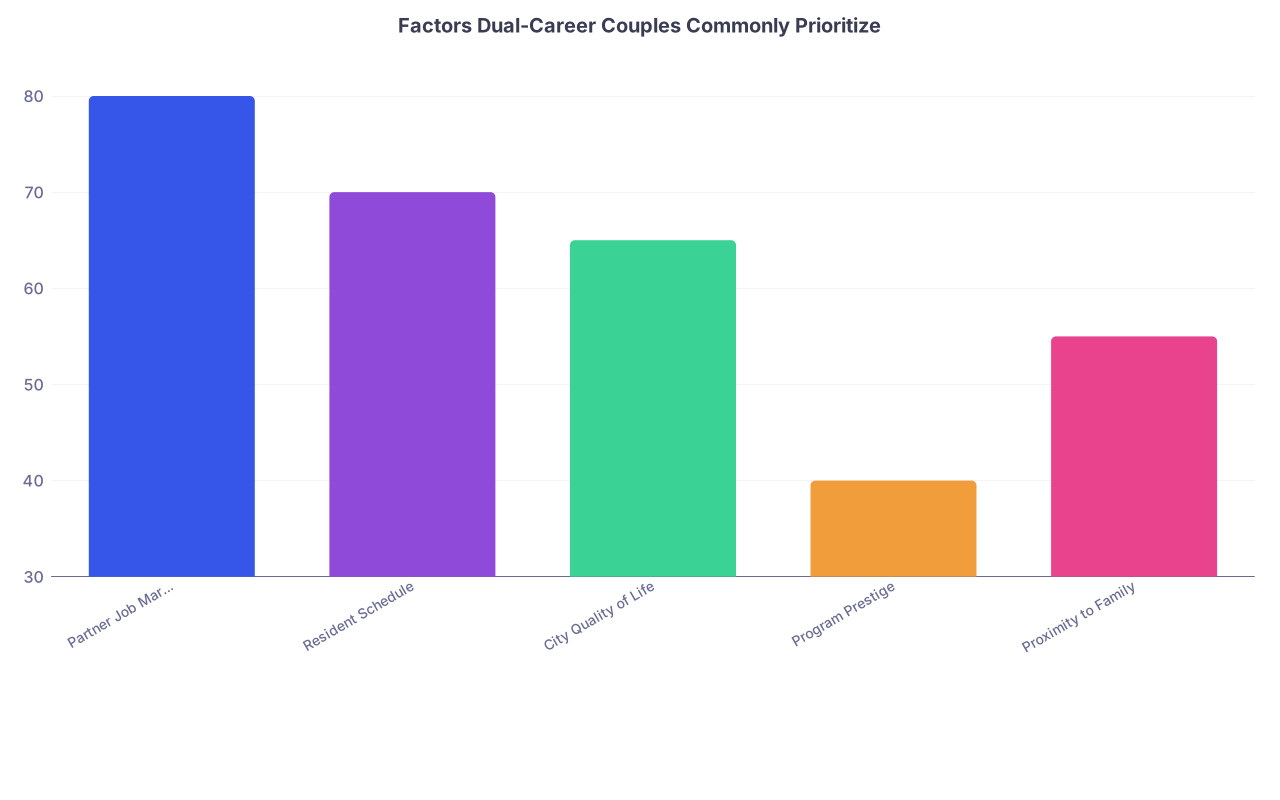
| Category | Value |
|---|---|
| Partner Job Market | 80 |
| Resident Schedule | 70 |
| City Quality of Life | 65 |
| Program Prestige | 40 |
| Proximity to Family | 55 |

| Step | Description |
|---|---|
| Step 1 | Start - Dual career couple |
| Step 2 | Prioritize cities with academic centers |
| Step 3 | Lean academic but check partner jobs |
| Step 4 | Include strong community options |
| Step 5 | Compare 2-3 cities |
| Step 6 | Rank programs in those cities higher |
| Step 7 | Partner job needs big market |
| Step 8 | Resident needs competitive fellowship |
| Step 9 | Which city supports both careers |
The Bottom Line
Three things I want you to walk away with:
- You’re choosing a city and life first, a program second. Academic vs community is just one lever in making that life work for both careers.
- Give more weight to the partner with fewer geographic options and to the program structure that keeps your household functioning, not just your CV shiny.
- The “best” program is the one where, five years from now, you still have a strong relationship, viable careers for both of you, and enough energy left to actually enjoy being an attending.
Aim for that. The rest is noise.