
You’re sitting in your childhood bedroom in a town of 8,000 people, staring at two open tabs on your laptop.
Tab 1: A big-name academic program in a major city, NIH funding, subspecialty fellowships, residents quoting New England Journal articles on their website photos.
Tab 2: A community-based program two hours from where you grew up, smaller hospital, no fancy research page, but residents look… normal. Happy. Human.
You keep thinking:
“I want to practice in a big city eventually. But I’m from a rural place. Programs see that and assume I should do ‘rural track.’ If I pick community now, am I closing the door on an academic or urban career?”
That’s the situation. Rural background. Urban goals. You’re trying to decide how community vs academic programs fit into that, and you’re worried that one wrong click on ERAS or one wrong rank choice will lock in your whole future.
Let’s be blunt: it will not. But there are ways to make smart moves here, and there are definitely ways to paint yourself into a corner.
Here’s how I’d walk you through it if we were sitting together with your ERAS list open.
Step 1: Get brutally clear on your actual endgame
Before you even care about “community vs academic,” answer three questions in plain language. Not what sounds good in an interview. What’s actually true.
Do you see yourself:
- A. Doing primarily clinical work in 5–10 years?
- B. Doing a fellowship, being at a big academic center, or doing research/teaching as a major part of your job?
How committed are you to living/working in a big city long term?
- “I just want out of this town” is not the same as “I must be in LA/NYC/Chicago.”
How much do you like the idea of academia vs the reality? Reality = writing IRB protocols at 10 p.m., struggling for funding, grinding on manuscripts, doing QI projects that die in committee. Some people love this. Others like the brand name but hate the life.
Write your answers out. One paragraph each. If your answers are basically:
- “I want to be a clinically strong doc in a city, maybe teach, but I don’t need to be a researcher,”
then community programs are absolutely still in play.
If your answers are:
- “I want a competitive fellowship, I like research, I want to be on faculty or be sub-sub-specialized in a major city,”
then you lean academic—but not exclusively.
Your rural background isn’t the issue here. Your trajectory is.
Step 2: Understand what community and academic actually buy you
Strip away the marketing language. Here’s the real tradeoff.
| Factor | Community-heavy Program | Academic-heavy Program |
|---|---|---|
| Research output | Lower, must be self-driven | Built-in, structured, often expected |
| Fellowship pipeline | Variable, often narrower | Stronger, especially for competitive fields |
| Autonomy early on | Often higher | Slower early, more layers of supervision |
| Breadth of pathology | More “everyday” bread-and-butter | More zebras, complex tertiary care |
| Lifestyle | Often more humane, fewer services | Can be brutal, high service load |
This is not universal. Some community programs are ridiculously rigorous and send people to top fellowships. Some academic programs function like over-glorified community hospitals. But if you’re trying to decide direction, those are the usual patterns.
Now add your context: rural background, urban goals.
What you care about is not “Is it community or academic?” but:
- “Will this place give me enough training and exposure to get me hired in an urban practice or accepted to an urban fellowship?”
- “Will this place trap me locally if I’m not careful?”
Those are different questions.
Step 3: Use your rural background strategically, not as a label
Programs love rural kids. They see “from small town, first-gen, grew up on a farm” and they immediately think: “This person might practice in an underserved area. Gold.”
That’s fine. But you do not owe anyone a career in rural medicine just because of your origin story.
Here’s how to present your background without locking yourself into “rural track forever”:
Emphasize what rural gave you:
- Continuity of care (everyone knows everyone)
- Resourcefulness (you don’t send every cold to the ED)
- Appreciation of primary care and generalists
Then connect it to your urban goals:
- “Growing up in a small town showed me how limited access affects outcomes. I want to train in a larger, diverse setting so I can bring that experience back to underserved patients—whether they’re in rural communities or underserved urban neighborhoods.”
Avoid overly committal phrases in your personal statement:
- Do NOT write: “I know I will return to a rural area to practice.”
- Better: “I’m drawn to working with underserved populations, including rural communities like the one I grew up in and urban communities facing similar barriers.”
Programs will project whatever they want onto you. Your job is to be internally consistent: rural background + urban training goals + underserved focus. That combination actually reads very well at both community and academic programs.
Step 4: Identify the real career limitations of each path for you
Now we get practical. You’re not comparing “community vs academic” in the abstract. You’re comparing specific program types vs specific career goals.
I’ll break it by scenario.
Scenario A: You’re aiming for a competitive fellowship in an urban center
Think GI, Cards, Heme/Onc, Derm, certain surgical subspecialties.
Rules of the game:
- Publications and letters from known faculty matter.
- Case volume and complexity matter.
- Where previous residents matched matters a lot.
In this scenario, your safest choices are:
Academic programs in cities or strong regional centers that:
- Have in-house fellowships, and
- Consistently place residents into those fellowships or comparable external programs.
Large “hybrid” community programs that:
- Are affiliated with an academic center,
- List concrete fellowship match outcomes into major cities.
Red flag: small isolated community programs with vague “our grads go on to fellowships” and no specific list. If they can’t write the list on their website, it is probably not impressive.
If you’re choosing a community-heavy program here, you need to see:
- Named fellowship matches at the kinds of places you want to be.
- Evidence that residents can get research (even if it’s QI and retrospective stuff).
If you don’t see that, you’re gambling.
Scenario B: You want urban general practice, maybe teaching, not research-heavy
This is where people from rural backgrounds can overshoot—chasing a hyper-academic name they don’t actually need.
If your dream is:
- Hospitalist in a city
- Outpatient doc in a big metro area
- Maybe clinical educator, but not on an R01 track
Then:
- Many community programs are absolutely fine, especially those based in or near cities.
- You don’t need a “Top 10” academic name to get an urban job. You need good training, solid letters, and networking.
Here, choosing a strong community program might actually be an advantage:
- More autonomy early, more real-world bread-and-butter.
- Less pressure to constantly “produce” academically.
- You can still moonlight, teach, and find your way into a city job after.
I’ve seen residents from solid community programs end up as hospitalists at big academic centers in major cities. How? Rotations there as senior residents, networking, good evaluations. It’s not magic.
Step 5: How to read programs through your “rural background, urban goals” lens
When you look at a program website or interview day, you should be asking:
Where do grads physically end up?
- Pull up their current resident list and alumni destinations.
- If 90% of grads stay within a 2-hour radius in small towns, that’s a local pipeline program. It’s built to feed the region. Escaping to a big city isn’t impossible, but the wind is not at your back.
What kind of catchment area do they serve?
- A “community program” in a metro area of 2 million is not the same as a 150-bed hospital two hours from the nearest city.
- Your urban goals are better served if the patient population is already urban or at least mixed.
Who are their affiliated hospitals?
- Some “community” programs have academics in the background: a university name, a tertiary referral center, a VA with subspecialties.
- That can give you the best of both worlds if you play it right.
What’s their attitude toward research and QI?
- You don’t have to be obsessed with research. But if a program acts allergic to it—no projects, no protected time, no mentorship—that can hurt you for fellowships and academics.
Step 6: Use your application strategy to keep both doors open
You don’t need to resolve your entire life plan before ERAS. You just need to avoid boxing yourself into only-rural-community or only-ultra-academic.
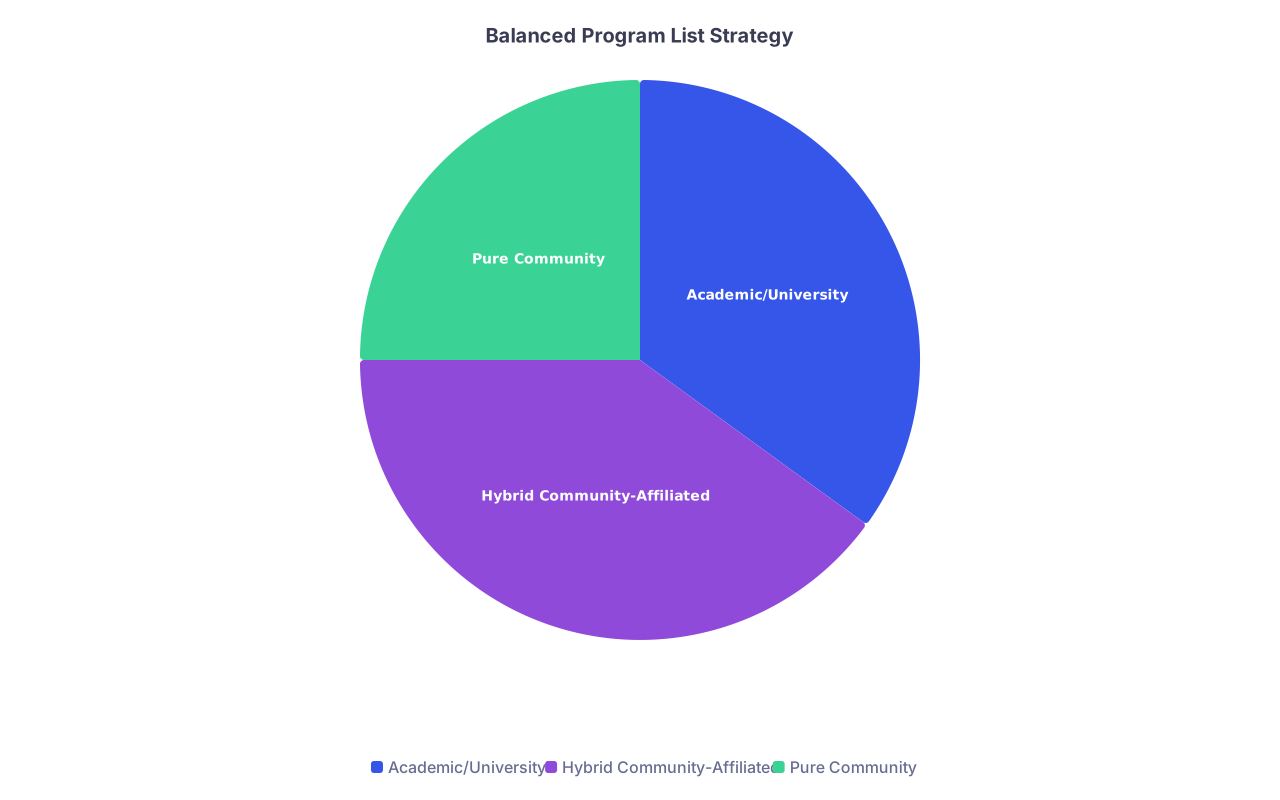
Here’s a simple mix that works for a lot of students in your shoes:
| Category | Value |
|---|---|
| Academic/University | 35 |
| Hybrid Community-Affiliated | 40 |
| Pure Community | 25 |
That mix keeps options alive:
- You have academic-heavy places if you decide you really want the academic grind.
- You have hybrid and community programs if you realize you actually want a saner, clinically focused training but still might shoot for an urban future.
On your application materials:
- Personal statement: rural story + underserved focus + desire for broad, diverse training, not “must return to hometown clinic.”
- Experiences: show that you handled rural and sought out variety—urban rotations, safety-net hospitals, maybe a public health angle.
- Letters: try to get at least one from someone at a bigger/urban institution if possible. That bridges your background with your goals.
Step 7: On interview day, ask the questions that really matter
You’re not asking, “Is this community or academic?” You’re asking, “Does this place move people from where I am to where I want to be?”
Concrete questions to use:
To residents:
- “Where are recent grads practicing? Do many end up in large cities?”
- “Have people matched into urban fellowships? Which ones in the last 3–5 years?”
- “How easy is it to set up an away elective at a big academic center if I want to?”
To program leadership:
- “What kind of support exists for residents who want to pursue academic or urban careers, given that many trainees here come from rural backgrounds?”
- “Could you share where your last few residents who wanted urban jobs/fellowships ended up?”
Pay attention to how fast they answer. If they stumble and generalize—“Oh, our grads do very well!”—and cannot give examples, that’s telling.
Step 8: Protect yourself from the “local trap”
Here’s the real risk with some rural-heavy community programs: you get silently track-typed.
You show up: rural background, say you love underserved work. They hear “future local recruit.” They may unconsciously steer you toward:
- Local job fairs
- Networking with only local private groups
- “We really need a hospitalist in [Town 45 minutes away]. You’d be perfect.”
None of that is evil. But if you want to end up in a city, you have to swim upstream a bit.
Ways to protect your future self if you choose such a program:
Say your plan out loud early:
- To PD: “Long term, I see myself working in an urban safety-net or academic setting. I also really value my rural roots and want to train broadly. I’d like your guidance on how to position myself for that path.”
Push for external exposure:
- Electives at big city academic centers.
- Conferences in cities where you can meet faculty.
- Case reports or small projects with external collaborators.
Build your CV with “portable” things:
- Quality QI or clinical work that can be discussed at interviews anywhere.
- Leadership roles not limited to local issues (state specialty societies, national organizations, etc.).
If you do this intentionally, a community program—even a rural-leaning one—does not have to keep you in the region.
Step 9: When community actually beats academic for your situation
There’s a myth that if you want an urban life, you must train at a big city academic center. That’s lazy thinking.
Here are situations where I’d actually tell you to pick the strong community option:
- You’re already leaning burned out, and the thought of constant call + research + “be impressive or die” culture makes your chest tight.
- The academic program you’re considering is malignant, undersupported, or chaotic, but “big name.”
- The community program:
- Has high board pass rates,
- Solid case volume,
- A track record of placing graduates in the kind of jobs you want (even if not with famous names),
- And the residents actually look like they’re surviving.
Also, some community programs are in metro areas themselves. They just aren’t university-owned. Training at a big community hospital in a city can be a fantastic way to transition from rural upbringing to urban life without frying yourself.
Step 10: When an academic program is worth the pain
Flip side. Sometimes the big academic program is the right call, even if it means less comfort.
Choose the academic path if:
- You’re serious about a competitive fellowship in a Tier 1 city.
- You get actual research opportunities with mentors who publish, not just “we support projects.”
- You’re okay with being one small cog in a large, sometimes impersonal machine, because the tradeoff is branding, pipeline, and exposure.
Watch out for:
- Pure prestige with no mentorship.
- Programs that treat residents as cheap labor with no interest in where you end up.
- Vibes on interview day where every resident sounds exhausted and flat.
You’re not signing up for martyrdom. You’re making an investment. It needs a return.
A quick decision mini-map
Here’s a simple framework. Plug in your answers honestly.

| Step | Description |
|---|---|
| Step 1 | Start - Rural background |
| Step 2 | Prioritize academic or strong hybrid programs |
| Step 3 | Choose best community with fellowship track record and urban ties |
| Step 4 | Prioritize community or hybrid in or near cities |
| Step 5 | Strong community near desired lifestyle, ensure solid training |
| Step 6 | Want competitive fellowship or academic career? |
| Step 7 | Have offers from solid academic or hybrid programs? |
| Step 8 | Want urban general practice? |
You’ll notice “rural background” isn’t a fork. It’s context. Not a shackle.
What to do this week, concretely
If you’re in the middle of ERAS or rank list chaos, here’s a one-week action plan.
Day 1–2:
- Write out your real 5–10 year goals in a page. No fluff.
- Circle: academic-heavy, mixed, or clinical-heavy future.
Day 3:
- Take your current program list.
- Mark each as: academic, hybrid, or community-heavy.
- For each, quickly Google: “Program name + fellowship match” or “Program name + alumni.”
Day 4:
- Email 2–3 current residents at programs you’re seriously considering. Ask where grads end up and how easy it is to pursue urban opportunities.
Day 5–6:
- Rework your personal statement and interview answer to: “Tell me about your background and how it influences your career goals” so it says:
- Rural roots
- Underserved focus
- Desire for broad, diverse training
- Openness to urban/academic paths without sounding like you hate small towns
Day 7:
- Adjust your ERAS list or rank list:
- Drop any program that clearly traps almost everyone locally unless you’d actually be okay staying there.
- Make sure you’ve got a mix of academic, hybrid, and solid community that aligns with your written goals.
Looking ahead
You’re not really choosing between “rural” and “urban” right now. You’re choosing a training environment that either:
- Pushes you toward a narrow local pipeline you might not want, or
- Keeps multiple doors open while you grow into the doctor you’re actually going to be.
Your background is an asset. It makes you relatable, grounded, and attractive to programs. Your job is to use it without letting everyone else decide what it means for you.
Once you land in a residency, the next phase starts: using that environment—community, academic, or in between—to carve out the exact future you want in whatever city you choose. How to do that as an intern and resident, how to line up urban jobs or fellowships from wherever you train—that’s the next chapter.
For now, your goal is simple: pick a program that trains you well, doesn’t box you in, and matches who you are today with who you might want to be tomorrow. If you get that right, your rural roots and urban goals can actually work together, not against each other.