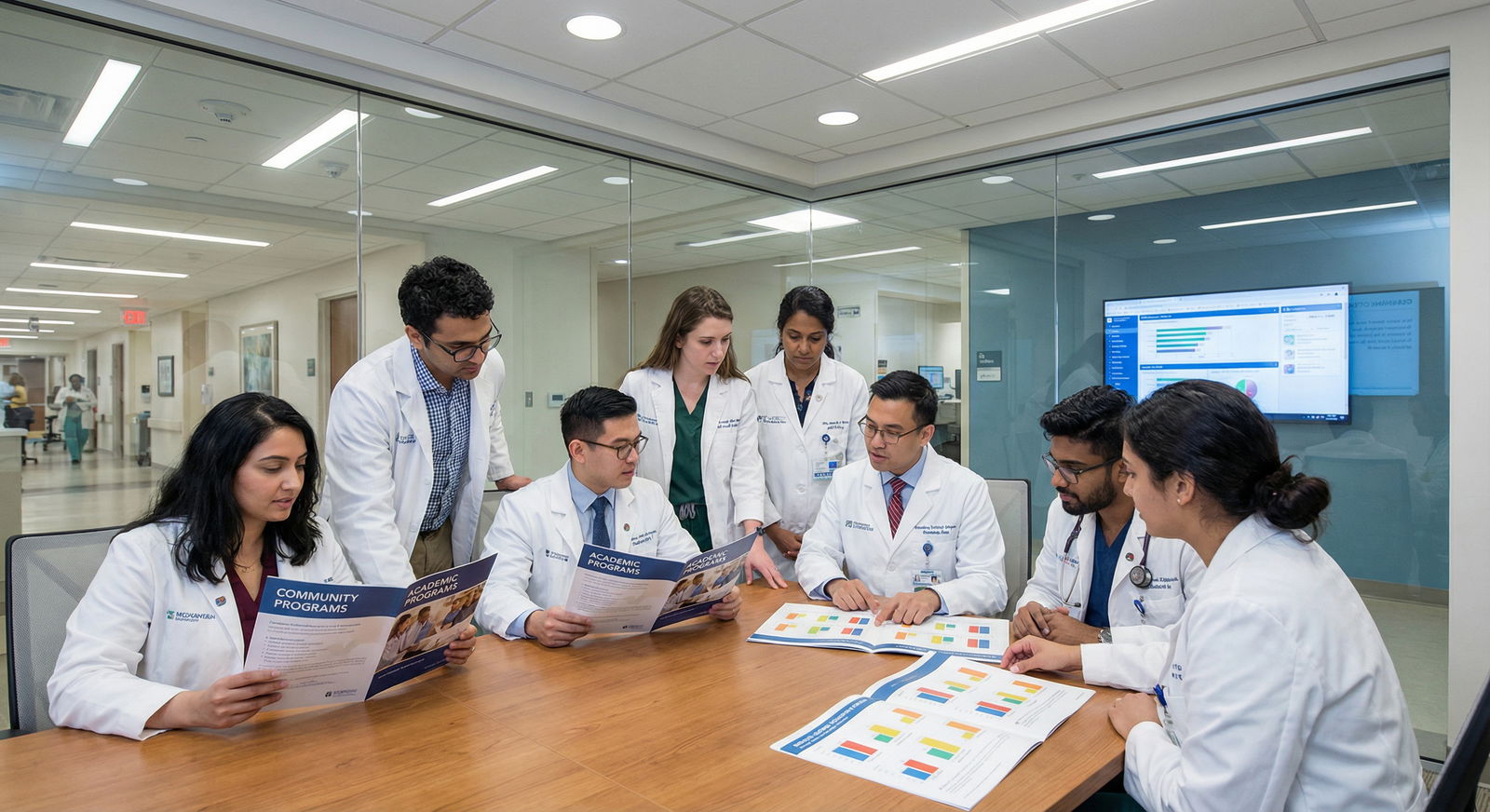
The prestige arms race you’re obsessing over? Community program directors are quietly using it against you—and against the big-name academic centers.
The Quiet Power Play You Do Not See
Here’s the part applicants rarely understand until it’s too late: community program PDs are not trying to beat Mass General or UCSF head‑to‑head on brand name. They win by playing a completely different game.
I’ve sat in on rank meetings where a “no-name” community hospital pulled in residents that academic centers thought they had locked up. The PD smiled, shrugged, and said, “They want a life. We actually offered them one.”
You’re being sold a very polished narrative by academic programs: research, prestige, fellowships, “leadership in the field.” Meanwhile, community PDs are having brutally honest conversations with you behind closed doors: schedule, lifestyle, operative volume, real mentorship, actual teaching. Those conversations flip more candidates than you think.
Let me break down how the game really works.
How Community PDs Think About You (Versus Academic PDs)
Here’s the key structural difference: academic programs recruit for the institution; community programs recruit for the service.
At the big academic center, you are one of many. They know they’ll fill. They know their name carries. They assume you’ll bend to them.
At a strong community program, every single resident matters. One bad hire poisons a small team. One superstar changes the whole culture. So they recruit like it actually matters—because it does.
I’ve heard this in a community PD’s office, word for word:
“If I get six residents per year, and I miss on two of them, my seniors are screwed. I cannot afford to just ‘see who shows up’ like [big academic nearby] does.”
So the mindset is different:
- Academic PD: “We’ll screen by Step, research, school name. The top 40 we like will rank us anyway.”
- Community PD: “Who is going to show up at 3 a.m., carry the pager, and not collapse in October? Who will actually stay in this city and thrive?”
That mindset shapes everything—what they ask you, how they sell the program, what they remember about you, and how they rank you.
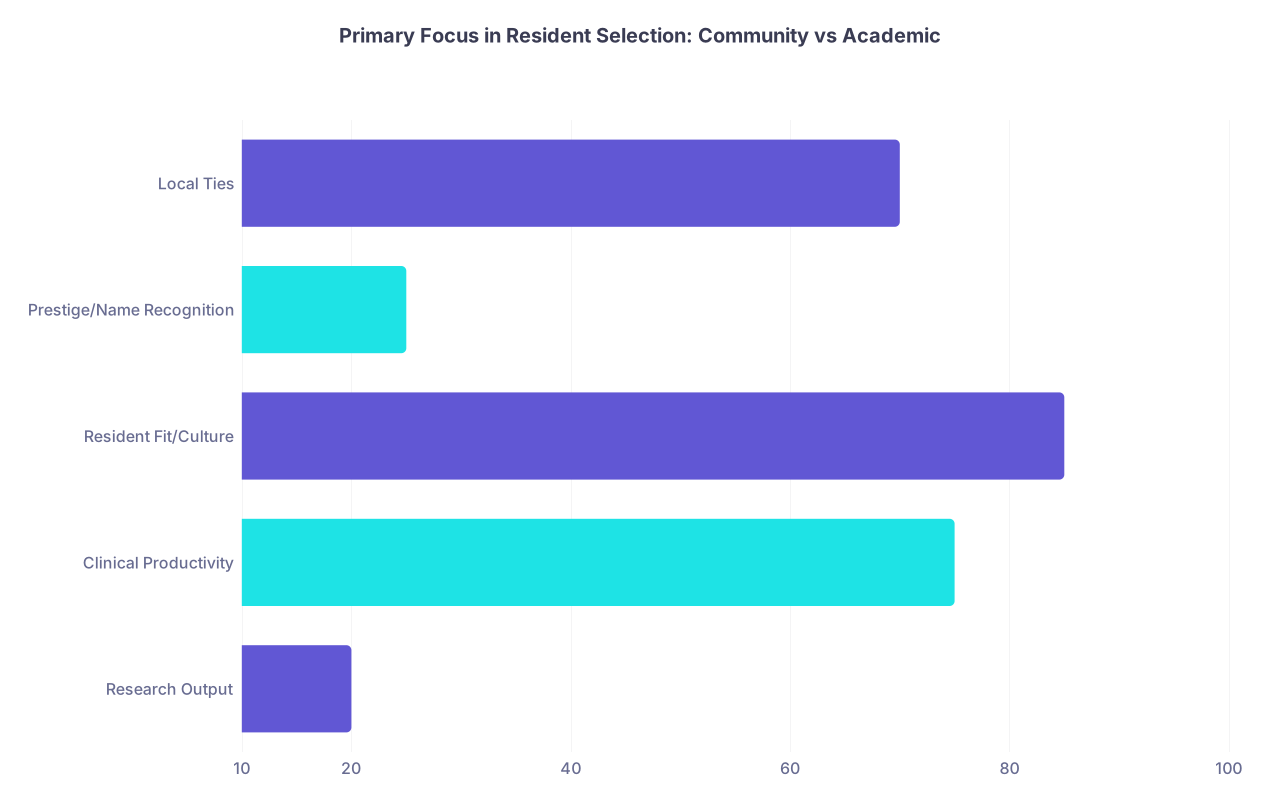
| Category | Value |
|---|---|
| Research Output | 20 |
| Clinical Productivity | 75 |
| Resident Fit/Culture | 85 |
| Prestige/Name Recognition | 25 |
| Local Ties | 70 |
Those numbers are not literal survey data—I’m telling you the reality of how often I hear each factor brought up in actual rank meetings at community sites.
Tactic #1: Selling What Academic Programs Secretly Cannot Offer
Academic places love to show you shiny things: simulation centers, NIH grants, “first to implant Device X.” Residents see the nice conference room and the prestige wall.
But step outside that tour, and the insiders know the truth: most of your day will be pages, notes, fighting the EMR, and covering three services because the fellow is off at a conference.
Community PDs exploit that gap hard.
They sell three big things—things academic programs either do not have or cannot safely admit to not having.
1. Real Autonomy, Earlier
In many community programs, there’s no fellow to fight you for cases. There’s no army of subspecialty residents blocking your procedures. When I hear a community PD talk in a selection meeting, you hear phrases like:
- “By October of intern year, they’re running the night float with backup.”
- “PGY-3s are doing all the central lines and most intubations.”
- “Our seniors run their own service; I’m there, but they’re the doctor.”
At the “name” academic center down the road? The PD can’t say that honestly. There are fellows. There are subspecialists. There are NIH studies with strict protocols. Residents are low on the hierarchy.
Applicants who ask the right questions pick up on that fast.
2. Work-Life Balance That’s Not Just PowerPoint
Lifestyle is the dirty word academics pretend not to care about in public—but absolutely talk about behind closed doors when it comes to faculty retention.
In interviews, academic programs will say: “We value wellness.”
In practice, you get passive-aggressive comments when you call in sick or refuse a “voluntary” extra clinic.
Community PDs, the smart ones, weaponize this:
- They show you real schedules.
- They introduce you to residents who actually look rested.
- They talk numbers: “You’ll average 60–65 hours here, not 80+ every week.”
I’ve seen applicants walk out of a big-name interview dazzled, then go to a mid-sized community program and say afterward, “Those residents seemed… happier.” That’s not an accident; the PD curated that.
3. The Honest Path to Fellowship (Yes, From Community)
Academic programs oversell fellowship placement as if they have a monopoly on it. They don’t.
Community PDs who know the game will show you their last 5–10 years of fellowship placements—CCM, GI, Cards, Heme/Onc—from “regular” hospitals. They’ll say it plainly:
“You want GI? You need strong letters, solid numbers, real responsibility, and a PD who picks up the phone. You don’t need a brand name if your application looks like you’re the best resident we’ve had in five years.”
Behind the scenes, I’ve seen fellowship directors say this:
“I care more about who’s calling me than what’s on the letterhead.”
A respected community PD with a reputation for sending high-functioning fellows carries more weight than a random associate PD at a famous university you barely worked with.

Tactic #2: Ruthlessly Personal Recruitment
Here’s where community programs absolutely crush big-name academics: they actually court you like you matter.
Academic programs, by volume, often cannot. They get 2000+ applications. They auto-filter. They blast generic emails. Their interview days can feel like a factory tour.
Community PDs know they don’t win the prestige battle unless they win the relationship battle.
So they:
- Email you personally, not from some generic coordinator account.
- Remember your spouse’s job and bring it up again in January.
- Connect you with a resident who shares your language, hometown, or niche interest.
- Offer second-look shadow days that are actually useful, not just fluff.
I’ve seen PDs write notes during your interview: “Partner is a nurse, wants city jobs,” “Needs J-1 friendly,” “Interested in teaching, maybe chief.” Those notes resurface in late January when they decide how to rank you—and how to pitch themselves if you’re on the fence.
Academic committees are often arguing about whether your 253 versus someone else’s 249 matters. Community committees are asking, “Will this person fit here and stay?”
That’s a completely different discussion. And it makes them more likely to chase you once they decide you’re their kind of resident.
Tactic #3: They Exploit Your Blind Spots About “Prestige”
Here’s one of the ugliest truths: a lot of academic mid-tier programs are coasting on an outdated reputation that doesn’t match their current reality.
They had big research 20 years ago. They were “the” place in the region. The website still looks impressive. The match list from 2008 is framed on the wall.
Inside? Attendings are burned out, case volume is diluted by too many trainees, and residents are quietly trying to transfer.
Smart community PDs know this pattern. They live in those same regions. They’ve watched the academic flagship decay while the private hospital across town upgraded its cath lab and hired three new surgeons.
So they do something very deliberate: they stop pretending to compete on “prestige” and start forcing you to ask better questions.
They’ll tell you in the interview, sometimes word for word:
- “You can match here and leave as a workhorse who can handle anything, or match there and be the third wheel behind fellows on every case. Which do you want?”
- “They have the name; we have the volume. You decide what prepares you better.”
You walk in thinking: “Academic = better training.”
You walk out thinking: “Wait, maybe not.”
They’ve shifted the frame from “name” to “competence” and “readiness.” And that’s a frame they win in a lot of fields: EM, FM, IM, surgery, OB, anesthesia.
What Really Happens in Their Rank Meetings
You want the real behind-the-scenes? Let’s talk about the room where your fate gets decided.
At academic programs, I’ve watched rank meetings that are basically:
- CV parade
- Step scores
- School list
- “Any red flags?”
- “Anyone know this person?”
At community programs, especially well-run ones, it’s much more visceral and concrete.
You’ll hear things like:
- “She felt like a chief. I’d trust her with consults right now.”
- “He talked over everyone. I don’t want to be on night float with him.”
- “She asked about how we treat nursing and ancillary staff—that’s a green flag.”
- “He seemed obsessed with research. He’ll be miserable here; we don’t have that infrastructure. Drop him down; he’ll leave or be toxic.”
Do they look at Step scores and transcripts? Of course. But there’s a brutal honesty about fit and real-world function that academic committees sometimes bury under metrics.
Community PDs also do something academic PDs rarely admit:
They prioritize people they believe will actually rank them high.
So that “courting” behavior? The emails, the extra call, the follow-up? That’s not just kindness. It’s strategy. They’re trying to read you as much as you’re reading them.
| Factor | Community Program PD Priority | Academic Program PD Priority |
|---|---|---|
| Step Scores | Moderate | High |
| Research Experience | Low–Moderate | High |
| Clinical Work Ethic | Very High | High |
| Cultural Fit/Teamwork | Very High | Moderate |
| Fellow Competition | Low (often fewer) | High (many fellows) |
| Lifestyle/Schedule | High | Low–Moderate |
Again, that’s not some glossy brochure comparison. That’s what I hear when the door closes and the rank list is on the screen.
Why High-Caliber Applicants Quietly Choose Community
You might be thinking, “Sure, but top applicants still go academic.” Many do. Many don’t.
Here’s the pattern I see over and over:
- Applicant with strong stats, but a partner and kids.
- Applicant who burned out on “chasing lines on CVs” in med school.
- Applicant who actually likes patient care more than papers.
- Applicant who’s sick of faculty who barely remember their name.
Those people go to community. Not because they “couldn’t match academic,” but because they actually did the math.
They look at:
- Call schedules side by side.
- Real case logs (if the program is brave enough to show them).
- How rested and supported the residents seem on interview day.
- Where grads ended up five years out, not just the fanciest one from last year.
And then, in March, when it’s just them and their rank list at 1 a.m., the thought hits:
“Do I want to survive residency or posture through it?”
That’s when all those quiet moves by the community PD pay off.
How You Can Tell If a Community Program Is The Real Deal (Or Just Talking)
Not all community programs are good. Some are malignant. Some are just service mills dressed up as “autonomy.”
Here’s how insiders distinguish:
Resident Candor Test
When you ask, “What would you change about the program?” do residents give a real answer—or a rehearsed, “honestly nothing”?Real programs let residents be slightly critical on tour. If everyone looks scared to speak, that’s not just culture; that’s control.
PD Transparency Test
A good community PD will openly talk about:- Their board pass rate trends, including bad years.
- Rotations that are weak and how they’re fixing them.
- Real data on fellowship matches, not just cherry-picked stars.
If they dodge every concrete question with “we’re like a family,” walk away.
Case Ownership Test
Ask seniors specifically:- “Walk me through a typical week on your busiest rotation.”
- “How often do fellows take cases you could have done?”
- “On nights, who actually makes the decisions?”
If they hesitate, or you get three different answers, something’s off.
Faculty Behavior Test
Watch how attendings treat residents on interview day.
At strong community programs, you’ll hear first names, inside jokes, and real warmth. At toxic ones, residents go quiet when faculty enter the room.
How Community PDs Quietly Out-Recruit Big Academics
So, put it all together. How do they actually beat the big names?
They don’t say it this bluntly on interview day, but here’s what they’re doing:
They let the academic programs chase prestige-driven applicants who want logos and PubMed counts. They target you if you value competence, autonomy, and a sustainable life more than a bumper sticker.
They give you:
- Clear expectations instead of vague branding.
- Real mentorship instead of a “research pipeline” you’ll never have time to use.
- Honest conversations about your goals instead of canned fellowship brag sheets.
And then they do the most powerful thing: they remember you as a person and follow up like you matter.
That’s how a mid-sized community IM program in the Midwest quietly outranks a coastal academic name on a lot of rank lists. Not for everyone—but for more of your classmates than you realize.
And year after year, when match results get shared, you see it:
“Wait, you didn’t go to [Big U]? You chose there?”
Yeah. They did. And most of them don’t regret it.