The way programs “use” you is not an accident. It’s baked into the model of the hospital long before you ever show up for orientation.
Let me be blunt: residents are a labor force first, trainees second. How much that balance tilts in either direction depends heavily on whether you’re at a pure community program, a hybrid community-academic, or a big-name academic center. Program directors won’t say this on interview day. I’ve heard what they say behind closed doors. Very different story.
You’re applying to “residency,” but what you’re really choosing is a service model. If you don’t understand that, you’re going to be blindsided by how your time, energy, and sleep get spent.
Let’s pull back the curtain.
The Three Service Models You’re Actually Choosing Between
Every program sits somewhere on this spectrum:
- Pure community (or community-heavy)
- Hybrid community-academic
- Pure academic (university-based, quaternary centers)
And each of these models uses residents differently to plug the service holes.
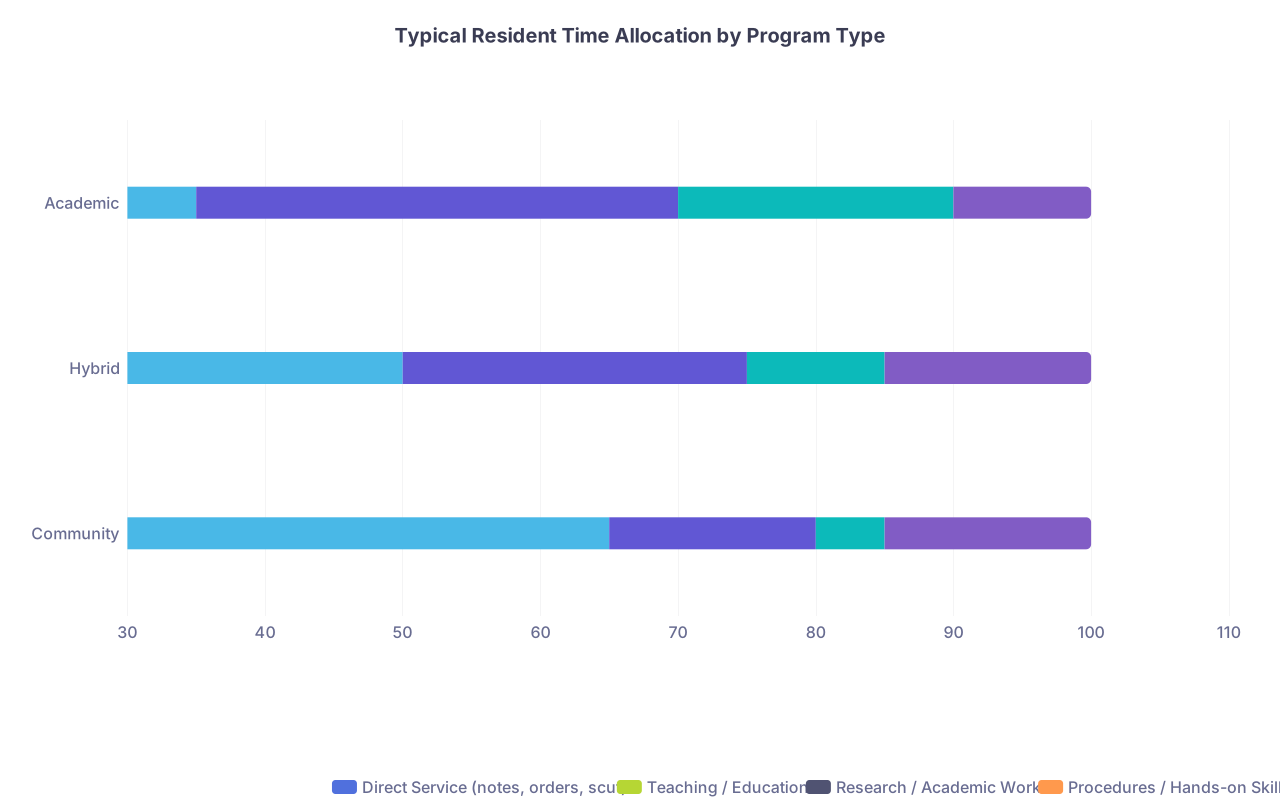
| Category | Direct Service (notes, orders, scut) | Teaching / Education | Research / Academic Work | Procedures / Hands-on Skills |
|---|---|---|---|---|
| Community | 65 | 15 | 5 | 15 |
| Hybrid | 50 | 25 | 10 | 15 |
| Academic | 35 | 35 | 20 | 10 |
These numbers aren’t “official.” They’re what actually happens when you watch residents for a week instead of reading glossy brochures.
Now, how do program directors think about you in each setting?
Community Programs: You Are the Backbone of the Hospital
Community programs exist to keep a hospital functioning efficiently in the real world. That does not mean “bad teaching.” But it does mean the hospital has service needs that must be covered 24/7, and residents are the cheapest, most flexible workforce to do it.
I’ve sat in community program leadership meetings. The language is blunt: “We need another resident on nights; volume is up.” Or, “If we lose our resident team on that floor, we’ll have to pay for another hospitalist shift.”
How PDs Use You in Pure Community Models
Here’s the unvarnished truth:
- You exist to keep the inpatient machine running. Admissions, cross-cover, discharges, ED consults. That’s where you live.
- Attendings often function as “signers and supervisors,” not primary note writers. So your documentation burden is heavy.
- Efficiency is king. PDs care about your ACGME milestones, sure. But on a daily basis they care a lot about, “Can this intern handle 10–15 patients? Can they move the list?”
What does that look like on the ground?
You’re the one:
- Writing the H&Ps and daily notes on nearly every admitted patient.
- Calling families, chasing down outside records, arranging SNF placement.
- Responding to every “patient is more short of breath” page at 2 AM, because there is no in-house fellow and sometimes not even an in-house attending after midnight.
In pure community programs, residents are plugged into service gaps like this:
- Night float: protects attendings, not you. Residents are the buffer between the 2 AM chaos and the person billing the big bucks.
- Weekends/holidays: staffed heavily by residents; attendings may only round for a few hours.
- Cross-cover: single resident covering multiple services because “it’s only overnight.”
Program directors in these settings think about you as:
- A required ACGME training position they must keep stable.
- A cost-effective solution to hospital coverage.
- A metric that administrators track: “What does resident coverage save us in hospitalist FTEs?”
They won’t phrase it that way at your interview dinner. But I’ve heard the conversations:
“We can’t cut that resident rotation; the ortho service will scream. They’re already complaining they don’t have enough help.”
The Upside No One Tells You
It’s not all exploitation. Community-heavy residents often:
- Get very comfortable managing sick patients without a safety net of five subspecialty teams.
- Develop strong independence and efficiency because there is no one to bail them out at 3 AM.
- Do more “real work” that mimics actual attending life in non-academic practice.
Attending at a community IM program once told me, “My residents are better at discharge planning than my new hires.” That’s not a compliment to the system. But it’s reality.
The Downside You Feel in Your Bones
You will:
- Feel like a workhorse.
- Sometimes feel like teaching is an afterthought squeezed in between discharges.
- Notice that any “new initiative” somehow involves you doing more data entry, more notes, more checklists.
You are the oil in the machine. When things get busier, the reflex solution is: “Can we add a resident or increase the cap?”
Hybrid Community-Academic: The Two-Masters Problem
Hybrid programs are tricky. They sell themselves as “best of both worlds.” You get academic exposure plus community experience. That’s the brochure version. The inside version is: you serve the needs of two masters—hospital service and academic reputation—and nobody fully owns protecting your time.

How PDs Think in Hybrid Models
These PDs sit in awkward meetings with:
- Hospital administrators complaining about unfilled shifts or backup coverage.
- University leadership complaining about research metrics, fellowship match lists, and board pass rates.
So the PD’s brain runs like this:
- “I need residents to keep the community hospital covered…”
- “…but I also need them on the main campus for subspecialty exposure and the academic look.”
- “…and I have to carve out time for research and exam prep or my board pass numbers tank.”
How does that land on you?
You might:
- Spend a couple months at a busy community site doing 80% service, 20% teaching.
- Then rotate at the university main campus where you’re surrounded by fellows, so your service shifts to more notes and less ownership.
- Be the “flex person” who fills in whichever site is short that month.
This “flex” concept is very real. I’ve seen PDs say, “We can fix coverage by shifting a resident off elective and onto that community ward.” Nobody in that room is asking you if that’s OK.
You as the Pressure Valve
In hybrid programs, residents become the pressure valve that absorbs fluctuations:
- Volume spike at community site? Pull a resident from an academic elective and plug them in.
- New subspecialty service opens at the academic center? Residents are the natural first coverage solution.
- Hospitalists push back: “We’re drowning!” PD responds by restructuring rotations so residents pick up more of the pre-rounding and note-writing.
The result is inconsistency. One month you feel like a scholar with noon conference and chalk talks. Next month you’re a clerk processing 12 discharges by 2 PM.
The Quiet Metric: “Resident Friendliness”
Savvy hybrid PDs know that word spreads fast if a site is brutal. They watch two things closely:
- Attrition and transfer rates.
- How residents speak on interview days when applicants ask, “So, how bad is the service load really?”
So they’ll do just enough to keep the place from open revolt:
- One more NP here.
- Slight cap reduction there.
- Token wellness half-day once a block.
But make no mistake: when push comes to shove, hospital service needs win more often than your elective or research time. Especially at the community-affiliated sites.
Academic Powerhouses: You Serve the Machine in a Different Way
At academic programs, people love to pretend residents are primarily learners. They are not. They are the glue that holds together a byzantine system of fellows, subspecialty attendings, research attendings, and service lines.
The difference is not that you’re not used for service. The difference is which services and whose goals you’re helping.
| Program Type | Who You Primarily Serve | Typical Service Pain Point |
|---|---|---|
| Community | Hospital administrators | Inpatient coverage, nights |
| Hybrid | Hospital + university | Coverage flexibility, float |
| Academic | Subspecialty services | Complex cases, consult volume |
The Hidden Service Model in Academic Centers
In big academic hospitals, there are three main “customers” you serve:
- The hospital: needs bodies to staff the busy inpatient wards and ED.
- Subspecialty divisions: need residents on their teams to handle consult volume and floor work.
- The fellowship pipeline: needs residents familiar with their field, integrated into their services.
So PDs sit in meetings with chiefs of service hearing things like:
- “We can’t maintain this transplant service without dedicated residents.”
- “Our consult numbers are up; we need another resident rotation.”
- “We want a new cardiology night float team.”
Guess who fills those holes? You.
How You’re Used, Specifically
At academic programs, residents are used to:
- Staff high-complexity services where the attending and fellow are doing procedures, in the OR, or in clinic, and someone has to write the notes and manage the floor.
- Provide 24/7 in-house coverage for specialties that “require immediate response”—think neuro, cards, trauma.
- Backfill daytime coverage so fellows can be freed up for procedures and research.
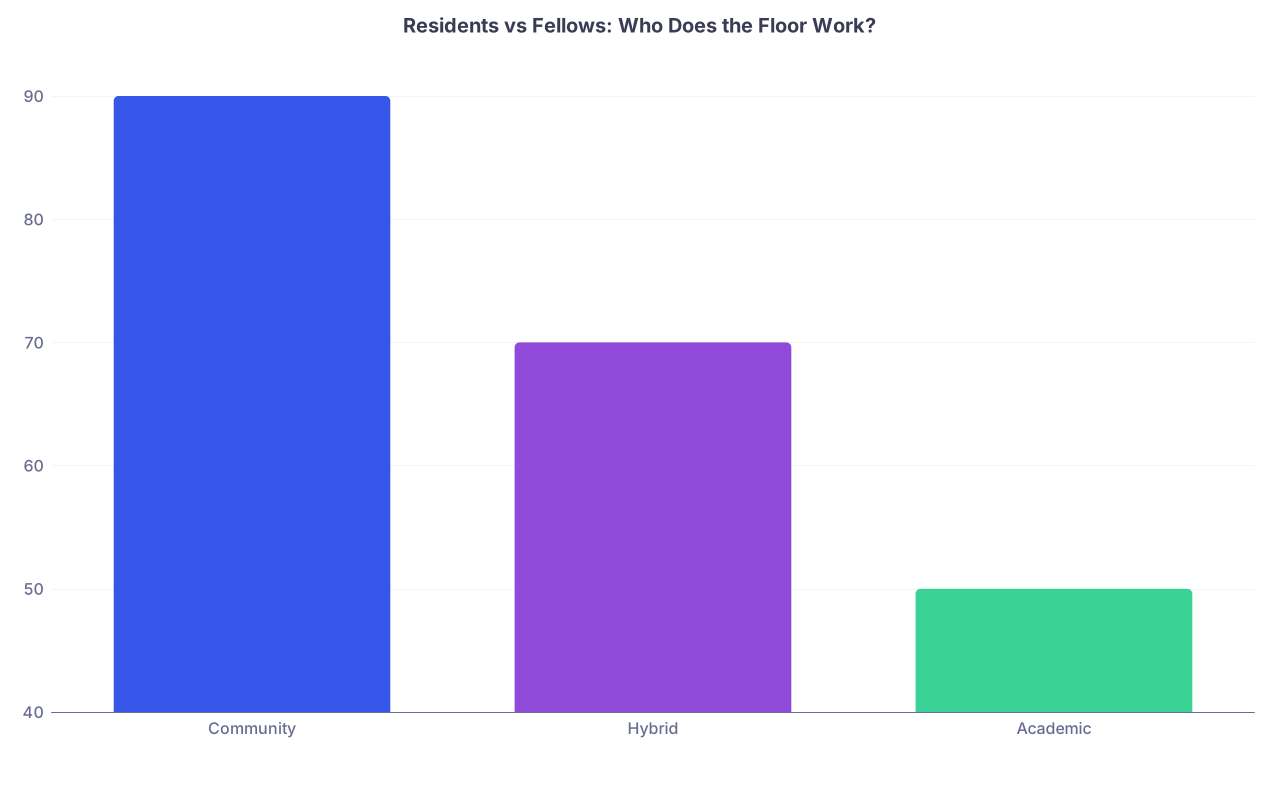
| Category | Value |
|---|---|
| Community | 90 |
| Hybrid | 70 |
| Academic | 50 |
That 50% for academic doesn’t mean less work; it means you’re sharing the misery with fellows and APPs. But you’re still the front line on many services.
The Academic Twist: Your Time is Currency
Here’s a subtle but crucial thing: at academic programs, your time is a currency that gets traded between stakeholders.
- Want a new ICU elective? Someone has to give up a ward month.
- Need more night coverage? PD shaves off an outpatient block or compresses electives.
- Subspecialty division argues: “We bring in NIH money; we deserve more resident coverage.”
I sat in one GME meeting where a division chief said, “If we don’t get residents for our consult service, we will have to cut clinic or research time for our faculty. That’s not acceptable.”
Nobody in that line of reasoning is asking what that means for the residents’ day-to-day conditions.
Teaching vs Service: The Illusion
Yes, there’s teaching. Morning reports, noon conferences, grand rounds. You will see zebras and manage complex disease.
But do not confuse “seeing interesting patients” with “not being used for service.” You’re still there to get the notes done, write the orders, call the consults, coordinate the tests. The complexity of the medicine doesn’t change the underlying dynamic: someone needs to do the work, and it’s not going to be the chair of medicine.
How To Tell How You’ll Be Used—Before You Match
Most applicants ask all the wrong questions. “What’s your board pass rate?” “How’s the camaraderie?” Nice questions. They don’t tell you how much you’ll be used to prop up service.
Here’s what actually exposes the truth.

| Step | Description |
|---|---|
| Step 1 | Look at Program Website |
| Step 2 | Check Rotation Schedule |
| Step 3 | High Service Load Likely |
| Step 4 | Ask About Nights |
| Step 5 | Moderate Service Load |
| Step 6 | Many ICU/Ward Months? |
| Step 7 | Night Float Heavy? |
1. Study the rotation schedule with a cold eye
Don’t just count ICU months. Look for:
- Number of inpatient ward months across three years.
- Presence of dedicated night float blocks vs scattered nights.
- How many true electives exist and whether they’re protected.
Residents used mainly as service plugs will have:
- A lot of ward/ICU blocks.
- Night coverage every year, sometimes heavy in PGY-2.
- “Electives” that are actually thinly veiled service rotations (e.g., “ED observation elective” that’s just another ward).
2. Ask residents: “What gets cancelled first when coverage is short?”
This question is nuclear. It reveals priorities.
If they say:
- “Electives usually get pulled to cover wards.”
- “Clinic gets cancelled a lot when the floor is short.”
- “We lose didactics when volume is crazy.”
That tells you where you stand. Teaching and electives are luxuries. Service is nonnegotiable.
If they say:
- “We bring in moonlighters.”
- “We cap census and transfer out.”
- “We protect didactics even when it’s nuts.”
Then you’re dealing with a leadership team that actually pushes back on hospital pressure. Rare, but it exists.
3. Look hard at night coverage structure
Night coverage exposes the real priorities more than anything.
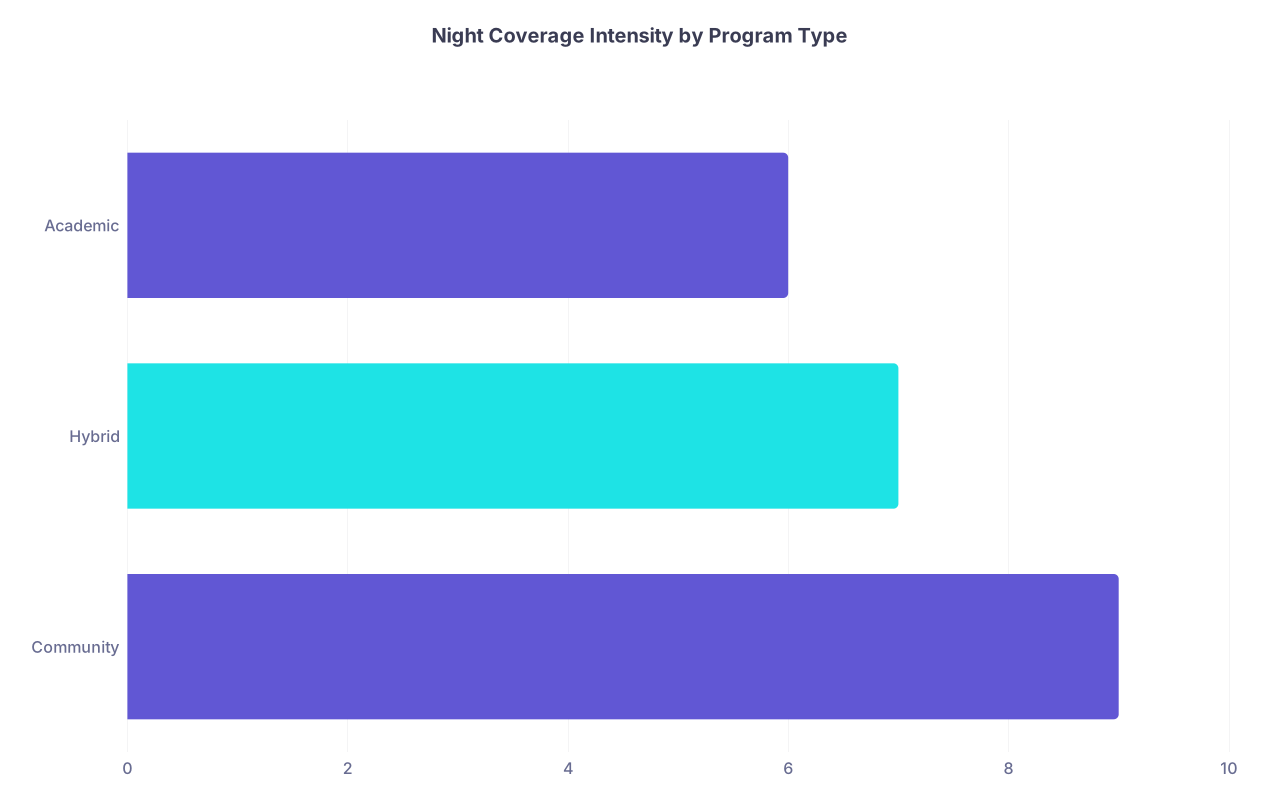
| Category | Value |
|---|---|
| Community | 9 |
| Hybrid | 7 |
| Academic | 6 |
(Scale 1–10, where 10 is “soul-crushing.”)
Community programs:
- Often have one or two residents covering giant chunks of the hospital.
- Attendings might be home call or only in-house for certain services.
Academic programs:
- More layers (fellow, in-house attending), but higher expectations for response time and consult volume.
- You may do less “global” cross-cover and more specialty-specific night work, but still intense.
Ask:
- “How many patients is the night team responsible for?”
- “Are there NPs/PA support at night?”
- “Are attendings in-house or home-call?”
Vague answers are not a good sign.
How Program Directors Actually Justify Using You
You won’t hear this on the tour. But I’ve heard these lines in closed meetings:
- “They need to see volume; that’s how they learn.”
- “This is how real practice is; we’re preparing them.”
- “We meet duty hours; they’re fine.”
- “If we don’t cover this service, the hospital will pull support for the program.”
The last one is the real dagger. GME programs live at the mercy of hospital funding. You are both a cost center (salary, benefits, GME office) and a savings engine (fewer hospitalists, cheaper coverage). When budgets tighten, the hospital leans harder on residents.
So PDs walk a tightrope:
- Protect you enough that you don’t burn out or leave.
- Use you enough that the hospital keeps writing the checks.
When you see sudden schedule changes—extra nights, more ward months, new “required rotations”—you’re seeing the result of those negotiations.

What This Means For Your Application Strategy
You’re not just choosing a logo and a city. You’re choosing how you’ll be deployed for three to seven years.
Here’s how to be strategic.
Decide what kind of “being used” you can tolerate
There’s no model where you’re not used to fill service needs. The question is: does the trade feel fair?
If you:
- Want independence, real-world decision making, and don’t care about NIH funding, a strong community program may be a better use of your suffering.
- Want subspecialty fellowship, complex path, and don’t mind being one cog in a giant machine, an academic center makes sense.
- Want flexibility and aren’t sure where you’re headed, hybrids can work—but interrogate how chaotic the service demands are.
Learn to decode red flags on interview day
Listen for:
- “We’re like a family here” repeated constantly, but nobody can tell you how they protect your time.
- Residents joking about “surviving” certain rotations.
- Program leadership getting defensive when you ask about service vs education.
And more importantly, listen for what’s not said:
- No specifics about average census.
- No clear answer about how often electives get pulled.
- Vague answers about night coverage.
If the PD won’t give you numbers, ask the senior residents in a quieter moment. They know exactly where you’re being used.
Remember: service can be educational, if it’s balanced
I’m not telling you to run from any program with a heavy service load. I’m telling you to run from programs that:
- Deny that residents are the primary service backbone.
- Do not acknowledge the trade-off and have no plan to improve it.
- Use “that’s residency” as a way to shut down legitimate concerns.
The best PDs say things like:
- “Yes, that rotation is brutal. Here’s what we’ve changed in the last 2 years to make it survivable.”
- “We fought the hospital on that coverage model.”
- “We’ve added an NP and capped census to keep it educational.”
Those are the places where you’re still being used—but not abused.