
You are in your hotel room after an academic interview day. It is 8:45 PM. You just got back from a glossy dinner where the PD shook your hand, the residents were all smiling, and someone said, “Our community affiliate is great too, but you really get the best experience here at main campus.”
You look at your rank list draft and realize:
You have not seen a single community hospital where you would actually spend half—or more—of your residency.
If you only visit the academic interview days and never set foot in the community sites, you are setting yourself up to miss serious red flags. The kind that do not show up in brochures, websites, or slide decks. The kind that will make or break your day-to-day life.
Let me walk you through the mistakes I see applicants make every single year and how to avoid them.
Mistake #1: Assuming “Academic Program” = “Academic Experience”
Here is the first trap:
Programs sell themselves as “university-based” or “academic” and applicants hear “protected teaching,” “robust subspecialty exposure,” “research everywhere.” That is not always what you actually live.
In many “academic” residencies, especially in IM, FM, EM, OB/GYN, and some surgical specialties, this is the real breakdown:
- 30–40% at the university hospital
- 60–70% at community affiliates
But on interview day?
You see the new academic tower, the simulation center, beautiful conference rooms, and the Starbucks in the lobby.
You do NOT see:
- the overcrowded community ED where you will be the only resident and “the consultant” mysteriously never answers
- the outlying clinic where the “15 min drive” is actually 45 minutes in traffic
- the small hospital with only 1 night attending for the entire department
You end up ranking the “academic program” based on the 30% you saw and ignore the 70% you will actually live.
How to not fall for this:
- Ask directly: “What percentage of rotations are at community sites?”
- Follow up with: “On average, how many days per month are we physically at the university hospital versus affiliates?”
- Then write those numbers down. Do not trust your memory or hand-wavy answers.
You should get suspicious if:
- People give vague ranges (“Oh, it depends… varies by schedule…”)
- No one can name how many months are at each site
- Residents dodge specifics with “well, it is pretty balanced”
Balanced usually means “you will be in your car a lot.”
Mistake #2: Ignoring the Commute and Site Spread
This one feels trivial to M4s. It is not trivial to a PGY-1 at 4:15 AM scraping ice off their windshield.
Here is what applicants often miss when they never see the community sites:
- Number of hospitals you are expected to cover
- Actual drive times at peak hours
- Parking situation (this sounds small—until you are losing 20–30 minutes per day)
- Call rooms or lack thereof at community sites
- Whether there is reliable public transit (for programs in big cities)
| Red Flag Type | What You Are Told | What Actually Happens |
|---|---|---|
| Distance | "15 minutes away" | 35–45 minutes in traffic |
| Parking | "Parking available" | Paid, far, or often full |
| Site Count | "Multiple training sites" | 3–5 hospitals plus clinics |
| Transportation | "Easy to get to" | No direct transit, car required |
| Transitions | "Smooth coordination" | AM clinic after post-call night |
The line I hear a lot from residents at these programs:
“I spend more time in my car than in conference.”
When you only attend the academic interview day, everything feels walkable and cohesive. Conference room, wards, ICU, ED—all in one footprint. The problem shows up when your schedule looks like this:
- Monday: Academic hospital wards
- Tuesday: Community hospital 35 minutes away
- Wednesday: Continuity clinic 25 minutes in the opposite direction
- Thursday: Community ED 40 minutes in morning traffic
- Friday: Back to academic hospital for didactics
You lose:
- Sleep
- Study time
- Any semblance of work–life stability
What you should ask (and verify):
- “How many different hospitals/clinics do residents rotate through regularly?”
- “What are typical commute times in rush hour?”
- “Does the program coordinate schedules to avoid back-to-back distant sites?”
- “Are post-call residents ever scheduled at distant clinics?”
If they say “you really do need a car to train here,” translate that to: “Your commute will affect your life more than you think.”
Mistake #3: Overlooking Culture Differences Between Academic and Community Sites
Academic interview day culture is curated.
You are seeing the version of the program they want the outside world to see. Rounding with the APD. Senior attendings on their best behavior. Residents selectively picked to talk to you.
The culture at community sites can be completely different.
Common disconnects:
Hierarchical vs. collaborative:
University hospital may be very teaching-oriented, while community sites are: “Just get it done. We are busy. Ask fewer questions.”How consultants treat you:
At main campus, subspecialists might like having residents. At the smaller community hospital, some will see you as an annoyance or free labor.Program visibility:
Many community hospitals “host” residents but do not really feel like part of the residency. They feel like a separate world, with their own norms, expectations, and rules.Nursing and ancillary staff support:
At academic sites, you might have phlebotomy, RT available, decent staffing.
At the community hospital: “Residents draw their own labs at night,” “You transport your own patients,” things like that. No one mentions this on interview day.
Red flag phrases to listen for from residents:
- “Community sites are… different.”
- “It is good exposure.” (Said with no specifics.)
- “You are more independent out there.”
- “It can be a little chaotic sometimes, but you learn a ton.”
Translated:
Culture shift. Less support. You will feel alone more often than you think.
What to ask:
- “How supported do you feel at the community hospitals compared to the main site?”
- “Any attendings or services at the community hospitals you try to avoid?”
- “Do you feel like part of the same program when you are at affiliate sites?”
- “Who advocates for residents when issues arise at community hospitals?”
If no one can name a faculty champion or site director who actually fixes things, that is a problem.
Mistake #4: Not Understanding Supervision and Safety at Community Sites
This is the one that can get dangerous. Literally.
Residents hear “more autonomy” and think “good for learning.” Sometimes that is true. Sometimes it is code for “less supervision than is safe.”
At community sites you may encounter:
- One attending covering the entire hospital service
- Night coverage that is “available by phone” but rarely physically present
- Limited in-house subspecialties (especially overnight)
- Lack of rapid backup for procedures or unstable patients
Programs will pitch it like: “You run the unit. Great autonomy.”
What they leave out: “At 2 AM, you are the only doctor at the bedside while the attending is at home and cardiology is not in-house.”
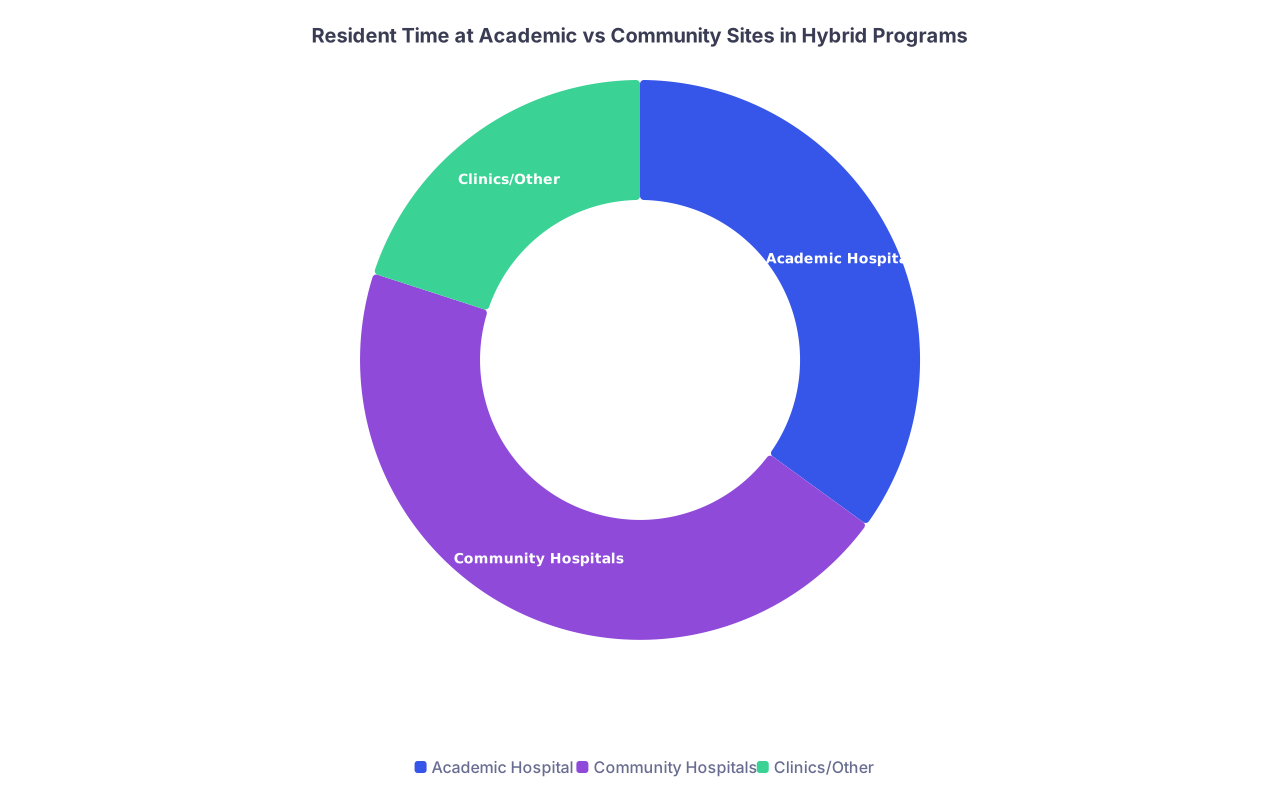
| Category | Value |
|---|---|
| Academic Hospital | 35 |
| Community Hospitals | 45 |
| Clinics/Other | 20 |
When you only see the academic campus, you assume supervision will look like what you saw on rounds. It may not.
You need precise answers here:
- “At each community hospital, who is in-house overnight for my specialty?”
- “Are attendings always physically present, or home call?”
- “Any situations where senior residents are essentially acting as the in-house attending?”
- “Have there been any recent resident safety concerns at affiliate sites? How were they addressed?”
If responses start sounding like:
- “We have not had any major issues… that I know of.”
- “Residents are very capable of handling most situations.”
- “Attendings are always just a phone call away.”
Push harder. Safety is not negotiable. Autonomy is not a substitute for competent supervision.
Mistake #5: Believing the Didactics Story Without Checking Site Logistics
Every academic program will tell you:
- “We have protected didactics.”
- “Attendance is mandatory.”
- “We really, really value education.”
Then you match, go to the community hospital, and discover:
- Conference is held at the academic campus
- You are 35 minutes away on a busy service
- There is no realistic coverage to let you leave to attend didactics
- Zoom is “available,” but you are constantly interrupted and miss half of it
Result:
Residents at the main academic site attend conference.
Residents at the community sites get scraps of education between pages.
Ask about this in detail:
- “How do residents at community sites participate in didactics?”
- “Is there protected transportation or time for us to get back to academic campus?”
- “What is the actual attendance rate from different sites?” (Watch if residents laugh or glance at each other.)
- “Are there local, site-specific teaching conferences at the community hospitals, or only centralized at the university?”
If you hear: “People do their best to make it when they can,” do not believe the “protected time” claim. It is not protected if the census or OR schedule always wins.
Mistake #6: Not Asking About Workload and Scut at Community Hospitals
Another huge discrepancy:
The academic site might be more focused on education, research, and shared responsibility. The community affiliates often lean heavy into “workhorse” mode.
Patterns I have seen:
- Higher patient caps at community sites
- More cross-cover responsibility at night
- Less ancillary staff doing “non-physician” tasks
- More admits with less subspecialty backup
- Residents doing procedures plus all the admission documentation, plus cross-cover, because “that’s how we do it here”
You do not hear this on academic interview day because:
- The PD trained at the academic hospital and rounds there
- Leadership rarely spends nights at community affiliates
- The “official” rotation descriptions are written for the university
You need the resident version.
Questions that reveal workload differences:
- “Compare a call night at the academic hospital vs the busiest community hospital.”
- “Where are your highest-census rotations?”
- “Where are you most likely to stay hours past your ‘end time’?”
- “On which sites do you feel like the scut work increases?”
- “Which hospital do residents dread the most, and why?”
If the answer to the last question is a community site you have never seen—and you are about to spend 6+ months there—that should make you pause.
Mistake #7: Ignoring How Well the Program Actually Manages Affiliate Relationships
Here is a subtle but important thing:
Some academic programs manage their community partners very well. Others barely manage them at all.
You see the difference in:
- How quickly resident complaints lead to change
- Whether duty hour violations from community sites are actually tracked and addressed
- Whether rotations are restructured when services become toxic or unsafe
- Whether the community sites feel “owned” by the academic program or like distant satellites
On interview day you are only seeing what leadership wants you to see. But the cracks usually show if you push.
Ask residents:
- “When there have been problems at affiliate sites, what happened next?”
- “Do you feel like leadership really knows what your life is like at the community hospitals?”
- “Any rotations that used to be terrible but actually improved after feedback?”
- “Do chiefs/residents ever have to ‘fight’ the affiliates for basic things like education time or reasonable caps?”
If you hear:
- “That is just how it is at that hospital.”
- “They have been talking about fixing it for years.”
- “We just power through those rotations.”
That tells you the academic program either does not have control—or does not care enough to use it.
Mistake #8: Not Doing Your Own Reconnaissance
If you rely only on the heavily produced academic interview day, you are trusting marketing. Not reality.
You need your own data.
At minimum, do this:
Google Maps everything.
Look up each named affiliate. Check drive times during realistic hours (e.g., 6:30–7:30 AM and 4–6 PM). Look at parking structures and neighborhood safety.Call or email the coordinator and ask bluntly:
“Can I have a list of all regular rotation sites for my PGY years?”
Then ask: “Are there any that residents find particularly challenging?”On interview day, pin residents down on specifics.
Do not ask, “Are community sites good?” That is useless.
Ask: “Which site is your least favorite and why?” and then shut up and let them talk.If feasible, drive by the main community hospital.
Even from the outside, you can see if it is in a safe area, looks functional, or appears like an afterthought.Pay attention to eye contact and body language.
When you mention community affiliates, do residents light up with examples and specifics—or do they look at each other and change the subject? That tells you a lot.
Quick Comparison: Programs That Handle Community Sites Well vs Poorly
| Aspect | Healthy Hybrid Program | Problematic Hybrid Program |
|---|---|---|
| Leadership Presence | PD/APDs round at affiliates | Leadership rarely visits |
| Didactics | True protected time, remote options | Residents at affiliates miss most |
| Resident Feedback | Issues fixed within months | Same complaints for years |
| Supervision | Clear in-house overnight model | “Attendings by phone” only |
| Culture | Same expectations at all sites | Each site a different universe |
If a program looks like the right column and you only saw the left-column version on your academic interview day, you will be furious by October of intern year.
What To Do Right Now
You cannot fix the fact that most programs will not bring you to every community site. That is reality. But you can avoid being blindsided.
Here is your immediate, concrete to-do list:
- Pull up your current list of hybrid academic–community programs.
- For each one, write down:
- Number of hospitals
- Approximate time at community sites
- Commute estimates (from Google Maps)
- Star the programs where:
- Residents were vague about affiliates
- You never heard a clear supervision plan for community hospitals
- Didactics from community sites sounded “aspirational” instead of real
- Email the coordinator or chief resident for those starred programs and ask:
- “Can you outline which months are at each site?”
- “What does overnight supervision look like at the community hospitals?”
- “How do residents at those sites attend conferences?”
If they dodge or give you marketing language instead of specifics, adjust your rank list accordingly.
Do not rank a program highly based on the prettiest tower you saw on interview day when most of your life will be lived in buildings you have never even driven past.
Open your spreadsheet or notes right now and add one new column: “Community site reality (1–10)”. Then score each program based on what you now know—and what you still do not. Programs with too many question marks do not deserve a top rank.
FAQ (Exactly 5 Questions)
1. How do I ask about community sites without sounding confrontational?
Ask from a curiosity and planning angle, not accusation. For example:
“I am excited about the mix of academic and community experiences. To plan realistically, can you walk me through how much time we spend at each site and what a typical day looks like at the busiest community hospital?”
Then follow with: “How does the program ensure residents at those sites get the same education and support as those at main campus?” The wording is respectful but still demands concrete answers.
2. Is it a dealbreaker if a program has lots of community time?
Not automatically. Some of the best training I have seen occurs at high-volume community sites with strong supervision and engaged faculty. The dealbreaker is not the existence of community time; it is:
- poor or unsafe supervision
- chronic duty hour problems
- no real access to didactics
- leadership that ignores resident concerns
Plenty of “academic” programs have worse training than well-run community-heavy hybrids. Focus on how the system functions, not the label.
3. What if residents give conflicting answers about community hospitals?
That is actually useful. Variation usually means:
- different rotations or call structures by class year
- recent changes (good or bad)
- inconsistent enforcement of policies
When you hear mixed messages, ask, “It sounds like experiences have changed over time—what has changed in the last 2–3 years, and what is still in progress?” You want to know whether the trajectory is up, stagnant, or down.
4. Are Zoom or virtual conferences an adequate replacement for in-person didactics at community sites?
They can be adequate if:
- you truly have protected time (no pages except emergencies)
- the tech infrastructure is solid
- faculty engage with remote participants
Most of the time, that is not what happens. Residents at community sites log in, get paged repeatedly, miss half the talk, and end up with worse education. Virtual access is not a solution unless the program has built systems to actually protect that hour for you.
5. I already interviewed and did not ask any of this. Is it too late to change my rank list?
No. You can still:
- Email the chief residents with specific, targeted questions
- Ask for a brief call with a current resident, explicitly to understand community sites
- Re-check commute times and site locations yourself
If answers raise red flags—vague supervision, impossible commutes, ignored complaints—adjust your rank list now. Better to drop a program a few spots today than spend three years discovering the truth at 3 AM on a poorly staffed community rotation.
Now, before you forget, open your notes from one “academic” program you liked and write down every community site they mentioned. If you cannot name even one, that is your first red flag—and your signal to start asking much better questions.