
What if the way you’re planning your fellowship right now quietly locks you out of half the jobs you’d actually want in five years?
Let me be very direct: the biggest fellowship mistakes aren’t about your Step scores or how many abstracts you have. They’re about planning for community vs academic tracks like that distinction is “later’s problem.” It’s not. You can absolutely box yourself in—without noticing—by how you spend your PGY2–PGY4 years.
You’re in residency. You’re tired. You’re trying to survive Q4 call and not miss critical lab values. But fellowship planning is already happening around you: who gets put on research projects, who presents at conference, who gets letters from division chiefs, who gets told “You’re a great fit for our academic track.”
If you don’t deliberately steer that, the system will happily steer it for you. And usually not in your favor.
Let’s walk through the most common, quiet landmines I see residents hit when thinking about community vs academic careers.
Mistake #1: Pretending Community vs Academic “Doesn’t Really Matter”
I hear this all the time: “I’ll just do a strong fellowship and keep my options open—community, academic, whatever.”
That’s how people accidentally close doors.
Academic and community paths don’t just differ in job titles. They’re built on different currencies:
- Academic: publications, grants, teaching, subspecialty depth, niche expertise.
- Community: clinical efficiency, broad competence, independence, procedural volume, the ability to run a service with minimal backup.
If you don’t decide which currency you’re actually trying to accumulate, you end up with a pocket full of the wrong coins for the job you eventually want.
How this plays out in real life
Internal medicine resident, PGY3, at a big university program:
- Says they “might want academic cardiology.”
- Has no abstracts, no ongoing project, no consistent mentor.
- Spent electives at smaller outside hospitals “for more autonomy.”
- Fellowship apps go in. Their CV looks like a community-heavy applicant: tons of clinical work, decent letters, no clear academic story.
Result: they mostly get interviews at strong clinically heavy community cardiology fellowships and a few mid-tier academics that don’t prioritize research.
Three years later they decide they want a research-heavy faculty position in heart failure at a major center. Too late. They’re coming from a very clinical fellowship without research infrastructure or protected time. That transition becomes uphill both ways.
Flip side: community-focused resident who actually wants to practice in a busy hospitalist or community subspecialist role but is told nonstop, “You have to chase academics to keep doors open.” They kill themselves doing research they hate, match into a research-heavy fellowship, and then are miserable because the culture, expectations, and schedule don’t match what they wanted in the first place.
You don’t need a perfect 10-year plan. But by mid-PGY2 you must at least know which direction you’re leaning:
- “I want to be mostly clinical in a community or hybrid setting”
- vs
- “I want a career with protected time, teaching, and academic promotion”
Not deciding is a decision. Usually a bad one.
Mistake #2: Building the Wrong Portfolio for the Track You Claim to Want
Saying “I’m interested in academic medicine” while your record screams “pure workhorse clinician” is a mismatch. So is saying “I want to be a community doc” while you spend three years chasing low-yield lab projects instead of volume and autonomy.

For academic-leaning applicants
Common errors:
- No longitudinal project. Everything is scattered: one case report here, a random QI poster there, nothing cohesive.
- No clear mentor in your target subspecialty.
- Zero first-author anything.
- No teaching involvement beyond what’s mandatory.
Academic fellowship programs don’t need you to be an R01-level star. They do expect:
- A clear narrative of curiosity and follow-through.
- Some evidence you can complete a project.
- Letters that mention your academic potential, not just your reliability on call.
If your “research” is three half-finished projects that never made it to abstract or manuscript, committees see through that immediately.
For community-leaning applicants
Different but equally damaging mistakes:
- Overinvesting in basic science or niche research that has no practical link to your future.
- Neglecting procedural skills or broad clinical exposure “because I have a poster to finish.”
- Choosing a fellowship solely based on brand name prestige instead of asking, “Where will I come out confident and fast clinically?”
Community jobs care more about:
- How prepared you are to see a high volume safely.
- Breadth of pathology you’ve actually managed yourself.
- Your ability to function independently without five layers of backup.
If your fellowship gives you prestige but very little hands-on work because fellows are fighting over cases or everything goes to super fellows, that’s a problem for your eventual day-to-day practice.
Mistake #3: Ignoring How Program Type Shapes Your Future Job Options
Academic vs community fellowship programs don’t just give different vibes; they feed different pipelines.
| Fellowship Type | Most Common First Jobs | Academic Job Chances |
|---|---|---|
| Pure Academic University | Academic faculty, hybrid roles | High |
| Academic-Community Hybrid | Community with teaching, hybrids | Moderate |
| Pure Community Fellowship | Community private practice/hospital | Low–Moderate |
| Top-Tier Research Fellowship | Research-heavy faculty roles | Very High |
Here’s the error: residents treat all “solid” fellowships as equally flexible. They’re not.
Trap 1: Using community-heavy fellowships as a springboard into hardcore academics
Can people cross over? Sometimes. But it’s an uphill slog. If you match into a community fellowship where:
- There’s no real research infrastructure.
- No one publishes more than a case report or two per year.
- There’s zero built-in protected time.
…then later trying to get an R01-track job or a major academic faculty position is going to be rough. You’ll be competing against people who did true academic fellowships with protected research years, name-brand mentors, and multi-center trials.
Possible? Yes. Smart plan? Usually not.
Trap 2: Doing a very academic fellowship when you actually want bread-and-butter clinical practice
I’ve seen residents match into prestige academic places mostly for the logo. It looks good on ERAS. It impresses their classmates. But then:
- They get minimal procedural numbers because cases are split between residents, fellows, and super-fellows.
- They have tons of conferences and meetings, fewer straightforward patient encounters.
- The entire fellowship is structured around producing future faculty, not future high-volume community clinicians.
Then they graduate, want a pure clinical community job, and find they’re slower, less confident, or less experienced in exactly the cases they’ll be doing every day.
The name on the diploma doesn’t fix that.
You need to ask very blunt questions at interviews:
- “Where do most graduates actually end up—academic vs community?”
- “What are your last five years of graduates doing now?”
- “If someone wants to go into community practice, what does their training path here usually look like?”
If a program dodges that, consider that your answer.
Mistake #4: Getting the Letters Completely Wrong
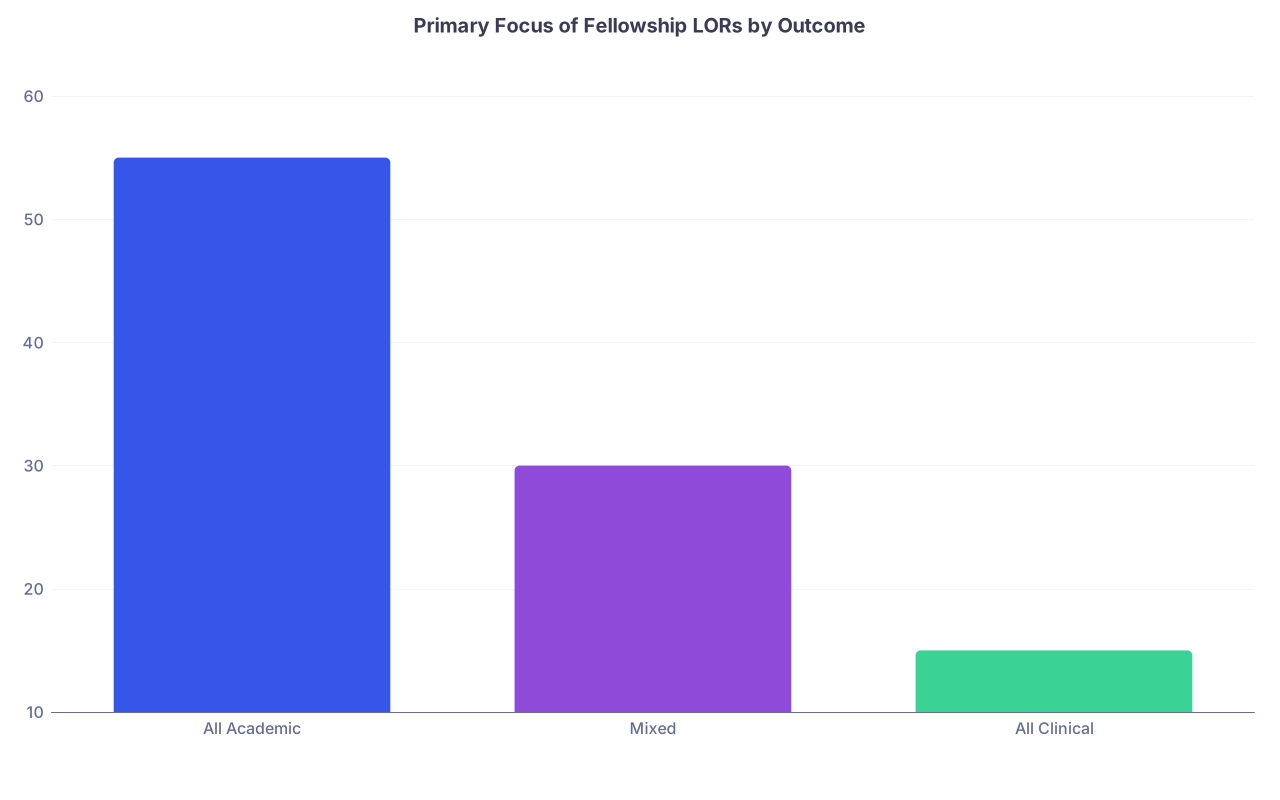
Letters of recommendation are not neutral. They can push you clearly into a community or academic lane whether you meant them to or not.
| Category | Value |
|---|---|
| All Academic | 55 |
| Mixed | 30 |
| All Clinical | 15 |
The subtle mistake: choosing letter writers based on title alone (big-name chair, division chief) instead of who can tell the right story for your chosen track.
For academic-track fellowship applications
Deadly errors:
- No letter from a true research or academic mentor.
- All letters are clinical, “workhorse” focused: “Shows up early, stays late, great team player.”
- No specifics on scholarly projects, critical thinking, or potential to ask meaningful questions.
Academic programs want at least one letter that says, in effect: “This person is capable of generating and answering questions, sticking with a project, and contributing to our academic output.”
If your letters sound like you’re a fantastic night-float intern forever, you’ll get filtered into the clinically-focused bucket—even at academic places.
For community-track applications
Different mistake:
- All your letters emphasize your research potential and academic ambitions.
- Nothing mentions your throughput, reliability, communication with nursing, or ability to manage complex services efficiently.
Community-oriented programs want reassurance that you will:
- Handle busy services safely.
- Get along with staff.
- Not need a hand-holding structure for every decision.
If your letters are all about how brilliant you are at bench research but vaguely mention your clinical work, you look like a risky bet for a community-heavy program.
Be direct with your letter writers:
- “I’m aiming for an academic fellowship. Could you comment on my scholarly potential and my work on X project?”
- “I’m aiming for a community-focused fellowship. It would really help if you could talk about my clinical reliability, independence, and communication.”
If they hesitate or seem unsure they can write that kind of letter, pick someone else. A lukewarm “generic nice” letter from a big name is worse than a strong specific letter from someone who knows you well.
Mistake #5: Misjudging What Each Track Actually Feels Like Day to Day
Too many residents decide “academic” vs “community” based on labels, not on lived reality.

| Step | Description |
|---|---|
| Step 1 | PGY1 |
| Step 2 | Early Interests |
| Step 3 | Find Research Mentor |
| Step 4 | Seek High Volume Rotations |
| Step 5 | Academic Fellowship Applications |
| Step 6 | Community Focused Applications |
| Step 7 | Academic Job or Hybrid |
| Step 8 | Community Job or Hybrid |
| Step 9 | Academic Leaning |
Academic paths: what residents often underestimate
- The pressure to produce: abstracts, manuscripts, talks.
- The expectation to attend meetings and conferences on your own time.
- The slower, more consult-heavy clinical pace at some large centers.
- The reality that “protected time” is rarely fully protected.
You will spend more hours in front of a computer than a bedside. If you hate that, do not force yourself into this lane because someone told you it’s “more prestigious.”
Community paths: what residents often misunderstand
- You might have less backup and more “I’m it” moments.
- Higher volume, less time per patient, more pressure to move the list.
- Fewer fellows/residents around, so you do more procedural and hands-on work but also more scut that would be resident work in academics.
- Less structure for teaching and research, so if you want those you have to carve them out yourself.
If you’re energized by being clinically essential and fast, this can be fantastic. If you’re the type who wants to dissect pathophysiology for 30 minutes with each patient, you’ll burn yourself out.
The mistake is idealizing one and demonizing the other based purely on reputation. You need actual exposure: electives at both types of sites if possible, conversations with graduates working in both environments.
Mistake #6: Believing You Have to Choose ONE Track Forever
This is a quieter but important error: thinking “community vs academic” is a permanent, binary identity.
Reality: the lines are fuzzier than they used to be.

Plenty of jobs blur the line:
- Community hospitals with academic affiliations and residents.
- Large multi-specialty groups that still do some teaching and limited research.
- Academic jobs that are basically 90% clinical with a “teaching” badge.
The actual mistake isn’t “picking the wrong binary.” It’s training in a way that gives you no flexibility.
Examples:
- Doing a very narrow, ultra-specialized research fellowship that leaves you uncomfortable with general cases—then trying to work in a small community hospital. Bad fit.
- Doing a bare-bones community fellowship with minimal complexity—then trying to jump straight into tertiary referral center academic faculty. Also bad fit.
You avoid this by being honest about your priorities during fellowship selection:
- If you lean academic but want a safety net of community options: choose an academic or hybrid program with heavy clinical exposure and a decent research structure—not a fellowship where fellows are mostly in the lab and rarely on the wards.
- If you lean community but want a shot at teaching or a hybrid role: choose a community or hybrid fellowship with residents, conferences, and some structured academic time, not an isolated private group that never interacts with trainees.
Your goal is not “pick pure community” vs “pick pure academic.” Your goal is align training with how much structure, scholarship, and clinical load you realistically want long term.
Mistake #7: Not Timing Your Preparation to Match the Track
Fellowship applications do not care about your PGY4 epiphany. They care about what you did by early-mid PGY3 (and earlier for some competitive subspecialties).
Here’s where people blow it:
- Decide they want academic GI or cards in late PGY2.
- Start a project that won’t produce anything visible until PGY4.
- Have zero academic output on ERAS when it matters.
Or:
- Decide they want to be a high-volume community intensivist.
- Spend PGY2-3 doing lots of low-yield research while avoiding the busiest ICUs “because it’s brutal.”
- Finish residency without the clinical chops or letters that say, “This person thrives in a demanding clinical environment.”
Timing mistakes are track-specific:
- If you want academic: you need to be on a project and tied to a mentor by early-mid PGY2. Not finishing a paper is forgivable if you can show serious involvement, an abstract, and strong letters that explain your role.
- If you want community: you need to stack your schedule with the rotations that give you the most real responsibility—busier services, community electives where fellows act independently, procedure-rich environments.
By the time you’re filling out ERAS, “potential” doesn’t count. Visible action does.
Mistake #8: Letting Other People’s Values Dictate Your Track
Last one, and it’s more psychological but still lethal.
You will hear:
- “You’re too smart for community.”
- “It’s a waste not to take an academic job.”
- “Real doctors don’t spend their lives in research labs.”
- “If you don’t go for a big-name academic fellowship, you’ll regret it forever.”
This noise is constant. If you’re not careful, your “plan” becomes a collage of other people’s anxieties and status games.
Here’s the harsh truth: none of those people will be there with you on your fourth weekend of the month in a job you hate because it aligns with their idea of success, not yours.
The mistake isn’t listening to advice. You should absolutely gather opinions. The mistake is:
- Not filtering those opinions through your own tolerance for stress, your actual interests, and the way you want your everyday life to look.
- Confusing prestige with fit.
- Assuming more academic automatically means “better doctor” or “better life.”
I’ve seen miserable “successful” academic attendings who would have been outstanding, fulfilled community docs. And vice versa.
Your job is not to impress your co-residents at graduation. It’s to build a training path that still makes sense 10 years later when no one cares where you matched.
Key Takeaways
You can’t “stay neutral” on community vs academic forever. By mid-PGY2, your choices start signaling one direction or the other—whether you admit it or not.
Align your portfolio—projects, rotations, letters, and fellowship selection—with the track you actually want, not the one that sounds prestigious. Wrong-track planning quietly locks doors that are very hard to reopen later.