
What Attendings Whisper About Community vs Academic Career Paths
It’s January. You just finished a brutal call month. On nights, the senior wandered into the workroom at 3 a.m., sat down with a stale muffin, and said it:
“So… you thinking community or academic?”
You gave some half-answer about “keeping options open,” but you felt it. That little panic. Because nobody has actually sat you down and told you what really happens once the badge says “Attending” instead of “PGY-3.”
Let me tell you what they say when you’re not in the room.
I’m talking about the conversations that happen at 10 p.m. after M&M, in the back corner of the physician lounge. The way your program director talks about the “job market” when the med student leaves. The way an old-school community doc describes academic people as “meeting addicts,” and how academic attendings roll their eyes about “RVU factories across town.”
You’re about to hear that, unfiltered.
What “Community” and “Academic” Really Mean Behind the Label
On paper, you know the definitions. Academic = university, teaching, research. Community = non-university, more service, less research.
That’s the brochure version. The real divide is about how much control you have, what you get measured on, and who you answer to.
In most attendings’ heads, the options look roughly like this:
| Factor | Academic Center | Community Hospital |
|---|---|---|
| Primary Metric | Publications & grants | RVUs & patient volume |
| Daily Work | Mixed clinical + nonclinical | Mostly clinical |
| Politics Type | Departmental/School-wide | Group/Administration |
| Autonomy | Lower early, maybe higher later | Higher clinically, variable admin |
| Trainee Involvement | Residents/med students | Variable, often less |
Nobody will tell you this in a recruitment talk, but among attendings, here’s the mental shorthand:
- Academic = prestige, slower money, more meetings, more titles.
- Community = faster money, less prestige, more patients, less committee nonsense.
That shorthand is not always fair. But it’s what they’re thinking when they lean back in a chair and say, “So what do you really want?”
What You’re Actually Doing All Day: The Truth About Daily Life
Forget job ads promising “protected time” and “balanced practice.” Let’s talk about what the days actually feel like.
Academic: The Triple Life
In academics, you’re doing three jobs, whether they admit it or not: clinician, educator, and “scholar” (research/admin/whatever looks good on a CV).
A typical academic attending’s week might look like:
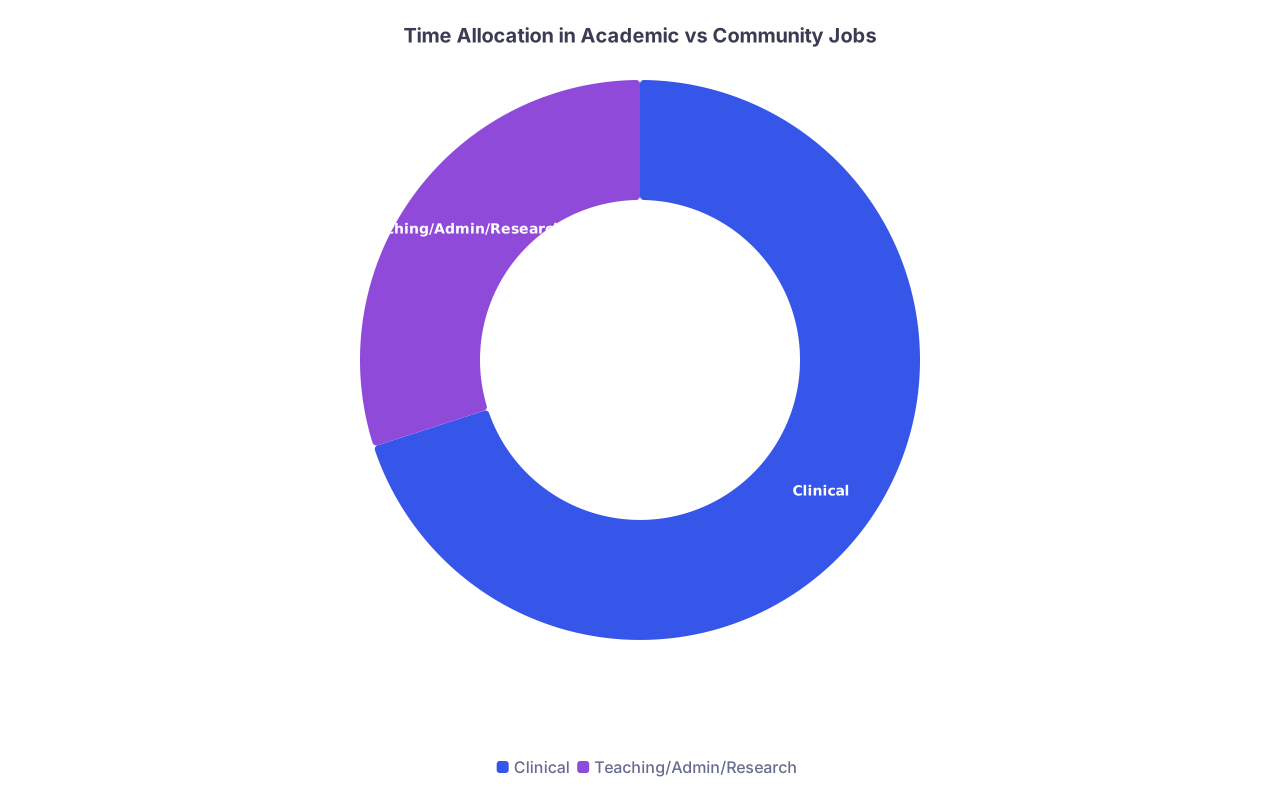
| Category | Value |
|---|---|
| Clinical | 70 |
| Teaching/Admin/Research | 30 |
That 30% “nonclinical” block? Here’s the part they whisper:
Your “protected time” is rarely protected. Things bleed:
- That half day of “research” is when you catch up on notes.
- That “educational” block becomes a mandatory meeting about documentation changes.
- That “admin” hour is spent on some painful EMR committee you got voluntold for.
The reward? You get to:
- Shape how residents are trained.
- Run a program, a service line, or a fellowship.
- Build a niche (IBD, stroke, HF, gyn-onc, whatever) that people know you for.
But understand: the price is constant low-level guilt. If you’re on service, you feel like you’re behind on research. If you’re doing research, you feel like you’re letting the team drown on the wards.
Community: The RVU Engine
In a real community job, you’re there to see patients. Full stop.
If academic life feels like three part-time jobs, community life is one full-time job turned up to 1.3x speed.
A reasonable community schedule in IM, EM, or hospitalist work can easily be:
- 18–22 patients per day in clinic, or
- 18–22 inpatients on a hospitalist census, or
- 1.7–2.2 patients per hour in the ED for full shifts
Whether they say it out loud or not, the numbers drive your reality.
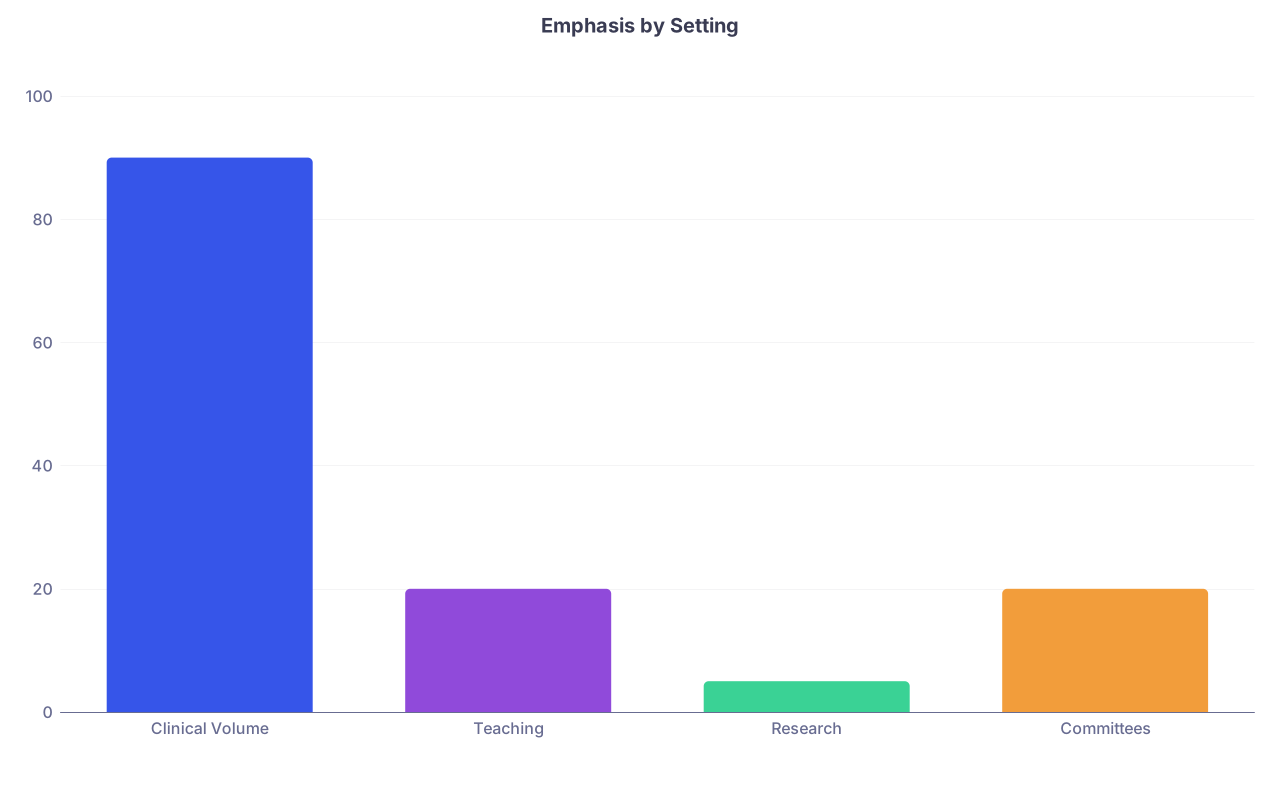
| Category | Value |
|---|---|
| Clinical Volume | 90 |
| Teaching | 20 |
| Research | 5 |
| Committees | 20 |
Community attendings whisper this part to each other after you leave the workroom:
“I make great money, I’m home for dinner more than my academic friends, but if I stop seeing patients, I disappear. I am my volume.”
That doesn’t mean bad lifestyle. Some community jobs are structured and humane. But the lever they pull when business is down is always the same: “Can you see just a few more?”
Money: What They Actually Take Home (Not What HR Shows You)
You want the taboo stuff. Let’s talk about money and how people really feel about it.
I’ve watched this debate between two attendings in the same specialty more times than I can count:
- Academic: “I like my job. I like teaching. I could make more elsewhere but I’d be miserable.”
- Community: “I do not love every policy here, but I’m paid what I’m worth and my time is my own.”
A rough, very real-world comparison in many core specialties:
| Setting | Early Attendings (Approx) |
|---|---|
| Academic IM | $220k–$280k |
| Community IM | $280k–$400k+ |
| Academic EM | $260k–$330k |
| Community EM | $330k–$450k+ |
| Academic Surg | $350k–$500k |
| Community Surg | $450k–700k+ |
Ballpark. Region matters. Specialty matters. But the direction is consistent: community almost always pays more base + bonus, and it usually happens earlier.
Here’s what academic people do not say in front of residents:
Most have seriously considered jumping to community at some point, often with a specific number in mind. I’ve literally heard, “If they ever offer me 150k more with no call, I’m gone.”
And what community people do not say in front of residents:
Some quietly miss the prestige and the intellectual ecosystem. They go to one national meeting, see their old co-residents presenting, and wonder if they sold out too early.
Money buys you options: neighborhood, school district, how fast loans vanish, how much “no” you can say. Do not pretend it doesn’t matter. Just do not make it the only metric. That’s how attendings end up bitter at 45.
Teaching, Residents, and Your Own Sanity
Here’s the part people rarely say aloud: whether you thrive or burn out often comes down to whether you like being around learners.
Academic: You Live With Trainees
In academics, everything revolves around the fact that trainees are in the middle:
- Your efficiency is constantly diluted by teaching.
- Your notes are scrutinized by residents, coders, and quality metrics.
- Your hallway conversations turn into chalk talks.
If you naturally narrate your thinking, enjoy hearing yourself explain physiology at 2x speed on rounds, and get actual joy from watching a PGY-1 finally “get” something — you will do well here. You might be tired, but not dead inside.
If teaching feels like a tax, not a reward, academic life will grind you down. I’ve watched brilliant clinicians flame out because they resented every minute they weren’t just moving the list.
Community: Teaching Is Optional, but So Is Feedback
Community jobs vary.
Some have residents (community-based university affiliates or new programs) but far fewer layers. Teaching tends to be more informal, shorter, and more practical. “Here’s how I actually run this clinic.” Med students love these places.
Others are pure service. No trainees. Maybe a few NP/PA colleagues if that.
The upside? You move quicker. Less rounding theater. Fewer 30-minute case discussions that could have been a 3-line plan.
The downside that attendings whisper about later: “I don’t get better unless I work at it. Nobody’s questioning me anymore.”
In pure community settings, there’s less natural friction to force you to stay sharp. The feedback loop weakens. If you’re not careful, you become “good enough for our hospital” rather than actually excellent.
Politics, Power, and How People Really Get Promoted
Medical students and residents are naïve about this. They think “work hard, be smart, you’ll rise.” Attendings know better.
Academic Politics
In academic centers, the ladder looks something like this:
- Clinical Instructor → Assistant Professor → Associate Professor → Professor
- Plus side-quests: Associate Program Director, Program Director, Vice Chair, Division Chief, etc.
You don’t move up that ladder just by being clinically solid. That’s expected. The people who get real influence:
- Publish, or at least attach themselves to the right projects.
- Say yes to the “right” committees (curriculum, promotions, big institutional initiatives).
- Get mentored by someone who already has power.
Here’s a quiet secret: a lot of academic attendings feel trapped by the promotion system. They get stuck at Assistant Professor forever because they don’t publish enough, even though they’re workhorses clinically and beloved educators.
And the program directors? When they talk among themselves, they divide junior faculty into three buckets:
- Workhorses (carry the service, hard to replace)
- Stars (bring in grants, reputation, or leadership potential)
- Dead weight (just enough to not fire, but nobody would fight to keep them)
Where you end up is not purely meritocratic. It’s politics + timing + who is willing to champion you.
Community Politics
Community systems and private groups have fewer titles. The hierarchy is usually simpler: partner vs non-partner, medical director vs staff, hospital committee roles.
The currency is different:
- RVUs, patient satisfaction, procedural volume.
- Willingness to take call, cover ugly shifts, be “reliable.”
- Relationships with hospital administration.
You will hear this exact sentence from older community attendings:
“Be the person they don’t want to lose — then everything gets easier.”
But here’s the darker undertone: when groups get bought by large systems, the old partnership track often evaporates. Younger docs become “employees with productivity bonuses,” and true power consolidates in a small inner circle.
So academically, you’re jockeying for titles and promotion. In community, you’re jockeying for schedule, pay, and a seat at the table when the group negotiates with the hospital.
Both have politics. Just a different flavor.
The Match, Your Training, and How This All Boxes You In Later
You’re in the match/application phase. So here’s the part nobody spells out when you rank programs:
Where you train will quietly push you toward one side.
Training at an Academic Program
If you match at a big university program — think Michigan, UCSF, Duke, MGH, WashU, Iowa, etc. — here’s what happens:
- You’re surrounded by faculty who chose academics and normalize it.
- The “best” residents are subtly steered into fellowships and academic tracks.
- You see complex zebras, rare complications, and massive tertiary-care pathology.
You end up with an implicit narrative in your head:
Real medicine = academic center. Community = where “regular” doctors go.
That bias is strong. Some never shake it.
Program directors quietly worry about this when they see graduates flounder in community jobs because they weren’t mentally prepared for “you are it, there is no transplant team, no four fellows, and the CT surgeon is 45 minutes away.”
Training at a Community or Hybrid Program
If you train at a strong community-based or hybrid academic-community program, the experience is different:
- You learn to manage a broader scope independently.
- You see what high-volume, bread-and-butter looks like up close.
- You may get less depth in rare tertiary-care zebras but more autonomy earlier.
Here’s what the attendings really say about residents from these places:
“If they survived here and did well, I know they can work.”
These grads are often very employable in community practice and smaller markets. They need more deliberate effort if they want a pure academic research career; the fellowship pathway is there, but more narrow and competitive at top-tier research institutions.
So when you’re ranking programs, understand you’re not just ranking training — you’re choosing which ecosystem will shape what feels “normal” to you.
How to Decide: The Questions Attendings Ask Each Other (And Themselves)
The smartest attendings I know do not ask, “Which is better, community or academic?” They ask:
- What kind of problems do I want to deal with all day?
- Whose opinion about my career actually matters to me?
- How much money do I need to not resent my job?
- Do I want to be around residents forever, or am I done after chief year?
If I were sitting across from you during a late-night cross-cover lull, I’d push you on a few things.
When you picture an ideal clinical day, are there residents and students with you or not?
Don’t answer aspirationally. Answer honestly. Some of you are done teaching the second you graduate.Does your ego need reputation or income more?
Both are valid. Some people light up at being “Dr. X, national expert on Y.” Others feel best paying off debt fast, buying a house, and never worrying about a car repair. Know which one actually moves your needle.How do you handle committee nonsense?
If sitting through a 2-hour meeting about documentation requirements makes you want to claw your eyes out, pure academia may drain you. Committees are the tax you pay for institutional influence.How much risk are you willing to take early?
Chasing a pure research academic career is higher risk, higher upside for prestige. Community practice is usually more financially straightforward but can pigeonhole you if you never develop any niche or leadership lane.
You’re not signing a 30-year contract with one choice. People switch. Academics jump to community. Community docs come back as clinical faculty. But the longer you sit on one side, the harder the jump.
FAQ – The Questions You’d Ask If You Were Being Completely Honest
1. If I’m even slightly interested in academics, should I avoid community programs for residency?
Not automatically. What matters is whether the program routinely sends people into fellowships and academic jobs. Plenty of “community-based” university programs place grads into solid fellowships at academic centers.
Here’s the trick: look at the last 3–5 years of graduates. Where did they end up? That list tells you more about your future options than the label “academic” or “community” on a website.
2. Is it true that once you go community, you can’t go back to academics?
No, but it gets harder with time. If you spend 5–10 years in pure community practice with no teaching, no publications, and no academic involvement, you’re not a competitive hire for most serious academic departments except as a “clinical workhorse” faculty.
If you think you might want to go back, maintain some connection: volunteer teaching, co-author a paper with old colleagues, stay involved in national organizations. Keep something on your CV that says, “I care about more than just RVUs.”
3. Do academic attendings secretly look down on community doctors?
Some do. Some don’t. And the reverse is true: I’ve heard community surgeons say, “The ivory tower folks would die if they had to run my OR list.”
What matters is not their ego. It’s yours. If you choose community but carry a chip on your shoulder about “not being academic,” you’ll be miserable. If you choose academics and quietly resent the pay cut every year, you’ll sour, too. Pick the setting where you can respect yourself doing the work you actually do every day.
4. When I’m interviewing for residency, what’s a subtle question that reveals a program’s real culture around career paths?
Ask this: “If I told you I was 90% sure I wanted [community practice / academic career], what would you advise I do here over the next 3 years to set myself up for that?”
Then shut up and listen. If they have a crisp, specific answer — named mentors, tracks, recent grads they can reference — they know how to develop both paths. If they hand-wave and say, “Oh, you’ll have lots of opportunities,” with no details, they probably have a default lane and everything else is an afterthought.
Years from now, you won’t remember the exact RVU conversion factor or how many committees your attendings sat on. You’ll remember which problems you chose to own — trainees or volume, prestige or autonomy — and whether you were honest with yourself when you picked your side.