It’s 11:47 p.m. You’re on night float at your community program. The floor is finally quiet for five minutes, and you’re doom-scrolling on your phone: ‘cardiology fellowship match stats,’ ‘do community residents match GI,’ ‘am I screwed if not at an academic powerhouse.’
And the thought hits you like a gut punch:
“What if my community residency can’t get me the fellowship I want? Did I just cap my own career before it even started?”
I’ve seen residents spiral on this. I’ve watched people on small community IM services panicking about matching heme/onc while their friends at big-name university programs casually name-drop attendings who sit on fellowship selection committees. It feels wildly unfair. And terrifying.
Let’s be blunt: program name does matter. But not the way your anxiety is telling you it does.
First: Are You Actually “Locked Out” By Being Community?
No. You’re not locked out.
Does that mean it’s all the same and “everything will work out”? No again.
Fellowship directors aren’t scrolling ERAS thinking, “Community program? Trash pile.” They’re doing something a bit more boring and brutal: quick mental risk assessment. Questions like:
- Do I know this program?
- Do I trust the letters from there?
- Do their graduates survive and thrive in our fellowship?
Here’s the part nobody tells you in med school: there are community programs that place people into competitive fellowships every single year, and there are university programs that barely match anyone outside their own mediocre in-house fellowships.
| Factor | Strong Community Program | Mid Academic Program |
|---|---|---|
| Name recognition | Variable, often regional | Better nationally |
| Research infrastructure | Limited but possible | Easier access |
| Built-in fellowship | Often none or few | Often several |
| Match to competitive fields | Possible but requires hustle | More structured pipeline |
The real questions you should be asking aren’t “community vs academic” in abstract. They’re:
- Has my program actually matched people into my specialty?
- What did those people do to get there?
- Do I realistically have the energy and bandwidth to do those things?
Because I promise you this: there are cardiology fellows right now who came from:
- Small community IM programs
- Caribbean schools
- Osteopathic programs nobody brags about on Reddit
They just couldn’t afford to be passive. And that’s the uncomfortable truth about community training and fellowship.
How Much Does Program Name Really Matter?
Let me peel back what actually happens in selection meetings.
When a PD is scanning 500+ applications for 3–5 spots, they need shortcuts. Program name is one of those shortcuts, not because they love prestige, but because they know what they’re getting with certain places. They’ve seen cohorts from “Big Name University IM” for ten years. Less guesswork.
For you at a community program, that means:
You don’t get the benefit of the doubt by default. You have to force them to slow down on your application.
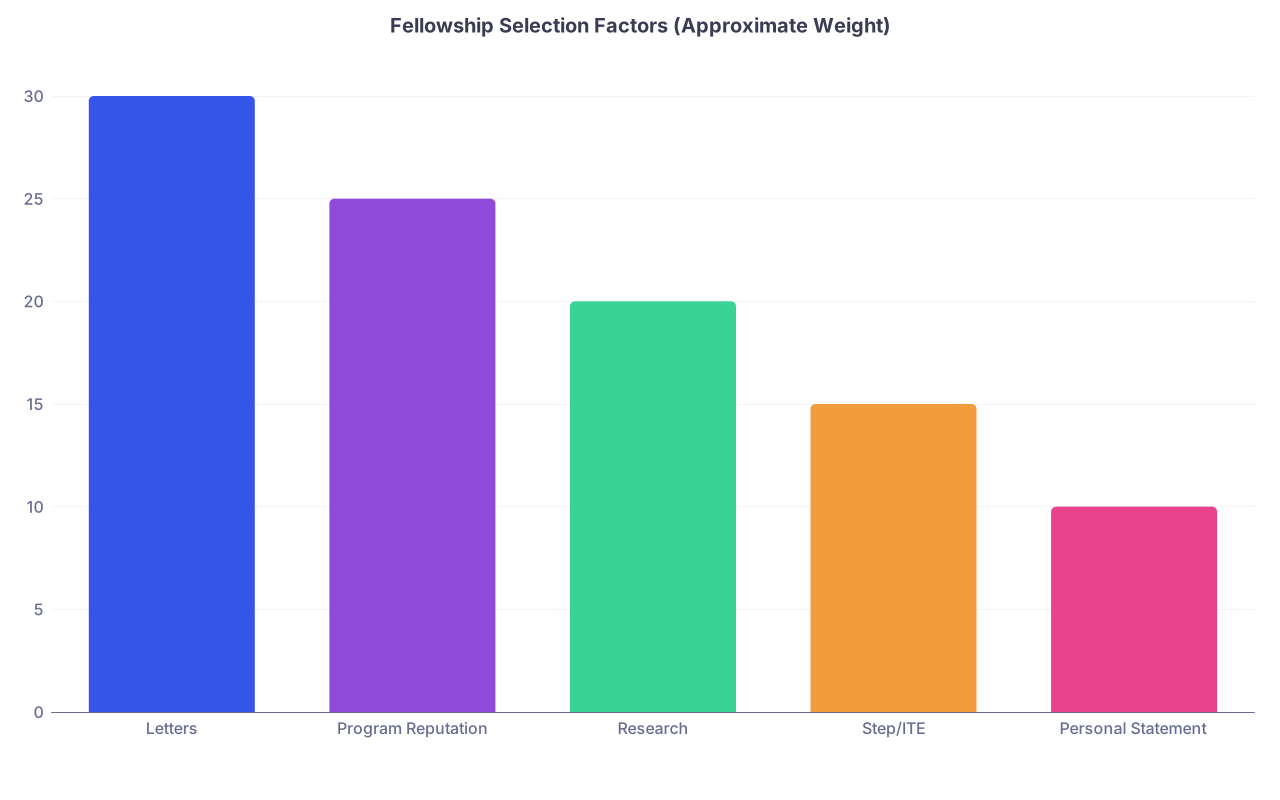
| Category | Value |
|---|---|
| Letters | 30 |
| Program Reputation | 25 |
| Research | 20 |
| Step/ITE | 15 |
| Personal Statement | 10 |
Here’s my take on how people actually get pulled out of the pile, roughly ordered by impact:
Letters of recommendation that hit hard
Not generic “hardworking and pleasant” nonsense. I’m talking:- “Top 5% of residents I’ve worked with in 15 years”
- “Already functioning at a fellow level in clinical reasoning”
At academic centers, big names help. At community, the content of the letter has to be undeniably strong. If your GI letter from your community program is clearly better than a bland one from Big Name U, it wins.
Reputation of your specific residency, not just ‘community vs academic’
Some community programs are known to be brutal but produce solid clinicians. Some are known black holes where nobody has any idea what training is actually like. There’s a difference.Research and scholarly output
No, you don’t need a first-author NEJM paper. But you can’t have zero output if you’re aiming for competitive specialties like GI, cards, heme/onc. Case reports, retrospective reviews, QI projects, conference posters – from anywhere – show that you’re engaged.USMLE/COMLEX + ITE performance
These matter more when you’re not riding on a top-brand residency. They’re “portable” signals. If your program is less known, high scores help offset that.Contacts and networking
Brutal truth: a phone call or an email from a known faculty member to a fellowship PD can move you from “auto-reject” to “interview.” That happens. A lot.
So yes, the game is harder from a smaller place. But it’s not unwinnable. It just requires intentional strategy instead of coasting.
The Ugly Fear: “What If My Program Has Terrible Fellowship Placement?”
This is the one that hits at 2 a.m.: “What if nobody from my program has ever matched into what I want?”
Sometimes that’s a red flag. Sometimes it’s not as bad as it looks.
Here’s what I’d actually do if I were you:
Get real numbers, not vague vibes
Ask your chiefs: “Where did the last 5 grads who wanted GI/cardiology/whatever match or end up?”
Notice I said “who wanted that fellowship,” not “all residents overall.” A program might not send many to GI because…only one person in 5 years cared enough to apply.Find people who did what you want to do
Even if it’s just one person. Stalk them (professionally). Ask:- When did you start research?
- Who wrote your letters?
- How many programs did you apply to?
- What hurt you? What saved you?
Look for patterns, not miracles
One superstar matching GI from a tiny community program with 10 publications and a 260+ doesn’t mean it’s easy. That’s an outlier. But if you see a consistent trickle of people doing what you want? That’s runway.
Here’s the nightmare scenario you’re afraid of: discovering that nobody before you has matched your dream specialty, and there’s zero infrastructure to help you.
If that’s where you are, the response isn’t “I give up.” The response is: “Ok, I’m going to have to build what other people had handed to them.”
Concrete Moves If You’re at a Community Program Aiming High
Let’s talk about what you can actually do, not just vibes and reassurance.
1. Start Early. Like… Now.
If you want a competitive fellowship from a community program, you don’t get a “chill” PGY-1 year. You just don’t. You need to start moving before everyone else wakes up and decides they suddenly love cardiology too.
PGY-1:
- Identify your target field and say it out loud to faculty early.
- Ask: “Who here has contacts at fellowship programs in X?”
- Start at least one tiny, doable project (case report, chart review, QI).
-
- Ramp output. Abstracts. Posters. Anything with your name on it.
- Do away rotations if possible, at places that actually have the fellowship you want.
- Crush your in-training exam. This matters if your program is less known.
PGY-3:
- Get your best letters lined up early.
- Apply broadly and aggressively.
- Use every human you know to send “by the way, this person is good” emails.

| Step | Description |
|---|---|
| Step 1 | PGY1 Start |
| Step 2 | Pick Target Specialty |
| Step 3 | Find Mentor |
| Step 4 | Small Research Project |
| Step 5 | PGY2 Strong Rotations |
| Step 6 | More Projects and Posters |
| Step 7 | Away Rotation at Fellowship Site |
| Step 8 | Secure Strong Letters |
| Step 9 | Apply Broadly |
| Step 10 | Fellowship Interview |
2. Leverage Any Academic Connection You Can Find
You’d be surprised how many “community” attendings:
- Trained at MGH, Hopkins, Mayo, UCSF, etc.
- Still have friends at big programs.
- Would happily send an email for a resident they truly believe in.
You have to ask them directly. Not in a weird, transactional way, but in a “I really want this, what would you recommend?” way.
Ask things like:
- “If you were me, at this program, wanting GI, what would you do differently than your fellows at Big Name U?”
- “Do you know anyone I could talk to at [Target Fellowship] just for advice?”
People underestimate how powerful one phone call can be. I’ve literally watched borderline applications get interviews because some well-known attending wrote, “This resident is the real deal. Please review their app.”
3. Accept You’ll Have To Over-Document How Good You Are
At a big-name academic program, the brand itself says, “We vetted this person.” At a smaller community place, that’s not assumed.
So your job is to shove as much evidence as possible into your application that you are not just “fine” but outstanding.
That means:
- Comments on your MSPE or residency evals that say you’re at the top of your class.
- Letters that explicitly rank you (“top 10% of residents”).
- A CV that shows trajectory, not just survival. One poster is fine. Three or four? Better.
- Step/COMLEX and ITE scores that don’t give anyone an easy excuse to screen you out.
Is it fair that you have to be louder on paper than someone from a top 10 program? No. Is that the game? Yes.
When You Might Actually Need a Backup Plan
Here’s the hard conversation: sometimes, your current setup + your goals do not match. At least not in a one-step straight path.
Here are a few cases where I’d tell a resident, honestly, to consider alternatives:
- Your program has zero track record of matching to your dream fellowship
- You started late (PGY-3) with no research, no real mentorship, and no time
- Your scores and evaluations are just… fine, not great, and the specialty is brutal (like derm, plastics, GI, cards at top programs)
Does that mean “it’s over”? No. It means the route might become:
- Chief year → then fellowship
- Hospitalist for a bit + more research → then fellowship
- Less competitive fellowship first → niche you like (e.g., general cards then advanced imaging)
Or yes, sometimes: re-evaluating specialty choice.
People act like that’s failure. It’s not. It’s recalibrating based on reality instead of fantasy. I’d rather see someone thriving as a hospitalist who still loves their life than burned out and miserable after chasing a fellowship that never fit them in the first place.
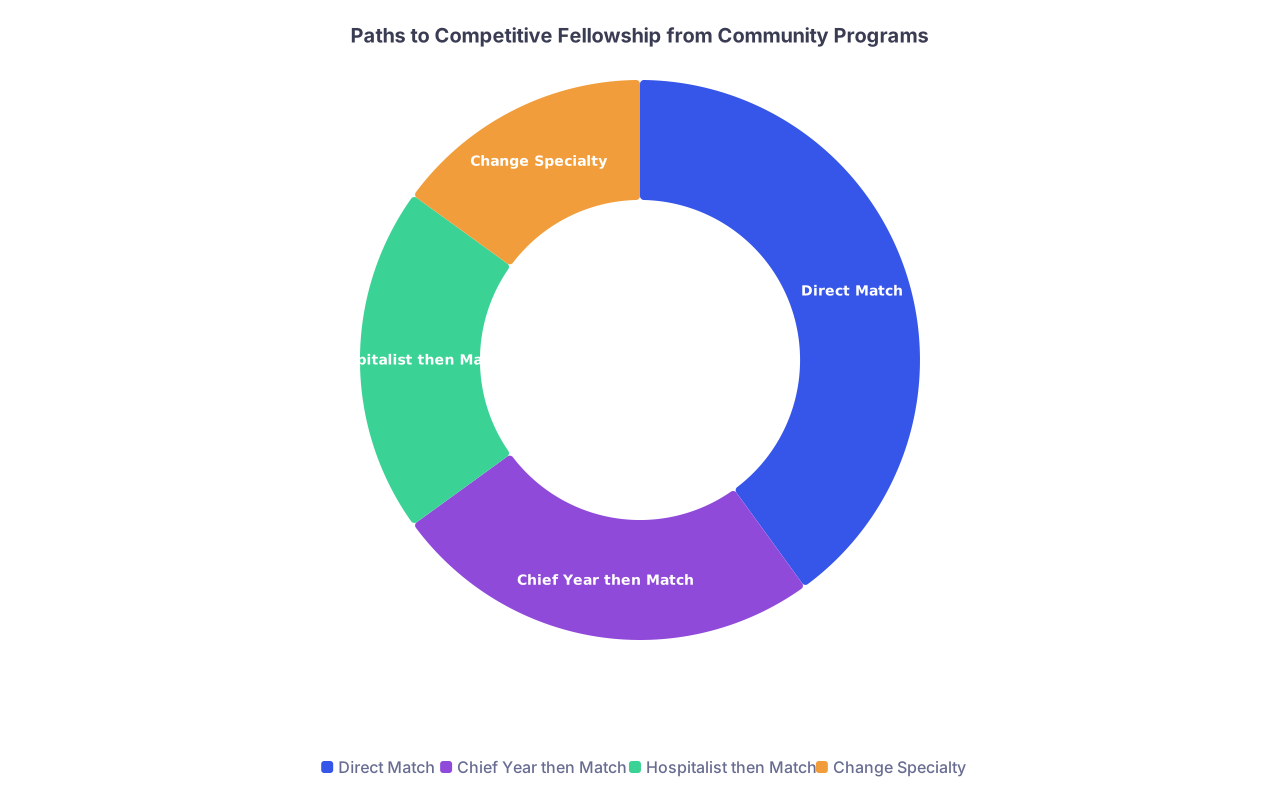
| Category | Value |
|---|---|
| Direct Match | 40 |
| Chief Year then Match | 25 |
| Hospitalist then Match | 20 |
| Change Specialty | 15 |
How to Tell If Your Community Program Is Actually Working For You
Not all community programs are created equal. Some quietly do an excellent job getting their people where they want to go. Others… don’t.
Signs you’re in a decent situation:
- Attendings know exactly which graduates matched where, and can list them off without pausing.
- There’s at least a small culture of “we can get you there if you really want it.”
- You can name at least one or two graduates who are doing what you want to do, even if at less famous fellowships.
If you get nothing but shrugging and “eh, most people just become hospitalists,” and no one knows where people went beyond “local practice”… that’s a problem.
Again, not an automatic death sentence. But it means the lift is mostly on you, not the system.
The Emotional Side Nobody Talks About
Underneath all the strategy, there’s this constant hum of: “Did I already screw up my career by ending up here?”
Let me answer that directly: No, you didn’t.
You might have made your path steeper. You might have to hustle in ways your friends at academic giants don’t. You might need to swallow your pride and take more circuitous routes.
But you are not doomed.
I’ve seen:
- DO residents from tiny community programs match heme/onc at very solid university fellowships.
- IMGs from non-name places carve out legit academic careers because they kept publishing and networking.
- People who missed the fellowship they wanted on first try come back 2–3 years later with a stronger CV and get in.
The ones who consistently fail are usually not the ones from “weak” programs. They’re the ones who assume the name of any program—fancy or not—will carry them without them doing the work.
You’re already anxious. You’re reading this. That alone puts you ahead of a lot of people who wake up in PGY-3 and suddenly decide, “I think I’ll do cards now” with zero groundwork.
Use that anxiety as fuel, not as proof you’re doomed.
FAQs
1. Be honest – is it significantly harder to get a competitive fellowship from a community program?
Yes. It’s harder. Not impossible, not rare, but harder. At a community program, you often lack automatic name recognition, built-in research infrastructure, and in-house fellowships that preferentially take their own. So you have to compensate with stronger letters, more visible scholarly work, and often broader applications. But I’ve seen plenty of people still get where they wanted to go.
2. If nobody from my program has matched into my dream specialty, should I just give up on it?
No. But you should stop pretending the path will look like it does for someone at a top academic program. You may need a longer runway: start projects early, do away rotations, apply very broadly, and be open to a less “prestigious” first fellowship or a delayed application cycle. And talk to people outside your program in that specialty to sanity-check your plan.
3. How much research do I actually need from a community program to be competitive?
You don’t need a stack of RCTs. But for competitive specialties like cards, GI, heme/onc, you should aim for at least a few tangible things: case reports, abstracts, posters, maybe a small retrospective study. Not all from your home program—multi-center or remote projects count. The real goal: show that you understand and can participate in academic work, not that you’re a full-time scientist.
4. Are strong letters from “non-famous” community attendings worth anything?
Yes, if they’re specific and powerful. A detailed, concrete letter saying you’re one of the best residents they’ve worked with will absolutely help you. Does a letter from a nationally known researcher carry extra weight? Of course. But fellowship committees can tell when a famous name phones in a generic letter. A non-famous but deeply honest and glowing letter + maybe one letter from someone with national connections is a very solid combo.
5. If I miss out on fellowship the first time, is that basically the end?
No. It feels like the end in the moment, but it’s not. Many people match on their second try after doing a chief year, working as a hospitalist while doing research, or strengthening letters and scores. The key is not to just reapply with the exact same application. You need to spend the gap time deliberately: new projects, new mentors, maybe a different mix of programs. Programs don’t hate reapplicants; they hate unchanged reapplicants.
Key takeaways:
- A community residency doesn’t automatically block you from competitive fellowships, but it does mean you can’t be passive.
- You’ll need strong letters, some form of scholarly output, and intentional networking to compensate for less name recognition.
- If the straight shot doesn’t work, there are still side doors and longer paths that get you very close to the career you originally imagined.