
Last year, a PGY‑2 in medicine at a big-name academic program hugged the PD at graduation dinner… then quietly handed in his resignation three weeks later. This was the same resident chief candidates were whispering about, the “future star fellow,” the one faculty kept name-dropping on rounds. He didn’t transfer. He walked. Straight to a community program down the road.
Everyone pretended to be “happy for him.” Behind closed doors, the questions were a lot uglier: “What did we do wrong?” “Is he weak?” “Is this going to look bad on our match slides?”
You want to understand that move? Let me show you what actually drives these decisions — the stuff no one tells you on interview day.
The Hidden Contract of Academic Programs
Academic programs sell you a very specific dream: complexity, prestige, research, fellowship pipelines, “leadership in medicine.” They don’t say this outright, but there’s an unspoken contract:
You give them:
- Your 80 hours (and then some).
- Your name on their call schedules, their quality projects, their QI dashboards.
- Your weekends, your continuity clinic numbers, your patient volume metrics.
They give you:
- Access. To letters, to fellowships, to brand-name CV lines.
- A seat in conferences with subspecialty giants.
- The illusion that you’re at the center of academic medicine.
Here’s the first truth: that contract feels very different as an MS4 on interview day than it does as a PGY‑2 staring at your 14th H&P of the night on a service staffed 80% by APPs and 20% by “supervising” attendings who walk in at 10 am and out at 3 pm.
PGY‑1 you’re just trying not to drown. PGY‑2 you’re competent enough to look around and realize the water you’re swimming in might not be the ocean you thought it was.
That’s when the exodus starts.
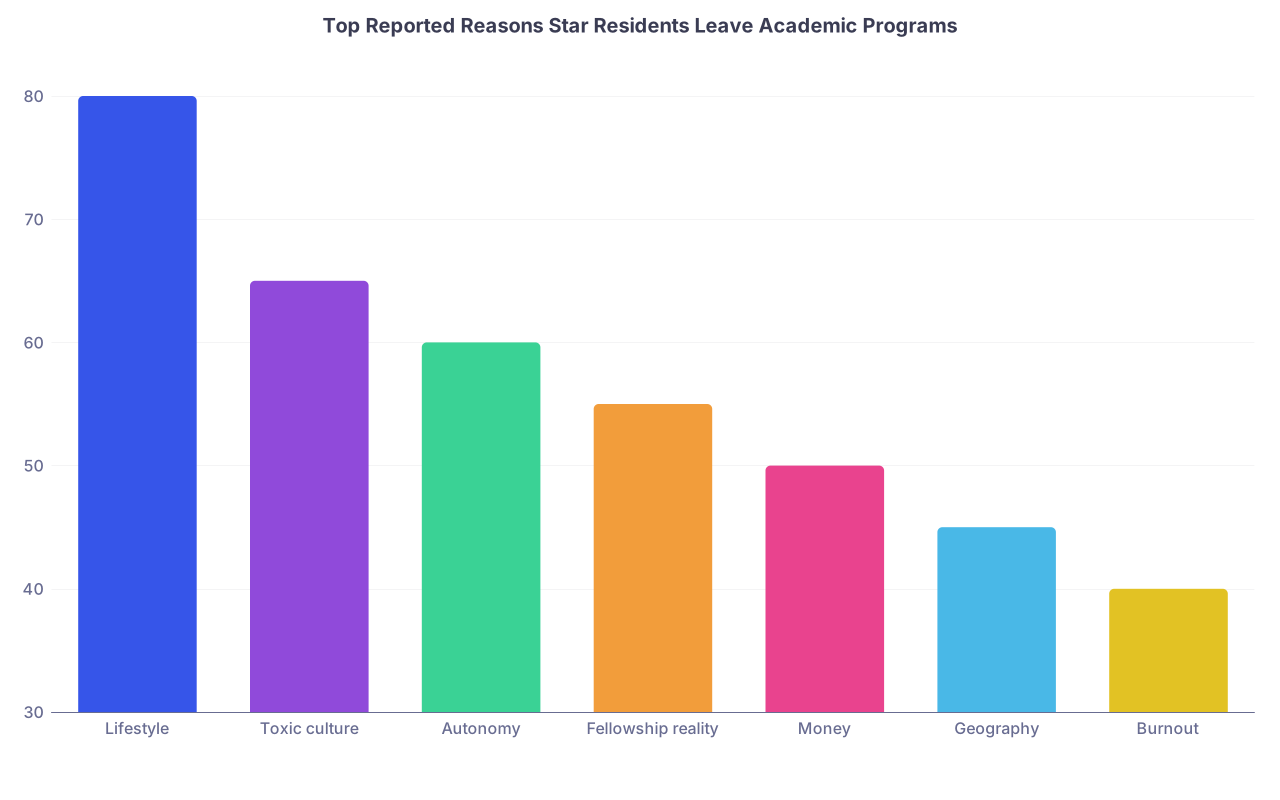
The Seven Things That Push Star Residents Out After PGY‑2
| Category | Value |
|---|---|
| Lifestyle | 80 |
| Toxic culture | 65 |
| Autonomy | 60 |
| Fellowship reality | 55 |
| Money | 50 |
| Geography | 45 |
| Burnout | 40 |
These are not the struggling residents. These are the ones everyone assumed would be chiefs. Let’s go through what actually makes them bolt.
1. The Lifestyle Lie: “It’ll Get Better in PGY‑3”
Residents are not stupid. They compare notes. Group chats with friends at community programs are devastating.
At one midwestern academic IM program, PGY‑2s on wards were still on a 28‑hour call model, routinely going home at hour 29–30 “for patient care reasons.” Meanwhile, their classmate at a community program 40 minutes away was sending pictures from 4 pm post-call brunch. Same specialty. Same board pass rate. Very different lives.
By mid‑PGY‑2, the “this is just intern year” excuse has expired. If your schedule, call structure, and night coverage still look like a bad parody of 1990s residency, high-performers start asking a simple question:
Why am I doing this here, when I could do the same residency with 20 fewer hours a week somewhere else?
Here’s the part no one advertises: plenty of community programs now have:
- Equal or better ICU exposure.
- Similar procedural numbers.
- Shorter call, more strict enforcement of duty hours.
- Attendings who actually staff at the bedside, not via “remote supervision” and late chart cosigns.
Academic leadership likes to tell themselves, “Our residents stay for the teaching and complexity.” Some do. But the stars, the ones who have options, start running the math on their time and energy. Many don’t like the answer.
2. The Prestige–Pay Tradeoff Stops Making Sense
You’ll never hear this in a recruitment talk, but attendings joke about it all the time in workrooms:
“Academics: where people take a 40% pay cut for a slightly bigger ego.”
Residents see the numbers. The minute PGY‑2s start looking at job offers and MGMA data, they realize something brutal: the lifestyle difference between academic and community after residency is massive. Clinical-only community jobs often pay double what academic hospitalist or generalist gigs pay, with fewer committees, meetings, and teaching duties layered on.
So when they watch their own attendings scraping by, hustling RVUs, fighting billing, flying out every weekend to moonlight just to afford life — while community attendings down the street have newer cars, bigger houses, and more time off — it lands.
Some residents decide: if I’m 90% sure I’m going pure clinical anyway, why suffer through academic residency when a community program can:
- Train me well enough for boards.
- Plug me directly into the job market I actually plan to work in.
- Introduce me to private groups early.
The “brand name” residency suddenly feels like a bad investment.

The Fellowship Mirage: What They Don’t Put on the Slide Deck
You’ll hear this line a lot from academic PDs on interview day: “Our residents match to top-tier fellowships every year.”
Here’s what they don’t say: some of those matches are powered by brutal overwork and political maneuvering that only a handful of residents want to tolerate. And that the pipeline is thinner — and more biased — than it looks on the brochure.
3. Realizing the “Advantage” Was Oversold
PGY‑2 is when fellowship reality hits. Match lists start circulating. People finally see:
- Who actually matched cards, GI, heme/onc.
- Whose name keeps getting attached to the “big projects.”
- Which attendings really write the letters that move the needle.
I’ve watched star PGY‑2s with strong Step 2 scores and good evaluations realize:
- The program’s GI fellowship has 3 spots.
- Those spots are effectively earmarked for the chair’s favorite mentees or MD/PhDs.
- External applicants are coming from equal or “better” branded residencies.
- Their own letters will be “strong” but not from the rainmakers.
So the resident asks themselves: if I’m not going to match in-house anyway, does this brand actually offset the years of extra pain?
Sometimes the answer is no. And remember: many community programs now send people to solid, mid-tier fellowships regularly. Not everybody needs Mass General.
4. The Politics Turn Ugly
Here’s a dirty little academic secret: in some programs, if you’re not in the right research clique by early PGY‑2, your shot at ultra-competitive fellowships is already heavily compromised.
I’ve seen it:
- The “golden child” gets priority for every complex case and conference presentation.
- Their chart reviews become QI “projects” with minimal effort.
- Their name shows up second author on multiple abstracts just because they’re in the right lab.
- The rest of the residents scramble for crumbs — case reports, one-off posters, meaningless QI dashboards.
Star residents who weren’t politically connected early sometimes respond the same way sharp people do in a bad corporate job: they stop trying to win a rigged game. Some pivot: “I’m going to be a beast of a clinician and go somewhere that values that.”
And that somewhere is often a high-volume community program that doesn’t care how many PubMed hits you have.
| Factor | Academic Program | Community Program |
|---|---|---|
| In-house fellowship slots | Usually more | Often none or few |
| Name recognition | Higher at top-tier places | Variable |
| Research expectations | High | Low to moderate |
| Clinician reputation weight | Lower relative to research | Higher for strong clinicians |
Culture, Autonomy, and the “Soft” Stuff That Actually Breaks People
On paper, academic and community programs can look similar: same ACGME requirements, same rotations, same call caps. Culture is where the real differences live — and where high performers quietly reach their breaking point.
5. Toxic Microcultures in “Prestigious” Programs
Not every academic program is malignant. But some very famous ones absolutely are. Things I’ve personally heard behind closed doors:
- “We don’t remediate; we just make people resign.”
- “If you can’t handle this, you’re not cut out for our level of medicine.”
- “Well, we survived it. They can too.”
At these places, the very fact that they’re “top 20” becomes the shield that protects terrible behavior. Residents are simultaneously proud to be there and miserable.
Academic arrogance shows up as:
- Public shaming in conferences and on rounds.
- Attendings who confuse “high expectations” with humiliation.
- PDs who will defend toxic faculty because they bring in big grants.
Star residents initially tolerate it because they’re used to excelling in harsh environments. By PGY‑2, though, many are just tired. Then they rotate at a community site where the attendings:
- Give direct feedback without theatrics.
- Say “thank you” at 2 am.
- Protect them from unnecessary scut.
That contrast is searing. Some never want to go back.

| Step | Description |
|---|---|
| Step 1 | PGY1 Survival Mode |
| Step 2 | PGY2 Gains Competence |
| Step 3 | Stay Academic |
| Step 4 | Explore Options |
| Step 5 | Transfer to Community |
| Step 6 | Happy with Culture |
| Step 7 | Need Academic for Fellowship |
6. Autonomy: Too Little, Too Late
Another insider truth: some academic programs are paralyzed by layers of supervision, protocols, and subspecialties. Residents become glorified triage coordinators.
I’ve watched PGY‑2s write orders that get rewritten three times:
- First by a fellow.
- Then by an attending.
- Then vetoed by an interventional specialist.
By the time anything happens, the patient has been in the ED for 12 hours.
Then that same resident moonlights at a community hospital, or does an elective there, and suddenly:
- They run the codes.
- They handle bread-and-butter ICU management.
- Their decisions actually matter, quickly.
The smart ones realize: this is the skill set I need for real-world practice, not just the ability to present a consult-ready differential to four different services. If they feel they’re being trained as data-gatherers for specialists rather than as physicians who can actually act, they get out.
Academic programs will tell you, “We protect you from overstepping.” Community-heavy places argue, “We grow you into someone who doesn’t need that much protection.” High performers tend to side with the latter by PGY‑2.
Money, Geography, and the Quiet Math of Adult Life
PGY‑2 is also when your personal life starts competing with your training fantasy. Loans, relationships, kids, aging parents — those aren’t abstract anymore. They’re in your face.
7. Cost of Living and Invisible Financial Pressure
A lot of flagship academic programs sit in brutal cost-of-living markets: Boston, New York, San Francisco, LA, Seattle.
Residents try to ignore it PGY‑1. By mid‑PGY‑2 they’re:
- Sharing a tiny apartment with two other residents.
- Watching classmates at community programs own townhomes already.
- Realizing their moonlighting options are constrained by their program or location.
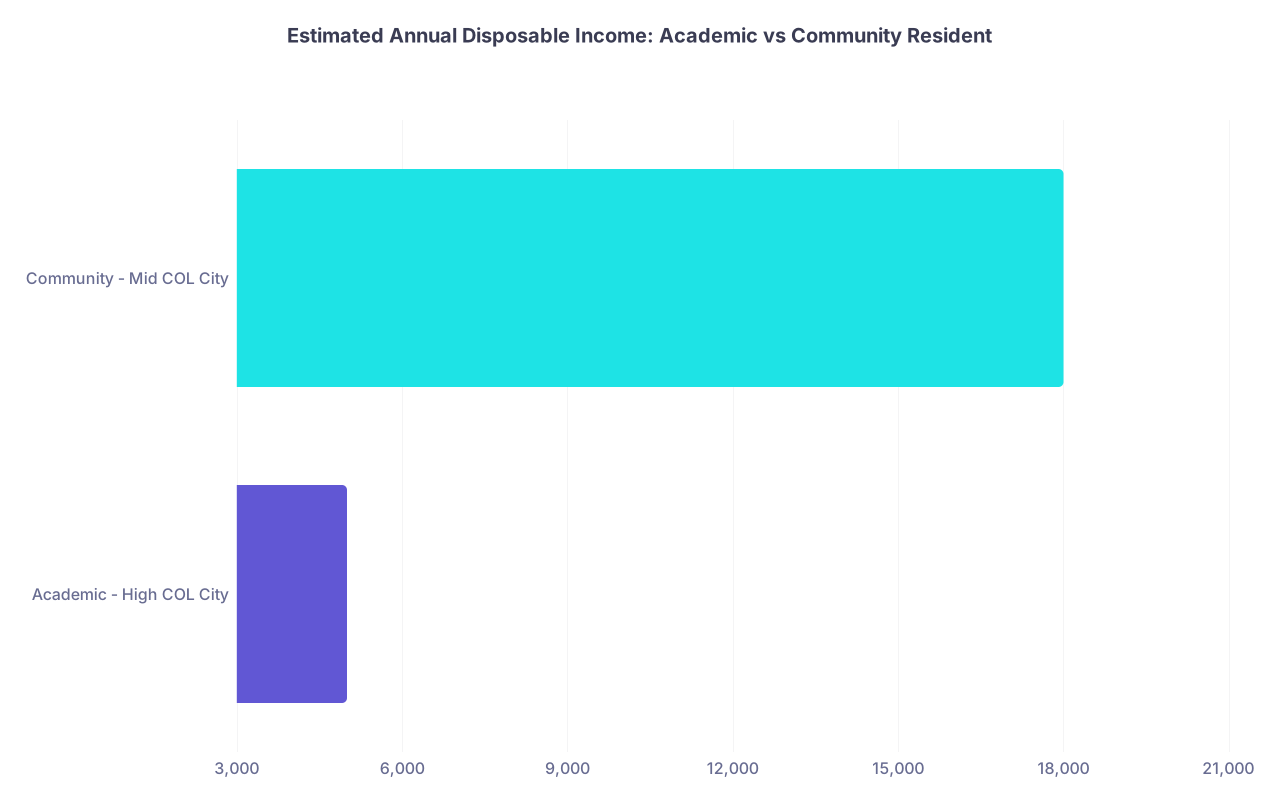
So yes, $5–10k more in salary at some community programs, plus lower rent, plus cheaper everything, plus easier moonlighting — that can be the difference between feeling constantly underwater and finally breathing.
| Category | Value |
|---|---|
| Academic - High COL City | 5000 |
| Community - Mid COL City | 18000 |
Nobody will say on interview day, “You should pick us even though you’ll be broke and exhausted.” But that’s the reality at some big academic centers. Again, the sharp residents run the math. And then run.
8. Geography and Relationships
Here’s what really happens in PD offices around February every year. Someone comes in and closes the door.
“Dr. X, my partner just matched to a different city. I need to transfer.”
“Dr. X, my dad was diagnosed with cancer. I can’t stay this far.”
“Dr. X, I’m getting married and my spouse’s whole life is in Y city.”
Academic programs talk about being “families” until you ask for something that breaks their structure. Some will work with you. Some will say, “We can’t accommodate that” and then act surprised when their star resident finds a community program two hours closer to home that will.
Transfers for family reasons are often coded delicately, but let’s be honest: once residents stop worshiping the institution and start centering their actual lives, community programs suddenly look a lot more appealing.
Why Academic PDs Won’t Tell You Any of This on Interview Day
To be fair, many program directors are trying to fix exactly these problems. Some are fighting hospital leadership about service loads, duty hours, culture. But remember their incentives:
They are graded on:
- Board pass rates.
- Fellowship matches.
- Service coverage.
- Recruitment fill rates.
They are not graded on:
- How many residents quietly wish they were somewhere else.
- How many moonlight elsewhere just to survive.
- How many “star” residents leave after PGY‑2.
So the messaging you hear is carefully curated. The behind-the-scenes conversations are very different. I’ve heard PDs say:
“We’re losing our best people to that community program down the road; they’re poaching.”
No. Those residents are voting with their feet.“Residents these days don’t want to work.”
Correction: they don’t want to be exploited when there are alternatives.“If they leave us, they’ll close doors for themselves.”
Occasionally true for hyper-academic careers. Largely false for clinical ones.

So What Do You Do With This as an Applicant?
If you’re applying to residency now — especially deciding between academic and community programs — you need to interrogate three things before you sign on.
1. Separate Marketing From Reality
On interview day, do not just ask, “Do residents match well in fellowships?” Instead:
“Can you tell me about anyone who transferred out after PGY‑2 in the last three years and why?”
They’ll dance. The way they dance matters.“How many residents moonlight and where?”
Tells you a lot about financial pressure and autonomy.“Can I talk to some PGY‑3s off the schedule, without faculty present?”
Back-channel those conversations. Ask: “If you had to choose again, would you still come here?”
2. Be Honest About Your Endgame
If you are absolutely set on a top-tier academic fellowship and research career, some academic pain may be a reasonable price. If you’re 60–70% sure you want to be a strong clinician in the region where you’ll live, do not let ego and brand name push you into a program whose main output is burnt-out junior faculty.
There are academic-lite and community programs that:
- Protect your time more.
- Give you real autonomy.
- Still get you into solid fellowships if you’re good.
These are underrated.
3. Watch the Community Sites Closely
Here’s a trick: in many academic programs, the best rotations are actually at their community affiliate hospitals. Residents will tell you this if you ask the right way:
“Which rotations feel most like how you want to practice after residency?”
If their answer is always the community site — better attendings, more hands-on, saner culture — that’s your data point. You might be happier doing all three years in an environment like that instead of just the few months your schedule gives you.

Quick Comparison: Academic vs Community for the “Star” Resident
| Aspect | Academic Program | Community Program |
|---|---|---|
| Prestige | Higher at name-brand centers | Variable, often regional |
| Lifestyle | Often heavier service, more call | Often better hours, more predictable |
| Autonomy | Slower, more layered supervision | Earlier, more direct responsibility |
| Fellowship edge | Strongest for hyper-competitive | Adequate for many fellowships |
| Culture risk | Higher chance of arrogance/toxicity | Depends on PD; often more pragmatic |
| Financial reality | Worse in high cost-of-living cities | Often better pay:COL balance |
FAQs
1. Does leaving an academic program after PGY‑2 hurt your career long-term?
Not automatically. If you leave in good standing, with strong evaluations and letters, and you’re going to a reputable community program, most future employers will barely blink. What raises eyebrows is a vague or contentious departure, poor documentation, or leaving under a cloud. The key is to control the narrative and secure clear, written confirmation from your PD that you left in good standing. For ultra-academic careers, yes, some doors may narrow — but for the majority who will work as clinicians, it’s usually a non-issue.
2. Can you still match a competitive fellowship from a community program?
Yes — but you have to be very intentional. You won’t be carried by name recognition, so your application has to be airtight: strong clinical performance, great letters (ideally from known faculty or alumni of the target fellowships), at least a few legitimate scholarly products, and ideally some networking at national meetings. I’ve seen people match cards, GI, and heme/onc from solid community programs. It’s harder, not impossible.
3. Should I avoid academic programs entirely if I care about lifestyle?
No. Some academic programs have quietly modernized: night float systems, reasonable caps, genuinely supportive cultures. Others are relics. You can’t generalize by label alone. You have to drill down: talk to upper-levels, ask specifically about call, note how often you see residents in the hospital at 6 pm on a “short” day. An academic badge isn’t the problem; a dysfunctional culture is.
4. What are warning signs on interview day that a program might drive stars away later?
Watch for three things. First, residents who look exhausted or guarded when faculty are in the room, then suddenly honest in the chat afterward. Second, PDs who over-emphasize “grit,” “resilience,” and “we work hard here” without talking concretely about support. Third, evasive answers around transfers, attrition, or moonlighting. Programs that lose star residents often have a pattern; they just work very hard not to put it on the slide deck.
Bottom line. Star residents flee academic programs after PGY‑2 when the unspoken contract breaks: the prestige, pipeline, and supposed opportunities no longer justify the service load, culture, and personal cost. The sharp ones stop buying the narrative and start building a life that matches their actual goals. If you’re smart, you’ll make those calculations before you sign on — not two years in when you’re already planning your escape.