You are sitting on a Zoom interview. Program director asks: “So, you mentioned you’re interested in oncology and cardiology. How do you see our setting—community-based academic hospital—fitting into those goals?”
Your brain locks. Because on your spreadsheet, you have “Onc?” and “Cards?” scribbled next to half your internal medicine programs. You know you like both fields. You know some programs are “academic,” some “community,” some “hybrid.” But how that actually translates into your future heme/onc vs cards fellowship chances? And which differences actually matter vs what is just brochure language?
Let me be specific: if you care about oncology or cardiology, the setting of your residency program—pure academic, community, or community-academic hybrid—changes your day-to-day exposure, your fellowship competitiveness, and even what kind of oncologist or cardiologist you can realistically become.
Most MS4s hand-wave this. Then they spend PGY-2 frantically cold-emailing fellowship PDs because their program cannot support the path they now want.
Let’s prevent that.
First, reality check: You are not choosing “oncology vs cardiology” in ERAS
For internal medicine, you are choosing training environment now that will constrain or enable onc/cardiology options later.
Short version:
- Heme/Onc is numerically easier to match than cardiology, but more research-sensitive at the top tier.
- Cardiology is more competitive at every level and far more dependent on:
- Echo/cath exposure
- Letters from recognized cardiologists
- Fit with a “cardiology culture” in your residency
Both are absolutely doable from community and hybrid programs. But not from every community program. And even some “academic” programs quietly bottleneck you.
The core difference: what “academic” vs “community” means for onc and cards
Forget marketing labels. Look at function.
I’m going to use three buckets, because that’s how it actually feels on the ground:
- Big-name academic / university hospital
- Community-academic hybrid (large teaching hospital with university affiliation)
- Pure community (no or minimal fellowship programs, mostly service-driven)
For oncology
Academic and hybrid programs usually have:
- Dedicated inpatient malignant heme and solid oncology services (often multiple).
- Onc attendings who are:
- NIH-funded, or
- PI on pharma trials, or
- Section heads in national societies.
- Structured oncology rotations as an intern and resident, not just consults.
- A functioning research machine: data pulls, biostats, coordinators, IRB templates.
Pure community programs often have:
- A single combined “oncology” service or mostly outpatient oncology managed by private groups.
- Few or no inpatient malignant heme cases outside bread-and-butter:
- DLBCL, breast, lung, colon, “give FOLFOX and admit for neutropenic fever.”
- Minimal clinical trials; or trials are all industry, operationally driven by the private practice, not residents.
- Onc exposure that is:
- Mostly “consult, chemo held, discharge, follow up as outpatient,”
- With very little depth in transplant, cellular therapy, or experimental therapeutics.
For cardiology
Academic and hybrid programs typically have:
- High-volume cath lab, EP lab, and structural heart program.
- Dedicated CCU run by cardiology, not mixed MICU/SICU.
- Formal cardiology rotations with:
- Echo reading exposure
- Cath/shadowing embedded
- Maybe night float for CCU.
Pure community frequently means:
- General internal medicine running “telemetry” instead of dedicated CCU.
- Cardiology is a consult service with:
- Mostly ACS, CHF, afib, “rule out MI” medicine.
- Low procedural complexity: limited TAVR, ECMO, advanced LVAD, etc.
- Cardiology group is private, overbooked, and not deeply invested in teaching research or writing strong, nuanced letters.
So what? Because fellowship committees read environment through your CV and letters.
If your letters say, “Managed complex transplant oncology population on a high-acuity malignant heme service, participated in clinical trial enrollment,” that screams one type of training.
If they say, “Excellent resident on the oncology consult service, always communicated well with private oncology group,” that reads very differently to an academic fellowship PD scanning 500 applications.
Same for cards: “Led CCU rounds on ECMO, cardiogenic shock, post-TAVR care, collaborated with advanced heart failure team,” vs “Strong on telemetry floors, excellent team player, effective at managing CHF and NSTEMI.”
You can be phenomenal in either setting. But the content of your experience will steer what doors open.
Research: where the gap becomes obvious (especially oncology)
Onc fellowships care a lot about research. Top 20 heme/onc? They basically expect some research productivity, ideally oncology-related.
Cardiology also likes research, but outside the elite programs, you can get away without it if you have stellar clinical letters and strong performance in CCU/cath-heavy environments.
Typical research ecosystems
| Setting Type | Abstracts/Pubs Support | IRB/Stats Help | Trial Access |
|---|---|---|---|
| Big Academic | Strong | Formal core | Many |
| Community-Academic | Moderate | Informal help | Select |
| Pure Community | Weak to minimal | Rare | Few |
In oncology, the pattern is brutal:
Academic IM programs feeding academic heme/onc:
- Residents have ready-made projects (chart reviews, retrospective cohorts, case series).
- Attendings send, “Need a resident for ASH abstract,” emails.
- You can reasonably do 1–3 abstracts and maybe a paper in 3 years. Without killing yourself.
Community-academic hybrids:
- There is someone doing oncology research, but you have to find them.
- Infrastructure is patchy. You will fight for data, stats, and IRB.
- It’s doable, but you drive the process.
Pure community:
- Research is “present a poster at local ACP” or maybe a case report a year if you beg.
- Oncology projects are almost entirely self-initiated.
- Data access is a nightmare. When you finally get a dataset, you are a PGY-3 with boards and interviews in 2 months.
For cardiology, the difference matters mostly for academic cards destinations. Many community-based cardiology fellowships care far more about:
- How you function in high-acuity settings
- Strength of letters from recognized cardiologists
- Procedural curiosity and judgment
If you want MD Anderson heme/onc, Dana-Farber, Memorial Sloan Kettering—choosing a purely community residency with no oncology research track is shooting yourself in the foot. If you want a solid, clinical cards fellowship at a mid-tier program, that same community residency could still be enough if it has strong cardiologists and solid CCU.
Clinical exposure that actually changes your fellowship odds
Do not just ask, “Do you have an oncology rotation?” or “Is there a CCU?”
Those questions are vague and invite brochure answers.
You care about three kinds of exposure for oncology:
- Acuity and complexity
- Dedicated time and service structure
- Continuity and clinic
For cardiology, you care about:
- CCU structure and ownership
- Procedural volume and trainee inclusion
- Echo and imaging access
Oncology: red flags and green flags on interview day
On Zoom or in person, here is what I would actually ask:
“How many inpatient malignant heme and solid oncology services do you run, and who staffs them?”
Translation: Is there more than one “onc” service, or is it just general medicine with onc consults?“Do residents rotate on BMT / cellular therapy, or just on general oncology?”
If they say, “Fellows only,” you know where you stand for high-end heme/onc.“How many heme/onc fellows are there, and how involved are residents in their services?”
If there is no heme/onc fellowship at all, that is not automatically bad, but it shifts your strategy—your letters will come from community oncologists, not known academic names.“Can residents see their own oncology continuity patients in clinic, or is that separate?”
Oncology clinic exposure matters, especially if you are leaning toward solid tumor.
In big academic centers, you will see stem cell transplant, CAR-T, weird leukemias that only show up in ASH questions, and toxicities from obscure regimens. That translates directly into strong fellowship interviews because you can speak that language comfortably.
In small community settings, your oncology experience may be almost entirely:
- Breast
- Colon
- Lung
- Prostate
- “Work up anemia, send to heme clinic”
That is fine if you are aiming for a largely community-practice heme/onc life. It is limiting if you discover you are obsessed with transplant oncology or clinical trials.
Cardiology: what separates “cards-friendly” from “just telemetry”
Same drill. Stop asking, “Is there a CCU?” and start asking:
“Is the CCU run by cardiology or by the ICU team?”
Cards-run CCU = much stronger training signal for fellowships.“What proportion of CCU admissions are true cardiogenic shock, advanced heart failure, post-intervention vs general MICU spillover?”
If CCU is a dumping ground for sepsis and DKA, you are not getting real cardiology intensity.“Do residents routinely observe caths, device implants, and TTE/TEE, or is that reserved for fellows?”
You want systems where residents are a meaningful presence in high-level cardiology work, not just the admission/discharge paperwork.“Is there an in-house cardiology fellowship, and do they match any external residents into cardiology?”
Some internal cards fellowships take almost exclusively internal candidates. That can be good or bad depending on whether you plan to stay or leave.
High-value exposure for cards:
- Night calls where you are first to see STEMI, shock, VT, and escalate to cardiology.
- Days on CCU where you handle vasoactive drips and devices in partnership with cardiology, not just “call the fellow for every decision.”
- Direct teaching from interventional cards, EP, and imaging attendings who know how to write specific, detailed letters.
You want your LORs to say things like, “Took care of multiple cases of cardiogenic shock with Impella and ECMO, has strong grasp of invasive hemodynamics,” not just, “Excellent resident on telemetry, good at volume management.”
Match data patterns: onc vs cards from different settings
Let me break this into the actual downstream reality.
General patterns (yes, there are exceptions)
Oncology from big academic IM
- Easier to match into top-tier academic heme/onc with research output.
- Fellowship directors often know your attendings by name.
- You have natural paths into niche tracks (BMT, thoracic, GI, etc.).
Oncology from community-academic hybrid IM
- Good shot at mid-tier academic or strong clinical heme/onc fellowships if you produce some research and get strong letters.
- Top-tier is still possible, but you must be intentional—early research, targeted away electives, and networking.
Oncology from pure community IM
- Very feasible to match into solid, community-oriented heme/onc fellowships, often within the same system.
- Harder but not impossible to break into big-name academic programs; that requires:
- External research collaborations
- Away rotations at academic centers
- Exceptionally strong advocacy letters.
For cardiology:
Cardiology from big academic IM
- Strong CCU + echo + research → high probability of matching competitive cards programs.
- At some powerhouse institutions, the choke point is internal competition: half your co-residents also want cards.
Cardiology from community-academic IM
- Many grads match into cardiology, often regionally.
- If the hospital has its own cardiology fellowship and you perform well, your path may be relatively straightforward.
Cardiology from pure community IM
- Very program-dependent.
- If your hospital has:
- No cardiology fellowship,
- Limited CCU,
- Mostly consult-based coverage,
your cards chances are substantially lower unless you have stellar USMLEs, strong advocacy letters, and maybe research or externships.
Here is a crude but honest comparison:
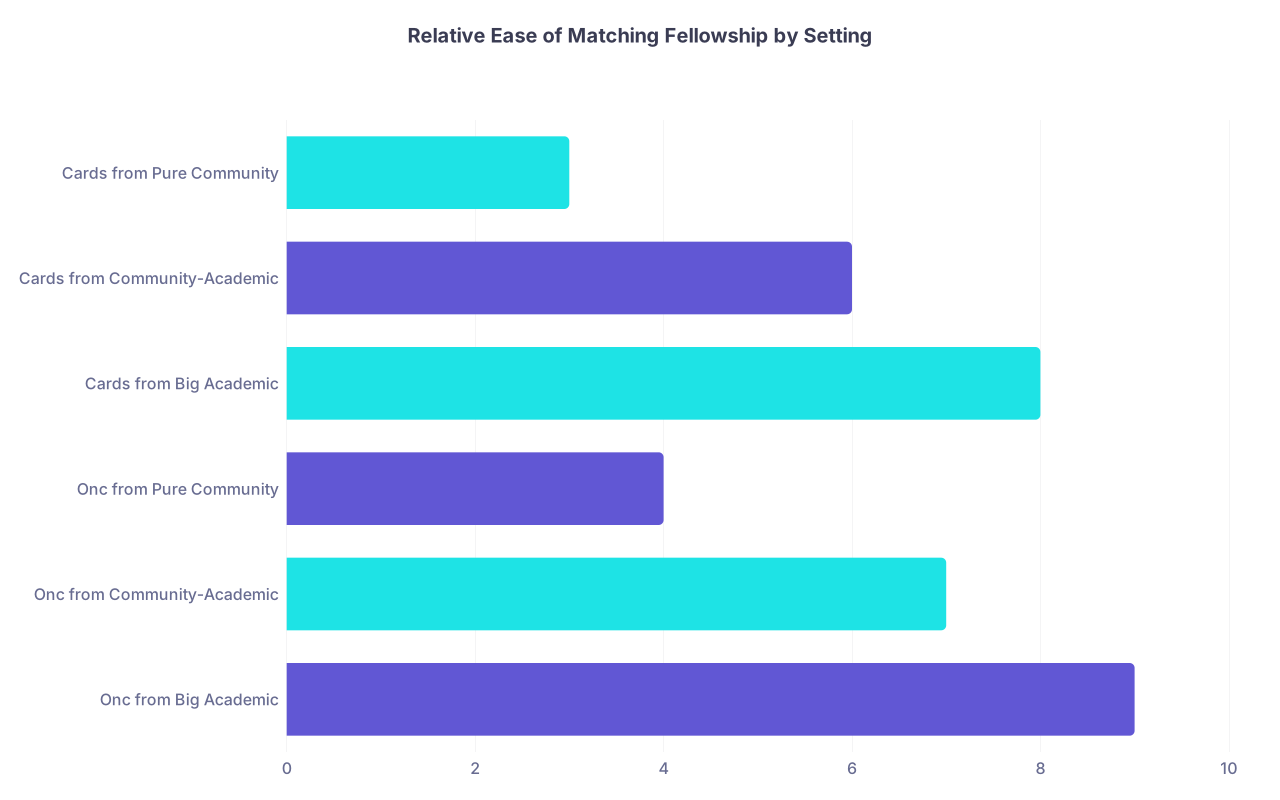
| Category | Value |
|---|---|
| Onc from Big Academic | 9 |
| Onc from Community-Academic | 7 |
| Onc from Pure Community | 4 |
| Cards from Big Academic | 8 |
| Cards from Community-Academic | 6 |
| Cards from Pure Community | 3 |
(Scale 1–10, “ease” meaning relative likelihood of matching a good fit fellowship if you are an above-average resident in that environment. Not a scientific metric, but it captures the lived pattern.)
Letters of recommendation: who writes them, and who reads them
This part is underappreciated.
Fellowship selection is not just about “strong letters.” Nearly everyone has “strong letters.” It is about:
- Who wrote them.
- How detailed and content-rich they are.
- Whether the writer has credibility to comment on fellowship readiness.
Oncology LOR nuances
From a big academic IM:
- PD/Chair often known by name.
- Heme/onc letter from someone who:
- Publishes actively.
- Sits on ASCO/ASH committees.
- Has collaborated with other programs’ faculty.
Those letters anchor your file. Even if your Step scores are average, PDs know what “star resident at X program” means.
From community-academic:
- Onc letter may be from a clinically superb but less-known figure.
- If that person has a history of sending fellows who perform well, their letter still carries weight. This is invisible to you as an applicant, but fellowship PDs remember.
From pure community:
- Many letters come from private practice oncologists.
- They may be eloquent and sincere. However, fellowship PDs cannot triangulate the grading curve of that writer. So your numbers, CV, and interview performance matter more to compensate.
Cardiology LOR nuances
Similar logic:
- Letters from cardiologists at programs like Cleveland Clinic, Mayo, Brigham, Duke have inherent brand weight.
- But there is a twist: cardiology fellowships care intensely about clinical judgment and procedural maturity.
- A detailed letter from a highly respected but mid-tier cardiologist describing you as the best resident they have worked with in 10 years can absolutely beat a vague letter from a famous name.
You want to train somewhere that produces:
- Faculty who actually watch you manage critical cases.
- Time and culture for thoughtful letter-writing, not templated blurbs.
On the interview trail, explicitly ask senior residents:
- “Who are the go-to letter writers for cards/onc here?”
- “Do fellows from here get interviews at external programs, or do most stay internal?”
Their answers will tell you more than any glossy PDF.
Daily work: what will your life actually feel like?
You are not just choosing match odds. You are choosing three years of your life and what kind of specialist you will become.
Life aiming for oncology
At a big academic IM:
- Expect:
- Many months on oncology or malignant heme, often high-acuity.
- Nights where every admit is neutropenic fever, tumor lysis, hyperleukocytosis.
- Tumor boards, journal clubs, and constant exposure to clinical trials.
- The upside:
- You will speak the language of academic oncology fluently by PGY-3.
- Strong mentorship paths toward niche focus (GI, thoracic, BMT, etc.).
- The downside:
- Heavy emotional burden, lots of end-of-life care.
- Potential for burnout if the service is understaffed.
At community-academic IM:
- Onc months are busy but more bread-and-butter.
- Fewer zebras, more classic textbook solid tumors.
- Easier to imagine yourself in a community heme/onc life, because you are essentially seeing that.
At pure community IM:
- Onc exposure may be limited:
- Short consult notes.
- “Follow-up with Dr. X as outpatient.”
- You may feel like you are barely scratching the surface of actual treatment decision-making. That can make fellowship interviews harder, because you cannot lean on rich clinical anecdotes.
Life aiming for cardiology
At big academic IM:
- CCU can be punishing. True ICU-level intensity.
- Your days will be:
- Rounds on ECMO, LVADs, post-CABG, cardiogenic shock.
- Working closely with fellows who may or may not let residents take the lead.
- If well-structured, you emerge highly confident in acute cardiac care.
At community-academic IM:
- CCU services vary wildly.
- In good ones:
- You are the face at the bedside, calling cards for every escalation.
- You build very real decision-making muscle.
- In weaker setups:
- “CCU” is just telemetry + step-down MICU, and your cardiology identity never really develops.
At pure community IM:
- Many days are:
- CHF tune-ups
- Rate control for afib
- Troponin leaks and borderline ACS
- That is fine if you want a general IM life. It is not enough to convince a rigorous cardiology PD that you are ready to live in the cath lab.
Strategy: choosing between oncology vs cardiology interest when picking program type
You might not know yet which field wins. That is normal. So you choose resilience: a program that keeps both doors open as long as possible.
Here is the blunt version:
- If you are genuinely torn between oncology and cardiology, and you are competitive:
- Favor academic or strong community-academic programs with:
- A heme/onc fellowship or strong affiliations with one.
- A robust, cardiology-run CCU and in-house cards fellowship.
- Favor academic or strong community-academic programs with:
- If you are leaning clearly:
- Leaning oncology and want academic heme/onc:
- Prioritize research infrastructure and depth of malignant heme exposure over CCU strength.
- Leaning cardiology and want academic cards:
- Prioritize CCU ownership, cardiology presence, and echo/cath exposure over oncology bells and whistles.
- Leaning oncology and want academic heme/onc:
For the truly numbers-focused:
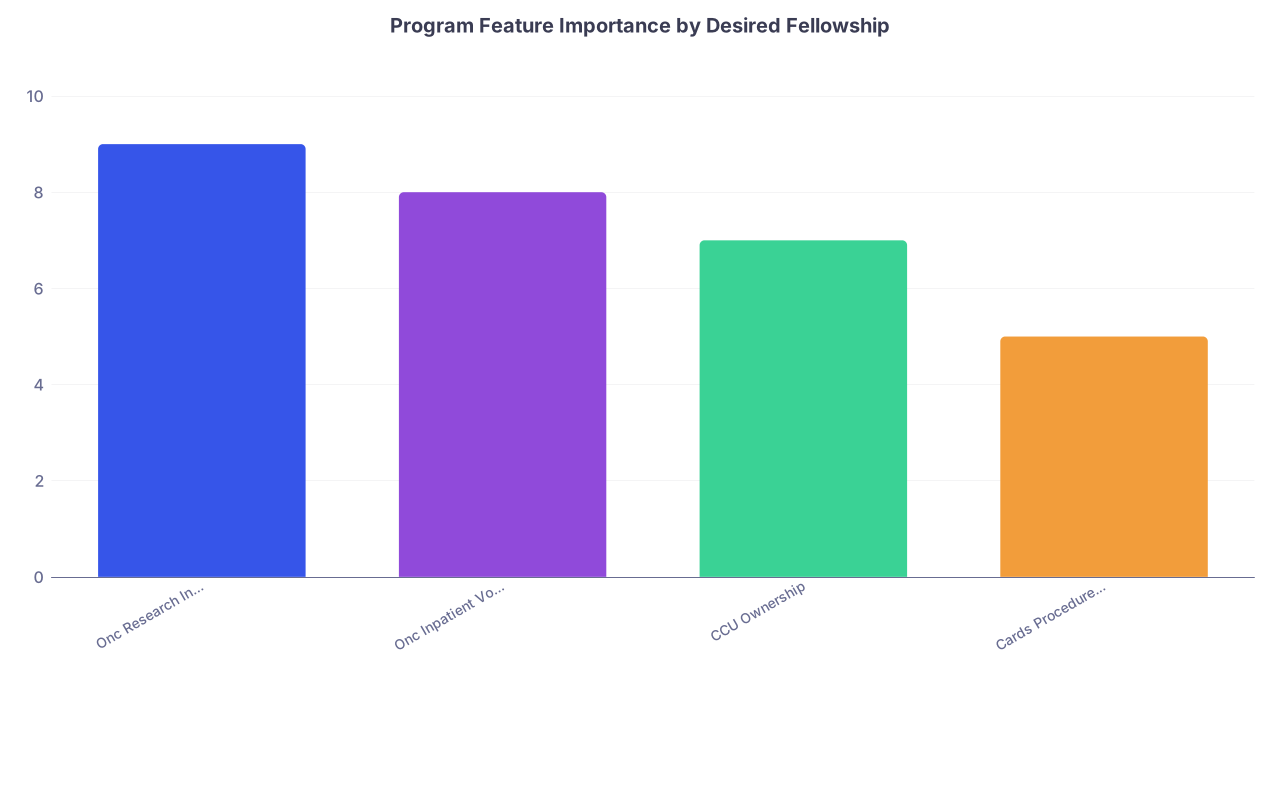
| Category | Value |
|---|---|
| Onc Research Infra | 9 |
| Onc Inpatient Volume | 8 |
| CCU Ownership | 7 |
| Cards Procedure Exposure | 5 |
(For heme/onc-focused applicants.)
| Category | Value |
|---|---|
| Onc Research Infra | 9 |
| Onc Inpatient Volume | 8 |
| CCU Ownership | 7 |
| Cards Procedure Exposure | 5 |
(For cardiology-focused applicants.)
You get the idea.
How to interrogate programs now like someone who wants options later
Let me give you a concrete, usable script. This is where most applicants fall flat; they ask questions that could apply to any program, any specialty.
You should be asking like this:
On interview day – oncology angle
During resident Q&A:
- “How many residents in the last 5 years matched into heme/onc, and where?”
- “For those who went into heme/onc, how did they get their research? Was it mostly internal, or did they collaborate with outside institutions?”
- “Is there a malignant heme / BMT unit, and do residents rotate there routinely or only as electives?”
During PD or faculty time:
- “For someone aiming at academic heme/onc, what have your successful residents typically done by the end of PGY-2? Number of projects, typical mentors, etc.?”
- “Do residents present at ASCO/ASH regularly? How many abstracts or posters last year?”
If they cannot answer those questions with specifics, that tells you a lot.
On interview day – cardiology angle
During resident Q&A:
- “How many residents matched cards in the last 5 years, and what proportion stayed here vs left?”
- “On CCU, who runs the show—residents with attending oversight, or fellows, or is it more ICU-based?”
- “How comfortable do you feel managing cardiogenic shock, recurrent VT, or post-MI complications by the end of residency?”
During PD or faculty time:
- “Do residents routinely get to observe or participate (even peripherally) in caths, TEE, and device placements?”
- “For residents who match into strong cardiology programs, what do their CVs usually look like—research-heavy, or more letters and clinical performance?”
You are looking for not just the content of the answer, but the ease and specificity. Programs that reliably produce oncologists and cardiologists know exactly how it happens.
The “setting differences that actually matter” — boiled down
Let me strip the fluff.
These are the structural differences that consistently change outcomes for oncology and cardiology-bound residents:
Presence and nature of fellowships on site
- Heme/Onc and Cardiology fellowships create:
- Faculty with fellowship-selection experience.
- Built-in letter writers.
- Exposure to the realities of each field.
- No fellowships is not fatal, but it removes a lot of scaffolding.
- Heme/Onc and Cardiology fellowships create:
Who controls the sickest patients
- Oncology:
- Is malignant heme/BMT controlled by heme/onc, or by general MICU with onc consults?
- Cardiology:
- Is CCU owned by cardiology, or is it just “MICU with a few STEMIs”?
- Oncology:
Research pipeline
- Oncology: Almost mandatory at high levels.
- Cardiology: Optional at mid-tier but key for top programs.
- Infrastructure differences between academic vs community here are massive.
Faculty visibility and credibility
- Recognized names in heme/onc and cards accelerate your applications.
- In community settings, stellar clinicians may not have that same external currency.
Culture of subspecialization
- In academic or strong hybrid programs, it is assumed many residents will subspecialize.
- In pure community programs, the default is general IM. That cultural baseline affects mentorship, opportunities, and expectations.
Here is one more way to conceptualize it:

Where this leaves you on match day
You are not picking “oncology vs cardiology” yet. You are picking how much friction you want later when that decision crystallizes.
If you are competitive enough on paper (scores, letters, grades) to land a strong academic or community-academic IM program, and you care deeply about onc or cards:
Do it. You will not regret having options.If your application realistically leans toward community-heavy IM programs:
- Be far more granular in how you rank them.
- Strong cards culture? Known pipeline into regional cardiology fellowships?
Better if you lean that way. - Oncology group that loves teaching, has some industry trials, and sends residents to heme/onc every year?
That is gold if you favor onc.
- Strong cards culture? Known pipeline into regional cardiology fellowships?
- Be far more granular in how you rank them.
You do not need perfection. You do need alignment.
And here is the final, mildly uncomfortable truth: by the time you are a PGY-2, you will know which field wins. At that point, switching residencies is almost impossible. Retrofitting a weak program into a “cards- or onc-powerhouse” is exhausting.
Choosing the right setting now lets you spend PGY-2 actually growing into that field instead of constantly patching gaps.
With that foundation, your future self—sitting in a heme/onc or cardiology fellowship interview—will have something better to say than, “I sort of stumbled into this.” You will be able to point to a coherent training path that matches where you are heading next.
And that next step—actually constructing a PGY-1 and PGY-2 that make you a serious oncology or cardiology candidate—is where the real strategy starts. But that is a conversation for another day.