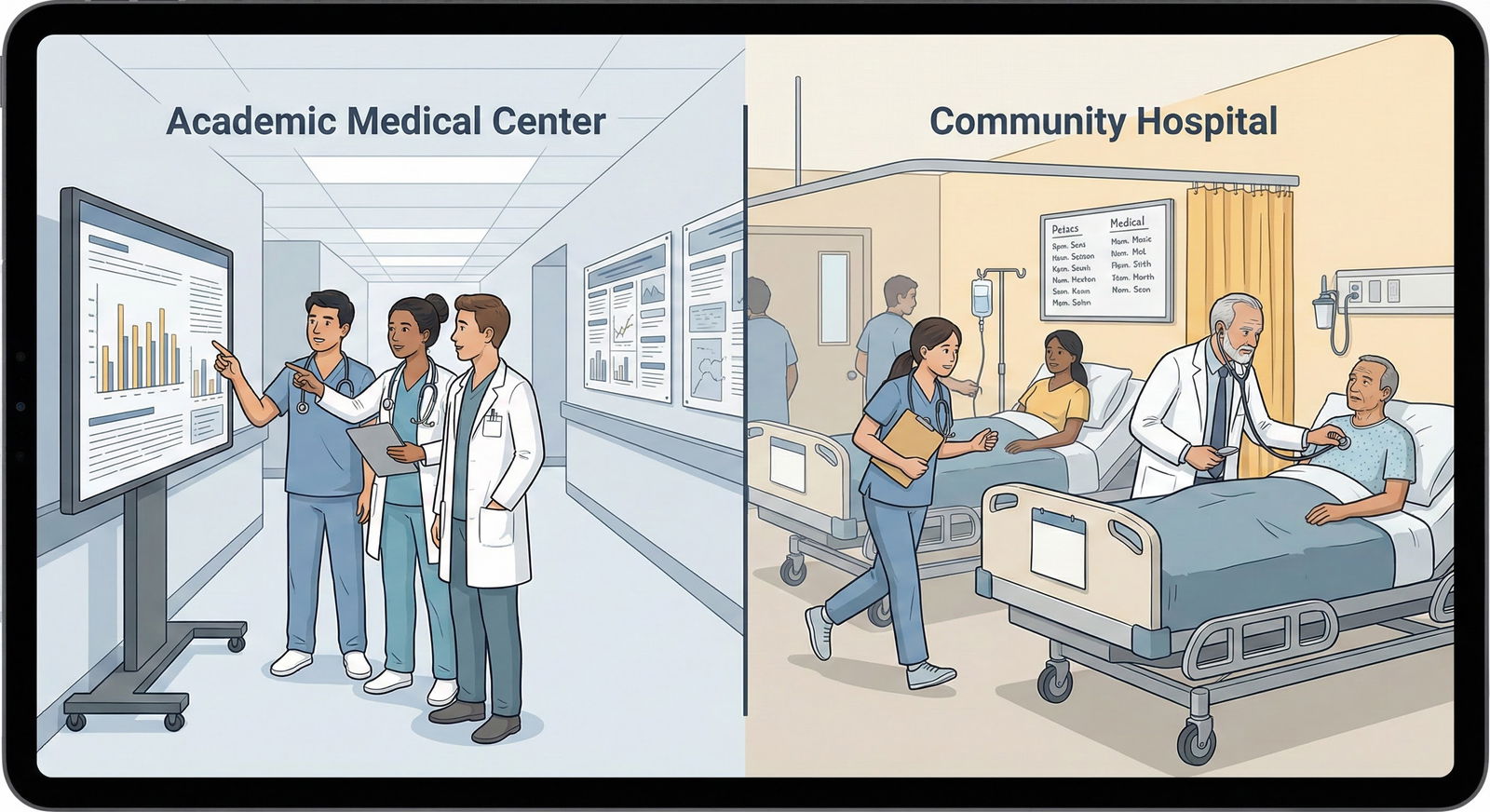
The belief that you must train at an academic powerhouse to have a serious research career is exaggerated—and sometimes flat-out wrong.
If your goal is a research-heavy career, academic programs do have clear structural advantages. But strong, intentional residents can absolutely build research-focused careers coming out of certain community programs. The key is this: not “academic vs community” as a label, but the research ecosystem you’ll actually have access to.
Let’s cut through the noise and look at what actually matters for residency applicants trying to build a research career.
The blunt truth: academic programs start with more advantages
If you want to live and breathe research, a university-based academic program with a strong department in your specialty is usually the easier path. Not always better in every way, but easier.
Academic programs typically give you:
- Built-in research infrastructure (IRB support, statisticians, research coordinators)
- Faculty whose promotions depend on publications and grants
- Ongoing trials and projects you can simply plug into
- Students, fellows, and other residents to share workload
- Name recognition that helps later with grants, fellowships, and jobs
In practice, that means you can show up Day 1, ask, “Who is doing work in cardio-oncology?” and within a week be added to 2–3 ongoing projects if you’re remotely competent and follow through.
Compare that to many community programs, where you might find:
- One faculty member “into research” who is also drowning in clinical work
- Minimal or clunky IRB infrastructure
- No research office, no statistician, no grants office
- Zero protected time
- A culture where research is “extra” and not valued
From a pure probability standpoint, choosing a strong academic program raises your odds of building a research-heavy CV with far less friction.
But that’s only half the story.
When a community program can work for research
Community programs are not all the same. Some are quietly excellent for research; others are a complete desert. The trick is knowing how to tell the difference before you sign your life away.
Here’s how to think about it: you’re not choosing between “academic” vs “community.” You’re choosing between:
- Research ecosystem present vs absent
- Research mentors available vs mythical
- Research time and support real vs promised only in brochures
| Factor | Strong Academic Program | Research-Active Community Program | Typical Community Program |
|---|---|---|---|
| Ongoing projects | Many, varied | Several, focused | Few or none |
| Protected research time | Often structured | Possible but ad hoc | Rare |
| Statistician/IRB support | Built-in | Shared with system/university | Minimal |
| Mentors with R01s | Common | Occasional | Very rare |
| Medical students/fellows | Many | Some | Few or none |
Here’s when a community program can genuinely support a future research career:
It’s closely affiliated with a med school or major academic center.
Example: a community hospital that’s a training site for a university’s med students or fellows and shares the same IRB and research infrastructure.There are multiple faculty with real, ongoing scholarly output.
Not “one paper 10 years ago.” Look for:- PubMedable publications from the last 2–3 years
- Ongoing QI projects that actually lead to posters or manuscripts
- Named PI or sub-I roles in multicenter trials
Residents actually present at national meetings.
Programs will brag about this. They should. Check if residents have:- Posters/orals at major specialty meetings (e.g., ACC, ATS, ASCO, RSNA, IDWeek)
- Named authorship (not just buried in 40 names)
Leadership that values research.
If the PD and core faculty care about scholarship, it shows up in:- Required scholarly project with real support
- Funds for travel to conferences
- Formal research tracks or elective time
Without at least 2–3 of those in place, a “community program with research” is often just marketing.
How to evaluate programs before you rank them
Do not rely on the word “academic” or “community” on ERAS alone. Those labels are sloppy.
Use this checklist when you’re on interviews or combing through websites.
1. Look at actual resident output
Go to the program website. Many list “resident scholarly activity.” If they don’t, ask.
You want to see, over the last year or two:
- Multiple residents with:
- First- or second-author case reports, series, or retrospective studies
- Abstracts at recognizable national conferences
- Not just one star resident doing everything; a pattern across classes
If they proudly show 2 case reports total over 3 years, that’s not a research program, academic or community.
2. Ask targeted questions on interview day
Do not ask, “Is there research?” That’s useless. Everyone will say yes.
Ask questions that force specifics:
- “Can you tell me about residents in the last 3–5 years who matched into research-heavy fellowships or academic positions? What did their research look like?”
- “How is research time built into the schedule? Is there guaranteed elective time protected from clinical pull?”
- “Do you have a statistician or research coordinator that residents can access?”
- “Who are the most productive research mentors here, and what are they working on right now?”
- “About how many residents present at national meetings each year?”
Pay attention to how quickly and concretely they answer. Hesitation or vague hand-waving is a red flag.
3. Check alignment with your specialty and niche
You might find a community program that is fantastic for outcomes research in cardiology but has nothing for basic science in immunology. If you already know your lane, match the program’s strengths to it.
Examples:
- You want critical care research. A large community hospital that runs multiple ICU-related multicenter trials might be better than a small university hospital with minimal ICU investigation.
- You’re into health services/quality research. A big community system with aggressive QI and data analytics can be fertile ground.
One size does not fit all. Look for where the data and people actually are.
The real tradeoffs: what you gain and what you lose
Academic programs and community programs push and pull on different parts of your career.
What academic programs usually give you for research careers
- Easier access to projects and mentors
- Higher density of people who care about academic careers
- Name-brand effect on fellowship and early faculty hiring
- More chances to be on grants, multicenter studies, guideline committees
- Fellows and students to help with data collection and writing
But they can also mean:
- Heavier non-clinical expectations (teaching, committees, resident conferences)
- More competition among residents for the “best” mentors and projects
- Sometimes more bureaucracy and slower decision-making
What community programs can offer (when they’re solid)
- Larger clinical volume → easier to do outcomes/QI/observational work
- Less competition for the few research-active attendings
- Greater autonomy and often more flexible projects (especially QI, clinical series)
- Sometimes more realistic clinical training if you plan to be a clinician-educator with some research
The downside:
- You may be initiating and driving much more of the research yourself
- Less name recognition when applying for highly competitive research fellowships or K-level grants
- Limited exposure to deep bench/lab science or complex trial design
- Networking mainly local/ regional, not national/global
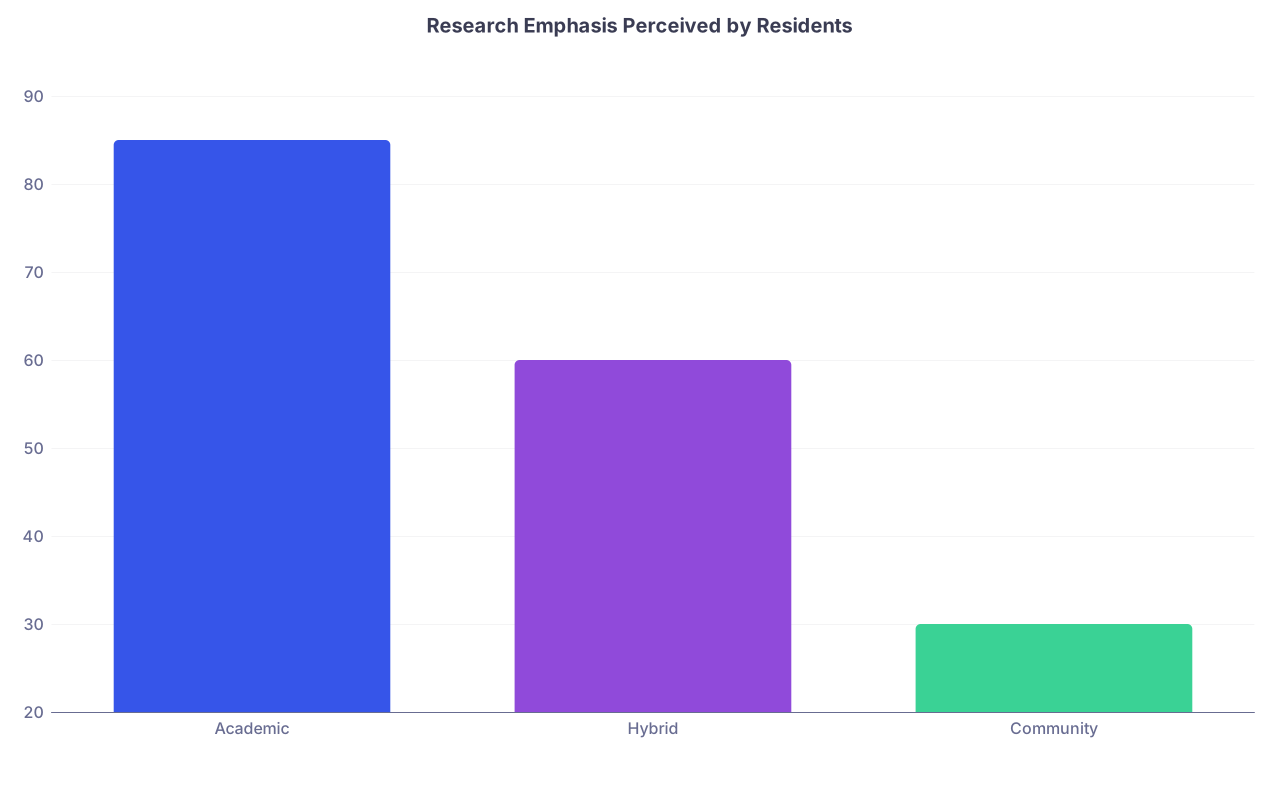
| Category | Value |
|---|---|
| Academic | 85 |
| Hybrid | 60 |
| Community | 30 |
(Think of those as rough “percent chance you’ll find a strong research environment,” not exact numbers.)
If you’re fellowship-bound and research matters: how to prioritize
Here’s the honest framework I give people applying to fields like cardiology, heme/onc, GI, pulm/crit, neurology, etc.
If you want:
- A top-20 fellowship
- A future as an NIH-funded PI
- A job at a research-heavy academic center
Then your rank list should heavily favor:
Strong academic programs with:
- Documented resident research productivity
- Multiple faculty in your target niche
- Structured research time or tracks
Hybrid programs: large community or VA programs tightly integrated with an academic center that show real scholarly output.
Only consider a pure community program for that path if:
- It has a clear, strong track record of sending residents to the kind of fellowships you want, and
- You’re ready to hustle more than your peers at big-name academic centers
Can it be done? Yes. But you’re choosing the uphill version of the game.
When a community program is absolutely fine (or even better)
Not everyone needs to be a grant-funded researcher. A lot of applicants feel like they should want that because everyone on the interview trail is posturing about “loving research.”
Here are cases where a community program—even one with modest research—can be a better choice:
- You want to be a clinician-educator with some QI/case-report-level scholarship
- You’re planning a community-based or private practice career where research is a “nice to have”
- You care more about operative volume, procedural autonomy, or clinical independence than PubMed citations
- Burnout is already whispering in your ear, and the thought of chasing grants sounds miserable
In those cases, a supportive community program that lets you do a manageable project or two, present at a regional or national meeting, and then focus on becoming an excellent clinician is not a consolation prize. It’s smart.
Just be honest with yourself about which camp you’re actually in.
Red flags: when “we have research” means “we have nothing”
I’ve seen this pattern over and over on the interview trail:
- “We have lots of research opportunities”
= One QI project and a faculty member thinking about writing a case report.
Watch for these warning signs:
- No mention of resident publications on the website
- PD answers research questions with generic enthusiasm but no names, numbers, or examples
- “Protected time” that residents then quietly tell you is always eaten by clinical needs
- Zero med students or fellows around (you’ll do all data grunt work alone)
- Faculty who say, “We’d love to start some research…” instead of, “Here’s what we’re doing now.”
If you want a real research career, those programs—academic or community—go near the bottom of your list.
How to make a community program work if you end up there
Maybe you did not match your dream academic program. Maybe geography or life forced your hand. You can still aim for a research-leaning career from a community base, but you need a deliberate plan.
Here’s the playbook that actually works:
Identify 1–2 research-active mentors in PGY-1.
Even if they’re at the affiliated university across town. Email them. Show up prepared with ideas and evidence that you follow through.Start small but early.
- Case series
- Retrospective chart review
- QI projects with clear endpoints
Publish something in PGY-1 or early PGY-2. Momentum matters.
Leverage regional or national collaborative groups.
Join multicenter registries, clinical trials, or consortiums where your local patient volume is an asset.Use electives strategically.
Do research electives at the nearest academic center, or even away electives if your program allows. Build that broader network.Track your output like a hawk.
- Abstracts
- Posters
- Oral presentations
- Manuscripts accepted/published
You’ll need this narrative for fellowship or job applications: “Here’s what I built starting from a community program.”
Bottom line: are academic programs always better, or can community work?
Here’s the answer you’re looking for, without the fluff:
- If your top priority is a research-intensive career with grants, major trials, and academic promotion, a strong academic or hybrid university-affiliated program is usually the better, easier, and more reliable choice.
- A well-chosen, research-active community program can support a research career, especially in clinical, outcomes, or QI-focused work—but it requires more initiative and careful selection.
- A typical community program with little infrastructure and sparse scholarly output is not a good launchpad for a serious research career, no matter how hard you plan to grind.
So your move today is simple:
Pick 3–5 programs you’re considering and look up their resident publications and conference presentations from the last 2–3 years. If you cannot find concrete evidence of resident research success, downgrade that program on your rank list—no matter what they called themselves on ERAS.

| Step | Description |
|---|---|
| Step 1 | Want strong research career |
| Step 2 | Prefer academic or strong hybrid |
| Step 3 | Consider lower on rank list |
| Step 4 | Verify mentors, support, track record |
| Step 5 | Academic program likely better for research |
| Step 6 | Program shows real resident output |
| Step 7 | Community program? |