What actually happens if you skip the big-name university residency and match at a community program—are you basically locking yourself out of a clinician-educator academic career?
Let me answer that bluntly:
No, you’re not locked out.
But the path is steeper, less obvious, and you can’t coast. At all.
If you want to be a clinician-educator and you’re coming from (or likely to match at) a community residency, you need a strategy. Not vibes. Not “I like teaching.” A real plan.
Let’s walk through what’s real, what’s myth, and what you should actually do.
1. The Core Question: Is It Possible?
Yes, you can get a clinician-educator academic job from a community residency.
I’ve seen:
- A family medicine resident from a small community hospital end up core faculty at a university-affiliated FM program within 3 years.
- An internal medicine resident from a community program land an academic hospitalist position with a formal teaching role and protected time.
- An EM resident from a community shop become an assistant program director at a university-affiliated site.
So the answer is yes. But here’s the catch:
From a pure probability standpoint, academic clinician-educator roles are easier to get if you train at a strong academic program that already lives in that world:
- Built-in medical student rotations
- Established education infrastructure (MedEd fellowships, academies, offices of education)
- PDs and chairs who pick up the phone and call other academic PDs
If you’re at a community program, you’re swimming upstream a bit. Not impossible. Just means:
- You can’t be “average” and expect the same outcome.
- You have to build what academic residents sometimes get handed.
2. Community vs Academic Programs: What Actually Matters for Clinician-Educator Careers
Forget marketing language. Here’s what actually matters for becoming a clinician-educator and how community vs academic programs compare.
| Factor | Academic Programs | Community Programs |
|---|---|---|
| Automatic exposure to learners | High (students, residents, fellows) | Variable (sometimes limited) |
| Built-in education infrastructure | Strong (MedEd tracks, academies) | Often minimal or informal |
| Research in medical education | Easier to access | Needs initiative, usually external |
| Name recognition | Helps on paper | Must offset with substance |
| Networking to academic jobs | Strong built-in networks | You must proactively build your own |
Here’s the key: clinician-educator jobs are about three broad buckets:
- Clinical competence
- Teaching experience and documented excellence
- Evidence you actually care about education (projects, curriculum work, scholarship, leadership)
Academic residencies hand you a lot of this on a platter if you lean in.
Community residencies make you hunt for it. But you can still get there.
3. What Academic Clinician-Educator Jobs Really Look For
Let’s be very concrete. When a division chief or program director is hiring a clinician-educator, they’re asking:
- Will this person be safe, solid clinically, and not a headache?
- Can they teach in multiple formats—bedside, small group, didactics?
- Have they done more than just say “I like teaching” in their cover letter?
- Do they have anything that looks like educational scholarship or leadership?
So from a community program, you need to build the following during residency:
Teaching Experience
- Precepting junior residents/medical students (if available)
- Giving noon conferences, M&Ms, board review sessions
- Leading case-based discussions, journal clubs
Educational Leadership
- Create or revamp a curriculum (e.g., a new consult bootcamp, ambulatory curriculum, ultrasound basics series)
- Take responsibility for something recurring: simulation sessions, EBM conference, intern orientation
-
- Posters or presentations at education or specialty conferences (APDIM, SAEM, STFM, etc.)
- Brief med-ed articles, QI with an educational angle, or curriculum descriptions
- Even one or two solid outputs look good—your goal is evidence of engagement, not a PhD in education
Mentors Who Can Vouch Specifically for Your Teaching
- Letters that say: “This person is the best teacher among our residents. Here’s what they built. Here’s student and resident feedback.”
If you’re at a community hospital, you can still do all of that. You just usually have to initiate it instead of joining an existing “education track.”
4. How to Maximize a Community Residency for a Future Academic Clinician-Educator Job
Let’s make this actionable. Here’s what I’d do if you either matched at a community program or are leaning that way but care about education.
Step 1: Choose the Right Kind of Community Program
Not all “community” is the same. You want a program that:
- Has at least some medical student rotations (home or visiting students)
- Has formal didactics where residents regularly present
- Has any academic ties (university-affiliated, regional campus, teaching site)
- Has faculty who have titles like “clinical assistant professor,” “clerkship director,” or “site director”
Red flag: zero students, minimal teaching culture, mostly service work, administrators who roll their eyes at “projects” because they just want RVUs.
If you’re still in the application phase, ask about:
- How many students rotate per year? From which schools?
- Do residents teach students on wards/clinic?
- Any residents recently go on to academic jobs or fellowships?
- Any ongoing education or QI projects residents have led?
Step 2: Start Teaching Early and Keep a Record
Day one as PGY-1, you’re obviously learning. But by mid-PGY-1 and definitely PGY-2:
- Volunteer to give short talks on rounds
- Ask chiefs or PD: “Can I take a noon conference slot?”
- Offer to run case-based sessions or journal clubs
- Take an active role with any students who rotate through
Keep a simple tracking document:
- Dates, titles of talks
- Audiences (students, interns, residents)
- Any evaluations or email feedback you get
That becomes part of your CV and later your teaching portfolio. Most residents don’t track this. You should.
Step 3: Create or Own a Small Curriculum
Direct route into “clinician-educator” territory: build something.
Examples that have actually worked for residents in community programs:
- A structured “Intern Bootcamp” – 4–6 session series on common calls, pages, cross-cover problems.
- A simple “Board Review Morning Series” – weekly case-based review, led by residents, with faculty support.
- A point-of-care ultrasound intro curriculum (if that’s your thing).
- A short “clinic efficiency and documentation” workshop sequence for interns.
You don’t need a 50-page manual. You need:
- Learning objectives
- A repeatable structure
- Some feedback/evaluation
- Ideally, a before/after assessment or satisfaction survey
That’s already educational scholarship fodder if you write it up or present it.
Step 4: Build External Academic Connections Early
If your local environment is thin on educational resources, import them.
- Join your specialty’s education-focused organizations (e.g., AAMC GEA, APDIM, STFM, SAEM Education committees, etc.).
- Submit abstracts to national/regional meetings, even simple ones.
- Reach out (yes, cold email) to academic clinician-educators at nearby universities:
- “I’m a resident at [X community hospital], really interested in MedEd. Could I meet with you for 20–30 minutes on Zoom to get advice on making myself competitive for a clinician-educator job after residency?”
You’re not begging for a job. You’re building mentorship and your name in that world.
Some residents from community programs eventually do MedEd fellowships (1–2 years) at academic centers after residency. That’s another clean on-ramp to academic clinician-educator roles.
Step 5: Do Something That Looks Like Scholarship
Notice the phrasing: “looks like.”
You don’t need R01 funding. You need pieces on your CV that signal: “I don’t just teach—I think about education in a structured way.”
Good targets from a community program:
Poster at regional or national meeting on:
- A new curriculum you created
- A QI project with education built in
- A resident-led teaching innovation (simulation, bootcamp, etc.)
Brief write-ups / publications:
- Innovations in medical education sections (many journals have these)
- Case conference formats or curricula
- Short educational perspectives
If your program has no built-in infrastructure for research, keep it simple. Surveys + pre/post knowledge tests + learner feedback are often enough for a poster.
5. What About Matching Right Now: Should You Avoid Community Programs?
If your only life goal is hardcore academic clinician-educator at a big-name university, then yes, an academic residency helps a lot. I’m not going to sugarcoat that.
But here’s the truth no one likes to say out loud:
- A lot of “academic” residents never actually build a teaching portfolio.
- They don’t do curriculum work.
- They don’t touch MedEd scholarship.
- They graduate and apply for clinician-educator roles with “I like teaching” as their main line.
I have seen community graduates with a well-constructed record of teaching, curriculum, and scholarship beat “average but academic” residents for jobs.
So if your realistic options are:
- A weaker academic program with poor teaching culture and bad support
- A strong community program with real teaching, QI, and space to build things
I’d pick the strong community program and be intentional.
6. Signs a Community Program Can Actually Launch You Toward a Clinician-Educator Job
If you’re deciding where to rank or where to lean in, here are good signs:
- They host students from a med school regularly.
- Residents present at regional/national conferences every year.
- The PD or APDs have academic titles or education roles (clerkship director, site director).
- They have any kind of “resident-as-teacher” workshop, simulation program, or curriculum committee with resident involvement.
- Recent grads have:
- Gone into academic hospitalist roles
- Done fellowships at academic centers
- Joined university-affiliated programs as faculty
If they can name actual graduates who now have titles like “assistant professor,” “core faculty,” “clerkship director,” that’s strong evidence it’s possible from there.
7. How To Present Yourself When You Apply for Academic Clinician-Educator Jobs
When you get to application time for jobs or fellowships:
Your CV should clearly label:
- “Teaching Experience”
- “Curriculum Development”
- “Educational Leadership”
- “Educational Scholarship”
Your personal statement/cover letter should:
- Explicitly own that you trained in a community setting but sought out and built educational opportunities.
- Highlight 2–3 specific projects or roles.
- Connect your experience to what you want to do for their learners.
Your letters of recommendation:
- Need at least one person to say you are in the top tier for teaching.
- Should mention actual examples: “She built X,” “He led Y,” “Students rate him as one of the best teachers.”
You’re selling a narrative:
“I didn’t just exist in residency. I used a community environment to intentionally build a clinician-educator skill set.”
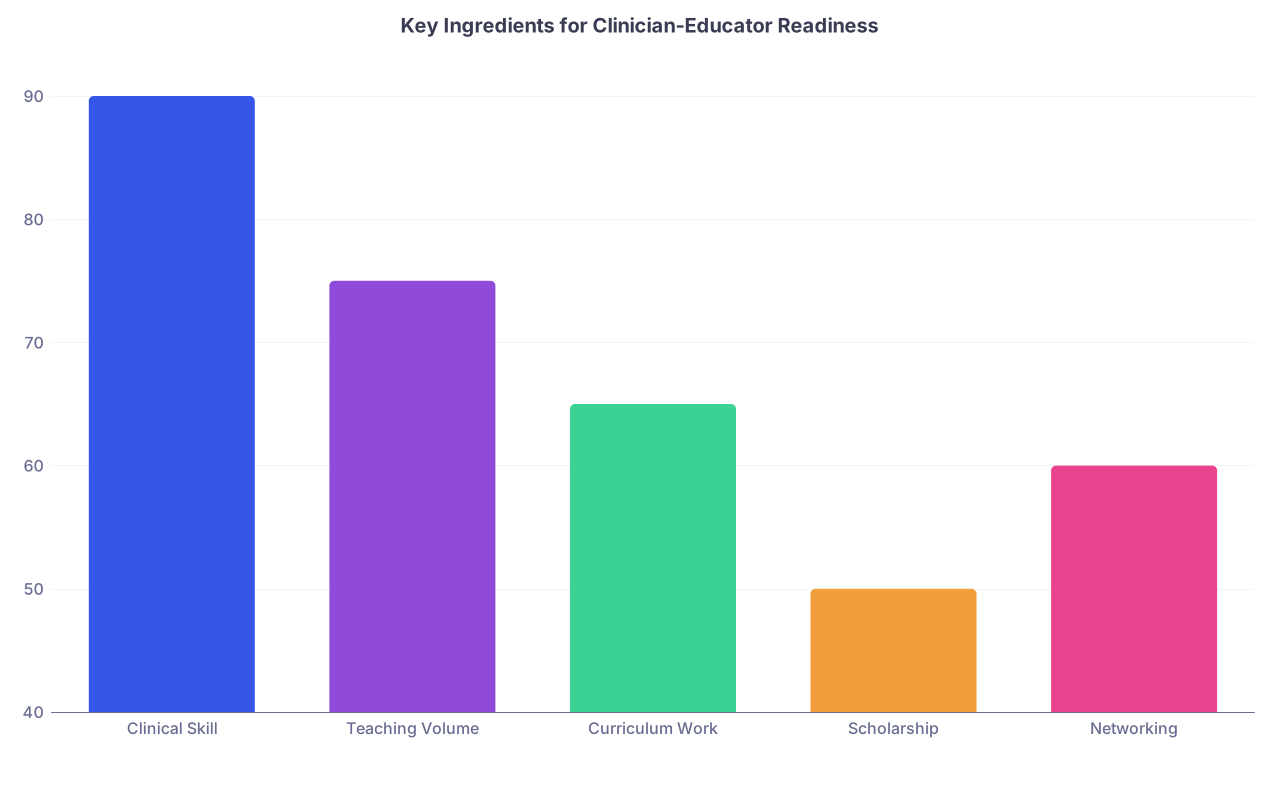
| Category | Value |
|---|---|
| Clinical Skill | 90 |
| Teaching Volume | 75 |
| Curriculum Work | 65 |
| Scholarship | 50 |
| Networking | 60 |

| Step | Description |
|---|---|
| Step 1 | Match at Community Program |
| Step 2 | Seek Teaching Roles Early |
| Step 3 | Create or Revamp Curriculum |
| Step 4 | Present Work at Conferences |
| Step 5 | Build Mentorship with Academic Faculty |
| Step 6 | Apply to Academic Job or MedEd Fellowship |
| Step 7 | Clinician Educator Faculty Role |
FAQs
1. Is it a red flag for academic jobs if I trained only in a community program?
Not automatically. What’s a red flag is a flat CV: no documented teaching, no projects, no sign you engaged with education beyond “I liked it.” If your community background comes with a strong teaching record and some scholarship, many academic places won’t care that it wasn’t a big-name university.
2. Do I need a MedEd fellowship if I come from a community residency?
You don’t need one, but it can be a powerful bridge. If your residency gave you lots of hands-on teaching but not much formal scholarship or mentorship, a 1–2 year MedEd fellowship at an academic center can polish your CV, expand your network, and make you a very clean hire for clinician-educator positions.
3. How early in residency should I start doing education-focused things?
By late PGY-1, you should be doing some basic teaching and at least thinking about a small project. By mid-PGY-2, you should have a defined education-related role (conference series, curriculum piece, student teaching), and by PGY-3 you should be converting that into at least one poster or presentation.
4. What if my community program has no students at all?
Then you need to get creative. Options: partner with a nearby med school to take students for electives, do remote teaching (online sessions, question-writing, virtual cases), build resident-focused curricula with formal evaluation, or look for away rotations or moonlighting/adjunct teaching at nearby institutions. It’s harder, but not impossible.
5. How much research do I need for a clinician-educator job?
A little goes a long way. One to three meaningful education-related posters or short publications is often enough at the assistant professor level, especially in teaching-heavy roles. You’re not competing with physician-scientists. You just need to show that you understand and participate in the scholarly side of education.
6. When applying to residency, should I pick a weaker academic program over a strong community program if I want to be a clinician-educator?
Not automatically. If the “academic” program has a poor teaching culture, no support, and miserable residents, you may be better off at a strong community program where you can thrive and build real educational experiences. The name helps, but substance beats label for clinician-educator careers.
Open your current CV (or start one if you don’t have it). Add three new headings: “Teaching Experience,” “Curriculum & Educational Projects,” and “Educational Scholarship.” If any of those are empty or thin, that’s your to-do list for the rest of residency—especially if you’re in a community program and aiming for an academic clinician-educator job.