
It’s 3:15 p.m. on your third interview day this week. You’re in a resident lunch, the PD just said, “Any questions for us?” and your mind goes totally blank. You mumble something about “work–life balance” and immediately regret wasting the chance.
You’re not just trying to be polite. You’re trying to compare a big-name academic program with a strong community program and a hybrid “community with academic affiliation” option. Different vibes. Different training. And you need to figure out: where will I actually become the best doctor?
Here’s the answer you’re looking for: specific, pointed questions you should ask on interview day to directly compare training environments between community, academic, and hybrid programs—and how to interpret the answers.
Step 1: Know What You’re Actually Comparing
Before you pick questions, you need to know what you’re trying to sort out. Community vs academic vs hybrid programs usually differ on:
- Patient volume and autonomy
- Subspecialty exposure and complexity
- Research and teaching culture
- Fellow vs resident role (who does the work and gets the cases)
- Job and fellowship placement
So your questions should pull on those threads, not vague “is your program good?” fluff.
Here’s the core filter:
Every question should help you answer at least one of these:
- Will I see enough bread-and-butter to feel confident on day one as an attending?
- Will I see enough complexity and subspecialty to not feel out of my depth with tough cases?
- Will I be supported or buried?
- Will this program open the doors I care about next (fellowship, job type, geography)?
If a question doesn’t help you with one of those, it’s probably filler.
Step 2: Core Questions for Any Program (Community or Academic)
These are baseline questions you should ask everywhere. The answers will sound different at a community-heavy program vs a big academic center, and that contrast is what you want.
1. “What are the residents here exceptionally good at by graduation?”
Ask this to residents, not faculty.
You’re listening for specifics, like:
- “Our grads are very comfortable managing high-volume floor medicine and ICUs independently.”
- “They’re strong in procedures; we don’t have fellows doing lines or scopes.”
- “They’re excellent at research design and presenting at national conferences.”
At a pure community program, you’ll often hear: volume, independence, efficiency, procedures.
At a pure academic program, you’ll often hear: complex patients, subspecialty exposure, research, teaching.
Hybrid programs might give you a mix. That’s good—if it’s real and not just marketing.
2. “When I talk to your recent grads, what do they usually say they felt most/least prepared for?”
This is a fantastic calibration question.
Strong answers sound like:
- “Most prepared: managing busy nights alone. Least: some niche zebras we mainly see in consults.”
- “Most prepared: complex oncology and transplant. Least: running a rural ED or very independent community hospital.”
You’re trying to understand: are the weaknesses acceptable for your career plans?
Step 3: Clinical Exposure & Autonomy – The Real Meat
This is where community vs academic really shows. Don’t ask, “Do residents get good autonomy?” Everyone will say yes. Ask questions that force them into details.
Questions to ask residents
“On a typical call shift, what decisions do you make independently vs always running by an attending or fellow?”
“Who actually does the procedures? Lines, intubations, lumbar punctures, scopes, central lines, chest tubes—how are they divided between residents and fellows?”
“Can you walk me through a recent ‘close call’ or sick patient you took care of and what your role was?”
“Are there any rotations where you feel more like an observer than the primary doctor?”
Academic programs often have more layers (fellows, multiple subspecialty attendings) and you want to sniff out: are you sidelined or still hands-on?
Community programs often have fewer layers and more responsibility; you want to confirm: are you supervised enough to be safe and learning, not drowning?
Questions to ask faculty / PD
“How do you think your residents’ level of autonomy compares with other programs in the region?”
“If a resident is progressing faster or slower than peers, how do you adjust autonomy for that person?”
“For rotations with fellows, how do you protect resident learning and procedural opportunities?”
You’re comparing philosophies now, not just logistics. That’s where the real differences live.
Step 4: Volume, Breadth, and Subspecialty Exposure
You need enough reps and enough variety. A high-powered community ICU with no transplant or ECMO is not the same training environment as a quaternary academic ICU. Different beasts.
Here’s a quick way to structure your questions.
| Area | What to Clarify |
|---|---|
| ICU | Types of patients, ventilators, supports |
| Subspecialties | In-house vs referred out |
| Procedures | Who does them, how many per resident |
| Outpatient | Continuity clinic depth and variety |
| Night coverage | Resident vs fellow vs hospitalist |
Concrete questions:
“Which types of patients are not managed here and usually transferred out?”
That tells you about ceiling of complexity.“What subspecialties are on site and which are mainly referred to outside centers?”
Academic centers usually have most subspecialties in-house. Community programs may send out certain things—cardiothoracic surgery, advanced HF, transplant, some oncology, etc.“Do residents get longitudinal exposure to subspecialty clinics or mostly inpatient consults?”
Hybrid and academic programs sometimes shine here; many community programs are more inpatient-heavy.“How many [key procedures for your specialty] do most residents log by graduation?”
If they dodge numbers, that’s a flag.
Step 5: Fellows, Students, and the Teaching Environment
Academic centers talk about teaching a lot. Community programs sometimes undersell how good their teaching actually is. You’re trying to find: who’s actually doing the teaching, and does the presence/absence of fellows help or hurt you?
Fellows: help, harm, or both?
Questions to ask:
“In services with fellows, in what ways do they enhance resident education? In what ways do they compete with residents for cases or procedures?”
“Are there rotations specifically designed to give residents priority over fellows for key learning experiences?”
“On a busy day, who’s writing the notes, who’s doing the procedure, and who’s talking to the family—the resident or the fellow?”
At a strong academic program, good answer = clear roles, fellows as teachers, residents still primary on lots of work.
At a weaker setup, you’ll hear: “Well, it depends…” with vague descriptions and lots of “sometimes the fellow…”
Students and teaching culture
Ask residents:
- “How much are you expected to teach students? Is that supported or just extra work?”
- “Are there formal teaching sessions where residents present or run chalk talks?”
A rich teaching environment is more common at academic and strong hybrid programs, but some community sites crush this too. Listen for specifics: noon conferences that actually happen, M&M conferences with resident involvement, journal clubs that aren’t just checkbox events.
Step 6: Research, QI, and Academic Opportunities
If you care about fellowship (especially competitive ones) or academics, you need to press here. Academic programs will usually have more built-in research. Community and hybrid programs often rely on hustle and a few key mentors.
Ask faculty/PD:
“If I start residency here wanting a competitive fellowship, what concrete support will I have: protected time, mentors, statisticians, IRB support?”
“What percentage of residents present at regional or national meetings each year?”
“Can you give a couple of examples of recent fellowships your graduates matched into and what made them competitive?”
Ask residents:
- “How hard was it to actually get involved in research? Could you walk me through what you did?”
- “Did you feel like you had to sacrifice your sanity or clinical learning to do research?”
If you hear: “Yeah, you can do research if you really push for it, but there’s not much structure”—that’s a classic community or weak hybrid answer. Not bad if you don’t care about research. A problem if you do.
Step 7: Culture, Support, and Hidden Red Flags
Community and academic programs can both be supportive. They can both be toxic. Don’t assume one is kinder than the other. You dig that out with targeted questions.
Ask residents (privately if you can):
“What makes residents here burn out, and how does the program respond when that happens?”
“Have there been any recent big changes—schedule, leadership, hospital ownership—and how did those affect residents?”
“If a resident is struggling—whether clinically or personally—what actually happens? Not the policy, but in real life.”
“Would you choose this program again? What would make you hesitate?”
Academic programs sometimes bury residents under bureaucracy and committees. Community programs sometimes overload them with service and coverage. You’re comparing types of pain here, not the existence of it.
Step 8: Outcomes – Fellowship and Job Placement
This is where the “academic vs community” decision hits real life.
You want hard outcomes, not vibes.
Ask PD or faculty:
“Can you show or summarize where the last 3–5 resident classes ended up—fellowships and jobs?”
“For residents who wanted purely community jobs, how easy was it for them to get positions they were happy with?”
“For residents who wanted competitive fellowships (cards, GI, heme/onc, ortho subspecialties, etc.), how did they fare?”
Then your follow-up:
- “What do you think made your successful applicants stand out?”
Academic centers usually have stronger pipelines to academic fellowships. Top community and hybrid programs often place well into community-based and some academic fellowships, especially regionally. You’re deciding how much that matters for you.
Step 9: Direct “Community vs Academic” Comparison Questions
When you’re literally torn between a strong community program and a strong academic program, ask this directly. I do this with applicants I advise all the time.
To faculty/PD:
“If you had an applicant deciding between your program and a large academic center, how would you explain the biggest training differences in practical day-to-day terms?”
“Where do you think your graduates outshine graduates from big academic centers, and where might they feel behind?”
To residents:
- “When you work with grads from other programs (e.g., at fellowship, moonlighting, or joint conferences), where do you feel stronger? Where do you feel less prepared?”
You’ll get very different answers at a community-heavy vs academic-heavy place. That contrast is gold.
Step 10: How to Actually Use These Answers
Don’t just collect answers. Compare them.
Here’s a simple mental framework to sort programs, especially across the community–academic spectrum.
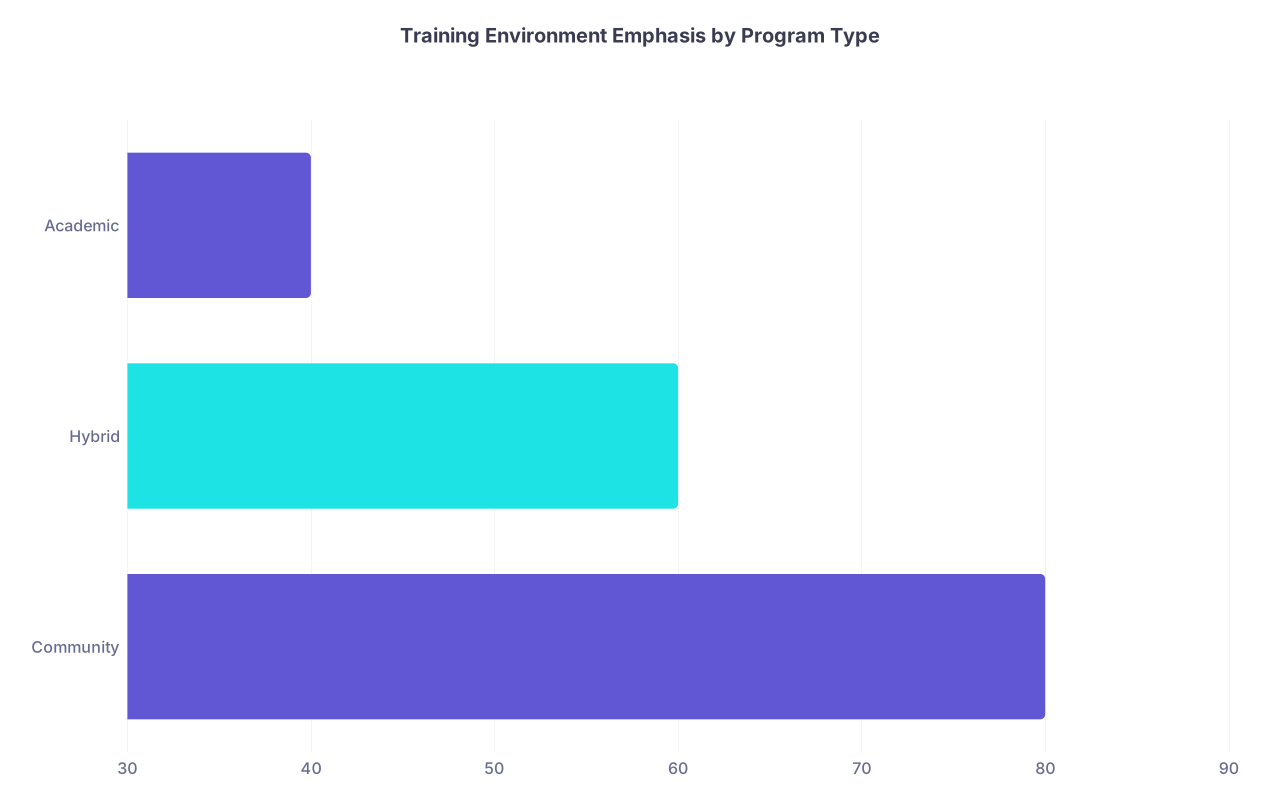
| Category | Value |
|---|---|
| Community | 80 |
| Hybrid | 60 |
| Academic | 40 |
Think of three dials for each program:
- Service vs Education
- Autonomy vs Supervision
- Bread-and-butter vs Zebras/Complexity
After each interview, quickly jot:
- 1–10: How much real autonomy did residents actually seem to have?
- 1–10: How strong was subspecialty / complex case exposure?
- 1–10: How realistic do research / academic opportunities seem?
- 1–10: How happy and supported did residents actually look?
Then ask yourself: for your goals, do you want that dial higher or lower? A future community hospitalist might pick differently than someone gunning for a competitive fellowship.
Simple Example Scenarios
To make this real:
You want cards or GI. A small community program with almost no research, limited subspecialty clinics, and no recent matches in your target fellowship? Tough road. You’d better hear very specific, recent success stories or I’d lean academic or strong hybrid.
You want to be a competent, independent community doc in a mid-sized town. A huge academic center where the fellow does everything in the MICU and you barely touch a vent? That might not be ideal. A strong community program with insane volume, lots of procedures, and supportive attendings might be perfect.
You’re uncertain. Then hybrid programs with both a main academic affiliation and multiple community rotations can be a smart bet—if they actually integrate both worlds instead of just saying “we’re affiliated with Big Name U” on the website.
Visual: What a Strong Hybrid Program Often Looks Like

| Step | Description |
|---|---|
| Step 1 | Academic Tertiary Hospital |
| Step 2 | Complex Inpatient Rotations |
| Step 3 | Subspecialty Clinics |
| Step 4 | Community Hospital |
| Step 5 | High Volume Medicine |
| Step 6 | Procedures and Autonomy |
| Step 7 | VA or Safety Net |
| Step 8 | Chronic Disease Management |
| Step 9 | Resident Skill Growth |
If a program says it’s hybrid, your questions should confirm whether it really gives you the best of multiple sites—or just adds commute time and confusion.
FAQ: Six Quick Questions
How many questions should I actually ask on interview day?
Enough to get real data without hijacking the room. Usually 2–3 good questions to residents in a group session, 1–2 to faculty per interview. Depth beats volume. Don’t fire off a list; pick your highest-yield ones for that specific program.Should I ask the same questions at every program?
Mostly, yes. Having a core set (autonomy, procedures, outcomes, support) makes programs easier to compare. Then layer a couple of program-specific questions based on what you saw on the website or heard earlier that day.Is it okay to ask directly about weaknesses or red flags?
Yes—if you’re professional. “Every program has areas they’re working on. What are you actively trying to improve in the next 1–2 years?” is a fair and revealing question. If they say “Honestly, nothing,” that’s either delusional or not transparent.How do I compare programs if everyone answers with generic positivity?
Push for specifics. “Can you give me an example?” is your best friend. When someone says “We get a lot of autonomy,” respond with, “Can you walk me through a recent shift where you felt that?” Vague answers are a data point in themselves.Should I ask about duty hour violations or workload directly?
Yes, but phrase it smartly. To residents: “What does your hardest month look like?” and “Do you ever feel like you have to cut corners on learning or patient care to keep up?” You’ll get more honest answers than if you say “Do you violate duty hours?”What if residents and faculty give totally different answers?
That’s huge. Believe the residents on day-to-day reality. Believe faculty on strategic direction and formal structure. If there’s a major mismatch—residents feel overworked while PD insists workload is “very reasonable”—I’d move that program down my list.
Key points to walk away with:
- Ask specific, scenario-based questions that force programs into concrete details about autonomy, procedures, subspecialty exposure, and support.
- Use the same core questions across programs so you can actually compare community, academic, and hybrid environments in a meaningful way.
- Pay close attention to how residents answer privately—that’s usually the clearest window into what your life there will look like.